
De Quervain's tenosynovitis exercises and physiotherapy
What is De Quervain's tenosynovitis?
Two tendons run along the thumb side of your wrist. One moves your thumb away from your hand (abductor pollicis longus) and the other straightens it (extensor pollicis brevis). They pass through a narrow tunnel, and in De Quervain's tenosynovitis they no longer fit well or glide freely inside it. That is how OrthoInfo, the patient site of the American Academy of Orthopaedic Surgeons, describes it. You may also see it called De Quervain's syndrome or De Quervain's tendinosis.
The typical picture is pain on the thumb side of the wrist, sometimes spreading up the forearm, that gets worse when you grip or twist. The British Society for Surgery of the Hand (BSSH) says lifting the thumb, as in a hitchhiker's sign, and using scissors are classic triggers. There may be swelling and tenderness over the sore spot, and the tendons occasionally click or snap.
OrthoInfo says it is most common in people in their 40s and 50s and affects more women than men. It is also linked with pregnancy, the weeks after having a baby and rheumatoid arthritis. BSSH notes that many cases appear without an obvious cause and that there is little evidence work causes it, although using the hand at work, at home, in the garden or at sport can certainly make it hurt. It is not harmful, but it can be very painful.
A doctor or physio often checks it with the Finkelstein test: you tuck your thumb into your palm, close your fingers over it and tip the wrist toward your little finger (OrthoInfo). Pain on the thumb side of the wrist points to De Quervain's. There is no need to keep testing it yourself, because that position is the one that stirs the tendons up.
Do exercises help De Quervain's tenosynovitis?
Nobody knows yet, because exercise has hardly been studied for this condition. Most of the research is about splints, injections and surgery. A 2026 review of non-surgical treatments found the best results from a splint worn full time plus a steroid injection, rated that evidence low certainty, and called for trials of active treatment such as gradually loading the tendon (Cuenca-Zaldívar 2026). A European panel of hand therapists, surgeons and rehab doctors agreed that advice should always be given alongside another treatment. The treatments it listed as suitable were anti-inflammatory medicine, a splint, an injection and surgery, and an exercise program was not among them (Huisstede 2014).
A 2016 review compared hand therapy, defined broadly, with steroid injections. Both improved pain and function, and the difference between them was not significant, but more people were treated successfully when a splint and an injection were combined (Cavaleri 2016).
So the exercises on this page are not the treatment. They keep the thumb and wrist moving while the splint and time do their work, then rebuild strength so you can get back to lifting and carrying. Gentle movement out of the splint is part of NHS hand therapy advice (Dorset County Hospital). The later strengthening stages borrow the gradual loading used for other tendon problems, which has not been tested for this one.
Splints, injections and other first steps
Start by changing what hurts. BSSH puts avoiding the activities that cause pain first on its list, where you can. An NHS hand therapy leaflet from Dorset County Hospital adds that side to side wrist movements usually cause the most pain, so avoid them while the tendons settle.
For medicine, OrthoInfo lists anti-inflammatory medicine such as ibuprofen, although a 2023 review found the research does not support it as a first treatment (Challoumas 2023). If you are pregnant, the NHS advises avoiding ibuprofen unless a doctor or pharmacist tells you to take it. Ask a pharmacist if you are not sure a medicine is safe for you.
A thumb splint is the other common first step. BSSH says it needs to hold the thumb still as well as the wrist, and that you can often get one from a sports shop or a physio. OrthoInfo says a removable splint that keeps the wrist straight and the thumb still may improve pain, especially at night. Advice on how long to wear it varies. NHS Devon says wearing it only during painful activities can help, but sometimes it needs to be worn continuously for up to 6 weeks, while the Dorset leaflet suggests trying 6 weeks of full-time wear, taking it off only to wash and do the exercises.
If that is not enough, a steroid injection into the tendon tunnel is often the next step. BSSH says it relieves the pain in about 70% of cases. A review of two trials found an injection clearly more effective than a splint (Ashraf 2014), and a 2023 review of 30 studies found a splint on its own among the least effective options (Challoumas 2023). Adding a thumb splint for 3 to 4 weeks after the injection gave a further gain in function in that review, though a small one. The risks of an injection are small, but BSSH notes it very occasionally causes thinning or a change in color of the skin where it goes in.
Lifting and caring for a new baby
BSSH says mothers of small babies seem particularly prone to De Quervain's, although no one knows whether hormonal changes or repeated lifting is the cause. OrthoInfo says people who get it after having a baby often notice it within 4 to 6 weeks.
How you lift matters. NHS Devon suggests finding ways to lift your baby that avoid scooping up under the arms, a grip that spreads your thumbs wide. One way many hand therapists teach is to slide your hands under the baby with your palms facing up, thumbs kept close to your hands and wrists straight, one hand under the bottom and one under the head and shoulders, then bring the baby close to your body before you lift.
NHS Devon also suggests a bottle with a handle if bottle feeding hurts, and relaxing your thumb and wrist once the baby is positioned for breastfeeding. It also advises against steering a pram one-handed. If someone else can share the lifting, let them.
This is lifting advice for the wrist only, not a postnatal exercise program. If the pain started during pregnancy or since the birth, check with your midwife or doctor before you start the exercises on this page, and before any medicine or injection if you are breastfeeding.
How to use this program
Pick the stage that matches your wrist today. If you are not sure, start at stage 1. Move up when the current stage feels easy and your wrist is no worse the next morning. While you are wearing the splint full time, or in the first weeks after a steroid injection, stay with stage 1 unless your physio or doctor says otherwise.
This program is for De Quervain's managed without surgery. If you have had surgery on the wrist, follow the program your surgeon or hand therapist gives you rather than this one.
The program is written for adults. A child or teenager with pain on the thumb side of the wrist should see a doctor or physio first. If you are pregnant, check with your midwife or doctor before starting.
As a rough guide, many programs use 2 to 3 sets of 10 slow movements for thumb bending and thumb extension, 2 to 3 times a day, and go through thumb opposition and the tendon glides 5 to 10 times. The static holds often start at 5 to 10 holds of 5 to 10 seconds, once or twice a day, with a light push. Putty work is often 2 to 3 sets of 10 to 15, once or twice a day, while the dumbbell and the gripper are often used once a day or every other day. Each exercise page gives its own starting range, and your physio will adjust this to your wrist and to what you need it for.
The holds in stage 2 and the putty and dumbbell work in stage 3 load the sore tendons directly. Their own exercise pages ask you to check with your physio before starting them if you have De Quervain's, and the same applies here, so have your wrist checked before you add them.
In stage 1, every movement should be pain free. From stage 2 on, mild discomfort on the thumb side of the wrist is fine if it settles soon after you stop and the wrist is no worse the next morning. Sharp pain during a repetition means stop that exercise. If the wrist is clearly worse the next day, the load was too much, so drop back a stage rather than stopping altogether.
This program leaves out stretches that tuck the thumb into the fist and bend the wrist toward the little finger. That is the Finkelstein position, and it stretches the sore tendons hard. Side to side wrist movement waits until stage 3 for the same reason. Your physio may add these later if they suit you.
The exercise program
Stage 1: Settle the tendons and keep the hand moving
This stage is for a wrist that hurts with pinching or gripping, and it often covers the weeks you wear a thumb splint. Take the splint off several times a day to move the hand gently, then put it back on, as NHS hand therapy advice suggests. Tendon glides and touching the thumb to each fingertip stop the fingers and thumb stiffening. Bending the thumb across the palm keeps its joints moving, and tipping the wrist up and down moves it without the side to side movement that usually hurts most. Everything in this stage should be pain free, so keep each movement slow and small and stop short of any pull on the thumb side of the wrist; leave out any exercise that brings the pain on.
 Tendon glides
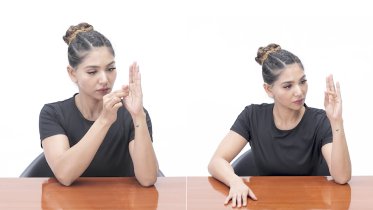 Thumb opposition
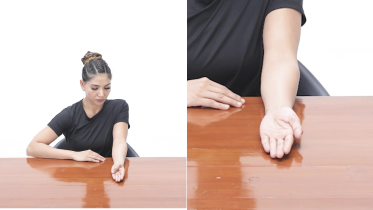 Thumb flexion
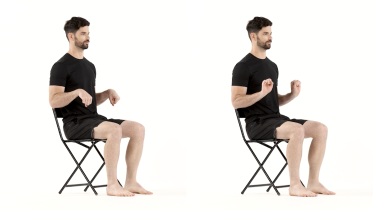 Wrist flexion and extension
Stage 2: Gentle holds and thumb movement
Move on when everyday tasks hurt less and the stage 1 movements feel easy. Thumb extension takes the thumb out to the side with no resistance, and the two static holds work the tendons on the thumb side of the wrist without the thumb or wrist moving. Start each hold with a light push, breathe normally through it, and build up over the following days only if the wrist stays settled. The soft ball squeeze brings grip back gently, but squeeze only as hard as is comfortable, because forceful gripping is one of the things that makes this pain worse. Mild discomfort is fine if it settles soon after you stop and the wrist is no worse the next morning; if it is worse, go back a stage.
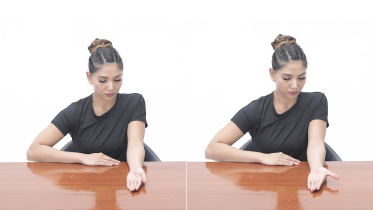 Thumb extension
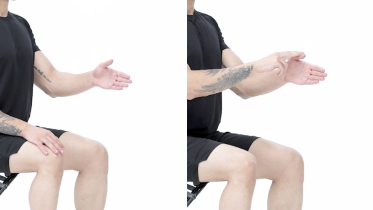 Isometric thumb extension
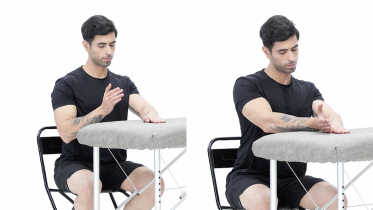 Isometric radial deviation
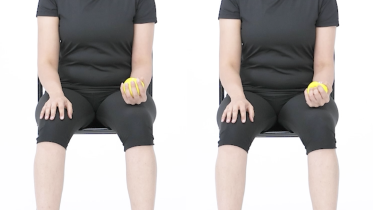 Hand grip squeeze
Stage 3: Rebuild strength for daily tasks
This stage comes when the holds feel easy, the wrist settles well the next day and you no longer need the splint for everyday tasks. Putty looped over the thumb and a light dumbbell tipped toward the thumb side load the same tendons through movement, so start with the softest putty and a light weight such as a small water bottle, and go up in small steps. The hand gripper builds on the ball squeeze; pick the lightest spring you can close slowly and fully. Wrist circles come in here rather than earlier because they take the wrist side to side, so keep the part of the circle toward the little finger small if it pulls on the thumb side. Practice the tasks you need, such as lifting your shopping or texting, for short spells at first.
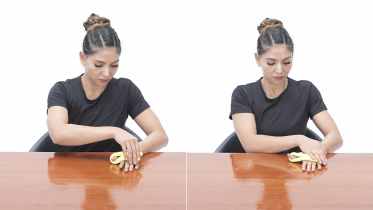 Thumb extension with putty
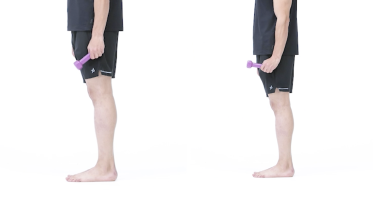 Wrist radial deviation with a dumbbell
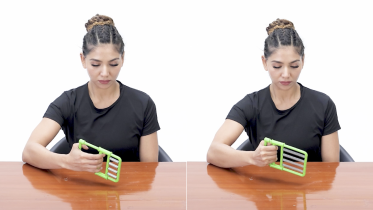 Hand gripper exercise
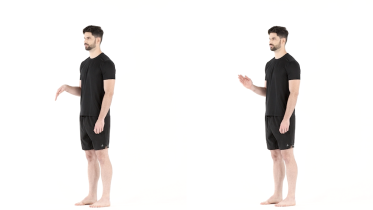 Wrist circles
When is surgery considered for De Quervain's?
OrthoInfo says surgery may be recommended if symptoms are severe or do not improve after 6 weeks of non-surgical treatment. The surgeon opens the roof of the tendon tunnel so the tendons have room to glide, taking care to protect the small nerves just under the skin. BSSH says the pain usually eases quickly. The scar may be sore for several weeks, and the back of the hand or thumb can feel numb for a while afterward.
A 2023 review notes that surgery is effective in up to 95% of patients in the studies it cites. Because of possible complications, especially injury to a small nerve on the back of the thumb (superficial radial nerve), the authors advise keeping it for people whose non-surgical treatment has failed (Challoumas 2023). Rehab after the operation is not covered on this page. Follow your surgeon or hand therapist.
What to change at work and at home
OrthoInfo lists typing, texting and lifting among the movements that can make it worse. Notice which tasks bring the pain on and change how you do them. Keep the wrist nearer straight, use your whole hand rather than pinching between thumb and finger, and use the other hand or both hands for heavier jobs. NHS Devon also suggests taking frequent breaks when you are using your wrist a lot.
The small habits count too. Hold your phone in the other hand and type with a finger rather than your thumb, and pick tools and kitchen utensils with thicker handles.
When to see a physio or doctor
See a physio or doctor if the pain has not eased after a few weeks of a splint and changing what you do, or if it stops you working or caring for your family. They can check the diagnosis and talk you through an injection or other next steps.
It is also worth a proper assessment if you are not sure the pain is De Quervain's. Pain near the base of the thumb can also come from arthritis in the joint there, and after a fall it can be a broken wrist bone. Tingling in the thumb, index and middle fingers usually points to a nerve at the wrist rather than the tendons: see the carpal tunnel syndrome program. The warning signs below need prompt medical attention.
For physiotherapists
This page gives patients a starting framework for De Quervain's tenosynovitis managed without surgery. Challoumas and colleagues (2023) pooled 30 studies (n = 1,663) and recommend a conventional corticosteroid injection at first contact plus full-time thumb spica immobilization for 3 to 4 weeks. Their splint includes the wrist and thumb MCP joint but not the IP joint, and comes off only for grooming and simple range-of-movement exercises. Adding the splint to CSI gave moderate-certainty functional gains that were statistically but not clinically significant, and US-guided injection ranked top for pain. Placebo injection and immobilization alone ranked least effective, and they found the literature does not support oral NSAIDs as first-line treatment.
Cuenca-Zaldívar and colleagues (2026) included 21 studies (n = 1,178), 12 in the network. Full-time orthosis plus CSI ranked highest for pain and function on low-certainty evidence, and they called for trials of progressive tendon loading and education. Cavaleri and colleagues (2016) found no significant difference between a multimodal definition of hand therapy and CSI across 6 studies, with combined orthosis and CSI better than either alone. The Cochrane review (Peters-Veluthamaningal 2009) found one controlled trial of 18 participants, all pregnant or lactating: 9 of 9 had complete pain relief with injection and 0 of 9 with a thumb spica, which the authors said limits applicability. Ashraf and Devadoss (2014) pooled two RCTs of injection against splinting and reported an NNT of 2.
The European HANDGUIDE consensus (Huisstede 2014) holds that instructions should always be given but never as the sole treatment. Its listed options are NSAIDs, splinting, NSAIDs plus splinting, CSI, CSI plus splinting and surgery, chosen by severity, duration and previous treatment. Exercise progression on this page runs from pain-free range of motion during the splint phase, through isometrics, to loaded thumb extension and radial deviation, with grip work alongside. That order follows general tendinopathy loading principles and is untested in this condition, so progress on symptom response and the 24-hour reaction rather than a fixed timetable. Avoid Finkelstein-type stretching and early loaded ulnar deviation.
Screen for scaphoid fracture after a fall on an outstretched hand, since OrthoInfo notes pain at the anatomic snuffbox and on the radial wrist that can be mistaken for a sprain. Consider thumb base osteoarthritis and cervical or peripheral nerve sources of radial wrist and thumb symptoms. Refer for injection or a surgical opinion when a well-fitted splint and load changes have not helped within about 6 weeks.
See a doctor promptly if
- Emergency: any sign of a stroke, even if it goes away. That means a face that droops on one side, an arm you cannot lift or keep up, slurred or muddled speech, weakness or numbness on one side of your body or face, sudden blurred vision, double vision or loss of sight, trouble swallowing, sudden dizziness with unsteadiness or falling over, a sudden severe headache, or a sudden fall where your legs give way but you do not black out (a drop attack). Call emergency services straight away.
- Emergency: numbness, tingling or pins and needles in the hand after a fall or injury to the wrist, or a wrist that has changed shape or sits at an odd angle. The same applies to a bone showing through the skin or a cut that is bleeding heavily. Go to an emergency department or call emergency services straight away, and do not drive yourself. The wrist may be broken.
- The pain on the thumb side of your wrist started with a fall onto your hand or another injury, even if it feels like a sprain. Get medical advice the same day. A break in the small wrist bone on the thumb side (scaphoid) can cause pain in just this spot, can feel mild at first and is easy to mistake for a sprain.
- The wrist is hot, red and swollen, or you have wrist pain with a high temperature or feel hot, cold or shivery. Get medical advice the same day, and go to an emergency department if you feel very unwell. This can be a sign of infection in the joint or tendon, which needs treatment quickly.
- Suddenly being unable to straighten the end of your thumb or lift it back, especially in the weeks after a wrist fracture. A thumb tendon can snap, so stop the thumb exercises and have a doctor check it within a few days.
- Several joints in your hands or feet are painful, swollen and stiff, not just the thumb side of one wrist. This is not an emergency, but see your doctor in the next week or two, because it can be a sign of an inflammatory arthritis such as rheumatoid arthritis, and early treatment helps.
- Numbness, tingling or burning on the back of the thumb or hand, or tingling that spreads into your fingers. Stop any exercise that brings it on and see a physio or doctor, because a nerve may be irritated rather than the tendons. If the pain spreads from your neck down the arm, mention that too.
- The pain is there at night or at rest and keeps getting worse. See your doctor within a few days. If you have had cancer, now or in the past, or are losing weight without trying, see your doctor sooner, within a day or two, and mention it. This applies even if the pain is not getting worse. If you are being treated for cancer now, contact your cancer team the same day.
Common questions
How long does De Quervain's take to heal?
It varies. The British Society for Surgery of the Hand says milder cases recover over a few weeks without treatment. With a splint, one NHS hand therapy leaflet suggests trying six weeks of full-time wear, then easing out of it over 2 to 4 weeks if the pain has improved (Dorset County Hospital). If it has not settled after several weeks of a splint and changing what you do, see your doctor or physio about the next step, such as an injection.
Should I wear a thumb splint for De Quervain's?
It is one of the usual first steps. The splint needs to hold the thumb as well as the wrist, and OrthoInfo says a removable one that keeps the wrist straight and the thumb still may improve pain, especially when worn at night. On its own, a splint has done less well than a steroid injection in research reviews, and the two together did best (Cavaleri 2016; Challoumas 2023). How long to wear it varies: NHS leaflets range from wearing it only during painful tasks to wearing it full time for up to 6 weeks, so ask your physio what suits you.
Are steroid injections good for De Quervain's?
They are the best-studied treatment for it. The British Society for Surgery of the Hand says an injection relieves the pain in about 70% of cases, and that the risks are small, though it very occasionally causes thinning or a change in color of the skin where it goes in. A review of two trials found an injection clearly more effective than a splint, with about one in every two people treated getting the benefit (Ashraf 2014). A 2023 review found that adding a thumb splint for 3 to 4 weeks after the injection gave a further gain in function, though a small one (Challoumas 2023). The decision is one to make with your doctor.
Why do new mothers get De Quervain's?
Nobody knows for sure. The British Society for Surgery of the Hand says mothers of small babies seem particularly prone to it, but whether this is due to hormonal changes after pregnancy or to lifting the baby repeatedly is not known. OrthoInfo says people who develop it after having a baby often notice it within 4 to 6 weeks. Changing how you lift and feed can take some of the load off the thumb, and the section on caring for a new baby above has practical tips.
When do you need surgery for De Quervain's?
OrthoInfo says surgery may be recommended if symptoms are severe or do not improve after 6 weeks of non-surgical treatment. The operation opens the tunnel so the tendons have room to glide. A 2023 review notes that it works for most people but is kept for those who have not improved with other treatment, because of possible complications such as injury to a small nerve on the back of the thumb (Challoumas 2023). Your doctor or hand surgeon will talk it through with you.
References
- American Academy of Orthopaedic Surgeons. De Quervain's tenosynovitis. OrthoInfo. https://www.orthoinfo.org/en/diseases--conditions/de-quervains-tendinosis/
- British Society for Surgery of the Hand. De Quervain's syndrome. Patient information. https://www.bssh.ac.uk/patients/conditions/19/de_quervains_syndrome
- Dorset County Hospital NHS Foundation Trust. De Quervain's tenosynovitis. Hand therapy patient leaflet, written February 2025, review date April 2028. https://dchft.nhs.uk/leaflets/de-quervains-tenosynovitis/
- MyHealth Devon (NHS Devon). De Quervain's syndrome. https://myhealth-devon.nhs.uk/my-condition/condition/de-quervains-syndrome/
- Challoumas D, Ramasubbu R, Rooney E, Seymour-Jackson E, Putti A, Millar NL. Management of de Quervain tenosynovitis: a systematic review and network meta-analysis. JAMA Network Open. 2023;6(10):e2337001. https://doi.org/10.1001/jamanetworkopen.2023.37001
- Cuenca-Zaldívar JN, Martínez-Pozas O, Riba E, et al. Conservative treatments for De Quervain's tenosynovitis: a systematic review and network meta-analysis. Journal of Hand Therapy. 2026;39(3):479-495. https://doi.org/10.1016/j.jht.2025.09.001
- Cavaleri R, Schabrun SM, Te M, Chipchase LS. Hand therapy versus corticosteroid injections in the treatment of de Quervain's disease: a systematic review and meta-analysis. Journal of Hand Therapy. 2016;29(1):3-11. https://doi.org/10.1016/j.jht.2015.10.004
- Ashraf MO, Devadoss VG. Systematic review and meta-analysis on steroid injection therapy for de Quervain's tenosynovitis in adults. European Journal of Orthopaedic Surgery and Traumatology. 2014;24(2):149-157. https://doi.org/10.1007/s00590-012-1164-z
- Peters-Veluthamaningal C, van der Windt DA, Winters JC, Meyboom-de Jong B. Corticosteroid injection for de Quervain's tenosynovitis. Cochrane Database of Systematic Reviews. 2009;(3):CD005616. https://doi.org/10.1002/14651858.CD005616.pub2
- Huisstede BM, Coert JH, Fridén J, Hoogvliet P; European HANDGUIDE Group. Consensus on a multidisciplinary treatment guideline for de Quervain disease: results from the European HANDGUIDE study. Physical Therapy. 2014;94(8):1095-1110. https://doi.org/10.2522/ptj.20130069
- American Academy of Orthopaedic Surgeons. Scaphoid fracture of the wrist. OrthoInfo. https://www.orthoinfo.org/en/diseases--conditions/scaphoid-fracture-of-the-wrist/
- NHS. Broken arm or wrist. Page last reviewed 26 May 2023. https://www.nhs.uk/conditions/broken-arm-or-wrist/
- NHS. Septic arthritis. Page last reviewed 3 September 2026. https://www.nhs.uk/conditions/septic-arthritis/
- NHS. Rheumatoid arthritis. Page last reviewed 8 March 2023. https://www.nhs.uk/conditions/rheumatoid-arthritis/
- NHS. Symptoms of a stroke. Page last reviewed 12 September 2024. https://www.nhs.uk/conditions/stroke/symptoms/
- NHS. Pregnancy, breastfeeding and fertility while taking ibuprofen. Page last reviewed 27 August 2025. https://www.nhs.uk/medicines/ibuprofen-for-adults/pregnancy-breastfeeding-and-fertility-while-taking-ibuprofen/
Written and checked by the PocketPhysio editorial team. Last updated 2026-09-28.
This page is general education, not a diagnosis or a personal treatment plan. See a physiotherapist or doctor for advice about your own situation.