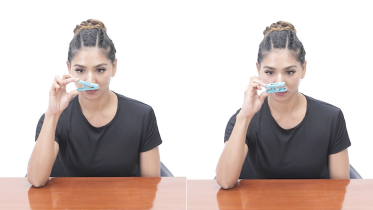
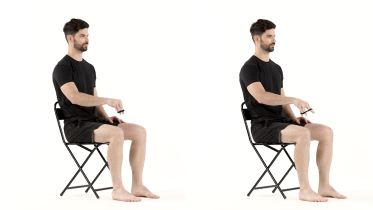
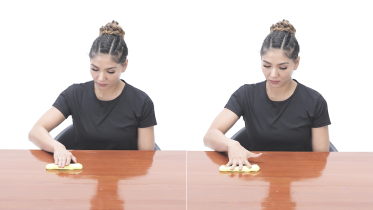
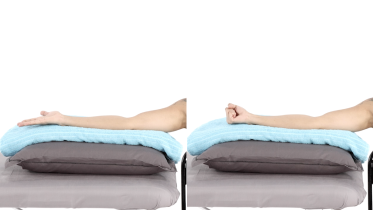
Hand gripper exercise
The hand gripper exercise strengthens the muscles that bend your fingers and close your fist (finger flexors). You sit at a table with your forearm resting on it, squeeze a spring gripper closed with your fingers and thumb, then let it open again slowly. Physios often use it to rebuild grip after a hand or wrist injury, once gentler squeezing with a soft ball feels easy.
How to do the hand gripper exercise
- Sit at a table, feet resting on the floor, with the gripper lying on the table in front of you.
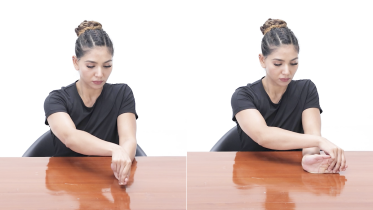
- Pick the gripper up in one hand and rest that forearm on the table, little finger side down and thumb on top, as in the video. Hold the gripper upright, with its handles across your palm and your fingers wrapped around them.
- Squeeze slowly to close the gripper as far as you comfortably can. Keep your wrist straight, in line with your forearm.
- Let the gripper open again slowly without letting go of it, and keep breathing throughout.
- When the set is done, put the gripper down and let your hand rest. Change hands if both are in your program.
What you should feel
Effort in your palm and in the forearm muscles on the palm side, just below the elbow. The fingers and forearm are often tired by the last few squeezes.
Common mistakes
- Starting with a gripper too stiff to close in a slow, controlled way.
- Letting the gripper spring open instead of releasing it slowly.
- Bending the wrist forward or back as you squeeze.
- Holding your breath or tensing the shoulder.
How often
Many programs start on the lightest setting with 2 to 3 sets of 8 to 15 slow squeezes, once a day or every other day. Your physio will adjust this.
Stop and check with your physio if
- Sharp pain at the base of the thumb, in a finger joint or in the wrist.
- Your fingers start to tingle or go numb. If one side of your face or body suddenly goes numb or weak, or your speech becomes slurred or muddled, call emergency services, even if it goes away.
- A finger that catches, clicks painfully or locks as you open your hand.
From the clinic
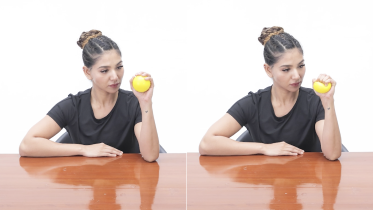
Grippers come in different strengths, and some let you change the spring tension. Pick the lightest one you can close fully and slowly, and only move up once every set feels easy and pain free. No gripper at home? A soft ball works the same muscles, as in the hand grip squeeze.
Hard gripping can flare up arthritis at the base of the thumb, a trigger finger or carpal tunnel symptoms, so check with your physio first if you have any of these. After a broken wrist, hand or forearm, or surgery on any of them such as a tendon repair, start only when your doctor, surgeon, physio or hand therapist says the bone or repair is ready for this, and follow their plan for how much to do. To balance the hand, finger extension with a rubber band works the muscles that open the fingers.
Written and checked by the PocketPhysio editorial team. Last updated 2026-09-28.
This page is general education, not a diagnosis or a personal treatment plan. If you have pain, an injury or a health condition, see a physiotherapist or doctor before starting new exercises.