Finger extension with a rubber band
Finger extension with a rubber band strengthens the muscles that open your hand and straighten your fingers. A rubber band goes around the tips of your fingers and thumb, and you open the hand against its pull, then close it slowly. Physios and hand therapists often give it alongside grip exercises, so the muscles that open the hand get worked as well as the ones that close it.
How to do the finger extension with a rubber band
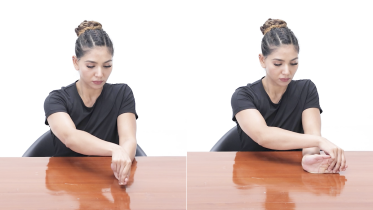
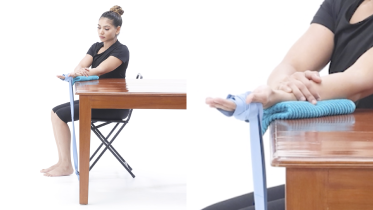
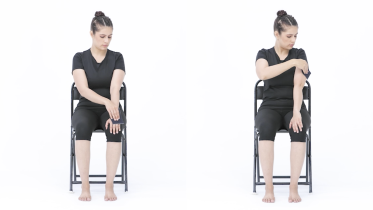
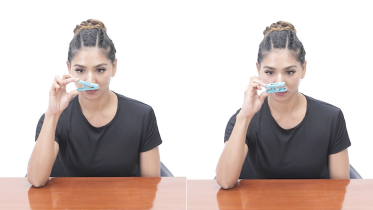
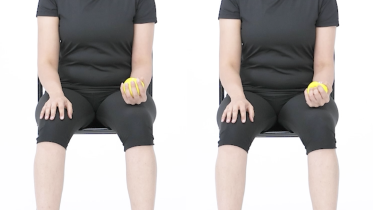
- Sit on a chair. Loop a rubber band around the tips of your thumb and all four fingers.
- Hold your forearm forward over your thigh with the elbow bent and the palm facing down. Let your fingers and thumb curl in gently, bunched together, so the band sits snug but not tight.
- Open your hand by straightening and spreading your fingers and thumb as far as you can against the band.
- Hold the open position for a moment, then let the fingers close slowly back to the start. Do not let the band snap them shut.
- Keep your wrist level and your forearm still, so the fingers do the work.
What you should feel
Work in the back of your hand and along the top of your forearm. The muscles may feel tired toward the end of a set.
Common mistakes
- Bending the wrist back to help the fingers open.
- Letting the band snap the fingers closed instead of controlling the return.
- Using a band so strong that the fingers can barely open.
- Letting the band slide down toward the knuckles.
How often
Many programs start with a light band and 2 to 3 sets of 10 to 15, once or twice a day. Your physio will adjust this for you.
Stop and check with your physio if
- A sharp pain in any finger joint or at the base of your thumb.
- Numbness or tingling in the fingers, or fingertips turning pale or blue under the band. If one side of your face or body suddenly goes numb or weak, or your speech becomes slurred or muddled, call emergency services, even if it goes away.
- Finger joints that are more swollen, hot or stiff once you finish.
From the clinic
An ordinary rubber band is enough to start. A thicker band, or two bands together, makes it harder, and finger bands made for this exercise are sold as well. The band should grip without squeezing: if your fingertips change color, it is too tight.
After a broken wrist, hand or forearm, or surgery on any of them such as a tendon repair, start only when your doctor, surgeon, physio or hand therapist says the bone or repair is ready for this, and follow their plan for how much to do. With rheumatoid or another inflammatory arthritis, ask your physio or hand therapist before adding resistance, and leave it out while the finger joints are hot and swollen. For another way to work the small hand muscles, see finger spread with putty.
Written and checked by the PocketPhysio editorial team. Last updated 2026-09-28.
This page is general education, not a diagnosis or a personal treatment plan. If you have pain, an injury or a health condition, see a physiotherapist or doctor before starting new exercises.