
Radial tunnel syndrome: symptoms, tests and exercises
Warning signs, and when to get help
What is radial tunnel syndrome?
The radial nerve runs down the back of the upper arm, crosses the outside of the elbow and then dives into the muscles of the upper forearm. The length it passes through, from the head of the forearm bone at the elbow to the lower edge of the muscle that turns your palm up, is the radial tunnel. Moradi and colleagues (2015) describe five points along it where the nerve can be squeezed, the commonest being a firm band at the top edge of that muscle, known as the arcade of Frohse.
Squeezed there, the nerve produces a deep, tiring ache in the top of the forearm and the outer elbow, which can run on toward the wrist and the back of the fingers and is often worse at night. Pain builds with turning the forearm and with lifting (Levina and Dantuluri, 2021). The compression tends to come and go rather than being constant, which matters later when the tests come back normal.
It is uncommon. Moradi and colleagues put compression of this nerve branch at roughly 0.03% of people a year, against 0.1% to 0.35% a year for carpal tunnel syndrome, so a hand clinic sees many of those for every one of these. Most people who get it are between 30 and 50 years old, it is usually the dominant arm, and both arms together is rare.
Radial tunnel syndrome or tennis elbow?
This is the question most people arrive with, and it is the one that decides what happens next. A sore tendon wants graded loading. An irritated nerve wants the load taken off first, and the squeezing, twisting work brought back slowly. Hand someone with radial tunnel syndrome a tennis elbow program and the forearm can stay sore through months of conscientious gripping work, which is how people end up being told they have failed treatment when they have been given the wrong one. That pattern is old news in the literature: when Roles and Maudsley first linked this pain to pressure on the nerve in 1972, the name they used was resistant tennis elbow with a nerve entrapment (Moradi and colleagues, 2015).
Start with a thumb. Tennis elbow is tender right on the bony point you can feel at the outside of the elbow, where the tendon anchors. Radial tunnel tenderness sits lower, out in the muscle of the upper forearm, over the line of the nerve: about 3 to 5 cm below that bony point in Levina and Dantuluri's review (2021), and about 5 cm below it in Moradi and colleagues (2015). Moradi and colleagues describe a way of comparing the two, the rule of nine, which maps tender points across the front of the upper forearm so that nerve irritation shows up in the upper outer part of it rather than at the epicondyle.
The quality of the pain differs as well. The NHS describes tennis elbow as pain on the outside of your elbow, worse when you lift, grip or move the wrist, with tenderness or swelling at the elbow. Radial tunnel pain is more often a deep ache that spreads along the top of the forearm and disturbs sleep. Take that one lightly on its own, though. Moradi and colleagues say dorsal forearm pain that worsens at night, along with arm fatigue, is a typical presentation but is not specific to radial tunnel syndrome, and the NHS says tennis elbow pain can be constant enough to affect sleep as well.
The MSD Manual names a more useful difference: in radial tunnel syndrome, tapping along the course of the nerve can send a pins and needles feeling down the forearm, and both tenderness along that line and that tapping response help separate it from tennis elbow. Levina and Dantuluri add that some people feel pins and needles over the back of the web between the thumb and index finger, which a sore tendon does not produce. Losing feeling altogether is rare here, because at this level the nerve mostly runs muscles rather than skin (MSD Manual).
Then there is the answer nobody wants. The two often sit together. Levina and Dantuluri cite a series in which 43% of patients with radial tunnel syndrome also had tennis elbow, and 20% had another compression problem alongside it, while Moradi and colleagues report the two found together in 21% to 41% of patients and radial tunnel syndrome present in about 5% of people diagnosed with tennis elbow. If you have both, the tendon and the nerve each need their own part of the plan, and that is a conversation to have in person rather than from a page.
Why do clinicians disagree about this diagnosis?
Because there is no test that settles it, and some clinicians think that makes it unsafe as a label. Moradi and colleagues (2015) say plainly that the existence of radial tunnel syndrome remains controversial, and that those who do not accept it point out that the only constant symptom is pain. Nerve conduction studies and electromyography are usually normal here, and so is MRI. Levina and Dantuluri (2021) give the reason: those electrical tests read the big fibers that drive muscles, and the fibers carrying this kind of pain are small and unmyelinated, so a normal result does not clear the nerve. Moradi and colleagues make that same argument and come down in favor of the diagnosis, pointing to the defined anatomical space the nerve has to pass through and to how consistent the spot of tenderness is.
We say this rather than skate over it, because it explains something that worries people. One clinician calls it tennis elbow, the next calls it radial tunnel syndrome, and both are looking at the same forearm. It does not mean one of them is careless. It means the diagnosis is made on the pattern of your symptoms and on where you are tender, and reasonable people read that pattern differently.
Is it an aching forearm, or real weakness?
This is the part of the page that is time critical, so do not skim it. An aching forearm that gives way when you are tested, because the test hurts, is the usual story in radial tunnel syndrome. Both reviews describe it as a pain problem: Moradi and colleagues (2015) define it as compression of the nerve without obvious weakness of the extensor muscles, and Levina and Dantuluri (2021) say any weakness found is put down to the pain rather than to the nerve losing power.
Painless loss of power is a different problem with a different name. When the fingers and the thumb will not lift at the knuckles, the same nerve branch has stopped driving those muscles, and that is called posterior interosseous nerve palsy. The MSD Manual treats weakened finger extension, or a wrist that drops, as a reason to consider surgery rather than more conservative care.
Moradi and colleagues (2015) point out that even in a complete palsy of this branch the wrist can still be lifted, because the main muscle doing that job is supplied above the radial tunnel, so the wrist usually comes up and drifts toward the thumb side rather than dropping. That is the piece of anatomy that decides whether you can spot this at home. A wrist that still lifts is no reassurance.
So the useful question is not how sore the forearm is. Rest the forearm on a table, palm down, and keep the wrist and the heel of your hand down on it, so the wrist cannot do the lifting for you. Now straighten the fingers and lift them off the table at the knuckles, and lift the thumb up off the table as well. Do the same on the other side and compare.
Most people find the two hands do this the same, which is the answer you expect. Fingers or a thumb that will not come up, or that are clearly weaker than the other side without the pain to explain it, are on the warning list below at same-day timing, and that is not something to stretch your way out of. A wrist that truly drops needs the same timing, and usually means the nerve is being squeezed higher up the arm than the radial tunnel.
Where else this pain comes from
Forearm pain that has not responded to treatment for the elbow is worth tracing further up. Pain traveling down the arm from the neck, or pins and needles that come on when you turn or tip your head, point at a nerve root rather than the forearm, and cervical radiculopathy covers that. Aching that takes in the whole arm, with heaviness or symptoms that arrive when you work with your arms overhead, fits thoracic outlet syndrome better.
Closer to the elbow, pain at the front with weakness bending the arm or turning the palm up can be the biceps tendon at its lower end, which elbow pain when lifting goes through. Levina and Dantuluri (2021) name that tendon among the things that mimic radial tunnel syndrome. If the problem is mainly tingling and numbness in the hand rather than forearm ache, pins and needles in the hand sorts the three nerves out by which fingers are affected.
How to use this program
Pick the stage that matches your forearm this week, and start at stage 1 if you cannot tell. Move up when the current stage feels easy and the forearm is no worse the next morning, rather than on a date in the diary.
Two things come before the exercises, and they do more than the exercises do. The first is the load on the nerve: the published advice is to change the activity and to splint temporarily so that forceful or repeated palm-up turning and bending the wrist back are taken out for a while (MSD Manual; Levina and Dantuluri, 2021). Look at the week rather than the hour, and look for the everyday forms of those two movements: a screwdriver or a stiff ratchet, wringing and scanning actions, a tool that has to be squeezed while it is twisted, and long spells at a mouse with the wrist held bent back. Moradi and colleagues add one more to avoid, which is holding the arm out with the elbow straight and the palm turned down, since that combination pulls the nerve along its course. The second is honesty about the evidence: neither review we rely on here sets out a physiotherapy program for radial tunnel syndrome, and Moradi and colleagues report that non-surgical treatment rarely clears it for good while still recommending it before an operation.
Each exercise page gives its own numbers and your physio will adjust them. As a rough guide, the moving exercises run at 5 to 10 slow circles or turns each way or 10 to 15 slow movements up and down, the static hold at 5 to 10 holds of 5 to 10 seconds, and the band work at 2 to 3 sets of 10 to 15 slow repetitions. There is no forearm stretch in this program, and the reason is set out under the program below. Keep breathing through every hold rather than straining against a held breath, and if you have high blood pressure, ask your doctor or physio about holds before you start.
Judge every session by the forearm the next morning. Mild discomfort that fades soon after you finish is acceptable. An ache that climbs through a set, tingling in the hand, or a forearm that is clearly worse the next day means the load was too much, and the exercise comes out or drops back a stage. Three things come before any of it: do not start this program if the fingers or wrist will not lift, if the elbow locks, catches or gives way, or if the elbow is hot, red and swollen or you have a fever with the pain. Each of those has its own line and its own timing in the warning signs at the foot of this page.
Every exercise below carries its own stop signs, and some of those lines are written for people who arrive at the exercise after a broken elbow or an operation on one, so if you have had neither, anything about a fracture clinic, a cast or the nerve behind the elbow is not aimed at you. The weakness that matters on this page is the one described above: fingers or a thumb that stop lifting at the knuckles.
The program is written for adults who have not had surgery on this arm. After a broken or dislocated elbow, or any elbow surgery, including an operation to free the nerve, follow your surgeon's or physio's plan and start only when they have cleared you. A child or teenager with forearm pain or hand weakness should be examined in person first.
The exercise program
The exercises below carry their own stop signs and precautions. Open the line under an exercise and read them before you try it.
Stage 1: Take the load off, keep the wrist and forearm moving
Start here while the forearm aches most days, alongside the changes to the tasks that set it off. Nothing in this stage adds resistance and nothing puts the nerve on stretch, because it is all done with the elbow bent and tucked in at your side. The circles keep the wrist moving in every direction, usually 5 to 10 slow circles each way, 2 to 3 times a day. Up and down movement covers the same ground one direction at a time, often 2 to 3 sets of 10 to 15 slow movements, 1 to 3 times a day. Add slow palm-up and palm-down turns with nothing in the hand, around 5 to 10 each way, 2 to 3 times a day, so the forearm keeps its turning range through the weeks before any band work. A few slow turns with an empty hand is not the forceful, repeated twisting that the splint and the changes to your tasks are there to take out, and that difference is the whole point: brief and unloaded rather than long and strong. Keep all of it inside the range that does not hurt instead of pushing to the very end of it, and hold nothing: a sustained end-range stretch is the thing this forearm does not want. Stop any of it if the forearm ache climbs as you go, or if the hand starts to tingle. Your physio will adjust this.
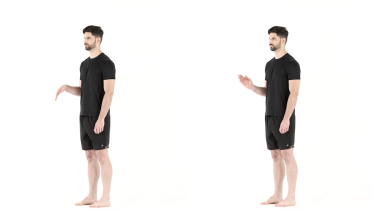 Wrist circles
Stop signs and precautions for the wrist circles
Before you start
- After a broken wrist, hand or forearm, or surgery on any of them such as a tendon repair, start only when your doctor, surgeon, physio or hand therapist says the bone or repair is ready for this, and follow their plan for how much to do.
When to stop and get help
- Sharp pain anywhere in the wrist.
- A painful click, clunk or catch as the wrist turns.
- Tingling or loss of feeling in your fingers. If one side of your face or body suddenly goes numb or weak, or your speech becomes slurred or muddled, call emergency services, even if it goes away.
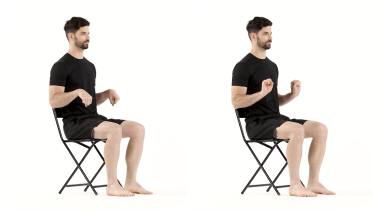 Wrist flexion and extension
Stop signs and precautions for the wrist flexion and extension
Before you start
- After a broken wrist, hand or forearm, or surgery on any of them such as a tendon repair, start only when your doctor, surgeon, physio or hand therapist says the bone or repair is ready for this, and follow their plan for how much to do.
When to stop and get help
- Sharp or catching pain in the wrist.
- Numbness or tingling in the hand or fingers that builds as you go. If one side of your face or body suddenly goes numb or weak, or your speech becomes slurred or muddled, call emergency services, even if it goes away.
- The wrist is more swollen, hot or stiff after the session.
- Since the fracture or cast, the hand is getting more painful rather than less, the skin becomes very sensitive to light touch, or the hand changes color, temperature, swelling or sweating compared with the other one, or looks shiny. See your doctor or physio as soon as you can, within a few days at most, as this can be complex regional pain syndrome (CRPS) and early treatment may help.
Stage 2: A gentle hold for the muscles that lift the wrist
Move up when the forearm is quieter and stage 1 leaves it no worse the next day. Lifting the wrist against resistance is one of the movements a clinician uses to provoke radial tunnel pain, which is why this hold comes second rather than first and why it starts gentle: often 5 to 10 holds of 5 to 10 seconds, once or twice a day, at an effort well short of your hardest. It should feel like work in the muscle rather than pain in the forearm. Keep the forearm down on the table, the fingers loose, and build the effort up over the following days rather than inside one session. Your physio will adjust this.
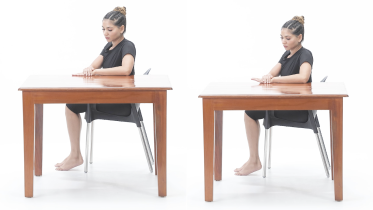 Isometric wrist extension
Stop signs and precautions for the isometric wrist extension
Before you start
- After a broken wrist, hand or forearm, or surgery on any of them such as a tendon repair, start only when your doctor, surgeon, physio or hand therapist says the bone or repair is ready for this, and follow their plan for how much to do.
- If you have high blood pressure, breathe steadily through every hold and never hold your breath.
When to stop and get help
- Sharp pain in the wrist or at the outer elbow while you push.
- Your fingers go numb or start to tingle. If one side of your face or body suddenly goes numb or weak, or your speech becomes slurred or muddled, call emergency services, even if it goes away.
- The wrist aches more, or looks more swollen, by that evening or the next morning.
- Since the fracture or cast, the hand is getting more painful rather than less, the skin becomes very sensitive to light touch, or the hand changes color, temperature, swelling or sweating compared with the other one, or looks shiny. See your doctor or physio as soon as you can, within a few days at most, as this can be complex regional pain syndrome (CRPS) and early treatment may help.
Stage 3: Strength for a working day
For getting back to tools, a keyboard or a racquet, once stage 2 is comfortable and the forearm settles overnight. Turning the palm up against a band is the movement most likely to flare this problem. When Werner and colleagues (1980) measured the tunnel directly, making that muscle contract raised the pressure about four times higher than a passive stretch did. They drove the contraction electrically, at full strength, so the figure tells you the direction rather than what a light band does, and it is still the reason this turn comes last and starts lightest: the lightest band, 2 to 3 sets of 10 to 15 slow repetitions once a day, the forearm kept down on the table, and the way back controlled rather than letting the band snap the hand round. The palm-down turn runs at the same numbers. If the palm-up turn is the one that leaves the forearm worse the next morning, take that one out and keep the other two going rather than dropping the whole stage. Finger extension with a rubber band trains the muscles that open the hand, often 2 to 3 sets of 10 to 15 once or twice a day, and since resisted finger extension is another of the provocation tests, the band stays light for longer here than it would after a tendon problem. Your physio will set the band, the order and the numbers. The plainest sign the load was right is a forearm that is no worse the next morning.
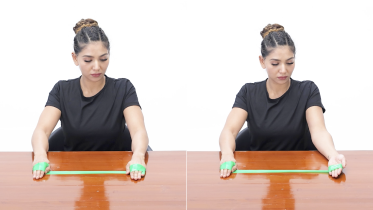 Forearm supination with band
Stop signs and precautions for the forearm supination with band
Before you start
- After a broken or dislocated elbow, or elbow surgery such as a tendon repair, follow your surgeon's or physio's plan, and start this exercise only when they have cleared you. If you have just hurt your arm and have severe pain or cannot move the elbow, do not exercise it. Go to an urgent care center or emergency department the same day. If you heard a snap or a crack at the moment of the injury, the arm looks a different shape or sits at an odd angle, a bone is showing, or your arm or hand tingles, feels numb or turns cold, pale or blue, go to an emergency department straight away or call emergency services, and do not drive yourself.
- After a broken wrist, hand or forearm, or surgery on any of them such as a tendon repair, start only when your doctor, surgeon, physio or hand therapist says the bone or repair is ready for this, and follow their plan for how much to do.
When to stop and get help
- Sharp pain in the wrist, forearm or elbow as you turn.
- The elbow is hot, red and swollen, or you have elbow pain with a high temperature or feel hot, cold or shivery. Get medical advice the same day, and go to an emergency department if you feel very unwell. This can be a sign of infection in the joint, which needs treatment quickly. If you have a very high or very low temperature, shivering you cannot control, you are breathing very fast or finding it hard to breathe, you are confused or your speech is slurred, your skin, lips or tongue look blue, gray, pale or blotchy (on brown or black skin this can be easier to see on the palms of the hands or soles of the feet), or you have a rash that does not fade when you press it, call emergency services, as this can be sepsis.
- A painful click or catch at the wrist.
- Numbness or tingling in the hand.
- Pins and needles in your arm or hand that do not go away after you stop, or part of your arm or hand goes numb. Get medical advice the same day. If one side of your face or body suddenly goes numb or weak, or your speech becomes slurred or muddled, call emergency services, even if it goes away.
- Since the elbow injury or an operation on it, your hand is getting weaker or clumsier, you are dropping things, you cannot pinch or grip as you could, the ring and little fingers feel numb or tingly all the time rather than only while you exercise, or the muscle between your thumb and index finger looks hollowed out. Contact your fracture clinic or surgical team the same day. The nerve that runs behind the elbow (the ulnar nerve) can be pressed on by swelling, by the healing bone or by metalwork, and a nerve that is losing power needs looking at quickly, because weakness left to run on may not fully recover.
- A sudden pop or snap at the front of your elbow, sudden sharp pain there, or the muscle at the front of your upper arm bunches up or changes shape. Stop and go to an urgent care center or emergency department the same day, even if you can still bend the elbow, as this can be a torn biceps tendon.
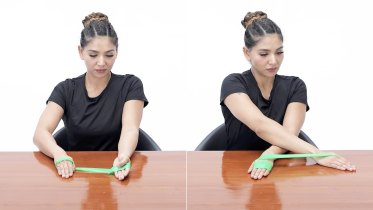 Forearm pronation with band
Stop signs and precautions for the forearm pronation with band
Before you start
- After a broken or dislocated elbow, or elbow surgery such as a tendon repair, follow your surgeon's or physio's plan, and start this exercise only when they have cleared you. If you have just hurt your arm and have severe pain or cannot move the elbow, do not exercise it. Go to an urgent care center or emergency department the same day. If you heard a snap or a crack at the moment of the injury, the arm looks a different shape or sits at an odd angle, a bone is showing, or your arm or hand tingles, feels numb or turns cold, pale or blue, go to an emergency department straight away or call emergency services, and do not drive yourself.
- After a broken wrist, hand or forearm, or surgery on any of them such as a tendon repair, start only when your doctor, surgeon, physio or hand therapist says the bone or repair is ready for this, and follow their plan for how much to do.
When to stop and get help
- Sharp pain in the forearm, wrist or elbow as you turn.
- The elbow is hot, red and swollen, or you have elbow pain with a high temperature or feel hot, cold or shivery. Get medical advice the same day, and go to an emergency department if you feel very unwell. This can be a sign of infection in the joint, which needs treatment quickly. If you have a very high or very low temperature, shivering you cannot control, you are breathing very fast or finding it hard to breathe, you are confused or your speech is slurred, your skin, lips or tongue look blue, gray, pale or blotchy (on brown or black skin this can be easier to see on the palms of the hands or soles of the feet), or you have a rash that does not fade when you press it, call emergency services, as this can be sepsis.
- A painful click or catch on the little finger side of the wrist.
- Your hand or fingers start to tingle or go numb.
- Pins and needles in your arm or hand that do not go away after you stop, or part of your arm or hand goes numb. Get medical advice the same day. If one side of your face or body suddenly goes numb or weak, or your speech becomes slurred or muddled, call emergency services, even if it goes away.
- Since the elbow injury or an operation on it, your hand is getting weaker or clumsier, you are dropping things, you cannot pinch or grip as you could, the ring and little fingers feel numb or tingly all the time rather than only while you exercise, or the muscle between your thumb and index finger looks hollowed out. Contact your fracture clinic or surgical team the same day. The nerve that runs behind the elbow (the ulnar nerve) can be pressed on by swelling, by the healing bone or by metalwork, and a nerve that is losing power needs looking at quickly, because weakness left to run on may not fully recover.
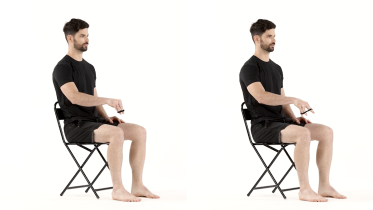 Finger extension with a rubber band
Stop signs and precautions for the finger extension with a rubber band
Before you start
- After a broken wrist, hand or forearm, or surgery on any of them such as a tendon repair, start only when your doctor, surgeon, physio or hand therapist says the bone or repair is ready for this, and follow their plan for how much to do. With rheumatoid or another inflammatory arthritis, ask your physio or hand therapist before adding resistance, and leave it out while the finger joints are hot and swollen.
When to stop and get help
- A sharp pain in any finger joint or at the base of your thumb.
- Numbness or tingling in the fingers, or fingertips turning pale or blue under the band. If one side of your face or body suddenly goes numb or weak, or your speech becomes slurred or muddled, call emergency services, even if it goes away.
- Finger joints that are more swollen, hot or stiff once you finish.
Small things that make these exercises work
The elbow is the detail people get wrong. The band turns are meant to move the forearm, and the moment the elbow drifts away from your side, the shoulder rolls in and does the turning while the forearm barely moves. Keep the upper arm against your ribs, keep the forearm down on the table for the band work, and watch the last part of the turn, which is where a band pulls hardest and the setup quietly falls apart.
Two forearm stretches that belong in a tennis elbow program are deliberately left out of this one. The first is the stretch that eases the palm further down to lengthen the muscle the nerve runs through. Werner and colleagues recorded the pressure in the radial tunnel directly and found that passively stretching that muscle pressed on the nerve at 40 to 50 mmHg. They judged that compression of that size, coming and going, might well be enough to injure the nerve and so account for the pain and the local nerve tenderness seen in this condition. Holding that position for half a minute at a time therefore works against the whole point of the early stages.
The second is the wrist extensor stretch, done with the elbow straight, the palm turned down and the wrist bent, which is the position clinicians use on purpose to put this nerve on tension, and Moradi and colleagues list avoiding prolonged elbow extension, forearm pronation and wrist flexion as part of non-surgical care. If either stretch is on a sheet you were given for tennis elbow, that is worth raising with your physio rather than working through it.
Can either of them come back once the forearm has settled? No study answers that, because nobody has published a rehabilitation program for this condition. Our reasoning is this: the pressure Werner and colleagues measured came from the position itself, so the same stretch would still press on the nerve inside the tunnel after your pain has gone, even though a nerve that is no longer irritable may well tolerate it. So neither stretch comes back as a routine step here.
Keep the range you actually use by moving through it rather than by holding it, which is what the slow turns and wrist movements in stage 1 are for. If a tight end range is still blocking a real task months later, that is the point to take it to a physio in person, who can see how your nerve behaves before anything gets held at the end of its range.
One more exercise is left out on purpose. A radial nerve glide slides the nerve along rather than stretching it, and physios do use glides for nerves that are squeezed elsewhere in the arm. Nobody has tested one in radial tunnel syndrome, and the position it starts from, elbow straight, forearm turned palm down and wrist bent, is the same combination both reviews name as the way to put this nerve on tension. How irritable your nerve is decides whether a glide helps or stirs it up, and that is a judgement for a physio in the room, not something to try off a page.
Grip is the hidden load. Finger extension with a rubber band trains the muscles that open the hand, and resisted finger extension is one of the tests used to provoke this problem, so the band stays light for longer than it would after a tendon injury. Keep the band up at the fingertips, open slowly, and let the fingers close slowly rather than letting the band snap them shut.
How long does radial tunnel syndrome take to settle?
There is no honest number, so this page will not give you one. Nobody has followed a group of people with this problem through physiotherapy and timed how long it took, so what the sources quote is something different wearing the same clothes: how long to try non-surgical care before surgery is discussed. It still gives you a sense of scale.
Non-surgical treatment is counted in months rather than weeks: 3 months before surgery is discussed in the MSD Manual and in Moradi and colleagues (2015), and Levina and Dantuluri (2021) describe trying non-operative care for about a year first. That spread between 3 months and a year is a real disagreement in the literature rather than a detail we have smoothed over, and it tells you what to expect from a first appointment, which is a plan measured in months. If you want one marker to hold on to, treat 3 months of genuinely changed load as the point at which it is reasonable to ask what else is on the table, not as the point at which exercises have failed.
What progress looks like is more useful than a date. The night ache usually settles before the daytime one. Then the forearm starts tolerating a longer spell of the task that used to set it off, and the last thing to come back is forceful twisting under load. Keep a short note of what you did and what the forearm was like the next morning, because a month of those notes answers the question better than how any single day felt.
If nothing at all has changed after several weeks of taking the load off, that is a reason to be reassessed rather than to push harder. Sometimes the answer is that the nerve was never the problem.
When to see a physio or doctor
See a physio or doctor if forearm pain has not improved after a few weeks of changing the tasks that cause it, if it keeps waking you, or if you have already been treated for tennis elbow without the pain changing. The NHS advises seeing a GP if elbow or arm pain does not go away after a few weeks, and it sends severe arm pain you can hardly move, an arm that has changed shape or snapped, or an arm that tingles or feels numb, to an urgent treatment center or emergency department. Get it looked at sooner if you cannot tell where the pain is coming from, since the neck, the shoulder, the elbow and the wrist can all send pain into a forearm.
An assessment is worth having early here for one reason above the others. No scan will settle this, so the examination is the diagnosis, and the two mistakes we see are loading a nerve as though it were a tendon and leaving the working week untouched while doing exercises. A physical therapist (physiotherapist) can test where you are tender, check whether the fingers and wrist have real power, and look at the tasks that keep stirring it up. Each of the warning signs below needs medical attention, and some of them need it straight away.
For physiotherapists
This page treats radial tunnel syndrome as a compression neuropathy of the posterior interosseous nerve presenting as proximal dorsal forearm pain, and links the differential out rather than restating it. There is no post-operative stage: decompression is named and left with the surgical team.
The entity itself is contested. Moradi and colleagues (2015) state that its existence remains controversial and that critics note pain as the only constant symptom. Levina and Dantuluri (2021) explain why electrodiagnostics do not resolve it: the small unmyelinated and lightly myelinated nociceptive fibers that carry this pain are not assessed by nerve conduction studies or electromyography, which are generally non-diagnostic. MRI is typically negative; where positive, denervation edema in PIN-innervated muscle is the commonest finding, in the supinator in 44% of cases and the proximal forearm extensors in 12% in the series that review cites. Diagnostic local anesthetic block into the tunnel is described as a clinical aid and produces a transient PIN palsy while it works.
On examination, tenderness lies over the mobile wad rather than on the epicondyle itself, 3 to 5 cm distal to the lateral epicondyle in Levina and Dantuluri and about 5 cm distal in Moradi and colleagues, with pain on resisted supination, resisted wrist extension and resisted long finger extension, and on the tension combination of elbow extension, passive pronation and wrist flexion. Moradi and colleagues describe the rule of nine for localization, with the two proximal lateral zones implicating the radial nerve. The MSD Manual adds a positive Tinel sign along the nerve as a discriminator from lateral epicondylalgia. Note that resisted middle finger extension is called pathognomonic by some of the sources Moradi and colleagues review and rarely provoked by others, so treat it as supportive rather than deciding.
Concurrence is high enough to change the plan: 43% with lateral epicondylitis and 20% with a second compression neuropathy in the series cited by Levina and Dantuluri, 21% to 41% concurrence across the studies Moradi and colleagues review, and radial tunnel syndrome in about 5% of patients carrying a lateral epicondylitis diagnosis. Screen for cervical radiculopathy, thoracic outlet syndrome and distal biceps insertional tendinopathy, the last named as a mimic in the Levina review.
No physiotherapy protocol exists in either review, which is why the staging here is reasoned rather than cited. Stage 1 is unresisted wrist and forearm movement inside the pain-free range; stage 2 adds submaximal isometric wrist extension, which is the provocation movement at a subthreshold dose; stage 3 loads supination, pronation and digital extension last, on the 24-hour response.
Neither forearm stretch is in the program. Werner and colleagues (1980) recorded 40 to 50 mmHg on the nerve during passive supinator stretch, and about four times that during active contraction driven by tetanic nerve stimulation, which argues for no sustained passive pronation stretch early and for resisted supination last, with the caveat that the contraction figure comes from a stimulated maximal contraction rather than anything a light band produces; and the wrist extensor stretch reproduces the elbow extension, pronation and wrist flexion tension position both reviews describe, which Moradi and colleagues list among the positions to avoid in non-operative care. Neither stretch is reintroduced after settling, since the pressure is positional rather than a property of the irritated state, and end-range rotation is instead maintained by unloaded active movement and referred to in-person judgement if it still limits function. Radial nerve sliders are not prescribed: untested in this condition, and the entry position is the tension combination itself.
One discrepancy to know about if you are reading the reviews alongside this page. Levina and Dantuluri state, with no citation marker, that passive supinator stretch raises intra-tunnel pressure to 250 mmHg from a 50 mmHg baseline. The only direct measurement study is Werner and colleagues, whose figures are 40 to 50 mmHg on passive stretch and about four times that on stimulated contraction, and those are the figures quoted here.
Published non-operative care is activity modification, temporary splinting out of forceful repetitive supination and wrist extension, and NSAIDs. A single corticosteroid injection at the point of maximal tenderness was studied prospectively in 35 patients, with significantly improved VAS and QuickDASH scores at 1 year and 57% reaching the minimal clinically important difference on QuickDASH; the same review quotes 70% improved at 6 weeks and 60% pain free at 2 years from the wider literature, and Moradi and colleagues report a single injection giving 72% pain relief at 6 weeks and 64% beyond 2 years. Dry needling rests on one case report; ultrasound-guided hydrodissection on a 54-patient series with no long-term follow-up (Levina and Dantuluri, 2021).
Surgical success is reported at 67% to 92%, satisfaction 40% to 83%, and is lower with concomitant entrapment neuropathy, concomitant lateral epicondylitis or a compensation claim. The threshold for referral differs between sources, 3 months in the MSD Manual and Moradi and colleagues against roughly a year in Levina and Dantuluri, and the page states that disagreement rather than choosing one.
Painless extensor weakness is PIN palsy, not radial tunnel syndrome, and is referred rather than loaded. ECRL is innervated proximal to the tunnel, so wrist extension with radial deviation is preserved even in a complete PIN palsy (Moradi and colleagues, 2015), and a wrist that extends does not exclude it: digital and thumb extension at the MCP joints is the test that does.
Warning signs
Get emergency help now
- Emergency: any sign of a stroke, even if it goes away. That means a face that droops on one side, an arm you cannot lift or keep up, slurred or muddled speech, weakness or numbness on one side of your body or face, sudden blurred vision, double vision or loss of sight, trouble swallowing, sudden dizziness with unsteadiness or falling over, a sudden severe headache, or a sudden fall where your legs give way but you do not black out (a drop attack). Call emergency services straight away.
- Chest pain or tightness, which may spread to your arm, neck or jaw, or shoulder or arm pain that comes with shortness of breath, sweating or feeling sick. This can be a heart attack. Call emergency services straight away.
- Emergency: after a fall or a blow to the elbow, the arm has changed shape or sits at an odd angle, a bone is showing through the skin, a cut is bleeding heavily, or the hand has gone numb or tingly or turns cold, pale or blue. Go to an emergency department or call emergency services straight away, and do not drive yourself.
- Your arm, hand or fingers turn cold, pale, blue or gray compared with the other side. Call emergency services or go to an emergency department straight away, and do not drive yourself. The blood supply to the arm may be blocked.
- Emergency: new problems walking, for example your legs feel stiff, heavy or weak or you have become unsteady on your feet, new trouble controlling your bladder or bowels, or hands that suddenly become clumsy, for example you can no longer do up buttons. Call emergency services straight away. These can be signs of pressure on the spinal cord in the neck.
- The pain started with a fall or a blow to the elbow, and the pain is severe, you heard a snap, the elbow is swollen or bruised, or you cannot bend or straighten the arm. Go to an urgent care center or emergency department the same day.
- A sudden pop or snap at the front of your elbow, sudden sharp pain there, or the muscle at the front of your upper arm bunches up or changes shape. Stop and go to an urgent care center or emergency department the same day, even if you can still bend the elbow, as this can be a torn biceps tendon.
Get help today
- Your wrist or fingers will not lift properly (the fingers may droop at the knuckles), or your hand keeps getting weaker, not just sore. Get medical advice the same day, as this can be a problem with a nerve rather than the tendon. If the weakness is getting worse by the hour, go to an emergency department.
- You have numbness, tingling or pins and needles in the hand or fingers, or pain that spreads from your neck down the arm. Stop any exercise that brings it on and see a physio or doctor, because this points to a nerve or to your neck rather than the tendon. If the pins and needles do not go away after you stop, or part of your arm or hand goes numb, get medical advice the same day. If one side of your face or body suddenly goes numb or weak, or your speech becomes slurred or muddled, call emergency services, even if it goes away.
- Hands that have slowly become clumsy, for example trouble doing up buttons or dropping things, or numbness in both hands. Get medical advice the same day. These can be signs of pressure on the spinal cord in the neck (cervical myelopathy). If the clumsiness or numbness gets worse quickly, call emergency services straight away.
- The elbow is hot, red and swollen, or you have elbow pain with a high temperature or feel hot, cold or shivery. Get medical advice the same day, and go to an emergency department if you feel very unwell. This can be a sign of infection in the joint, which needs treatment quickly. If you have a very high or very low temperature, shivering you cannot control, you are breathing very fast or finding it hard to breathe, you are confused or your speech is slurred, your skin, lips or tongue look blue, gray, pale or blotchy (on brown or black skin this can be easier to see on the palms of the hands or soles of the feet), or you have a rash that does not fade when you press it, call emergency services, as this can be sepsis.
- Same day: since a needle was put into the forearm or the elbow, for example a steroid or other injection, the pain and the swelling there are getting worse over the days rather than settling, the skin around the needle mark is hot or red, fluid or pus is leaking from it, or you feel unwell or have a temperature. Contact the team who gave the injection, get medical advice the same day if you cannot reach them, and go to an emergency department if you feel very unwell. Redness can be harder to see on brown or black skin. A needle is a way through the skin: NHS patient information for corticosteroid injections names pain and swelling that worsen over several days, with feeling unwell or a temperature, as the sign of infection to act on.
- The pain is there at night or at rest and keeps getting worse. If you are being treated for cancer now, contact your cancer team the same day.
Book an appointment
- The elbow locks, catches, or feels unstable, as if it slips or gives way. Get it assessed before you start these exercises, and ask your doctor or physio for an appointment within a few days.
- The pain is there at night or at rest and keeps getting worse. If you have had cancer, now or in the past, or are losing weight without trying, see your doctor sooner, within a day or two, and mention it. This applies even if the pain is not getting worse.
- The pain is there at night or at rest and keeps getting worse. See your doctor within a few days.
Common questions
How is radial tunnel syndrome different from tennis elbow?
By where it is tender and by what the pain feels like. Tennis elbow is tender directly over the bony point on the outside of the elbow, while tenderness in radial tunnel syndrome sits further down the forearm, over the course of the nerve under the muscles there: about 3 to 5 cm below the bony point in Levina and Dantuluri (2021) and about 5 cm below it in Moradi and colleagues (2015). Radial tunnel pain is usually described as a deep ache in the top of the forearm that can spread toward the wrist and the back of the fingers, is often worse at night, and is stirred up by turning the palm and by lifting, although Moradi and colleagues add that night pain and arm fatigue are not specific to this condition and the NHS says tennis elbow pain can affect sleep too. The MSD Manual adds a second check: tapping along the line of the radial nerve can send a pins and needles feeling into the forearm in radial tunnel syndrome, and tennis elbow does not do that. The two also keep company. Levina and Dantuluri cite a series in which 43% of people with radial tunnel syndrome also had tennis elbow, and Moradi and colleagues report the two found together in 21% to 41% of patients across several studies, so the answer is sometimes both rather than one.
How do you get radial tunnel syndrome?
The nerve is squeezed as it threads through the muscles of the upper forearm, most often at a firm band at the top edge of the muscle that turns your palm up (the arcade of Frohse). Moradi and colleagues (2015) list five places along that tunnel where it can happen, and describe the compression as intermittent rather than constant. Most of what the sources name is structure and space rather than a job, although Moradi and colleagues do list trauma and heavy manual work as contributing factors and cite a study that found more of it in factory workers whose job was forceful forearm turning. Levina and Dantuluri (2021) include fibrous bands, nearby blood vessels, the edge of the muscle and space-occupying things such as a ganglion, and the MSD Manual adds trauma, a lipoma, a bone tumor and inflammation inside the elbow joint. What the sources say about activity is still narrower than most advice on the internet: the pain worsens with turning the forearm and with lifting. Most people who get it are between 30 and 50, more often women, and usually in the dominant arm.
How is radial tunnel syndrome diagnosed?
On examination, not on a scan. Both reviews we lean on here say the diagnosis rests on where the tenderness is and on which resisted movements reproduce the pain, because nerve conduction studies and electromyography are usually normal in this condition (Moradi and colleagues, 2015; Levina and Dantuluri, 2021). The reason is worth knowing: those tests read the large fibers that drive muscles, and the fibers carrying this pain are too small to show up. MRI is usually normal too, and when it is not, the commonest finding is swelling in the muscle the nerve supplies. A doctor may inject local anesthetic into the tunnel to see whether the pain settles, which Levina and Dantuluri describe as a diagnostic step that briefly weakens the finger and thumb extensors while it works.
What to do for radial tunnel syndrome, and does it get better?
Start with the load rather than the exercise sheet. The published advice is activity modification, a temporary splint and anti-inflammatory tablets, with a splint worn to keep you off forceful or repeated palm-up turning and wrist bending back, which is what takes pressure off the nerve (MSD Manual; Levina and Dantuluri, 2021). If you are pregnant, the NHS advises avoiding anti-inflammatory painkillers such as ibuprofen and naproxen unless a doctor or pharmacist tells you to take them. Ask a pharmacist if you are not sure a medicine is safe for you. A doctor may also offer a steroid injection into the tunnel, which carries the most supportive numbers of any non-surgical treatment here: Moradi and colleagues (2015) report a single injection giving 72% pain relief at 6 weeks and 64% beyond two years, and Levina and Dantuluri describe a prospective study of 35 patients whose pain and arm function scores were still better a year afterward. If you do have one, and the forearm then gets hotter, more swollen or more painful over the following days, or you run a temperature, that has its own same-day line in the warning signs at the foot of this page, written for a needle rather than for an operation. Neither review we rely on here sets out a physiotherapy program for this condition, and we are not going to pretend otherwise: Levina and Dantuluri describe no therapy protocol, and Moradi and colleagues (2015) say non-surgical treatment rarely gives permanent relief while still being worth trying first. So the program on this page is built on what those sources do support, keeping the provocative positions out early and bringing them back slowly, and your physio will adjust it to your arm and your job.
Should I wear a splint or brace for radial tunnel syndrome?
A splint is part of the usual first treatment, but its job is different from a tennis elbow strap. The MSD Manual describes splinting to prevent forceful or repeated palm-up turning and bending the wrist back, because both raise the pressure on the nerve, and Levina and Dantuluri (2021) list temporary splinting alongside activity change and anti-inflammatory tablets. Temporary is the word to hold on to. A splint that takes the provocation out of a working week for a few weeks is useful, and one worn for months while nothing else changes tends to leave the forearm stiff and no better. Ask the person fitting it which movement it is meant to stop, since that is what decides where it has to reach.
When is surgery considered for radial tunnel syndrome?
When the forearm has not settled on non-surgical treatment, and the sources differ on how long that takes. The MSD Manual puts decompression on the table if symptoms are not relieved after 3 months, Moradi and colleagues (2015) also use 3 months of conservative care, and Levina and Dantuluri (2021) say non-operative care is first line and should often be tried for about a year before surgery. Published success rates run from 67% to 92% in one review and 67% to 93% in the other, with satisfaction reported between 40% and 83%, and results are worse when there is another nerve entrapment or tennis elbow alongside it, or a workers' compensation claim. So about 3 months is the earliest the question is usually put, and a longer trial of non-surgical care after that is a defensible plan rather than a sign of being fobbed off. Painless weakness is the exception to the whole timetable: the MSD Manual treats finger extension that has weakened, or a wrist that drops, as its own reason to consider decompression, whatever the clock says. A hand surgeon is the person to weigh that with. This page does not cover rehabilitation after a radial tunnel release, which belongs with the surgeon and hand therapist who did it.
Is radial tunnel syndrome the same as cubital tunnel syndrome?
No. They are different nerves on different sides of the same elbow. Cubital tunnel syndrome is pressure on the ulnar nerve behind the bony point on the inner side, and its main symptom is tingling and numbness in the little and ring fingers, which our cubital tunnel syndrome program covers. Radial tunnel syndrome is on the outer side and the top of the forearm, and it is a pain problem rather than a numbness one. Carpal tunnel syndrome is a third nerve again, squeezed at the wrist, with tingling on the thumb side of the hand. People do sort between all three, and the fastest way to narrow it down is to say which fingers are involved and whether the trouble is pain, tingling or weakness.
References
- Moradi A, Ebrahimzadeh MH, Jupiter JB. Radial tunnel syndrome, diagnostic and treatment dilemma. Archives of Bone and Joint Surgery. 2015;3(3):156-162. https://pmc.ncbi.nlm.nih.gov/articles/PMC4507067/
- Levina Y, Dantuluri PK. Radial tunnel syndrome. Current Reviews in Musculoskeletal Medicine. 2021;14(3):205-213. https://doi.org/10.1007/s12178-021-09703-w
- Werner CO, Haeffner F, Rosen I. Direct recording of local pressure in the radial tunnel during passive stretch and active contraction of the supinator muscle. Archives of Orthopaedic and Traumatic Surgery. 1980;96(4):299-301. https://doi.org/10.1007/BF00432870
- Steinberg DR. Radial tunnel syndrome. MSD Manual, Professional Edition. Reviewed and revised May 2024. https://www.msdmanuals.com/professional/musculoskeletal-and-connective-tissue-disorders/hand-disorders/radial-tunnel-syndrome
- NHS. Tennis elbow. Page last reviewed 31 May 2024. https://www.nhs.uk/conditions/tennis-elbow/
- NHS. Elbow and arm pain. Page last reviewed 26 January 2024. https://www.nhs.uk/symptoms/elbow-and-arm-pain/
- NHS. Sepsis. Page last reviewed 14 May 2026. https://www.nhs.uk/conditions/sepsis/
- Worcestershire Acute Hospitals NHS Trust. Corticosteroid injection. Patient information leaflet, accessed 29 October 2026. https://www.worcsacute.nhs.uk/leaflets/corticosteroid-injection/
- NHS. Ibuprofen for adults. Page last reviewed 27 August 2025. https://www.nhs.uk/medicines/ibuprofen-for-adults/
- NHS. Naproxen. Page last reviewed 25 June 2026. https://www.nhs.uk/medicines/naproxen/
Written and checked by the PocketPhysio editorial team. Last updated 2026-10-29.
This page is general education, not a diagnosis or a personal treatment plan. See a physiotherapist or doctor for advice about your own situation.