
Elbow pain when lifting: what it means and what helps
Why lifting is the movement that finds it
Gripping is the reason more often than the weight. Every time your hand closes around a handle, the muscles along the forearm hold the wrist steady so the fingers can pull, and those muscles anchor to small bony points at the elbow. So a task can be light for your arm and heavy for the tendon. A full mug held palm down does it. So does a laptop bag hooked on two fingers.
The load on that tissue climbs with how hard you have to grip, how far the weight sits from your body and how suddenly it arrives. The 2022 JOSPT clinical practice guideline for lateral elbow pain lists handling heavy tools or loads, and repeated bending and straightening of the wrist or elbow for more than two hours a day, among the risk factors (Lucado and colleagues, 2022). Catching something as it slips is the version people remember afterward, because the tendon takes the load with no time to prepare.
Which side of the elbow speaks up depends on which muscle group works hardest. Lifting palm down asks most of the wrist-lifting muscles on the outer side. Curling the wrist, turning the palm down and squeezing hard put the work on the inner group instead, while bending the elbow and turning the palm up loads the biceps tendon at the front.
Where it hurts, and what that points to
These are patterns, not diagnoses. Press around until you find the sorest spot, then read the part that matches.
The outside of the elbow
This is tennis elbow, or lateral elbow tendinopathy, where the tendon of the wrist-lifting muscles attaches to the bony point on the outer side. The NHS describes pain on the outside of the elbow that gets worse with lifting, gripping or moving the wrist, sometimes with tenderness, swelling and trouble straightening the arm fully. It builds over weeks, usually with no single moment that started it. The 2022 guideline recommends resisted exercise for those muscles and accepts static holds, lifting or slow lowering, with roughly 3 sets of 15 for 6 to 12 weeks (Lucado and colleagues, 2022). The tennis elbow program follows that order.
The inside of the elbow
Golfer's elbow, or medial elbow tendinopathy, sits where the muscles that curl the wrist and turn the palm down attach. OrthoInfo describes pain or burning in the inner part of the elbow with occasional shooting pain, weak grip strength and reduced wrist or elbow movement, and names pronator teres as the muscle most often injured. Rowing, deadlift holds, hammer curls and long carries are where people notice it, because each one pairs a hard grip with a palm-down forearm. There is far less research here than on the outer side, and the JOSPT clinical practice guideline covers lateral elbow pain only. Start with the golfer's elbow program.
The front of the elbow
The crease at the front is where the biceps tendon attaches, and it complains about curls, about carrying a load in the crook of the arm and about turning the palm up against resistance. A gradual ache there is usually tendon irritation, and a 2026 review of distal biceps partial tears and tendinopathy reported that tendinopathy tends to be treated without surgery, while partial tears are more often operated on, with the evidence too weak to compare the two properly (Sebastiani and colleagues, 2026). The biceps tendinopathy program covers that version.
The sudden version is the one worth knowing about before it happens. OrthoInfo describes the rupture happening when you grab a heavy box without realizing how much it weighs, so the weight forces your bent arms straight. There is often a pop at the elbow, then bruising at the elbow and forearm, and weakness twisting the forearm from palm down to palm up. Repair surgery is best done in the first 2 to 3 weeks after the injury, because the tendon and muscle start to scar and shorten after that. That timing is why the warning signs below send a pop at the front of the elbow to an urgent care center or emergency department the same day, even if you can still bend the arm.
Pins and needles in the ring and little fingers
Not a tendon problem at all. The ulnar nerve wraps around the inner side of the elbow, and OrthoInfo says symptoms show up more when the elbow is bent, for example while driving or holding a phone, and that some people wake at night with numb fingers. Lifting keeps the elbow bent for long stretches, so curls, carries and desk work stack up on the same nerve. In the one trial that tested the options, everyone was given advice about what brings the symptoms on, and adding a night splint or nerve gliding exercises made no measurable difference at 6 months (Svernlöv and colleagues, 2009). The cubital tunnel syndrome program sets out the elbow habits that matter, and numbness that never lifts or a hand that is getting weaker belongs in the warning signs, not in a home program.
What to change at home and in the gym
Keep lifting, and change how you lift. Complete rest takes the load off, but it also takes away the thing that builds the tendon back up, so the aim is to take out the spikes, not the load. Lift slowly instead of snatching, keep the weight closer to your body, and turn the load palm up where you can, since that shifts work away from the outer tendon. Leave that last one out if your pain sits at the front of the elbow, because turning the palm up against a load is the biceps tendon's own job. These are practical adjustments and not treatments in their own right, so judge each one by what it does to the elbow in the tasks you repeat most.
In the gym, the grip is the dial to turn down first. Thicker handles spread the pressure, straps take some of the demand out of the heaviest pulls, and a neutral grip is usually kinder than a fixed palm-down or palm-up bar. Cut the accessory work that is mostly grip for a few weeks, keep the rest of the session, and hold the main lifts at a weight you can control through the full range. If the elbow is still grumbling a full day after training, trim the next session instead of repeating it.
For the first couple of weeks, the NHS self-care advice for tennis elbow is to avoid what makes it worse, to try a hot or cold pack wrapped in a towel for up to 20 minutes every 2 to 3 hours, and to consider paracetamol or an anti-inflammatory gel. A forearm strap worn just below the elbow can take the edge off during activity, though the guideline found the evidence too mixed to recommend one for the longer term. Ask a pharmacist before starting a medicine if you take anything else.
Exercises for elbow pain when lifting
The progression in the guideline runs from holds that keep the tendon still, through lifting a light weight, to lowering it slowly, with each step added only if the elbow tolerates the one before (Lucado and colleagues, 2022). Work the side that hurts instead of doing all six: the wrist extensor stretch and wrist extension with a weight for the outer elbow, the isometric wrist flexion and the wrist curl for the inner one. The band turn and the ball squeeze suit a sore front of the elbow and a grip that has gone weak. Keep the ball squeeze gentle to begin with, because a hard grip is what loads both elbow tendons most.
Mild discomfort at the elbow while you work is common and acceptable if it settles within a few hours and the elbow is no worse the next morning. A sharp catch during a repetition is the signal to drop that one for now. If you have high blood pressure, breathe steadily through every hold and never hold your breath. Tingling in the hand while you work means stopping that exercise and reading the nerve section above.
Tingling that does not clear once you stop is the one that needs a phone call.
Pins and needles in your arm or hand that do not go away after you stop, or part of your arm or hand goes numb. Get medical advice the same day. If one side of your face or body suddenly goes numb or weak, or your speech becomes slurred or muddled, call emergency services, even if it goes away.
After a broken or dislocated elbow, or elbow surgery such as a tendon repair, follow your surgeon's or physio's plan, and start this exercise only when they have cleared you. If you have just hurt your arm and have severe pain, cannot move the elbow or heard a snap, do not exercise it. Go to an urgent care center or emergency department the same day. If the arm looks a different shape or sits at an odd angle, a bone is showing, or your arm or hand tingles, feels numb or turns cold, pale or blue, go to an emergency department straight away or call emergency services, and do not drive yourself. After a broken wrist, hand or forearm, or surgery on any of them such as a tendon repair, start only when your doctor, surgeon, physio or hand therapist says the bone or repair is ready for this, and follow their plan for how much to do.
Exercises that can help
Match these to where your elbow hurts: the first two work the outer side, the next two the inner side, and the band turn and the ball squeeze cover the front of the elbow and grip. Common starting points are 2 to 4 stretch holds of 15 to 30 seconds a few times a day, and 5 to 10 holds of about 5 to 10 seconds for the static work, once or twice a day. The lifting work usually starts at 2 to 3 sets of 10 to 15 slow repetitions with a light weight or a light band, once a day, and the soft ball at 10 to 15 squeezes held for about 3 to 5 seconds, 1 to 3 times a day. Each exercise page gives its own numbers and how often to do them, and your physio will adjust this.
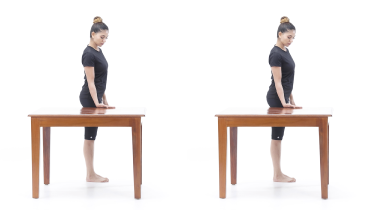 Wrist extensor stretch
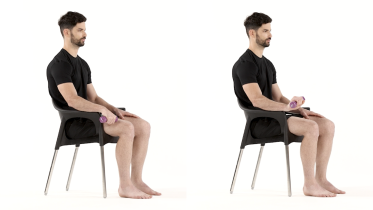 Wrist extension with weight
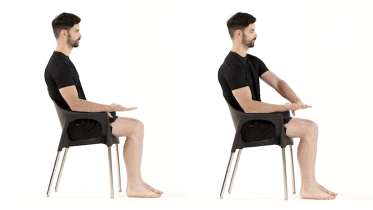 Isometric wrist flexion
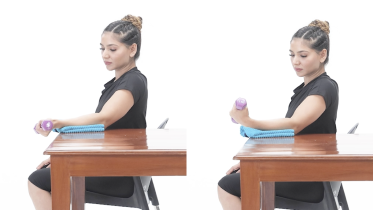 Wrist curl
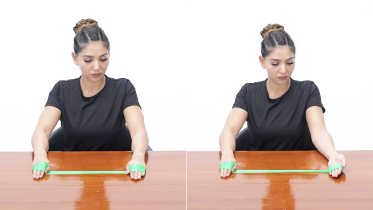 Forearm supination with band
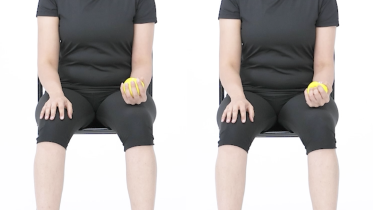 Hand grip squeeze
If the ache is at the front of the shoulder as well as the elbow, or reaching overhead is the harder movement, shoulder pain when lifting your arm covers that pattern instead.
When to see a physio (physical therapist)
The NHS suggests seeing a GP if your elbow pain is still there after resting it and trying self-care for at least 2 weeks, and its general elbow and arm advice is to see a GP if the pain has not gone after a few weeks. Go sooner if lifting has turned weak instead of sore, if your fingers tingle, or if the pain started with a pop.
An assessment mostly adds measurement. A physio will test resisted wrist lifting and wrist curling separately, compare grip strength that does not hurt against the other side, feel each attachment in turn, and check your neck and the nerves before settling on a starting load. The JOSPT guideline recommends questionnaires such as the PRTEE or DASH so progress is tracked with numbers, not impressions, and it suggests judging a loading program over 6 to 12 weeks (Lucado and colleagues, 2022). If you have had elbow surgery, your surgical team decides when new exercises start.
Related exercise programs
See a doctor promptly if
- Emergency: any sign of a stroke, even if it goes away. That means a face that droops on one side, an arm you cannot lift or keep up, slurred or muddled speech, weakness or numbness on one side of your body or face, sudden blurred vision, double vision or loss of sight, trouble swallowing, sudden dizziness with unsteadiness or falling over, a sudden severe headache, or a sudden fall where your legs give way but you do not black out (a drop attack). Call emergency services straight away.
- Emergency: jaw, neck, shoulder or arm pain that comes with chest pain or tightness, sweating, feeling sick, feeling light-headed or being short of breath, or that comes on when you exert yourself, feel stressed or go out in the cold and does not ease within a few minutes of rest. Call emergency services straight away, as this can be a heart attack. If it eases quickly with rest and none of these happen, get medical advice the same day, and do not exercise again until you have been checked.
- Emergency: after a fall or a blow to the elbow, the arm has changed shape or sits at an odd angle, a bone is showing through the skin, a cut is bleeding heavily, or the hand has gone numb or tingly or turns cold, pale or blue. Go to an emergency department or call emergency services straight away, and do not drive yourself.
- Emergency: new problems walking, for example your legs feel stiff, heavy or weak or you have become unsteady on your feet, new trouble controlling your bladder or bowels, or hands that suddenly become clumsy, for example you can no longer do up buttons. Call emergency services straight away. These can be signs of pressure on the spinal cord in the neck.
- Same day: the pain started with a fall or a blow to the elbow, and the pain is severe, you heard a snap, the elbow is swollen or bruised, or you cannot bend or straighten the arm. Go to an urgent care center or emergency department the same day.
- Same day: a sudden pop or snap at the front of your elbow, sudden sharp pain there, or the muscle at the front of your upper arm bunches up or changes shape. Stop and go to an urgent care center or emergency department the same day, even if you can still bend the elbow, as this can be a torn biceps tendon.
- Same day: a sudden pop or snap at the front of the shoulder or upper arm, or new bruising down the arm or a bulge in the lower part of the upper arm (a Popeye arm). Stop the exercises and get medical advice the same day, as this can be a torn long head of the biceps, and the rotator cuff can be torn at the same time.
- Same day: the elbow is hot, red and swollen, or you have elbow pain with a high temperature or feel hot, cold or shivery. Get medical advice the same day, and go to an emergency department if you feel very unwell. This can be a sign of infection in the joint, which needs treatment quickly.
- Same day: pain spreads from your neck down the arm, or turning or tilting your neck brings on the tingling in your hand. The problem may be in the neck rather than the elbow. If a doctor or physio has not checked it yet, get medical advice the same day.
- Same day: hands that have slowly become clumsy, for example trouble doing up buttons or dropping things, or numbness in both hands. Get medical advice the same day. These can be signs of pressure on the spinal cord in the neck (cervical myelopathy). If the clumsiness or numbness gets worse quickly, call emergency services straight away.
- Same day: your wrist or fingers will not lift properly, for example the fingers droop at the knuckles or the wrist drops when you hold your arm out in front of you. Get medical advice the same day. If the weakness is getting worse by the hour, go to an emergency department.
- Within a day or two: you throw, and you heard a pop or felt a sudden snap on the inside of the elbow, followed by pain, a throw you could not finish, or an elbow that feels loose or unstable. Stop throwing straight away and see a doctor within a day or two, because the ligament on the inner side of the elbow (ulnar collateral ligament) may be injured.
- Within a few days: your hand is getting weaker, you keep dropping things, your fingers feel clumsy, the numbness is there all the time, or the web of muscle between your thumb and index finger, or the little finger side of your palm, looks thinner or hollow compared with your other hand. See a doctor within a few days rather than waiting for it to settle, because a nerve that has been squeezed hard for a long time may not fully recover. If the weakness is getting worse from day to day, or both hands are affected, get medical advice the same day.
- Within a few days: the elbow locks, catches or keeps giving way in everyday use, without a pop from throwing. Stop the exercises that bring it on and see a physio or doctor within a few days rather than pushing on.
- Within a few days: the pain is there at night or at rest and keeps getting worse. See your doctor within a few days. If you have had cancer, now or in the past, or are losing weight without trying, see your doctor sooner, within a day or two, and mention it. This applies even if the pain is not getting worse. If you are being treated for cancer now, contact your cancer team the same day.
- Within a week or two: tingling or numbness in your ring and little fingers that has lasted more than 6 weeks, even if it is mild. See a doctor in the next week or two, or within a few days if the symptoms are severe. OrthoInfo advises seeing a doctor for these symptoms if they are severe, or if milder symptoms have lasted more than 6 weeks, because muscle wasting from a squeezed nerve cannot be reversed.
Common questions
Why does my elbow hurt when I lift weights or heavy things?
Usually because the tendon took on more load than it was ready for, and gripping is what carries that load to the elbow. The forearm muscles that hold your wrist steady while the fingers pull anchor to small bony points at the elbow: the outer point for the wrist-lifting group, the inner one for the wrist-curling group. So a heavy carry or a hard grip pulls on those attachments even though the work feels like it is in the hand. The 2022 JOSPT guideline for lateral elbow pain counts handling heavy tools or loads, and repeated bending and straightening of the wrist or elbow for more than two hours a day, among the risk factors. A jump in training, a new grip, or simply more volume than usual for a few weeks is the story most lifters tell, and the pain often shows up the day after, not during the session, so the session to look at is the last one.
Why does my elbow hurt when I lift something light, like a cup?
Because an irritated tendon reacts to the grip, not to the number on the scale. Holding a full mug with the palm facing down asks the wrist-lifting muscles to hold the wrist against the weight at the far end of a long lever, and the NHS names lifting, gripping and wrist movement as what makes tennis elbow pain worse. A cup lifted with the palm up, or held close to the body with the elbow bent, often does not hurt at all, which is worth noticing and not worth worrying about. If light tasks have started to catch you, it usually means the tendon is more irritable than it was, so reduce the heavy gripping for a couple of weeks instead of adding more. Pain that stops you using the arm for everyday tasks is worth an appointment, not another few weeks of waiting.
Should I keep lifting or working out with elbow pain?
Usually yes, with the load and the grip changed instead of training stopped. The 2022 JOSPT guideline puts resisted exercise for the wrist muscles at the center of treatment, progressing from static holds to lifting and then to slow lowering as the elbow allows, in place of rest. The rule of thumb most physios use: mild discomfort in a session is fine if it fades within a few hours and the elbow feels no worse in the morning. Keep the exercises you can do without a sharp catch, drop the ones that provoke it hard, and add the load back in small steps. Pain that came on suddenly with a pop, or weakness instead of soreness, is a different situation and belongs in the warning signs on this page.
Why does the inside of my elbow hurt when I grip and lift?
The inner side is where the muscles that curl the wrist and turn the palm down attach, so gripping plus a palm-down turn loads that corner hardest. OrthoInfo calls golfer's elbow pain or burning in the inner part of the elbow, sometimes shooting, with a weak grip and less movement at the wrist or elbow, and it names pronator teres as the muscle most often injured. Hammer curls, heavy rows, deadlift holds and carrying a suitcase are common provokers because they combine a hard grip with a long hold. One extra clue matters: OrthoInfo notes that some people also get numbness and tingling in the ring and little fingers, because the ulnar nerve passes right behind that bony point. If that is happening to you, read the nerve section of this page, since it changes what helps.
How do I stop elbow pain from lifting coming back?
Build the tendon up instead of protecting it forever. Once the pain has settled, the usual approach is to keep loading the forearm on purpose, two or three times a week, and to let the weight climb slowly instead of returning straight to your old numbers. The JOSPT guideline suggests around 3 sets of 15, kept up for 6 to 12 weeks, so think in months, not sessions. Watch the things that spike the load without you noticing: a new tool, a heavier bag, a longer carry, a grip that has to be tight because the handle is thin. Thicker handles, straps for the heaviest pulls and splitting long gripping jobs into blocks all reduce how much the tendon has to hold at once.
How long does elbow pain from lifting take to settle?
Longer than most people expect, and the trials are honest about it. In one Brisbane trial, physiotherapy beat waiting at 6 weeks, but at 52 weeks the two groups looked much the same and most people in both reported a good outcome (Bisset 2006). In a second Brisbane trial, 96% of the people given a dummy injection instead of a steroid one were recovered or much improved at 1 year (Coombes 2013), and much better is not always pain free, so the condition can come back. The NHS advises seeing a GP if elbow pain is still there after resting it and trying self-care for at least 2 weeks, and separately says to see a GP if elbow or arm pain does not go away after a few weeks. Judge a program over 6 to 12 weeks, not over a fortnight, and get it checked if nothing has shifted in that time.
References
- Lucado AM, Day JM, Vincent JI, MacDermid JC, Fedorczyk J, Grewal R, Martin RL. Lateral Elbow Pain and Muscle Function Impairments: Clinical Practice Guidelines. Journal of Orthopaedic and Sports Physical Therapy. 2022;52(12):CPG1-CPG111. https://doi.org/10.2519/jospt.2022.0302
- Bisset L, Beller E, Jull G, Brooks P, Darnell R, Vicenzino B. Mobilisation with movement and exercise, corticosteroid injection, or wait and see for tennis elbow: randomised trial. BMJ. 2006;333(7575):939. https://doi.org/10.1136/bmj.38961.584653.AE
- Coombes BK, Bisset L, Brooks P, Khan A, Vicenzino B. Effect of corticosteroid injection, physiotherapy, or both on clinical outcomes in patients with unilateral lateral epicondylalgia: a randomized controlled trial. JAMA. 2013;309(5):461-469. https://doi.org/10.1001/jama.2013.129
- Svernlöv B, Larsson M, Rehn K, Adolfsson L. Conservative treatment of the cubital tunnel syndrome. Journal of Hand Surgery (European Volume). 2009;34(2):201-207. https://doi.org/10.1177/1753193408098480
- Sebastiani RS, Herman ZJ, Rothrauff BB, Fowler JR, Lin A. Clinical outcomes following treatment of distal biceps tendon partial tears and tendinopathy: a systematic review. JSES Reviews, Reports, and Techniques. 2026;6(3):100770. https://doi.org/10.1016/j.xrrt.2026.100770
- American Academy of Orthopaedic Surgeons. Medial epicondylitis (golfer's elbow). OrthoInfo. https://www.orthoinfo.org/en/diseases--conditions/medial-epicondylitis-golfers-elbow/
- American Academy of Orthopaedic Surgeons. Biceps tendon tear at the elbow. OrthoInfo. https://www.orthoinfo.org/en/diseases--conditions/biceps-tendon-tear-at-the-elbow/
- American Academy of Orthopaedic Surgeons. Cubital tunnel syndrome (ulnar nerve entrapment at the elbow). OrthoInfo. https://www.orthoinfo.org/en/diseases--conditions/ulnar-nerve-entrapment-at-the-elbow/
- American Academy of Orthopaedic Surgeons. Ulnar collateral ligament (UCL) injury. OrthoInfo. https://www.orthoinfo.org/en/diseases--conditions/ulnar-collateral-ligament-ucl-injury/
- NHS. Tennis elbow. Page last reviewed 31 May 2024. https://www.nhs.uk/conditions/tennis-elbow/
- NHS. Elbow and arm pain. Page last reviewed 26 January 2024. https://www.nhs.uk/symptoms/elbow-and-arm-pain/
- NHS. Heart attack. Page last reviewed 31 March 2026. https://www.nhs.uk/conditions/heart-attack/
- NHS. Septic arthritis. Page last reviewed 3 September 2026. https://www.nhs.uk/conditions/septic-arthritis/
- NHS. Symptoms of a stroke. Page last reviewed 12 September 2024. https://www.nhs.uk/conditions/stroke/symptoms/
Written and checked by the PocketPhysio editorial team. Last updated 2026-09-30.
This page is general education, not a diagnosis or a personal treatment plan. See a physiotherapist or doctor for advice about your own situation.