
Biceps tendinopathy exercises and physiotherapy
What is biceps tendinopathy?
The biceps is the muscle at the front of your upper arm. It bends the elbow and turns the palm up. At the top it has two tendons, and the long one (the long head) runs up a groove at the front of the shoulder and into the joint. At the bottom a single tendon attaches just below the front of the elbow.
Biceps tendinopathy means one of these tendons has become painful and copes less well with load. By far the more common place is the long head at the front of the shoulder. OrthoInfo describes pain or tenderness at the front of the shoulder that is worse with overhead lifting, and pain when reaching backward, such as for a seatbelt or into a coat sleeve. Some people also notice an occasional snapping feeling in the shoulder.
It rarely comes on its own. Nho and colleagues (2010) note that long head problems often occur alongside other shoulder problems, and OrthoInfo lists rotator cuff wear or tears, shoulder arthritis, tears of the rim of the socket (labrum) and a shoulder that keeps dislocating. Much of the cause is gradual wear over the years, with repeated overhead activity, such as swimming, tennis or baseball, adding to the load.
Biceps tendinopathy at the elbow
Less often, the tendon at the elbow end becomes sore (distal biceps tendinopathy). The pain is at the front of the elbow, and because this tendon bends the elbow and turns the palm up, lifting can bring it on. So can twisting jobs such as using a screwdriver. A 2026 systematic review found no high-quality comparisons, and most of the patients in its studies had partial tears rather than tendinopathy. It concluded that nonsurgical care is the usual first step for tendinopathy at the elbow (Sebastiani and colleagues, 2026).
The curls and forearm turning in the program below load this tendon too, so the same program can be used, starting light. Pain on the outer or inner side of the elbow is a different problem; see the tennis elbow program or the golfer's elbow program. A sudden pop at the front of the elbow is not tendinopathy at all and needs the same-day check in the warning signs below.
How this differs from rotator cuff tendinopathy and impingement
If your main pain is at the top and outer side of the shoulder and worse reaching overhead, the rotator cuff tendinopathy program is probably the better fit. The shoulder impingement page covers the same kind of pain under its older name, with more on posture and the shoulder blade. Those pages also go through the rotator cuff research on scans, and on treatments such as steroid injections or surgery. That research is much stronger than anything written about the biceps.
This page is for pain that sits at the front of the shoulder or elbow and seems to come from the biceps. Because the two problems so often go together, this program includes the core rotator cuff work as well. It is not a program for rehab after a biceps tendon repair, a tenodesis or other shoulder surgery; follow your surgeon's and physio's plan for that.
Does exercise help biceps tendinopathy?
Probably, but the evidence is thin, and it is fair to say so. A 2024 scoping review found only 14 articles on physical therapy for long head biceps tendinopathy, and concluded that there is a dearth of evidence on its nonsurgical care (McDevitt and colleagues, 2024). Most of the studies it did find tested passive treatments such as ultrasound or laser, not exercise.
With so little trial evidence, the same research group asked an international panel of expert physical therapists to reach agreement (McDevitt and colleagues, 2022). The panel recommended combining exercise with hands-on treatment and education. For exercise, they agreed on loading the tendon with static holds as well as with lifting and slow lowering. They also agreed on strengthening the biceps step by step, along with the muscles around the shoulder and shoulder blade, including the deltoid and rotator cuff. The last piece was practicing the tasks people need to get back to, such as reaching and lifting, or a sport.
The panel did not recommend ultrasound, laser, shock wave therapy, electrical stimulation or cupping. Expert agreement is a weaker kind of evidence than a trial. So this program follows what the panel agreed, borrows the loading ideas from the better studied rotator cuff programs, and should be adjusted to how your arm responds.
How to use this program
Pick the stage that matches your arm this week. Stage 1 is the safe choice if you cannot decide. Move up when the current stage feels easy and your shoulder or elbow is no worse the next morning.
Many programs use 2 to 3 sets of 10 to 15 slow repetitions for the band exercises, once a day or every other day, and 2 to 3 sets of 8 to 12 for the curls with light dumbbells, 2 to 3 days a week. For the static holds, 5 to 10 holds of 5 to 10 seconds, once or twice a day, is a common start. Your physio will adjust the exercises and the numbers to your arm and to what you need to get back to.
Expect some discomfort while you exercise. Many programs accept mild discomfort that eases soon after you finish, with the arm no worse the next morning. Stop that exercise if the pain turns sharp or catching, or builds with each repetition. If the arm is clearly worse the next morning, or night pain comes back, the load was too much, so drop back a step rather than stopping altogether.
The exercise program
Stage 1: Settle the tendon and keep the arm moving
For a shoulder or elbow that aches at the front with lifting, reaching or carrying. The two static holds work the rotator cuff without the arm moving, and many programs use 5 to 10 holds of 5 to 10 seconds, once or twice a day, pushing well short of your hardest. The expert panel described below also agreed on static holds for the biceps, although it set no numbers, and this one has no video yet: sit with your elbow bent to a right angle at your side and palm up, put your other hand on top of the wrist, and push up gently into it so nothing moves. Start with the same holds and times as the shoulder holds, and your physio will adjust them. Push well short of your hardest and keep breathing during every hold, especially if you have high blood pressure. The pendulum and slow elbow bending and straightening keep both joints moving without load. If a hold makes the pain build as you go, or the arm is sorer the next morning, push more gently or hold for less time.
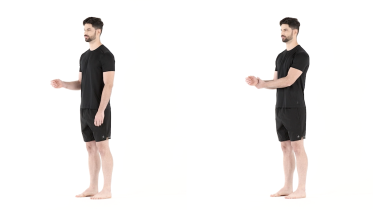 Isometric shoulder external rotation
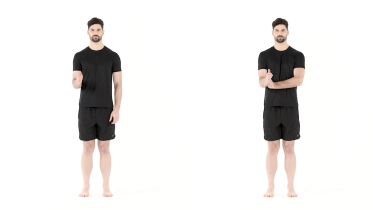 Isometric shoulder internal rotation
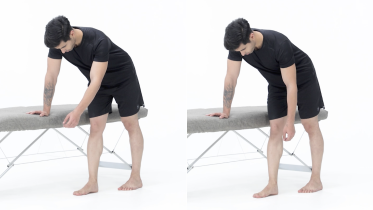 Pendulum exercise for the shoulder
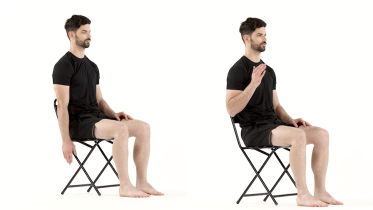 Elbow flexion and extension
Stage 2: Strengthen the shoulder and start moving the biceps against load
When the holds feel easy and everyday lifting hurts less. The band turns and the band row build the rotator cuff and shoulder blade muscles, which share the work at the front of the shoulder. The hammer curl is a gentler first curl, because with the palms facing in, the forearm muscle on the thumb side takes more of the load. Turning the palm up is the biceps' other main job, so start forearm supination with the lightest band, especially if your pain is at the elbow. Lower every curl and turn slowly, and keep the weight light enough that the last few repetitions still look controlled.
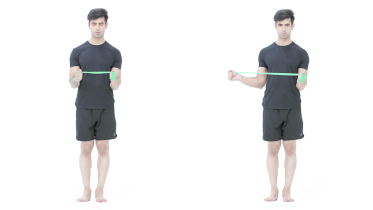 Shoulder external rotation with band
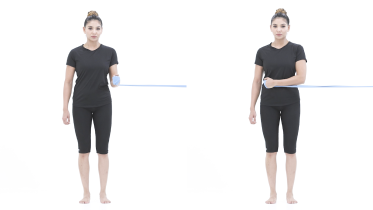 Shoulder internal rotation with band
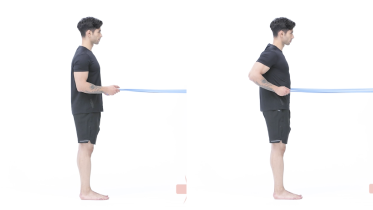 Resistance band row
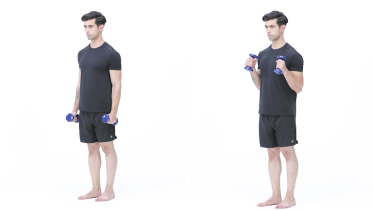 Hammer curl
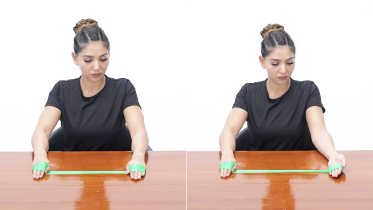 Forearm supination with band
Stage 3: Full curls and reaching up
When 3 sets of the stage 2 exercises feel easy and the arm is no worse the next day, keep those going and add these. The standard biceps curl loads the tendon with the palm up; start with a lighter weight than you used for the hammer curl and lower it more slowly than you lift it. The serratus punch and the prone Y raise train the muscles that steady the shoulder blade as the arm lifts, and wall slides rebuild reaching overhead with the wall taking some of the arm's weight. This is also the stage to practice what you need to get back to, such as lifting a child, carrying shopping or throwing, at a lighter load and for less time than usual.
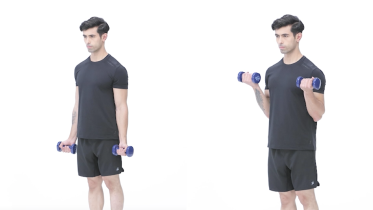 Biceps curl
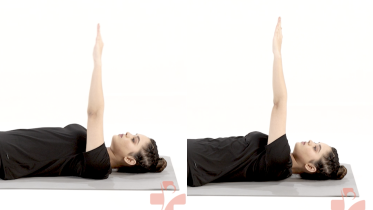 Serratus punch
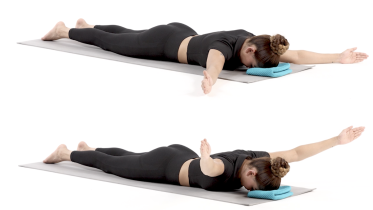 Prone Y raise
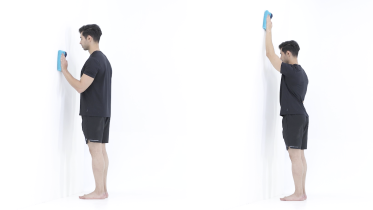 Wall slides with a towel
What to change at work and at home
OrthoInfo lists rest and ice among the first treatments, along with anti-inflammatory medicines and exercise. In practice that means cutting back, not stopping everything. The NHS advice for shoulder pain is to keep gently moving the arm, because stopping completely can slow recovery. If you are not sure a medicine is safe for you, ask a pharmacist.
Physios often suggest small changes like these, although they have not been tested on their own for the biceps. Carry bags close to your body and share heavy loads between both hands. Lift with both hands and keep the load near your body, rather than reaching out with a straight arm. If you train in a gym, drop heavy curls and dips for now, and wide-grip bench pressing too. Build them back up once the program feels easy.
When to see a physio or doctor
See a physio or doctor if your pain is getting worse or has not improved after 2 weeks, as the NHS advises for shoulder pain, or if it is very hard to move your arm. It is worth an assessment anyway, because pain at the front of the shoulder can come from the rotator cuff, the rim of the socket, the joint at the top of the shoulder or the neck, and each needs a different plan. If the pain spreads from your neck, the neck pain program may be the better place to start once someone has checked it.
If your program is not helping after several weeks, a physio can check the diagnosis and change the load. OrthoInfo notes that if things do not improve, or get better and then come back, a surgeon may talk to you about an operation. The warning signs below all need a doctor, some of them straight away.
For physiotherapists
This page gives patients a starting framework for long head of biceps (LHB) tendinopathy of gradual onset, with a short section on distal biceps tendinopathy. The evidence base is weak. McDevitt and colleagues (2024) found 14 eligible articles, mostly on modalities, and the 2022 Delphi study, which covered LHB tendinopathy only, reached consensus on multimodal care: exercise combined with manual therapy and education. Agreed exercise included tendon loading (isometric, concentric, eccentric), progressive resistance for the biceps and the surrounding shoulder muscles (deltoid, cuff, scapular stabilizers), open and closed chain work, and task-specific training. Consensus went against the electrophysical modalities (iontophoresis, phonophoresis, IFC, NMES, TENS, ultrasound, laser, ESWT) and against dry cupping.
LHB pathology commonly coexists with rotator cuff disease, labral lesions or instability (Nho 2010), so screen the cuff, the labrum, the AC joint and the cervical spine before settling on the label. Distal biceps tendinopathy has very little outcome data; Sebastiani and colleagues (2026) included 114 tendinopathies among 614 patients, with no level I or II comparative studies. A suspected complete distal rupture needs same-day assessment, as early repair is preferred. Progress on the 24-hour response rather than a fixed timeline.
See a doctor promptly if
- Chest pain or tightness, which may spread to your arm, neck or jaw, or shoulder or arm pain that comes with shortness of breath, sweating or feeling sick. This can be a heart attack. Call emergency services straight away.
- A sudden pop or snap at the front of your elbow, sudden sharp pain there, or the muscle at the front of your upper arm bunches up or changes shape. Stop and go to an urgent care center or emergency department the same day, even if you can still bend the elbow, as this can be a torn biceps tendon.
- A sudden pop or snap at the front of the shoulder or upper arm, or new bruising down the arm or a bulge in the lower part of the upper arm (a Popeye arm). Stop the exercises and get medical advice the same day, as this can be a torn long head of the biceps, and the rotator cuff can be torn at the same time.
- The shoulder feels as if it has slipped out of place, looks a different shape or suddenly locks so you cannot move the arm, or the pain is severe after a fall or an injury. Go to an emergency department straight away, without driving yourself, and do not try to put the shoulder back in yourself.
- Your arm, hand or fingers turn cold, pale, blue or gray compared with the other side. Call emergency services or go to an emergency department straight away, and do not drive yourself. The blood supply to the arm may be blocked.
- The shoulder is hot, red and swollen, or you have a fever or feel unwell. This can be a joint infection. Go to an emergency department the same day.
- The elbow is hot, red and swollen, or you have elbow pain with a high temperature or feel hot, cold or shivery. Get medical advice the same day, and go to an emergency department if you feel very unwell. This can be a sign of infection in the joint, which needs treatment quickly.
- Sudden, very bad shoulder pain, or you suddenly cannot lift or move your arm at all. Get medical help the same day.
- The pain started after a fall, a pull or another injury, especially if the arm has been weak since, for example you cannot lift it out to the side or hold it up. This can be a broken bone or a torn tendon. Ask for an urgent appointment with your doctor, within days rather than weeks, because UK shoulder surgeons advise urgent referral for a rotator cuff tear caused by an injury.
- Pins and needles or numbness in the arm that does not go away, no feeling in part of the arm, or weakness that is getting worse. Get medical advice the same day. For pain spreading down the arm from your neck, ask for an urgent appointment with your doctor. If one side of your face or body suddenly goes numb or weak, or your speech becomes slurred or muddled, call emergency services, even if it goes away.
- Severe pain in both shoulders that has come on recently. Ask for an urgent appointment with your doctor.
- New shoulder or arm pain and you have had cancer, now or in the past, or you are losing weight without trying. See your doctor within a day or two and mention it. If you are being treated for cancer now, contact your cancer team the same day.
- The pain is there at night or at rest and keeps getting worse, and no rest or change of position eases it at all. See your doctor within a few days. If you have had cancer, now or in the past, or are losing weight without trying, see your doctor sooner, within a day or two, and mention it. If you are being treated for cancer now, contact your cancer team the same day.
Common questions
Is biceps tendinopathy the same as biceps tendonitis?
They describe the same problem. OrthoInfo, from the American Academy of Orthopaedic Surgeons, uses biceps tendinitis for irritation of the long head of the biceps tendon at the front of the shoulder. Nho and colleagues (2010) describe biceps tendinopathy as a range, from an inflamed tendon to a worn one that has changed in structure. Tendinopathy is the wider term, which is why most physios use it.
What is the difference between biceps tendinopathy and rotator cuff tendinopathy?
Mainly where it hurts and which tendon is involved. Biceps pain at the shoulder is usually at the front, and can be worse reaching backward, such as putting on a coat. Rotator cuff pain is usually at the top and outer side of the shoulder and worse reaching overhead. The two often happen together, which is why this program includes rotator cuff work, and a physio can help tell them apart.
How long does biceps tendinopathy take to get better?
There is no good research that answers this for the biceps alone. The NHS says it can take 6 months or longer to recover from shoulder pain, and the rotator cuff programs this page borrows from are usually given around 12 weeks before they are judged. Tendons change slowly, so judge progress over weeks and months rather than days. Your physio will adjust the plan if it stalls.
Can biceps tendinopathy lead to a tear?
It can. OrthoInfo notes that the damage to the tendon can progress to fraying or a complete tear, which can change the shape of the upper arm. A tear of the long head at the shoulder usually shows as a sudden pain or pop and a bulge low in the upper arm, and OrthoInfo says the pain goes away over time for most people, with simple treatment. It still needs checking the same day, because the rotator cuff can be damaged at the same time. A tear at the elbow is different: OrthoInfo says surgery, if needed, is ideally done in the first 2 to 3 weeks after the injury, so get it checked the same day.
Do I need surgery for biceps tendinopathy?
Usually not at first. Nho and colleagues (2010) describe nonsurgical care, including rest, anti-inflammatory medicines, physical therapy and injections, as the first step for milder cases, with surgery for pain that does not settle or is severe. The usual operations either release the tendon (tenotomy) or reattach it to the bone of the upper arm (tenodesis). For biceps tendinopathy at the elbow, a 2026 systematic review found that nonsurgical care is the usual first choice.
References
- McDevitt AW, Young JL, Cleland JA, Hiefield P, Snodgrass SJ. Physical therapy interventions used to treat individuals with biceps tendinopathy: a scoping review. Brazilian Journal of Physical Therapy. 2024;28(1):100586. https://doi.org/10.1016/j.bjpt.2023.100586
- McDevitt AW, Cleland JA, Addison S, Calderon L, Snodgrass S. Physical therapy interventions for the management of biceps tendinopathy: an international Delphi study. International Journal of Sports Physical Therapy. 2022;17(4):677-694. https://doi.org/10.26603/001c.35256
- Nho SJ, Strauss EJ, Lenart BA, Provencher MT, Mazzocca AD, Verma NN, Romeo AA. Long head of the biceps tendinopathy: diagnosis and management. Journal of the American Academy of Orthopaedic Surgeons. 2010;18(11):645-656. https://doi.org/10.5435/00124635-201011000-00002
- Sebastiani RS, Herman ZJ, Rothrauff BB, Fowler JR, Lin A. Clinical outcomes following treatment of distal biceps tendon partial tears and tendinopathy: a systematic review. JSES Reviews, Reports, and Techniques. 2026;6(3):100770. https://doi.org/10.1016/j.xrrt.2026.100770
- American Academy of Orthopaedic Surgeons. Biceps tendinitis. OrthoInfo. https://www.orthoinfo.org/en/diseases--conditions/biceps-tendinitis/
- American Academy of Orthopaedic Surgeons. Biceps tendon tear at the shoulder. OrthoInfo. https://www.orthoinfo.org/en/diseases--conditions/biceps-tendon-tear-at-the-shoulder/
- American Academy of Orthopaedic Surgeons. Biceps tendon tear at the elbow. OrthoInfo. https://www.orthoinfo.org/en/diseases--conditions/biceps-tendon-tear-at-the-elbow/
- Kulkarni R, Gibson J, Brownson P, Thomas M, Rangan A, Carr AJ, Rees JL. Subacromial shoulder pain. BESS/BOA Patient Care Pathways. Shoulder and Elbow. 2015;7(2):135-143. https://doi.org/10.1177/1758573215576456
- NHS. Shoulder pain. Page last reviewed 22 May 2023. https://www.nhs.uk/symptoms/shoulder-pain/
- NHS. Heart attack. Page last reviewed 31 March 2026. https://www.nhs.uk/conditions/heart-attack/
Written and checked by the PocketPhysio editorial team. Last updated 2026-09-28.
This page is general education, not a diagnosis or a personal treatment plan. See a physiotherapist or doctor for advice about your own situation.