
Neck pain exercises and physiotherapy
What does non-specific neck pain mean?
Non-specific neck pain is pain and stiffness in the neck where no single damaged structure can be pinned down as the cause. It usually changes with movement and position, and it can spread into the tops of the shoulders, between the shoulder blades or up to the back of the head.
It is very common. The Global Burden of Disease study estimated that 203 million people worldwide had neck pain in 2020, with higher rates in women than in men. The NHS lists sleeping with your neck in an awkward position, and sitting at a desk for a long time, among the common causes. Most neck pain only lasts a few weeks.
The label can sound dismissive. It does not mean the pain is imagined. It means there is no sign of a serious problem, so treatment is about getting your neck moving and strong again rather than chasing something on a scan.
Do neck pain exercises help?
Exercise is a standard part of care. The JOSPT clinical practice guideline for neck pain (Blanpied 2017), written for physical therapists, includes exercise at every stage. For a new episode where the neck is stiff, it recommends neck range of motion exercises together with strengthening for the shoulder blades and arms. Once pain has lasted several weeks, it recommends endurance exercise for the neck and shoulder girdle. For pain lasting longer than about three months, it recommends a mix of exercise (strength, endurance, stretching and coordination work) combined with other physio treatment such as hands-on therapy.
A review that compared neck pain guidelines from around the world found that almost all of them recommended active exercise, often together with hands-on treatment (Parikh 2019).
The evidence has limits. A Cochrane review (Gross 2015) found no high quality evidence, so there is still real uncertainty about how well exercise works for neck pain. The most consistent signal, mainly in neck pain lasting more than three months, was for strengthening and endurance exercise for the neck and for the muscles around the shoulder blades and shoulders, which may reduce pain and improve function. Programs that used stretching alone showed no clear benefit. That is why the stretches here are for comfort, and the program builds toward strength work.
How to use this program
Pick the stage that matches how your neck feels today. If you are not sure, start at stage 1. Move slowly and keep breathing normally. Stay in a range that feels comfortable or only mildly uncomfortable. Move up a stage when the current one feels easy and your neck settles well afterward.
Each exercise page gives a typical starting dose. As a rough guide, many programs use 5 to 15 slow repetitions of the movement exercises, once or a few times a day. The chin tuck often starts with short holds of 3 to 5 seconds, repeated 8 to 10 times. The deep neck flexor exercise and the isometrics usually start with gentle holds of about 5 to 10 seconds, repeated 5 to 10 times.
Stretches are often held for 15 to 30 seconds, 2 to 3 times on each side, once or twice a day. The band and face-down exercises in stages 2 and 3 are often done as 2 to 3 sets of 8 to 15, once a day or every other day. Your physio will adjust this.
A little aching in the neck and shoulders during or after exercise is common. It is usually fine if it settles within a day. Pain, numbness or pins and needles spreading into your arm or hand is different: stop that exercise and tell your physio. Feeling dizzy or sick, or a change in your vision, means stopping and getting medical advice the same day. If any of the emergency warning signs on this page appear, call emergency services.
Keep walking and doing your normal activities alongside the exercises. The NHS also suggests heat or cold packs on the neck. Some people find a warm pack beforehand makes the first few movements easier.
The exercise program
Stage 1: Keep your neck moving
For a new episode or a flare-up, when turning your head to check over your shoulder feels stiff and sore. These are slow, easy movements kept inside a comfortable range. The isometric exercises work the neck muscles without moving the neck, which helps while movement is still too sore. If a neck movement makes you dizzy, stop, sit still until it settles, and get medical advice the same day before you try again. If the dizziness comes with blurred or double vision, slurred speech, trouble swallowing, numbness in your face or a sudden fall where your legs give way but you do not black out (a drop attack), call emergency services.
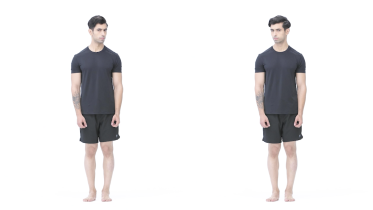 Neck rotation
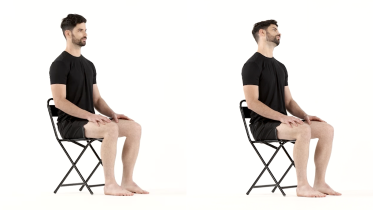 Neck side bend
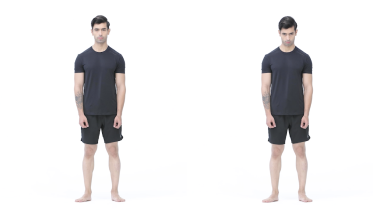 Neck flexion and extension
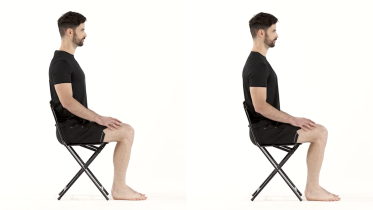 Chin tuck
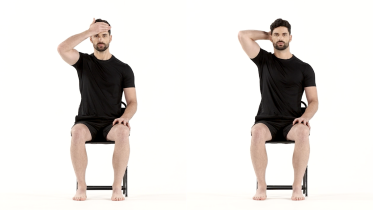 Neck isometric exercises
Stage 2: Build control and ease tight spots
When your neck moves more freely, which takes a few days for some people and a few weeks for others. The deep neck flexor exercise trains the small muscles at the front of the neck, and wall angels and the band row start the work for the muscles around your shoulder blades. The stretches are for the side of the neck and the top of the shoulder. Use them for comfort alongside the strength work, not instead of it. Leave out the scalene stretch if it brings on tingling in your arm or hand, or makes you dizzy.
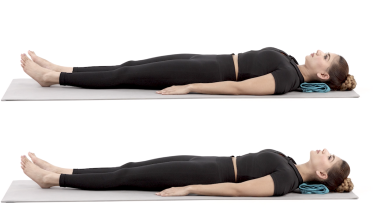 Deep neck flexor exercise
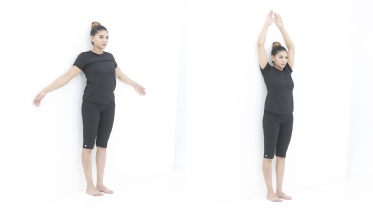 Wall angels
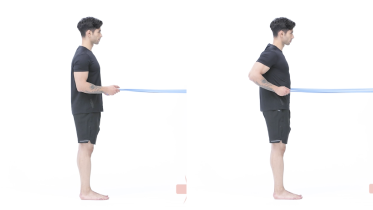 Resistance band row
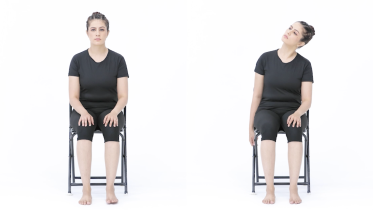 Upper trapezius stretch
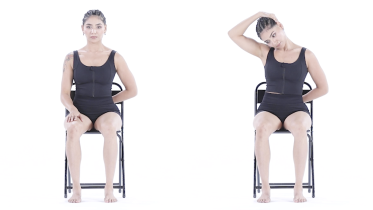 Levator scapulae stretch
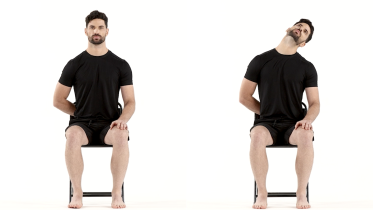 Scalene stretch
Stage 3: Build strength and endurance
For neck pain that keeps coming back, or when you want your neck and shoulders to cope with long days at a desk, driving, lifting or sport. These work the muscles between and below your shoulder blades harder. Keep the band row from stage 2 going. The Y and T raises are done lying face down with your forehead on a small folded towel, and your head stays down while the arms lift.
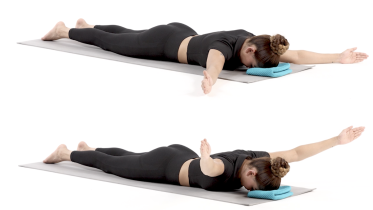 Prone Y raise
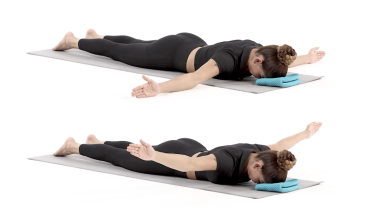 Prone T raise
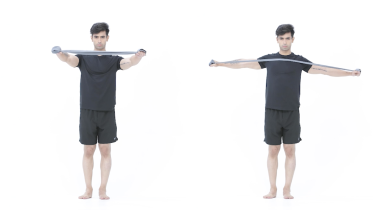 Band pull-apart
What to avoid or change
Skip the neck collar. The NHS advises against one for everyday neck pain because it is better to keep your neck moving. Until you can turn your head properly, do not drive or cycle. You need to be able to check over your shoulder. At a desk, the simplest change is to avoid staying in one position for too long: get up every so often, do a few of the stage 1 movements, then carry on.
This program is not meant for neck pain that started after an accident or a fall, such as whiplash, or for the months after neck surgery. It is also not the right starting point if your main problem is pain traveling down one arm with numbness or tingling, which can mean an irritated nerve in the neck (cervical radiculopathy). Those need an assessment first.
If you have rheumatoid arthritis, or you have been told the spaces around the nerves or spinal cord in your neck are narrowed, check with your physio or doctor before you start. Some movements, such as tipping your head right back or pushing a stretch to the end of the range, may need to be changed or left out.
When to see a physio or doctor
See a physio or doctor if your neck pain or stiffness has not gone away after a few weeks, if painkillers have not helped, or if you are worried about it. The NHS also advises getting checked if you have other symptoms, such as pins and needles or a cold arm. Get help, too, if the pain keeps coming back or stops you working or sleeping. The warning signs below need faster help.
For physiotherapists
This page gives patients a starting framework, not a full plan. The 2017 JOSPT guideline groups neck pain by impairment (mobility deficits, movement coordination impairments, headache, radiating pain) and by stage, and its exercise and manual therapy recommendations differ between those groups. It also asks clinicians to look for serious pathology, including infection, cancer, cardiac involvement, arterial insufficiency, upper cervical ligamentous insufficiency, unexplained cranial nerve dysfunction and fracture, and to refer as needed.
The IFOMPT cervical framework (Rushton 2023) sets out a clinical reasoning approach for vascular pathology of the neck before planned treatment. The full framework document (IFOMPT 2020, updated 2023) lists the reported features. They include headache and neck pain, visual disturbance, dizziness, unsteadiness, nausea and ptosis, paresthesia in the limbs or face, and problems with speech or swallowing. A 2025 review notes that headache or neck pain was the only symptom in about 8% of one large series of cervical artery dissections, and advises considering dissection in a new, unusual headache (Doukhi 2025).
Davies and colleagues advise prompt specialist referral for suspected degenerative cervical myelopathy, because a late diagnosis can leave lasting symptoms. The Finucane 2020 red flags framework points out that high-quality evidence for the diagnostic accuracy of most red flags is lacking, so they work best as prompts for clinical reasoning rather than as a checklist. For outcomes, the JOSPT guideline recommends a validated self-report questionnaire at baseline and again to track change. The Neck Disability Index (Vernon 1991) is one widely used option.
See a doctor promptly if
- Emergency: any sign of a stroke, even if it goes away. That means a face that droops on one side, an arm you cannot lift or keep up, slurred or muddled speech, weakness or numbness on one side of your body or face, sudden blurred vision, double vision or loss of sight, trouble swallowing, sudden dizziness with unsteadiness or falling over, a sudden severe headache, or a sudden fall where your legs give way but you do not black out (a drop attack). Call emergency services straight away. With neck pain, these can rarely come from a tear in an artery in the neck.
- Emergency: a new headache, or new pain on one side of your face, jaw or neck, with a drooping eyelid or a smaller pupil on the same side, or with a new pulsing or whooshing sound in one ear that keeps time with your heartbeat. Call emergency services or go to an emergency department straight away, and do not drive yourself. This can be a tear in an artery in the neck (cervical artery dissection), which can lead to a stroke.
- Emergency: a sudden, severe headache or neck pain that feels new and unlike anything you have had before. Call emergency services straight away.
- Dizziness, a spinning feeling or feeling sick that comes on when you turn or tip your head, without any of the emergency signs above. Stop the exercises and get medical advice the same day. If you faint, it does not settle within a few minutes of sitting still, or you cannot stand or walk steadily, call emergency services.
- Emergency: neck pain straight after a high-energy accident, such as a crash at high speed, a car that rolled over, being thrown from a vehicle, being hit by a vehicle while walking or cycling, a motorbike or quad bike accident, a horse riding accident, a diving injury, or a fall from a height or down several stairs. Keep still and call emergency services. If the neck pain only starts later and nobody has checked your neck since, go to an emergency department straight away, and do not drive yourself.
- Emergency: in the first days after the accident, numbness, tingling, pins and needles or weakness in your arms or legs, or a sudden electric shock feeling in your neck and back that runs into your arms or legs. If it starts straight after the accident, keep still and call emergency services. If it starts later, call emergency services or go to an emergency department straight away, and do not drive yourself.
- Emergency: a stiff neck with a fever, a severe headache that is getting worse, pain when you look at bright lights, confusion, or a rash that does not fade when you press a glass on it. Call emergency services. These can be signs of meningitis.
- Emergency: neck, jaw or arm pain that comes with chest pain, shortness of breath, sweating or feeling sick. Call emergency services.
- Emergency: new problems walking, for example your legs feel stiff, heavy or weak or you have become unsteady on your feet, new trouble controlling your bladder or bowels, or hands that suddenly become clumsy, for example you can no longer do up buttons. Call emergency services straight away. These can be signs of pressure on the spinal cord in the neck.
- Hands that have slowly become clumsy, for example trouble doing up buttons or dropping things, or numbness in both hands. Get medical advice the same day. These can be signs of pressure on the spinal cord in the neck (cervical myelopathy). If the clumsiness or numbness gets worse quickly, call emergency services straight away.
- Pain or tingling in both arms at the same time, rather than in one. Get medical advice the same day. This can also be a sign of pressure on the spinal cord in the neck.
- An arm or hand that is getting weaker. Get medical advice the same day.
- Severe neck or arm pain that comes on suddenly or is getting worse quickly, without any of the emergency signs above. Get medical advice the same day.
- Neck pain with a fever or chills, or you feel generally unwell. Get medical advice the same day, and go to an emergency department if you feel very unwell.
- New, frequent headaches with pain or tenderness at your temples or on your scalp, or jaw pain when you eat or talk. Get medical advice the same day. These can be signs of inflamed arteries in the head (temporal arteritis, also called giant cell arteritis). If your vision changes, call emergency services.
- New neck pain and you have had cancer, now or in the past, or you have lost weight without trying. Get medical advice the same day and mention it. If you are being treated for cancer now, contact your cancer team the same day.
- Emergency: you have had cancer, now or in the past, and your back or neck pain feels like a tight band around your body, or comes with pain spreading down an arm or leg, weakness, numbness or pins and needles in your arms or legs, trouble walking, or trouble controlling your bladder or bowels. Call your cancer team's emergency number straight away, or go to an emergency department if you do not have one or cannot get through. This can be cancer pressing on the spinal cord (metastatic spinal cord compression), which needs treatment straight away.
- Pain that is there all the time and does not ease with rest or changing position, or pain at night that keeps getting worse. See your doctor within a few days. If you have had cancer, now or in the past, or you have lost weight without trying, get medical advice the same day. If you are being treated for cancer now, contact your cancer team the same day.
- Emergency: new neck or back pain after a fall, a knock or a jolt, even a minor one such as a trip or a sudden stop in a car, if you have a condition that stiffens the spine, such as ankylosing spondylitis. Call emergency services or go to an emergency department straight away, do not drive yourself, and tell the staff about your spine condition, so they keep your neck and back in their usual position. A stiff spine can break after a small injury, and the break is easy to miss at first. If the pain started straight after the injury, or you also have numbness, tingling or weakness in your arms or legs, keep still and call emergency services.
- Neck pain after a car accident or a fall, even a minor one, if you are 65 or older, have low bone density (osteoporosis) or have taken steroid tablets for a long time. Get your neck checked by a doctor the same day, for example at an emergency department, before you start these exercises. At 65 or older, doctors usually want an X-ray or scan of the neck after an accident.
- You have rheumatoid arthritis and get new neck pain, or a new headache at the back of your head that keeps coming back. If it comes with tingling or numbness in your hands or arms, get medical advice the same day. If you also feel unsteady on your feet or your legs feel stiff, heavy or weak, call emergency services straight away. Without any of those, tell your doctor or rheumatology team within a few days, and leave out any neck exercises until you have been checked.
Common questions
How long does neck pain last?
The NHS says most neck pain only lasts a few weeks. For some people it lasts longer or keeps coming back. If your neck has not eased after a few weeks, or painkillers have not helped, see a physio or doctor.
Should I wear a neck collar for neck pain?
For everyday neck pain, no. The NHS advises against wearing a neck collar because it is better to keep your neck moving. A collar is sometimes used for other reasons, for example after an injury or surgery, and then your doctor or physio will guide you.
What is the best pillow for neck pain?
The NHS suggests a low, firm pillow, a firm mattress, and keeping your head at the same height as the rest of your body while you sleep, rather than propped up or dropping down. It also advises against sleeping on your front. Lying face down keeps your head turned to one side for hours.
Do I need an X-ray or MRI for neck pain?
Usually not. A review of neck pain guidelines from around the world found that several advised against routine X-rays for neck pain of recent onset (Parikh 2019). Scans also pick up changes in people with no pain at all. In a study of 1,211 adults with no neck symptoms, 87.6% had bulging discs on MRI, including most people in their 20s (Nakashima 2015). A scan is arranged when a doctor suspects a serious cause or pressure on a nerve or the spinal cord.
Should neck exercises hurt?
Mild aching or a stretching feeling in the neck and shoulders is common and usually fine if it settles within a day and is not building up from week to week. Stop and tell your physio if pain, numbness or pins and needles spread into your arm or hand. If you feel dizzy or sick, or your vision changes, stop and get medical advice the same day. If any of the emergency warning signs on this page appear, call emergency services. Your physio will help you find the right level.
Can neck pain cause headaches?
Yes. The JOSPT neck pain guideline treats neck pain with headache (cervicogenic headache) as its own group. It recommends active mobility exercise early on, and later a mix of hands-on treatment with neck and shoulder stretching, strengthening and endurance exercise. A sudden, severe or unusual headache is different: see the warning signs on this page.
References
- Blanpied PR, Gross AR, Elliott JM, et al. Neck pain: revision 2017. Clinical practice guidelines linked to the International Classification of Functioning, Disability and Health from the Orthopaedic Section of the American Physical Therapy Association. Journal of Orthopaedic and Sports Physical Therapy. 2017;47(7):A1-A83. https://doi.org/10.2519/jospt.2017.0302
- Gross A, Kay TM, Paquin JP, et al. Exercises for mechanical neck disorders. Cochrane Database of Systematic Reviews. 2015;(1):CD004250. https://doi.org/10.1002/14651858.CD004250.pub5
- Parikh P, Santaguida P, Macdermid J, Gross A, Eshtiaghi A. Comparison of CPG's for the diagnosis, prognosis and management of non-specific neck pain: a systematic review. BMC Musculoskeletal Disorders. 2019;20:81. https://doi.org/10.1186/s12891-019-2441-3
- GBD 2021 Neck Pain Collaborators. Global, regional, and national burden of neck pain, 1990-2020, and projections to 2050: a systematic analysis of the Global Burden of Disease Study 2021. The Lancet Rheumatology. 2024;6(3):e142-e155. https://doi.org/10.1016/S2665-9913(23)00321-1
- Nakashima H, Yukawa Y, Suda K, Yamagata M, Ueta T, Kato F. Abnormal findings on magnetic resonance images of the cervical spines in 1211 asymptomatic subjects. Spine. 2015;40(6):392-398. https://doi.org/10.1097/BRS.0000000000000775
- Davies BM, Mowforth OD, Smith EK, Kotter MR. Degenerative cervical myelopathy. BMJ. 2018;360:k186. https://doi.org/10.1136/bmj.k186
- Doukhi D, Debette S, Mawet J. Headaches attributed to cranial and cervical artery dissections. The Journal of Headache and Pain. 2025;26(1):28. https://doi.org/10.1186/s10194-025-01958-9
- Rushton A, Carlesso LC, Flynn T, et al. International framework for examination of the cervical region for potential of vascular pathologies of the neck prior to musculoskeletal intervention: International IFOMPT Cervical Framework. Journal of Orthopaedic and Sports Physical Therapy. 2023;53(1):7-22. https://doi.org/10.2519/jospt.2022.11147
- Rushton A, Carlesso LC, Flynn T, et al. International framework for examination of the cervical region for potential of vascular pathologies of the neck prior to orthopaedic manual therapy (OMT) intervention: International IFOMPT Cervical Framework. IFOMPT. 2020, with 2023 addendum. https://www.ifompt.org/wp-content/uploads/2026/09/IFOMPT-cervical-framework-final-2020-Add-2023.pdf
- Finucane LM, Downie A, Mercer C, et al. International framework for red flags for potential serious spinal pathologies. Journal of Orthopaedic and Sports Physical Therapy. 2020;50(7):350-372. https://doi.org/10.2519/jospt.2020.9971
- Vernon H, Mior S. The Neck Disability Index: a study of reliability and validity. Journal of Manipulative and Physiological Therapeutics. 1991;14(7):409-415. https://pubmed.ncbi.nlm.nih.gov/1834753/
- NHS. Neck pain. https://www.nhs.uk/symptoms/neck-pain-and-stiff-neck/
- NHS. Symptoms of a stroke. https://www.nhs.uk/conditions/stroke/symptoms/
- NHS. Meningitis. https://www.nhs.uk/conditions/meningitis/
- NHS. Temporal arteritis. https://www.nhs.uk/conditions/temporal-arteritis/
Written and checked by the PocketPhysio editorial team. Last updated 2026-09-28.
This page is general education, not a diagnosis or a personal treatment plan. See a physiotherapist or doctor for advice about your own situation.