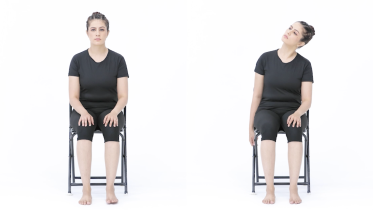
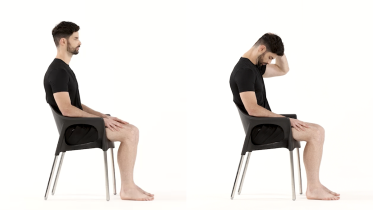
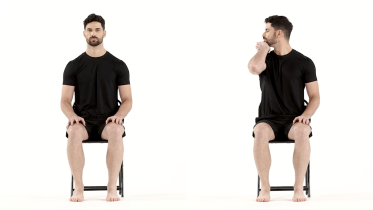
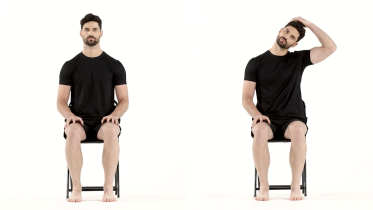
Neck flexion and extension
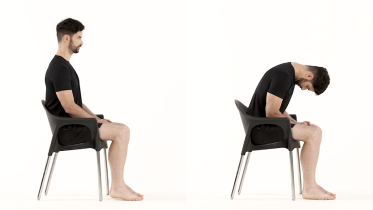
Neck flexion and extension means slowly bending your head forward toward your chest, then tipping it back to look up. It takes the neck through its forward and backward range (flexion and extension), and physios often give it for a stiff neck.
How to do the neck flexion and extension
- Stand tall with your back straight, feet about shoulder width apart and arms relaxed by your sides.
- Start with your head level and your eyes looking straight ahead.
- Slowly bend your head forward, chin moving toward your chest, only as far as feels comfortable.
- Come back up to the level starting position.
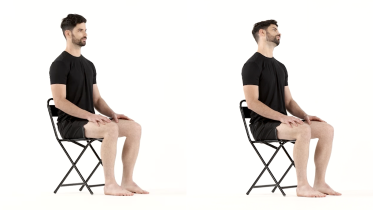
- Slowly bend your head back to look upward, again only as far as feels comfortable, then return to level.
What you should feel
Easy movement in the neck. A mild stretch at the back of the neck as you look down, and at the front as you look up.
Common mistakes
- Moving quickly or bouncing at the end of the movement.
- Letting the head drop back as far as it will go. Stop at a comfortable point.
- Rounding the shoulders or swaying the back. The movement comes from the neck, and the body stays still.
How often
Often 10 to 15 slow repetitions, once or several times a day. Some people use it as a break from desk work. Your physio will say how many suit you.
Stop and check with your physio if
- You feel dizzy, faint or unsteady. Stop and get medical advice the same day. If you faint, it does not settle within a few minutes of sitting still, or you cannot stand or walk steadily, call emergency services.
- Things look double, your vision suddenly blurs or goes, your speech slurs or becomes muddled, swallowing becomes hard, your face or lips go numb, one side of your face droops or one side of your body goes weak or numb, you suddenly become so dizzy or unsteady that you fall or cannot stand or walk, your legs suddenly give way but you do not black out (a drop attack), or you get a sudden severe headache. Stop and call emergency services, even if it goes away.
- Pain, pins and needles or numbness moves down into an arm or hand.
- The neck catches or hurts sharply at any point in the movement.
- An electric shock feeling runs down your back or into your arms or legs as your head bends forward. Stop and get medical advice the same day.
From the clinic
Start slow and small. The video shows an easy, partial range in both directions, and that is a good place to begin. You do not need your full range on the first repetition, and a stiff neck often moves a bit more by the fifth or sixth.
Looking up is the part that bothers people most. If a neck movement makes you dizzy, stop, sit still until it settles, and get medical advice the same day before you try again. It can also be done sitting in a chair if standing is awkward for you. For turning the head side to side, see neck rotation.
After neck surgery or a broken bone in the neck, check with your surgeon or physio before you start. The neck is often kept still for a while at first.
Reviewed by the PocketPhysio by VirtueLife expert physiotherapy team. Last reviewed 2026-09-25.
This page is general education, not a diagnosis or a personal treatment plan. If you have pain, an injury or a health condition, see a physiotherapist or doctor before starting new exercises.