
Torticollis in adults (wry neck): exercises and what to expect
Warning signs, and when to get help
What is torticollis in adults?
Torticollis is the medical word for a neck held twisted or tilted to one side. In the UK, Australia and New Zealand you are more likely to hear it called a wry neck. healthdirect Australia describes it as the neck muscles going into spasm or cramp, which causes pain and stiffness and can twist the neck to one side.
In adults the word covers two very different situations, and sorting out which one you have is the first thing this page is for.
The common one is sudden. You wake up with it, or you turn quickly and something catches, and now your head sits slightly tilted and will not turn one way at all. It hurts, it came from nothing much, and it eases over days. That is what most people mean by a wry neck, and the clinical name is acute torticollis.
The other one is slow. The head pulls into a position by itself over weeks or months, it may come with tremor or with the shoulder lifting, and pain is not always the main complaint. That is cervical dystonia, and it is a neurological condition rather than a muscle that has cramped. The NHS describes dystonia as uncontrolled and sometimes painful muscle spasms, lists cervical dystonia as the form affecting the neck only, and says it can start at any age.
Acute torticollis: what the first days usually look like
The movement loss is one-sided and specific, which is what makes it so recognizable. Turning toward the painful side is usually what is blocked, side bending away from it pulls, and the head finds one position it is comfortable in and refuses to leave it. Reversing out of a parking space is the moment most people discover how limited they are.
The pain often sits in the muscle on one side and up into the base of the skull. Many people get a headache with it. Swelling is not part of this, and neither is pain running into the arm: pins and needles or weakness down one arm points at a nerve in the neck instead, and the warning signs below cover it.
Over the first two or three days the guarding is usually the biggest problem, not the tissue. The neck is holding itself still, the muscle on one side is working flat out to protect it, and that is why gentle movement does more than rest. The day-by-day self care, from heat and cold to pain relief and sleeping position, is set out on stiff neck after sleeping, which is the sister page to this one. There is no sense in reading two versions of it, so this page keeps to the condition, its course and the things that look like it.
Is it safe to move a neck that has locked?
For an ordinary wry neck with none of the warning signs below, yes, and it is the single most useful thing you can do. healthdirect advises staying active and moving the neck as normally as possible. Stay inside the range that is comfortable or only mildly uncomfortable, go slowly, and let the range grow by itself over the following days.
What is not safe is having an irritable neck cracked or thrust-manipulated by somebody who has not examined it, and that includes doing it yourself. The emergency warning signs below include a pattern that can follow neck manipulation, and the reason it is written out at that length is that a tear in an artery in the neck can begin as pain alone with nothing else to find.
Two situations change the answer completely. If your neck pain followed an accident, a fall or a knock to the head, get it checked before you do any of this. And if you are 65 or over, have low bone density or have taken steroid tablets long term, new neck pain after even a minor fall needs a same-day check first.
How long does torticollis in adults last?
healthdirect Australia puts the usual course at 7 to 10 days, depending on the cause, and advises seeing a doctor if the pain is getting worse or has not improved by then. That is the clearest sourced figure available for this condition, and it is worth knowing how thin the ground around it is. The clinic pages that fill the search results for this condition publish timeframes ranging from a couple of days to several weeks, and not one of them names a source.
Two studies of acute neck pain more broadly are worth knowing about, with the caveat that neither was about torticollis specifically. A meta-analysis of seven studies of acute neck pain with no identified cause found average pain falling from 64 to 35 on a 100 point scale by about six and a half weeks, and then creeping back up to 42 by twelve months. Its authors titled the paper "Prognosis of acute idiopathic neck pain is poor" for that reason (Hush and colleagues, 2011). In a Norwegian population study of 219 people with a new episode of neck or low back pain, neck pain improved in the first month and then changed very little over the year, and only about one in five sought any care at all (Vasseljen and colleagues, 2013).
Put together, those say something useful. A single wry neck usually does settle in a week or two. A neck that keeps hurting or keeps locking up is not something to wait out, because waiting is not what resolves it.
Torticollis in adults treatment: what helps and what does not
Gentle movement, warmth, over-the-counter pain relief if you need it to move, and time are the core of it, and healthdirect lists heat and gentle massage, staying active, and pain relief or muscle relaxants from a clinician among the options. For an ordinary wry neck, that is most of the answer.
Collars are the thing people most often get wrong. The NHS advises against wearing one, because keeping the neck moving is better, unless a doctor has told you otherwise. You will find pages telling you to wear a soft collar for no more than 48 hours. We cannot trace that figure to a document that produced it, so this page does not give it as advice.
Exercise has a better evidence base for necks in general than for wry neck in particular. The Cochrane review of exercise for mechanical neck disorders found no high-quality evidence overall, with the more consistent results coming from strengthening and endurance work rather than stretching alone (Gross and colleagues, 2015). Read the small print on that review: for acute neck pain it found no trials at all, and its moderate-quality findings are in people whose neck pain has lasted months. So the staging below, from movement to control to strength, is reasoned from the general neck evidence rather than demonstrated for a neck that locked up this week.
Botulinum toxin and surgery turn up in searches for this condition, and it is worth being clear about which torticollis they are for. healthdirect does list botulinum toxin injections, a collar and surgery for torticollis, in the places where other treatments have not worked, and it is writing about all three types at once, including the long-term kind that slowly gets worse. The NHS describes the same injections, given into the affected muscles and repeated about every 3 months, as a treatment for dystonia. Neither belongs to a neck that locked up this week. If that is what you were searching for, the referral you want is neurological rather than a neck exercise program.
When a twisted neck is not a wry neck
Most of the time a locked neck is exactly what it looks like. The list below is short, but each item on it has turned up in the published case reports as a neck that was first treated as a simple wry neck.
An infection at the back of the throat or in the neck can hold the head to one side, and it comes with a sore throat, painful or impossible swallowing, drooling, fever or feeling unwell. A medicine reaction can pull the neck into a sustained spasm within hours of a dose change, often with the eyes rolling up or the jaw clamping (NHS Dystonia; Marano and colleagues, 2016, a single filmed case). healthdirect also names a tumor at the back of the head or in the spine as a rare cause, which is part of why the warning signs below take night pain and a cancer history seriously.
Meningitis gives a stiff neck with fever, light hurting the eyes and a headache that builds. A tear in an artery in the neck can present as one-sided neck pain and a headache that does not feel like your usual ones. And after any accident, fall or blow to the head, a neck that will not turn is assessed for a bony injury before anything else.
If the pain is one-sided and keeps coming back to the same side, neck pain on one side works through the causes. If this followed a car accident, read whiplash first. If a headache rather than the neck is the main complaint and neck movement changes it, cervicogenic headache is the closer fit. Symptoms running into the arm belong with cervical radiculopathy.
How to use this program
Start at stage 1, on the first or second day, with the movements kept small. Move to stage 2 once the sharp block has eased and you can turn further than you could. Stage 3 is for afterward, and especially for anyone whose neck does this more than once a year.
Each exercise page gives its own starting numbers. Across this program that is mostly 5 to 10 slow repetitions several times a day for the movements, holds of 5 to 10 seconds, stretches of 20 to 30 seconds, and 2 to 3 sets of 8 to 15 for the strength work. Your physio will adjust the exercises and the numbers to your neck and to how irritable it is.
Read the warning signs at the end of this page before you start, and check them again if anything new appears. After neck surgery or a broken bone in the neck, get the go-ahead from your surgeon or physio first. The same applies if you have rheumatoid arthritis, if you have been told the spaces around the nerves or the spinal cord in your neck are narrowed, if you have Down syndrome, or if you have been told the top of your neck is unstable.
If you are pregnant, check with your midwife, doctor or physio before you start. If you are pregnant and past the first three months, check with your physio before exercising flat on your back, which is the position the deep neck flexor exercise in stage 2 is done in. These exercises were chosen for adults, so a child or teenager with a twisted or tilted neck needs their own assessment first.
The exercise program
Stage 1: Keep the neck moving in the first days
For the first few days, when turning your head to one side is blocked and painful. These are slow, small movements kept inside a comfortable range, and the range grows on its own over the following days. Expect the stiff direction to be much smaller than the other one, and do not push into the catch and hold there. Little and often beats one long session: many people do 5 to 10 slow repetitions in each direction, several times a day, and your physio will adjust this. If a neck movement makes you dizzy, stop, sit still until it settles, and get medical advice the same day before you try again. If you faint, it does not settle within a few minutes of sitting still, or you cannot stand or walk steadily, call emergency services. Call emergency services straight away for any sign of a stroke too, even if it goes away: a face that droops on one side, an arm you cannot lift or keep up, slurred or muddled speech, weakness or numbness on one side of your body or face, sudden blurred vision, double vision or loss of sight, trouble swallowing, sudden dizziness with unsteadiness or falling over, a sudden severe headache, or a sudden fall where your legs give way but you do not black out (a drop attack).
 Neck rotation
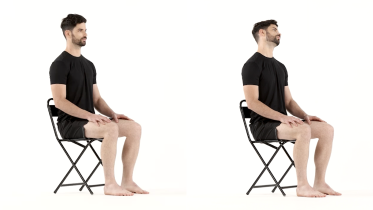 Neck side bend
 Neck flexion and extension
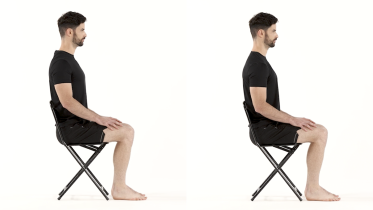 Chin tuck
Stage 2: Add control, then ease the tight spots
Start once the neck turns further and the sharp block has gone, which for most people is somewhere in the first week or two. The isometric work and the deep neck flexor exercise train the muscles that hold your head where you put it, which is the part that tends to be missing when a neck keeps locking up. The two stretches are for the top of the shoulder and the side of the neck, and they are for comfort alongside the control work rather than instead of it. Holds usually run 5 to 10 seconds and stretches 20 to 30 seconds, once or twice a day. If you have high blood pressure, breathe steadily through every hold and never hold your breath. If a stretch brings on tingling in your arm or hand, leave it out and tell your physio. If it makes you dizzy, follow the dizziness advice in stage 1.
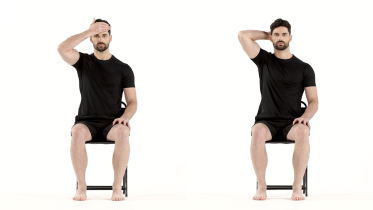 Neck isometric exercises
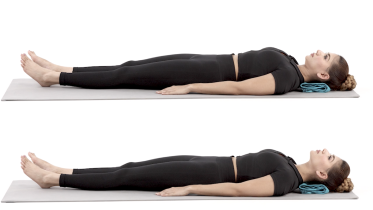 Deep neck flexor exercise
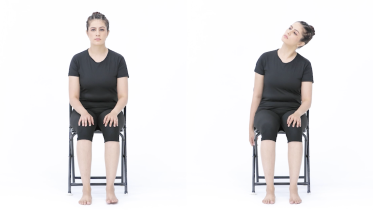 Upper trapezius stretch
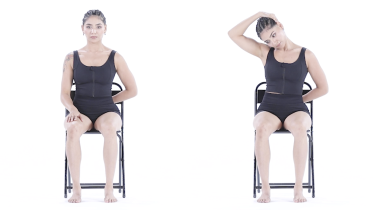 Levator scapulae stretch
Stage 3: Build strength so it is less likely to come back
For anyone whose neck locks up every few months, and for necks that have to cope with long days at a desk, driving or lifting. These work the muscles around and below the shoulder blades, which carry a share of the load your neck would otherwise take. Wall angels come first because they need nothing, then the band row, then the band pull-apart. Most people do 2 to 3 sets of 8 to 15, 2 or 3 days a week, and build the band resistance slowly. If you have high blood pressure, breathe steadily through every repetition and never hold your breath. This stage is the one people skip once the pain has gone, and it is the one that changes how often this happens.
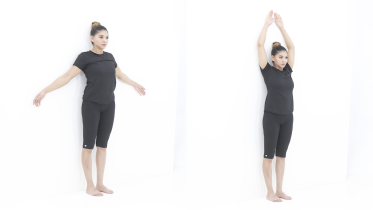 Wall angels
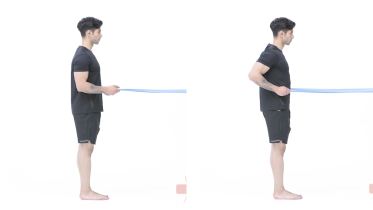 Resistance band row
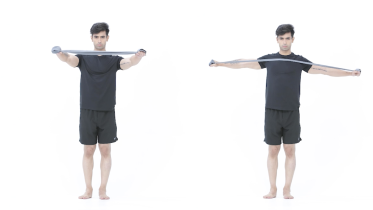 Band pull-apart
What we notice in the clinic
People come in braced. Not just the neck: the shoulder on that side is up near the ear, the jaw is clenched, and the whole upper body has stopped rotating, so they turn by moving their feet. Getting the shoulder down and the breathing slow often buys more movement in the first minute than any technique does.
Then the mirror. Almost everybody has decided their head is dramatically crooked, and almost nobody is as crooked as they think. Seeing it in a mirror takes a surprising amount of the fear out of it, which matters because fear is doing some of the holding.
The last one is the follow-up nobody books. The wry neck settles in a week, everyone is relieved, and the strength work never happens. Then it recurs in the spring. The group who stop getting these are the ones who did stage 3 after the pain had gone, when it felt least necessary.
When to see a physio or doctor
See someone if the neck has not started to free up in 7 to 10 days, if it is getting worse rather than better, or if this keeps happening every few months (healthdirect). Go sooner if you cannot turn your head far enough to drive safely, because that is a practical problem that will not solve itself by waiting.
Get medical advice the same day if symptoms travel into your arm, if an arm feels weak or numb, or if the pain is severe and nobody has looked at it. Book an appointment about a head that has been slowly pulling to one side for weeks or months, which is a different assessment altogether. The warning signs below say what needs help faster, and how fast.
For physiotherapists
This page is written for adult acute torticollis and deliberately separates it from cervical dystonia, which the search demand for this phrase mixes in: the tail carries medication and surgery, both of which belong to dystonia. The page routes long-standing involuntary posturing, with or without tremor, to a medical assessment rather than to a neck program, and routes acute drug-induced dystonic reaction to emergency care. The sourcing for that route is the NHS (medicine-induced dystonia, and the metoclopramide warning on uncontrollable movements and spasms) plus Marano and colleagues (2016), which is a single filmed case and is described on the page as one case rather than as a series. The emergency department tier is a deliberate step above the NHS 111 route, because the reaction needs a parenteral anticholinergic to settle, our readers are in countries with no 111, and the differential includes neuroleptic malignant syndrome.
Prognostic honesty matters more here than usual, because the condition has almost no literature of its own. The only sourced patient-facing figure used is healthdirect's 7 to 10 days. Hush and colleagues (2011) and Vasseljen and colleagues (2013) are cited for acute neck pain more broadly and are labelled as such on the page, since neither studied torticollis. The timeframes published by the clinic pages ranking for this phrase disagree with each other and carry no sources, and the widely repeated soft collar instruction could not be traced to an originating document, so neither appears as advice.
Program content follows the general neck evidence rather than anything torticollis-specific: early active range within tolerance, then cervical isometrics and deep cervical flexor training, then scapulothoracic strength and endurance, consistent with the direction of Gross and colleagues (2015), whose overall certainty is low. The full neck red flag set is carried, including the cervical artery dissection pair with its position-dependent same-day branch, the pre-manipulation caution, the stiff spine route and the retropharyngeal and meningitis routes. The staged neck pain program is the handover for anyone whose episodes recur.
Warning signs
Get emergency help now
- Emergency: any sign of a stroke, even if it goes away. That means a face that droops on one side, an arm you cannot lift or keep up, slurred or muddled speech, weakness or numbness on one side of your body or face, sudden blurred vision, double vision or loss of sight, trouble swallowing, sudden dizziness with unsteadiness or falling over, a sudden severe headache, or a sudden fall where your legs give way but you do not black out (a drop attack). Call emergency services straight away. With neck pain, these can rarely come from a tear in an artery in the neck.
- Emergency: a new headache, or new pain on one side of your face, jaw or neck, with a drooping eyelid or a smaller pupil on the same side, or with a new pulsing or whooshing sound in one ear that keeps time with your heartbeat. Call emergency services or go to an emergency department straight away, and do not drive yourself. This can be a tear in an artery in the neck (cervical artery dissection), which can lead to a stroke.
- Emergency: a sudden, severe headache or neck pain that feels new and unlike anything you have had before. Call emergency services straight away.
- Emergency: a new headache or neck pain, or both, that does not feel like ordinary neck pain. If this is your first bout, judge it by how it behaves rather than by how it compares. Either of the next two is enough on its own. One, it came on suddenly, in a single moment, even if it is not severe and even if it has eased since. Sudden onset counts on its own. Two, nothing you do changes it much: no position or rest makes a real difference, and after the first day or two it has not started to settle. It counts even if you have none of the other emergency signs above, and it matters more if it started after a neck injury or strain, even a minor one, a bout of heavy coughing, or having your neck manipulated. Go to an emergency department straight away, or call emergency services if you cannot get there safely, and do not drive yourself. Do not start these exercises, and do not have any hands-on treatment to your neck, until your neck has been checked. A tear in an artery in the neck can start as pain alone, often on one side, with nothing else to find. If you can find a position that eases it, follow the same day warning sign for this below instead.
- Emergency: a stiff neck with a fever, a severe headache that is getting worse, pain when you look at bright lights, confusion, or a rash that does not fade when you press a glass on it. Call emergency services. These can be signs of meningitis.
- Emergency: you cannot swallow, you are drooling because you cannot swallow, you have trouble breathing, you make a high-pitched noise as you breathe in, or your symptoms are severe and getting worse quickly. Call emergency services or go to an emergency department straight away, and do not drive yourself.
- Emergency: your neck has pulled or twisted to one side on its own within hours or days of starting, stopping or changing a medicine, especially one for sickness, reflux, dizziness or mental health, and you cannot hold your head straight. The same applies if your eyes roll upward, your jaw clamps shut, your tongue feels thick or your speech changes. Go to an emergency department straight away, taking the packet or a list of your medicines with you, and do not drive yourself. This can be a reaction to the medicine (an acute dystonic reaction), and it is treated quickly with a different medicine. If you have any trouble breathing or swallowing, or you also have a high temperature, heavy sweating or confusion, call emergency services.
- Emergency: neck pain straight after a high-energy accident, such as a crash at high speed, a car that rolled over, being thrown from a vehicle, being hit by a vehicle while walking or cycling, a motorbike or quad bike accident, a horse riding accident, a diving injury, or a fall from a height or down several stairs. Keep still and call emergency services. If the neck pain only starts later and nobody has checked your neck since, keep your neck as still as you can, do not twist or bend it, and call emergency services or go to an emergency department straight away. Do not drive yourself, and tell them what kind of accident it was, because that is one of the things that decides whether you need a scan.
- Emergency: severe neck pain after a knock to the head, whatever the fall or the knock was like. Keep still and call emergency services, and do not let anyone move you until someone trained has checked your neck. If the neck pain only starts later and nobody has checked your neck since, go to an emergency department straight away, and do not drive yourself.
- Emergency: in the first days after the accident, numbness, tingling, pins and needles or weakness in your arms or legs, or a sudden electric shock feeling in your neck and back that runs into your arms or legs. If it starts straight after the accident, keep still and call emergency services. If it starts later, call emergency services or go to an emergency department straight away, and do not drive yourself.
- Emergency: new neck or back pain after a fall, a knock or a jolt, even a minor one such as a trip or a sudden stop in a car, if you have a condition that stiffens the spine, such as ankylosing spondylitis. Call emergency services or go to an emergency department straight away, do not drive yourself, and tell the staff about your spine condition, so they keep your neck and back in their usual position. A stiff spine can break after a small injury, and the break is easy to miss at first. If the pain started straight after the injury, or you also have numbness, tingling or weakness in your arms or legs, keep still and call emergency services.
- Emergency: new problems walking, for example your legs feel stiff, heavy or weak or you have become unsteady on your feet, new trouble controlling your bladder or bowels, or hands that suddenly become clumsy, for example you can no longer do up buttons. Call emergency services straight away. These can be signs of pressure on the spinal cord in the neck.
- Emergency: neck pain with a fever, or you feel hot, shivery or very unwell, and you also have new weakness, numbness or tingling in one or both arms or legs, new trouble walking, or new trouble with your bladder or bowels. Call emergency services or go to an emergency department straight away. This can be an infection pressing on the spinal cord or nerves in the neck (spinal epidural abscess), which needs emergency treatment.
- Emergency: neck, jaw or arm pain that comes with chest pain, shortness of breath, sweating or feeling sick. Call emergency services.
- Emergency: your arm, hand or fingers turn cold, pale, blue or gray compared with the other side. Call emergency services or go to an emergency department straight away, and do not drive yourself. The blood supply to the arm may be blocked.
- Emergency: you have had cancer, now or in the past, and your back or neck pain feels like a tight band around your body, or comes with pain spreading down an arm or leg, weakness, numbness or pins and needles in your arms or legs, trouble walking, or trouble controlling your bladder or bowels. Call your cancer team's emergency number straight away, or go to an emergency department if you do not have one or cannot get through. This can be cancer pressing on the spinal cord (metastatic spinal cord compression), which needs treatment straight away.
Get help now, day or night
- You have rheumatoid arthritis and get new neck pain, or a new headache at the back of your head that keeps coming back. If it comes with tingling or numbness in your hands or arms, get medical advice the same day. If you also feel unsteady on your feet or your legs feel stiff, heavy or weak, call emergency services straight away. Without any of those, tell your doctor or rheumatology team within a few days, and leave out any neck exercises until you have been checked.
Get help today
- A new headache or neck pain, or both, that does not feel like ordinary neck pain, that started after a neck injury or strain, even a minor one, a bout of heavy coughing, or having your neck manipulated, but that does ease when you change position or rest. Get checked the same day before you start these exercises or have any hands-on treatment to your neck. If nothing you do changes it much any more, or it has not started to settle after a day or two, follow the emergency warning sign for this above.
- Neck pain after a car accident or a fall, even a minor one, if you are 65 or older, have low bone density (osteoporosis) or have taken steroid tablets for a long time. Get your neck checked by a doctor the same day, for example at an emergency department, before you start these exercises. At 65 or older, doctors usually want an X-ray or scan of the neck after an accident.
- Neck pain that makes swallowing very hard, a sore throat or pain when you swallow alongside the neck pain, or swollen glands in your neck with a very high temperature or feeling hot, cold or shivery. Get medical advice the same day, for example an urgent appointment with your doctor.
- Neck pain with a fever or chills, or you feel generally unwell. Get medical advice the same day, and go to an emergency department if you feel very unwell.
- Hands that have slowly become clumsy, for example trouble doing up buttons or dropping things, or numbness in both hands. Get medical advice the same day. These can be signs of pressure on the spinal cord in the neck (cervical myelopathy). If the clumsiness or numbness gets worse quickly, call emergency services straight away.
- Pain or tingling in both arms at the same time, rather than in one. Get medical advice the same day. This can also be a sign of pressure on the spinal cord in the neck.
- An electric shock feeling runs down your back or into your arms or legs as your head bends forward. Stop and get medical advice the same day.
- Pins and needles in an arm together with neck or arm pain, or an arm that feels heavy or weak, and nobody has checked it yet. Get medical advice the same day.
- An arm or hand that is getting weaker. Get medical advice the same day.
- Severe neck or arm pain that comes on suddenly or is getting worse quickly, without any of the emergency signs above. Get medical advice the same day.
- Dizziness, a spinning feeling or feeling sick that comes on when you turn or tip your head, without any of the emergency signs above. Stop the exercises and get medical advice the same day. If you faint, it does not settle within a few minutes of sitting still, or you cannot stand or walk steadily, call emergency services.
- New, frequent headaches with pain or tenderness at your temples or on your scalp, or jaw pain when you eat or talk, or, if you are 50 or over, a temple or scalp that has become tender to touch, for example when you brush your hair or rest your head on a pillow. Get medical advice the same day. These can be signs of inflamed arteries in the head (temporal arteritis, also called giant cell arteritis). If your vision changes, call emergency services.
- New neck pain and you have had cancer, now or in the past, or you have lost weight without trying. Get medical advice the same day and mention it. If you are being treated for cancer now, contact your cancer team the same day.
- Pain that is there all the time and does not ease with rest or changing position, or pain at night that keeps getting worse. If you have had cancer, now or in the past, or you have lost weight without trying, get medical advice the same day.
- Same day: a baby or child has a neck that is twisted or tilted to one side, or will not turn their head one way. Get an urgent appointment with a doctor the same day. If they also have a fever or a sore throat, are drooling more than usual, cannot swallow, have trouble breathing, or seem very unwell or hard to settle, go to an emergency department. This page is for adults, and a twisted neck in a child has its own causes, including infection in the throat or neck.
Book an appointment
- Pain that is there all the time and does not ease with rest or changing position, or pain at night that keeps getting worse. See your doctor within a few days.
- Within a few days: the neck has not started to free up, or it is going backwards rather than forwards. Book an appointment with a doctor or physio. healthdirect Australia advises seeing a doctor if neck pain is getting worse or has not improved after 7 to 10 days.
- Within 2 weeks: your head has been slowly pulling, tilting or turning to one side over weeks or months, it happens without you meaning it to, or the pulling comes with a tremor or with your shoulder lifting on that side. Book an appointment with your doctor and ask about a referral. This is not the same as a neck that locked overnight, and a long-standing twist is assessed differently (cervical dystonia).
Common questions
How long does acute torticollis last?
healthdirect Australia puts the usual course at 7 to 10 days, depending on the cause, and advises seeing a doctor if the pain is getting worse or has not improved by then. Treat that as a yardstick rather than a promise, because the figures published on clinic websites for this condition vary from a couple of days to several weeks and none of them cites a source. Watch the direction of travel instead: a little more movement each day, even while it still hurts, is the pattern you want. Standing still for more than a week, or going backwards, is the reason to be seen.
Should I rest my neck or move it?
Move it, gently and often, inside the range you can manage. healthdirect advises staying active and moving the neck as normally as possible, with heat and gentle massage for comfort. Resting a locked neck feels right and tends to prolong the guarding. The first few days, including heat, cold, pain relief and sleeping position, are covered in detail on stiff neck after sleeping, so read that alongside this page.
Should I wear a neck collar for a wry neck?
Not for an ordinary wry neck. The NHS advises against wearing a collar because keeping the neck moving is better, unless a doctor has told you otherwise. healthdirect lists a collar or brace among the treatments a clinician might use, which is not the same as a reason to buy one yourself. You will find instructions online telling you to wear one for no more than 48 hours, and we have not been able to trace that instruction to a document that produced it, so it is not advice this page gives.
Can I drive with torticollis?
Not until you can check over both shoulders. That is the practical test, and it matters more than the pain level, because the movement you cannot make is the one driving needs. The NHS advises against anything that could be dangerous while your neck will not move. If you are nowhere near being able to turn your head after a few days, that is also a reason to be seen rather than to wait it out.
Can torticollis come back in adults?
Yes, and for some people it comes back every few months. That pattern is the reason stage 3 of the program exists. There is no trial showing that strength work prevents another episode of wry neck specifically, but the Cochrane review of exercise for mechanical neck disorders found the more consistent results came from strengthening and endurance work rather than from stretching alone (Gross and colleagues, 2015), and that is what we build on. Those findings are in people with long-standing neck pain; the same review found no trials in acute neck pain. If this keeps happening, the useful conversation is about neck and shoulder strength and what your days ask of your neck.
What is the difference between a wry neck and cervical dystonia?
Timing and behavior. A wry neck arrives suddenly, hurts, blocks movement in one direction and settles over days to a couple of weeks. Cervical dystonia is a long-term condition in which muscles pull the head into a position on their own, often slowly getting worse, and it can come with tremor. The NHS describes dystonia as uncontrolled and sometimes painful muscle spasms that can start at any age, and lists botulinum toxin injections into the affected muscles, repeated about every 3 months, among the treatments. If your head has been pulling to one side for weeks or months, that is the assessment to ask for.
Can a medicine cause torticollis?
It can, and this one is urgent. Some medicines, particularly those used for sickness and for mental health conditions, can cause the neck and other muscles to pull into a sustained spasm within hours or days of a dose being started or changed. The NHS lists anti-sickness and antipsychotic medicines among the causes of dystonia, and says of metoclopramide, a common anti-sickness medicine, that uncontrollable movements, stiffness and spasms can start as soon as you begin taking it. Marano and colleagues (2016) filmed and described the whole course of one such reaction, to metoclopramide, in an emergency room. It is treated with a different medicine rather than with exercises, so a neck that twisted on its own soon after a medicine change goes to an emergency department, with your medicines or a list of them, as the warning signs on this page say.
References
- healthdirect Australia. Torticollis (wry neck). Last reviewed March 2026. https://www.healthdirect.gov.au/torticollis
- NHS. Neck pain and stiff neck. https://www.nhs.uk/symptoms/neck-pain-and-stiff-neck/
- NHS. Dystonia. Page last reviewed 16 May 2024. https://www.nhs.uk/conditions/dystonia/
- NHS. Metoclopramide: an anti-sickness medicine. Page last reviewed 11 August 2026. https://www.nhs.uk/medicines/metoclopramide/
- Marano M, di Biase L, Salomone G, Di Santo A, Montiroli A, Di Lazzaro V. The clinical course of a drug-induced acute dystonic reaction in the emergency room. Tremor and Other Hyperkinetic Movements. 2016;6:436. https://doi.org/10.7916/D87P8ZS1
- Gross A, Kay TM, Paquin JP, et al. Exercises for mechanical neck disorders. Cochrane Database of Systematic Reviews. 2015;(1):CD004250. https://doi.org/10.1002/14651858.CD004250.pub5
- Hush JM, Lin CC, Michaleff ZA, Verhagen A, Refshauge KM. Prognosis of acute idiopathic neck pain is poor: a systematic review and meta-analysis. Archives of Physical Medicine and Rehabilitation. 2011;92(5):824-829. https://doi.org/10.1016/j.apmr.2010.12.025
- Vasseljen O, Woodhouse A, Bjørngaard JH, Leivseth L. Natural course of acute neck and low back pain in the general population: the HUNT study. Pain. 2013;154(8):1237-1244. https://doi.org/10.1016/j.pain.2013.03.032
- NHS. Meningitis. https://www.nhs.uk/conditions/meningitis/
- NHS. Symptoms of a stroke. https://www.nhs.uk/conditions/stroke/symptoms/
- NHS. Cervical spondylosis. Page last reviewed 2 August 2023. https://www.nhs.uk/conditions/cervical-spondylosis/
Written and checked by the PocketPhysio editorial team. Last updated 2026-10-27.
This page is general education, not a diagnosis or a personal treatment plan. See a physiotherapist or doctor for advice about your own situation.