
Neck pain on one side: what causes it and what to do
Does the side you feel it on matter?
Very little. Left and right are built the same: the same muscles running from the skull to the shoulder blade, a pair of small joints at the back of every level of the neck, and nerve roots leaving at matching heights. No clinical guideline separates left-sided from right-sided neck pain, and everything below can happen on either.
One-sided is the normal shape of neck pain, not an unusual one. It does not mean a bone has slipped or that your neck is out of alignment. A physio will want to know when it started, what makes it worse over a day, whether anything runs into the arm, and what else has changed in your health since.
What causes neck pain on one side?
Read the headings below as possibilities, never as a diagnosis. None of them can be confirmed from a description alone, and two can be true at the same time.
An overworked or strained muscle
The muscles along the side and back of the neck spend all day holding your head up, and they do it in whatever position you put them in: bent over a laptop, turned toward a second screen, or with a bag hanging off one shoulder. Among the everyday causes of neck pain, the NHS names an awkward sleeping position and long stretches sitting at a desk. This group aches more than it stabs. It feels tender when you press along the top of the shoulder, builds through a long day and eases once you get moving.
It seldom lasts. Keep the neck moving inside a comfortable range, which is what the NHS advises, and most ordinary neck pain settles within a few weeks. The neck pain program is the staged exercise route.
Waking with the neck locked to one side
Some people go to bed fine and wake with the neck jammed, unable to turn one way without a sharp catch. Acquired torticollis, or wry neck, is the name healthdirect Australia gives it, and the site notes it can follow something as small as sleeping in a different position or sitting awkwardly on a flight. The head is often held slightly tilted and turned away from the painful side, and the pull comes on hard if you try to force the movement back.
It is uncomfortable, and in the mirror it can look alarming. Recovery is usually complete within 7 to 10 days according to healthdirect, which suggests a heat pack, gentle massage and keeping the neck moving in the meantime. If you woke up with it this morning, stiff neck after sleeping goes through the first days in more detail.
One of the small joints at the back of the neck
Behind each pair of vertebrae sit two facet joints, one on the left and one on the right, and they guide how far your head turns and tilts. They refer pain in a way that is reliably one sided. In a study where volunteers had these joints stimulated one at a time, each joint produced its own recognizable pattern of pain, and those patterns became charts used to predict which level was involved in patients (Dwyer and colleagues, 1990; Aprill and colleagues, 1990).
Those charts explain why a single sore joint can be felt as neck pain spreading up behind the ear, out toward the shoulder blade or across the top of the shoulder, all on the same side. They do not give you a home test, though, and no hands-on examination confirms a facet joint as the source either. That matters less than it sounds. The JOSPT guideline groups a recent episode by how the neck moves and behaves, not by which tissue is at fault, and the first treatment is much the same either way (Blanpied and colleagues, 2017).
A nerve root in the neck
When a nerve root in the neck is compressed or inflamed, the symptoms leave the neck and go down the arm. Radhakrishnan and colleagues tracked every case in Rochester, Minnesota, from 1976 to 1990 and found the rate peaked in people aged 50 to 54, with spondylosis or a disc protrusion behind roughly two thirds of them. Pain, pins and needles or numbness follow a band down one arm, sometimes reaching the thumb or the little finger, and the arm can feel weak.
That pattern is assessed differently from a sore neck, and the cervical radiculopathy program covers it. Symptoms in both arms at once, hands that have become clumsy, or an arm that is getting weaker are in the warning signs below and need checking, not exercises.
Pain shared with the shoulder
The territory between the neck and the point of the shoulder belongs to both, so a neck problem can be felt over the shoulder and a shoulder problem can ache up into the neck. One question usually separates them: which movement changes it? Neck-driven pain shifts when you turn or tilt your head. Shoulder-driven pain shifts when you lift, reach behind your back or lie on that arm at night.
If lifting the arm is the movement that hurts, the rotator cuff tendinopathy program is a better fit than a neck program. When both seem involved, a physio tests each in turn instead of guessing.
When one-sided neck pain is not coming from the neck
Some one-sided neck pain has nothing to do with muscles or joints at all. The clue is almost always a symptom that movement cannot explain.
Pain that arrives when you swallow, with a sore throat or tender lumps you can feel on that side, is behaving like an infection in the throat or the lymph glands. The NHS describes swollen glands as tender, painful lumps on each side of the neck and under the chin, and says they usually settle within 1 to 2 weeks. Glands that keep growing, have not gone down within a week, or feel hard and will not move under your fingers belong with a doctor, and so does a lump in the neck or a sore throat that will not settle.
Headache with one-sided neck pain deserves a second look. Most of the time it is a cervicogenic headache, which comes from the neck and eases as the neck eases. The exception matters: in one large series summarized by a 2025 review, headache or neck pain was the only symptom in about 8% of cervical artery dissections, and the authors advise thinking of a dissection when a headache is new and unusual (Doukhi and colleagues, 2025). A headache or neck pain that feels new and unlike anything before, or that comes with a drooping eyelid, a smaller pupil or a whooshing sound in one ear, is in the warning signs below.
What helps at home
Keep the neck moving. The NHS advises neck flexibility exercises, a low firm pillow, heat or cold packs, and paracetamol or ibuprofen, and it advises against wearing a collar because keeping the neck moving is better. Ask a pharmacist which painkiller suits you if you take other medicines.
Take the load off the sore side for a few days without protecting it for weeks. Swapping the shoulder you carry a bag on, moving the screen so you are not turned toward it, and using a headset instead of pinning a phone between ear and shoulder all remove work from the side that is complaining. When you sleep, aim to keep your head level with the rest of your body, neither propped up nor dropping down.
Do not drive until you can check over your shoulder properly. The NHS advises against anything that could be dangerous while your neck will not move, and it names driving and cycling. Do not let anyone crack or thrust-manipulate your neck while it is irritable if they have not examined it first.
Exercises for neck pain on one side
The aim is simple: range back on the stiff side, and the muscles working again on both. This is not about correcting an imbalance. The JOSPT neck pain guideline recommends neck range of motion exercise together with strengthening for the shoulder blade and arm in a recent episode, and endurance work as it goes on (Blanpied and colleagues, 2017). The Cochrane review of exercise for mechanical neck disorders found no high-quality evidence, with the most consistent signal for strengthening and endurance rather than stretching on its own (Gross and colleagues, 2015), so the stretches here are for comfort alongside the rest.
Move slowly and stay inside a range that feels comfortable or only mildly uncomfortable. The stiff side will not match the easy one at first, and it does not need to. Mild aching in the neck and shoulders afterward is common, and it is usually nothing to worry about once it has gone by the next day.
If a neck movement makes you dizzy, stop, sit still until it settles, and get medical advice the same day before you try again. Pain, numbness or pins and needles spreading into your arm or hand means stop that exercise and tell your physio. After neck surgery or a broken bone in the neck, check with your surgeon or physio before you start. If you have rheumatoid arthritis, or you have been told the spaces around the nerves or spinal cord in your neck are narrowed, check with your physio or doctor before you start.
If you have had a recent neck injury, or have been told your upper neck may be unstable, ask your physio before you use your hand to guide your head in the stretches. If your neck pain started after a recent car accident or fall, get it checked by a doctor or physio before you begin. Read the warning signs below first.
Exercises that can help
Do every exercise on both sides, even though only one hurts, because the comfortable side shows you and your physio what normal looks like for you. As a starting point, many programs use 5 to 10 slow turns and tilts to each side a few times a day, stretch holds of 15 to 30 seconds repeated 2 to 3 times on each side once or twice a day, and gentle isometric holds of 5 to 10 seconds repeated 5 to 10 times. Each exercise page gives its own numbers, and your physio will adjust this.
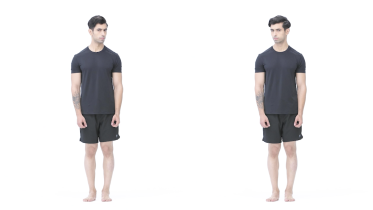 Neck rotation
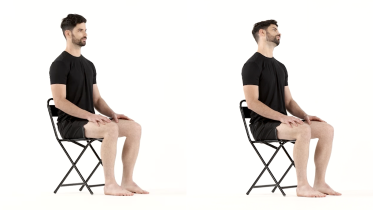 Neck side bend
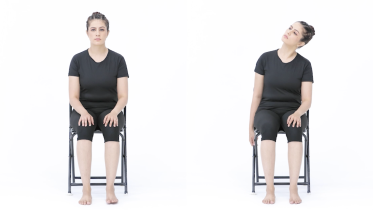 Upper trapezius stretch
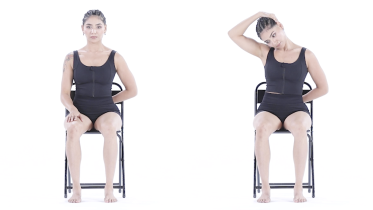 Levator scapulae stretch
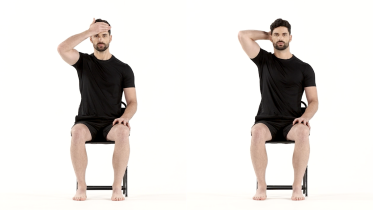 Neck isometric exercises
Build the shoulder blade work in once the neck moves more freely. The staged neck pain program adds it in order, which saves you guessing what comes next.
When to see a physio (physical therapist)
Book if the pain has not eased after a few weeks, if painkillers are not touching it, if it keeps coming back, or if it is stopping you working or sleeping (NHS). Go sooner if anything travels into the arm, if the arm feels weak or numb, or if the neck locked several days ago and has not started to free up.
An assessment for one-sided pain covers more than the sore spot. Expect the physio to measure how far your head turns and tilts each way, press along the joints and muscles on both sides, move and test the shoulder, and check the nerves in the arm if symptoms travel. That is usually enough to start treatment, which matters more than landing on a label. Several weeks of a program done properly with nothing to show for it is a reason to change the plan, not to push harder into the same exercises.
Related exercise programs
See a doctor promptly if
- Emergency: any sign of a stroke, even if it goes away. That means a face that droops on one side, an arm you cannot lift or keep up, slurred or muddled speech, weakness or numbness on one side of your body or face, sudden blurred vision, double vision or loss of sight, trouble swallowing, sudden dizziness with unsteadiness or falling over, a sudden severe headache, or a sudden fall where your legs give way but you do not black out (a drop attack). Call emergency services straight away. With neck pain, these can rarely come from a tear in an artery in the neck.
- Emergency: a new headache, or new pain on one side of your face, jaw or neck, with a drooping eyelid or a smaller pupil on the same side, or with a new pulsing or whooshing sound in one ear that keeps time with your heartbeat. Call emergency services or go to an emergency department straight away, and do not drive yourself. This can be a tear in an artery in the neck (cervical artery dissection), which can lead to a stroke.
- Emergency: a sudden, severe headache or neck pain that feels new and unlike anything you have had before. Call emergency services straight away.
- Emergency: a stiff neck with a fever, a severe headache that is getting worse, pain when you look at bright lights, confusion, or a rash that does not fade when you press a glass on it. Call emergency services. These can be signs of meningitis.
- Emergency: you cannot swallow, you are drooling because you cannot swallow, you have trouble breathing, you make a high-pitched noise as you breathe in, or your symptoms are severe and getting worse quickly. Call emergency services or go to an emergency department straight away, and do not drive yourself.
- Emergency: neck, jaw or arm pain that comes with chest pain, shortness of breath, sweating or feeling sick. Call emergency services.
- Emergency: new problems walking, for example your legs feel stiff, heavy or weak or you have become unsteady on your feet, new trouble controlling your bladder or bowels, or hands that suddenly become clumsy, for example you can no longer do up buttons. Call emergency services straight away. These can be signs of pressure on the spinal cord in the neck.
- Emergency: neck pain straight after a high-energy accident, such as a crash at high speed, a car that rolled over, being thrown from a vehicle, being hit by a vehicle while walking or cycling, a motorbike or quad bike accident, a horse riding accident, a diving injury, or a fall from a height or down several stairs. Keep still and call emergency services. If the neck pain only starts later and nobody has checked your neck since, go to an emergency department straight away, and do not drive yourself.
- Emergency: in the first days after the accident, numbness, tingling, pins and needles or weakness in your arms or legs, or a sudden electric shock feeling in your neck and back that runs into your arms or legs. If it starts straight after the accident, keep still and call emergency services. If it starts later, call emergency services or go to an emergency department straight away, and do not drive yourself.
- Emergency: new neck or back pain after a fall, a knock or a jolt, even a minor one such as a trip or a sudden stop in a car, if you have a condition that stiffens the spine, such as ankylosing spondylitis. Call emergency services or go to an emergency department straight away, do not drive yourself, and tell the staff about your spine condition, so they keep your neck and back in their usual position. A stiff spine can break after a small injury, and the break is easy to miss at first. If the pain started straight after the injury, or you also have numbness, tingling or weakness in your arms or legs, keep still and call emergency services.
- Emergency: you have had cancer, now or in the past, and your back or neck pain feels like a tight band around your body, or comes with pain spreading down an arm or leg, weakness, numbness or pins and needles in your arms or legs, trouble walking, or trouble controlling your bladder or bowels. Call your cancer team's emergency number straight away, or go to an emergency department if you do not have one or cannot get through. This can be cancer pressing on the spinal cord (metastatic spinal cord compression), which needs treatment straight away.
- You are pregnant or had a baby in the last few weeks and have a severe headache that does not go away with simple painkillers, problems with your vision such as blurring or flashing lights, pain just below your ribs, vomiting, or sudden swelling of your face, hands or feet. Contact your maternity unit straight away, or get urgent medical help if you cannot reach them. These can be signs of pre-eclampsia.
- A new headache and neck pain that feel different from anything you have had before, especially if they started after a neck injury or strain, even a minor one, a bout of heavy coughing, or having your neck manipulated, without any of the emergency signs above. Get checked by a doctor the same day, for example at an emergency department, before you start these exercises or have any hands-on treatment to your neck.
- Neck pain that makes swallowing very hard, or swollen glands in your neck with a very high temperature or feeling hot, cold or shivery. Get medical advice the same day, for example an urgent appointment with your doctor.
- Neck pain with a fever or chills, or you feel generally unwell. Get medical advice the same day, and go to an emergency department if you feel very unwell.
- Hands that have slowly become clumsy, for example trouble doing up buttons or dropping things, or numbness in both hands. Get medical advice the same day. These can be signs of pressure on the spinal cord in the neck (cervical myelopathy). If the clumsiness or numbness gets worse quickly, call emergency services straight away.
- Pain or tingling in both arms at the same time, rather than in one. Get medical advice the same day. This can also be a sign of pressure on the spinal cord in the neck.
- An electric shock feeling runs down your back or into your arms or legs as your head bends forward. Stop and get medical advice the same day.
- Pins and needles in an arm together with neck or arm pain, or an arm that feels heavy or weak, and nobody has checked it yet. Get medical advice the same day.
- An arm or hand that is getting weaker. Get medical advice the same day.
- Severe neck or arm pain that comes on suddenly or is getting worse quickly, without any of the emergency signs above. Get medical advice the same day.
- Dizziness, a spinning feeling or feeling sick that comes on when you turn or tip your head, without any of the emergency signs above. Stop the exercises and get medical advice the same day. If you faint, it does not settle within a few minutes of sitting still, or you cannot stand or walk steadily, call emergency services.
- New, frequent headaches with pain or tenderness at your temples or on your scalp, or jaw pain when you eat or talk. Get medical advice the same day. These can be signs of inflamed arteries in the head (temporal arteritis, also called giant cell arteritis). If your vision changes, call emergency services.
- New neck pain and you have had cancer, now or in the past, or you have lost weight without trying. Get medical advice the same day and mention it. If you are being treated for cancer now, contact your cancer team the same day.
- Neck pain after a car accident or a fall, even a minor one, if you are 65 or older, have low bone density (osteoporosis) or have taken steroid tablets for a long time. Get your neck checked by a doctor the same day, for example at an emergency department, before you start these exercises. At 65 or older, doctors usually want an X-ray or scan of the neck after an accident.
- You have rheumatoid arthritis and get new neck pain, or a new headache at the back of your head that keeps coming back. If it comes with tingling or numbness in your hands or arms, get medical advice the same day. If you also feel unsteady on your feet or your legs feel stiff, heavy or weak, call emergency services straight away. Without any of those, tell your doctor or rheumatology team within a few days, and leave out any neck exercises until you have been checked.
- Pain that is there all the time and does not ease with rest or changing position, or pain at night that keeps getting worse. See your doctor within a few days. If you have had cancer, now or in the past, or you have lost weight without trying, get medical advice the same day. If you are being treated for cancer now, contact your cancer team the same day.
- A mouth ulcer that has lasted more than 3 weeks, a lump in your mouth, on your lip, in your neck or in your throat, a red or white patch in your mouth, or a hoarse voice that does not go away. See your doctor or dentist within a few days. These are usually caused by something else, but they need checking for mouth cancer.
- Within 2 weeks: swollen glands in your neck that are getting bigger or have not gone down within a week, glands that feel hard or do not move when you press them, swelling just above or below your collarbone, night sweats, or swollen glands with no other sign of illness or infection. Book an appointment with your doctor.
- Within 2 weeks: a sore throat that has not settled after a week or keeps coming back. Book an appointment with your doctor.
Common questions
Why does one side of my neck hurt when I turn my head?
Turning your head loads the small joints at the back of the neck on the side you turn toward and lengthens the muscles on the opposite side, so a movement that hurts in one direction only is the pattern you would expect. A sore facet joint is often described as a sharp catch near the end of the turn, felt in a patch you can point to. A tight or strained muscle gives a pulling ache that builds as you go further. Neither can be diagnosed from the description alone. If the turn brings on dizziness, or pain that travels into your arm, stop and use the warning signs on this page.
Why does one side of my neck hurt when I swallow?
Swallowing does not load the muscles and joints that cause mechanical neck pain, so pain on swallowing usually points away from the neck itself and toward the throat, the tonsils or the lymph glands. The glands on each side of the neck and under the chin swell and become tender when the body is fighting an infection, and the NHS says these usually settle within 1 to 2 weeks. Being unable to swallow, drooling because you cannot swallow, or trouble breathing needs emergency services. Finding it very hard to swallow, or swollen glands with a very high temperature, needs medical advice the same day.
Can stress or grinding your teeth cause neck pain on one side?
Clenching and grinding load the jaw joint and the chewing muscles, and those muscles sit close enough to the upper neck that people often describe the ache as one problem. Jaw pain, clicking, headaches around the temple and a jaw that feels tired after eating point at the jaw, not the neck. Stress is harder to pin down, because it changes how much you hold a position, how well you sleep and how sensitive you feel, rather than damaging a structure. If the jaw seems to be the driver, start with the jaw pain and TMJ program instead of a neck program.
Is neck pain on the left side different from neck pain on the right?
For the muscles, joints and nerves, no: both sides carry the same anatomy, and no clinical guideline separates them. The one thing that changes with the side is which other organs sit nearby, and for the neck that mainly means the thyroid gland, the lymph glands and the large blood vessels, all of which exist on both sides too. A left-sided neck ache is no more and no less worrying than a right-sided one. What it comes with is the part that counts. One exception is worth knowing: pain from the heart can be felt in the neck, jaw or arm, and the NHS treats chest pain that spreads to the arms, neck or jaw as a reason to call emergency services, whichever side you feel it on.
Can meningitis cause neck pain on one side?
The neck stiffness of meningitis is not usually a one-sided ache. It is a stiff, sore neck that comes as part of a wider illness, and the NHS lists it alongside a high temperature, a severe headache, being sick, sensitivity to light, confusion, cold hands and feet, and a rash that does not fade under a glass. Meningitis can come on very quickly, so nobody should wait to see whether the neck pain spreads. A stiff neck with any of those other symptoms is an emergency and is listed in the warning signs on this page.
How long should neck pain on one side take to settle?
A neck that locked overnight often frees up inside 7 to 10 days, according to healthdirect Australia. A muscular ache after a heavy week or an awkward trip usually follows a similar path. The NHS puts ordinary neck pain at a few weeks and advises seeing a doctor if it has not gone after that, if painkillers have not helped, or if you are worried. If the pain is unchanged after several weeks of sensible self-management, book an assessment instead of repeating the same routine.
References
- Blanpied PR, Gross AR, Elliott JM, et al. Neck pain: revision 2017. Clinical practice guidelines linked to the International Classification of Functioning, Disability and Health from the Orthopaedic Section of the American Physical Therapy Association. Journal of Orthopaedic and Sports Physical Therapy. 2017;47(7):A1-A83. https://doi.org/10.2519/jospt.2017.0302
- Gross A, Kay TM, Paquin JP, et al. Exercises for mechanical neck disorders. Cochrane Database of Systematic Reviews. 2015;(1):CD004250. https://doi.org/10.1002/14651858.CD004250.pub5
- Dwyer A, Aprill C, Bogduk N. Cervical zygapophyseal joint pain patterns. I: A study in normal volunteers. Spine. 1990;15(6):453-457. https://doi.org/10.1097/00007632-199006000-00004
- Aprill C, Dwyer A, Bogduk N. Cervical zygapophyseal joint pain patterns. II: A clinical evaluation. Spine. 1990;15(6):458-461. https://doi.org/10.1097/00007632-199006000-00005
- Radhakrishnan K, Litchy WJ, O'Fallon WM, Kurland LT. Epidemiology of cervical radiculopathy. A population-based study from Rochester, Minnesota, 1976 through 1990. Brain. 1994;117(Pt 2):325-335. https://doi.org/10.1093/brain/117.2.325
- Doukhi D, Debette S, Mawet J. Headaches attributed to cranial and cervical artery dissections. The Journal of Headache and Pain. 2025;26(1):28. https://doi.org/10.1186/s10194-025-01958-9
- healthdirect Australia. Torticollis (wry neck). Last reviewed March 2026. https://www.healthdirect.gov.au/torticollis
- NHS. Neck pain and stiff neck. https://www.nhs.uk/symptoms/neck-pain-and-stiff-neck/
- NHS. Swollen glands. https://www.nhs.uk/conditions/swollen-glands/
- NHS. Sore throat. https://www.nhs.uk/conditions/sore-throat/
- NHS. Meningitis. https://www.nhs.uk/conditions/meningitis/
- NHS. Heart attack. https://www.nhs.uk/conditions/heart-attack/
- NHS. Symptoms of a stroke. https://www.nhs.uk/conditions/stroke/symptoms/
- NHS. Pre-eclampsia. https://www.nhs.uk/conditions/pre-eclampsia/
- NHS. Temporal arteritis. https://www.nhs.uk/conditions/temporal-arteritis/
Written and checked by the PocketPhysio editorial team. Last updated 2026-09-30.
This page is general education, not a diagnosis or a personal treatment plan. See a physiotherapist or doctor for advice about your own situation.