
Stiff neck after sleeping: why it happens and how to ease it
What happens to a neck overnight
Nothing dramatic, which is the reassuring part. You spend six or eight hours with almost no position changes, and if your head has been held turned or tilted for a long stretch, the tissues on the short side stay short and the ones on the long side stay stretched. Wake up, ask the neck to move quickly, and it answers with a sharp catch and a protective tightening. The result feels like damage and behaves like irritation.
Two habits make it more likely. The first is sleeping face down, which keeps the head turned to one side for hours at a time. The second is a night spent upright in a chair, on a sofa or on a plane, where the head drops forward and the muscles at the back hold it there.
Some people wake with the neck genuinely locked, held slightly tilted and turned away from the sore side, unable to come back through the middle. The name for that is wry neck, or acquired torticollis, and healthdirect Australia lists an unfamiliar sleeping position and an awkward spell on a flight among its everyday triggers. It is genuinely sore, and it usually frees up on its own.
Is your pillow to blame?
Probably less than you have been told, though it is not irrelevant. A 2025 systematic review of pillows in people with chronic neck pain screened more than 29,000 records and found five studies fit to include, with 239 participants in total. It concluded that evidence supporting any specific pillow as an add-on treatment is limited, and that no type stood out as better than the others (Ghosh and colleagues, 2025).
A larger meta-analysis reached a slightly stronger position. Across nine higher-quality studies with 555 participants, rubber and spring pillows reduced neck pain, waking symptoms and disability compared with other pillow types in people who already had neck pain (Chun-Yiu and colleagues, 2021). That is a real finding, but it comes from small trials in people with long-standing symptoms, and none of it was designed to answer whether a pillow causes the one-off stiff neck you woke with today.
The practical guidance from the NHS is unchanged by any of that: use a low, firm pillow, sleep on a firm mattress, and keep your head at the same height as the rest of your body rather than propped up or dropping down. Buying a new pillow because of a single bad night is usually premature. Changing one that leaves your head clearly angled up or down every night is reasonable.
Which sleeping position is best?
Side and back sleeping both let you keep the head roughly in line with the rest of the spine, which is the only thing the NHS advice actually asks of a position. On your side, the pillow has to fill the gap between your ear and the mattress, so broad shoulders need more height than narrow ones. On your back, a pillow that is too thick pushes the chin toward the chest all night.
From about 28 weeks of pregnancy the NHS advises going to sleep on your side rather than on your back, because going to sleep on your back in the last months is linked to a higher risk of stillbirth. So use a side set-up from then on, and leave lying on your back until after the birth. The NHS also says not to worry if you wake up on your back: settle onto your side again and carry on.
Front sleeping is the one position with a clear argument against it, and the NHS advises against it. The reason is mechanical: your head has to stay turned to one side for hours so that you can breathe. Changing a lifelong habit is hard, and few people manage it in a week, so treat it as something to work on, not a fault to fix by morning.
Beyond those points, the evidence runs out quickly. There is no trial telling you which side to lie on, how many pillows to own, or whether a particular filling will stop you waking stiff. Anyone offering that level of certainty is going beyond what has been studied.
The first two or three days
Move it. This is the single most useful thing, and it is the opposite of what the neck asks you to do. Small, slow movements in each direction, repeated through the day, keep the guarding from setting in. Stay inside the range that feels comfortable or only mildly uncomfortable, and let the range grow on its own over the next few days.
Use warmth or cold for comfort, whichever you prefer. The NHS suggests a bag of frozen peas wrapped in a tea towel for 5 minutes, 3 times a day, or a hot water bottle wrapped in a tea towel for 20 minutes, 2 to 3 times a day. For a neck that has locked, healthdirect adds gentle massage alongside the warmth. Paracetamol or ibuprofen, or ibuprofen gel rubbed into the neck, can make movement possible on the worst day, and a pharmacist can tell you which suits you.
Leave the collar alone. The NHS advises against wearing one because keeping the neck moving is better, unless a doctor has told you otherwise. It also advises against anything that could be dangerous while your neck will not move, so do not drive until you can check over your shoulder on both sides. Do not let anyone crack or thrust-manipulate your neck while it is irritable if they have not examined it first.
How long it takes
According to healthdirect Australia, symptoms of a neck that has locked usually disappear completely within 7 to 10 days, depending on the cause, and it advises seeing a doctor if the pain has not improved in that window or is getting worse. A general neck ache after an awkward night often clears sooner than that.
The NHS frames ordinary neck pain more broadly, saying most of it lasts a few weeks and advising a doctor if it has not gone by then, if painkillers have not helped, or if you have other symptoms such as pins and needles or a cold arm. Neither timeline is a promise. Watch the direction of travel instead: a little more movement each day, even if the pain is still there.
Exercises for a stiff neck after sleeping
These are movement exercises first, with one stretch added when the neck will take it. The JOSPT neck pain guideline recommends neck range of motion exercise together with shoulder blade and arm strengthening for a recent episode of neck pain with stiffness (Blanpied and colleagues, 2017). The Cochrane review of exercise for mechanical neck disorders found no high-quality evidence overall, with the more consistent results coming from strengthening and endurance work rather than stretching alone (Gross and colleagues, 2015), so use the stretch for comfort and keep the movement going.
Expect the stiff direction to be smaller than the other one for the first few days. Go to the edge of comfort and come back. Do not push through the catch and hold there. Little and often beats one long session.
If a neck movement makes you dizzy, stop, sit still until it settles, and get medical advice the same day before you try again. Pain, numbness or pins and needles spreading into your arm or hand means stop that exercise and tell your physio. After neck surgery or a broken bone in the neck, check with your surgeon or physio before you start. If you have rheumatoid arthritis, or you have been told the spaces around the nerves or spinal cord in your neck are narrowed, check with your physio or doctor before you start.
If your neck pain started after a recent car accident or fall, get it checked by a doctor or physio before you begin. Read the warning signs below first.
Exercises that can help
Begin with the movement exercises and add the stretch only once turning your head is easier, because a neck that has locked overnight will not tolerate a long hold on day one. Typical starting doses are 5 to 10 slow turns and tilts to each side and 10 to 15 slow nods, once or several times a day, 8 to 10 chin tucks with a 3 to 5 second hold a few times a day, and a 15 to 30 second stretch repeated 2 to 3 times on each side. Each exercise page gives its own numbers, and your physio will adjust this.
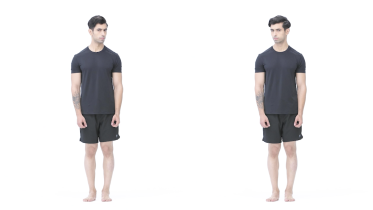 Neck rotation
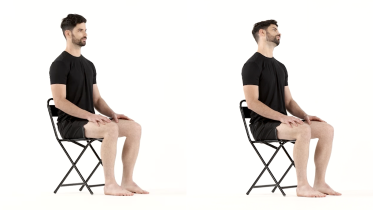 Neck side bend
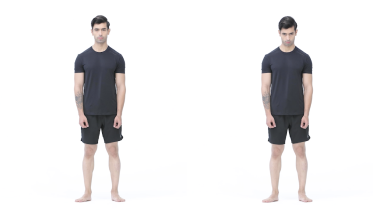 Neck flexion and extension
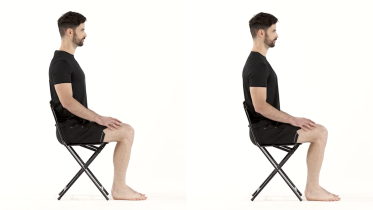 Chin tuck
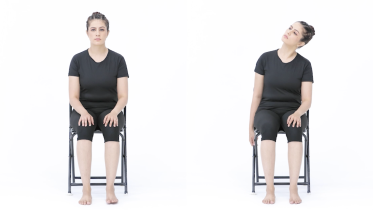 Upper trapezius stretch
Once the neck moves freely again, the staged neck pain program adds the shoulder blade and arm strength work the JOSPT guideline recommends, in order.
When it is not really about sleep
Waking with it does not prove that sleep caused it. A few things simply announce themselves in the morning because that is when you first ask your neck to move.
A nerve root in the neck gives pain, pins and needles or weakness running down one arm, and it does not behave like an overnight crick. Pain that is worse on one side alone, or that keeps returning to the same side, is covered on neck pain on one side. If a headache dominates and neck movement changes it, the cervicogenic headache program is the closer fit. When the headache sits across both sides like a band, the tension-type headache program explains that pattern.
A neck that will not turn, together with a sore throat, painful swallowing or tender lumps you can feel in the neck, points at a throat or gland infection instead of an overnight crick. healthdirect lists trouble swallowing, more drooling than usual, a sore throat and trouble breathing among the reasons a locked neck needs urgent care, and the NHS says swollen glands from an infection usually settle within 1 to 2 weeks.
The warning signs below cover the group that has nothing to do with your pillow. A stiff neck with a fever, a severe headache that keeps building, dislike of bright light or a rash needs emergency services, because meningitis can move fast. Neck or jaw pain that arrives with chest pain, breathlessness or sweating needs emergency services too, since the NHS treats chest pain spreading to the arms, neck or jaw as a reason to call them. A sudden or unfamiliar headache with neck pain can come from a tear in an artery in the neck, and a 2025 review of those cases advises keeping that possibility in mind whenever a headache is both new and unlike your usual ones (Doukhi and colleagues, 2025).
When to see a physio (physical therapist)
See someone if the neck has not started to free up after 7 to 10 days, if it is going backwards instead of forwards, or if this keeps happening every few weeks (healthdirect; NHS). Go sooner if symptoms travel into the arm, if the arm feels weak or numb, or if you cannot turn your head far enough to drive safely.
The assessment is quick and mostly practical. A physio will watch you turn and tilt your head each way, find the irritable spots by hand, rule the shoulder in or out, and examine the nerves of the arm if symptoms have spread past it. Treatment usually pairs the exercises above with hands-on work and advice on your sleeping set-up. If you have had several of these episodes in a year, the useful conversation is about neck and shoulder strength and endurance work, and about what your days ask of your neck. It is not about buying another pillow.
Related exercise programs
See a doctor promptly if
- Emergency: any sign of a stroke, even if it goes away. That means a face that droops on one side, an arm you cannot lift or keep up, slurred or muddled speech, weakness or numbness on one side of your body or face, sudden blurred vision, double vision or loss of sight, trouble swallowing, sudden dizziness with unsteadiness or falling over, a sudden severe headache, or a sudden fall where your legs give way but you do not black out (a drop attack). Call emergency services straight away. With neck pain, these can rarely come from a tear in an artery in the neck.
- Emergency: a new headache, or new pain on one side of your face, jaw or neck, with a drooping eyelid or a smaller pupil on the same side, or with a new pulsing or whooshing sound in one ear that keeps time with your heartbeat. Call emergency services or go to an emergency department straight away, and do not drive yourself. This can be a tear in an artery in the neck (cervical artery dissection), which can lead to a stroke.
- Emergency: a sudden, severe headache or neck pain that feels new and unlike anything you have had before. Call emergency services straight away.
- Emergency: a stiff neck with a fever, a severe headache that is getting worse, pain when you look at bright lights, confusion, or a rash that does not fade when you press a glass on it. Call emergency services. These can be signs of meningitis.
- Emergency: you cannot swallow, you are drooling because you cannot swallow, you have trouble breathing, you make a high-pitched noise as you breathe in, or your symptoms are severe and getting worse quickly. Call emergency services or go to an emergency department straight away, and do not drive yourself.
- Emergency: neck, jaw or arm pain that comes with chest pain, shortness of breath, sweating or feeling sick. Call emergency services.
- Emergency: new problems walking, for example your legs feel stiff, heavy or weak or you have become unsteady on your feet, new trouble controlling your bladder or bowels, or hands that suddenly become clumsy, for example you can no longer do up buttons. Call emergency services straight away. These can be signs of pressure on the spinal cord in the neck.
- Emergency: neck pain straight after a high-energy accident, such as a crash at high speed, a car that rolled over, being thrown from a vehicle, being hit by a vehicle while walking or cycling, a motorbike or quad bike accident, a horse riding accident, a diving injury, or a fall from a height or down several stairs. Keep still and call emergency services. If the neck pain only starts later and nobody has checked your neck since, go to an emergency department straight away, and do not drive yourself.
- Emergency: in the first days after the accident, numbness, tingling, pins and needles or weakness in your arms or legs, or a sudden electric shock feeling in your neck and back that runs into your arms or legs. If it starts straight after the accident, keep still and call emergency services. If it starts later, call emergency services or go to an emergency department straight away, and do not drive yourself.
- Emergency: new neck or back pain after a fall, a knock or a jolt, even a minor one such as a trip or a sudden stop in a car, if you have a condition that stiffens the spine, such as ankylosing spondylitis. Call emergency services or go to an emergency department straight away, do not drive yourself, and tell the staff about your spine condition, so they keep your neck and back in their usual position. A stiff spine can break after a small injury, and the break is easy to miss at first. If the pain started straight after the injury, or you also have numbness, tingling or weakness in your arms or legs, keep still and call emergency services.
- Emergency: you have had cancer, now or in the past, and your back or neck pain feels like a tight band around your body, or comes with pain spreading down an arm or leg, weakness, numbness or pins and needles in your arms or legs, trouble walking, or trouble controlling your bladder or bowels. Call your cancer team's emergency number straight away, or go to an emergency department if you do not have one or cannot get through. This can be cancer pressing on the spinal cord (metastatic spinal cord compression), which needs treatment straight away.
- You are pregnant or had a baby in the last few weeks and have a severe headache that does not go away with simple painkillers, problems with your vision such as blurring or flashing lights, pain just below your ribs, vomiting, or sudden swelling of your face, hands or feet. Contact your maternity unit straight away, or get urgent medical help if you cannot reach them. These can be signs of pre-eclampsia.
- A new headache and neck pain that feel different from anything you have had before, especially if they started after a neck injury or strain, even a minor one, a bout of heavy coughing, or having your neck manipulated, without any of the emergency signs above. Get checked by a doctor the same day, for example at an emergency department, before you start these exercises or have any hands-on treatment to your neck.
- Neck pain that makes swallowing very hard, or swollen glands in your neck with a very high temperature or feeling hot, cold or shivery. Get medical advice the same day, for example an urgent appointment with your doctor.
- Neck pain with a fever or chills, or you feel generally unwell. Get medical advice the same day, and go to an emergency department if you feel very unwell.
- Hands that have slowly become clumsy, for example trouble doing up buttons or dropping things, or numbness in both hands. Get medical advice the same day. These can be signs of pressure on the spinal cord in the neck (cervical myelopathy). If the clumsiness or numbness gets worse quickly, call emergency services straight away.
- Pain or tingling in both arms at the same time, rather than in one. Get medical advice the same day. This can also be a sign of pressure on the spinal cord in the neck.
- An electric shock feeling runs down your back or into your arms or legs as your head bends forward. Stop and get medical advice the same day.
- Pins and needles in an arm together with neck or arm pain, or an arm that feels heavy or weak, and nobody has checked it yet. Get medical advice the same day.
- An arm or hand that is getting weaker. Get medical advice the same day.
- Severe neck or arm pain that comes on suddenly or is getting worse quickly, without any of the emergency signs above. Get medical advice the same day.
- Dizziness, a spinning feeling or feeling sick that comes on when you turn or tip your head, without any of the emergency signs above. Stop the exercises and get medical advice the same day. If you faint, it does not settle within a few minutes of sitting still, or you cannot stand or walk steadily, call emergency services.
- New, frequent headaches with pain or tenderness at your temples or on your scalp, or jaw pain when you eat or talk. Get medical advice the same day. These can be signs of inflamed arteries in the head (temporal arteritis, also called giant cell arteritis). If your vision changes, call emergency services.
- New neck pain and you have had cancer, now or in the past, or you have lost weight without trying. Get medical advice the same day and mention it. If you are being treated for cancer now, contact your cancer team the same day.
- Neck pain after a car accident or a fall, even a minor one, if you are 65 or older, have low bone density (osteoporosis) or have taken steroid tablets for a long time. Get your neck checked by a doctor the same day, for example at an emergency department, before you start these exercises. At 65 or older, doctors usually want an X-ray or scan of the neck after an accident.
- You have rheumatoid arthritis and get new neck pain, or a new headache at the back of your head that keeps coming back. If it comes with tingling or numbness in your hands or arms, get medical advice the same day. If you also feel unsteady on your feet or your legs feel stiff, heavy or weak, call emergency services straight away. Without any of those, tell your doctor or rheumatology team within a few days, and leave out any neck exercises until you have been checked.
- Pain that is there all the time and does not ease with rest or changing position, or pain at night that keeps getting worse. See your doctor within a few days. If you have had cancer, now or in the past, or you have lost weight without trying, get medical advice the same day. If you are being treated for cancer now, contact your cancer team the same day.
Common questions
How do I fix a stiff neck from sleeping wrong?
There is no trick that unlocks it in a minute, and anything sold on that promise is worth ignoring. The approach with the best backing is unglamorous: move the neck a little in every direction, often, staying inside the range that feels comfortable, and carry on with your day instead of holding still. Warmth before you move tends to make the first few repetitions easier, and a simple painkiller can buy you enough comfort to move at all, so ask a pharmacist which one suits you. Forcing the neck past the catch is not part of it, and neither is cracking it yourself or asking anyone else to while it is irritable.
Should I use heat or ice on a stiff neck after sleeping?
Either is reasonable, and the honest answer is that neither has strong trial evidence behind it for this. The NHS suggests heat or cold packs on the neck and gives practical limits: a bag of frozen peas wrapped in a tea towel for 5 minutes, 3 times a day, or a hot water bottle wrapped in a tea towel for 20 minutes, 2 to 3 times a day. healthdirect Australia suggests a heat pack and gentle massage for a neck that has locked. Pick whichever feels better on the day and protect your skin with a towel. Treat it as the thing that lets you move, not as the treatment.
Can my pillow give me neck pain?
It can contribute, but it is rarely the whole story, and the research is thinner than the marketing. A systematic review of pillows in people with chronic neck pain found only five eligible studies with 239 participants between them, and concluded that evidence for any particular pillow as an add-on treatment is limited, with no clear winner among latex, foam and standard pillows (Ghosh and colleagues, 2025). A larger meta-analysis did find that rubber and spring pillows reduced neck pain and waking symptoms compared with other types, in people who already had neck pain (Chun-Yiu and colleagues, 2021). The NHS keeps its advice simple: a low, firm pillow, a firm mattress, and your head at the same height as the rest of your body rather than propped up or dropping down.
Why do I wake up with a stiff neck and a headache?
A headache that starts in the neck and eases as the neck eases is called a cervicogenic headache, and it commonly turns up on the same side as the neck pain, spreading from the base of the skull forward. Tension-type headache is the other everyday possibility, and it usually sits on both sides like a band of pressure. Jaw clenching overnight can produce both a sore jaw and a headache around the temple. Any headache that feels sudden, severe or unlike anything you have had before needs emergency services, and the same applies to a headache with a fever, a rash, confusion or a drooping eyelid.
When should I worry about a stiff neck?
The pattern to act on is a stiff neck that arrives as part of a wider illness or with symptoms that have nothing to do with movement. A fever, a severe headache that keeps building, dislike of bright light, confusion or a rash that does not fade under a glass can mean meningitis and needs emergency services. Neck or jaw pain with chest pain, breathlessness, sweating or feeling sick can be a heart attack, and the NHS advises calling emergency services for chest pain that spreads to the arms, neck or jaw. Pain that never eases whatever position you take, pain at night that keeps worsening, unexplained weight loss or a history of cancer belong with a doctor, not with exercises. Every one of these is written out with its urgency in the warning signs on this page.
Is a stiff neck an early sign of pregnancy?
No, it is not a recognized early sign, and nothing here should be used to work out whether you are pregnant. Neck stiffness is common enough in everyone that it carries no signal on its own, and a pregnancy test settles the question properly. The things that do matter in pregnancy are a severe headache that simple painkillers do not touch, changes in your vision, pain just below the ribs, vomiting or sudden swelling of the face, hands or feet, since those can be signs of pre-eclampsia and need contact with your maternity unit straight away. If you are pregnant and want to start neck exercises, your midwife or maternity physio should guide what you do. One thing on this page does change in pregnancy. From about 28 weeks the NHS advises going to sleep on your side rather than on your back, because going to sleep on your back in the last months is linked to a higher risk of stillbirth. So use a side set-up from then on, and leave lying on your back until after the birth. The NHS also says not to worry if you wake up on your back: settle onto your side again and carry on.
References
- Blanpied PR, Gross AR, Elliott JM, et al. Neck pain: revision 2017. Clinical practice guidelines linked to the International Classification of Functioning, Disability and Health from the Orthopaedic Section of the American Physical Therapy Association. Journal of Orthopaedic and Sports Physical Therapy. 2017;47(7):A1-A83. https://doi.org/10.2519/jospt.2017.0302
- Gross A, Kay TM, Paquin JP, et al. Exercises for mechanical neck disorders. Cochrane Database of Systematic Reviews. 2015;(1):CD004250. https://doi.org/10.1002/14651858.CD004250.pub5
- Ghosh S, Goyal M, Goyal K. Effect of pillow on pain, disability and sleep quality in patients with chronic neck pain: a systematic review. Rehabilitacion (Madrid). 2025;59(3):100922. https://doi.org/10.1016/j.rh.2025.100922
- Chun-Yiu JP, Man-Ha ST, Chak-Lun AF. The effects of pillow designs on neck pain, waking symptoms, neck disability, sleep quality and spinal alignment in adults: a systematic review and meta-analysis. Clinical Biomechanics. 2021;85:105353. https://doi.org/10.1016/j.clinbiomech.2021.105353
- Doukhi D, Debette S, Mawet J. Headaches attributed to cranial and cervical artery dissections. The Journal of Headache and Pain. 2025;26(1):28. https://doi.org/10.1186/s10194-025-01958-9
- healthdirect Australia. Torticollis (wry neck). Last reviewed March 2026. https://www.healthdirect.gov.au/torticollis
- NHS. Neck pain and stiff neck. https://www.nhs.uk/symptoms/neck-pain-and-stiff-neck/
- NHS. Meningitis. https://www.nhs.uk/conditions/meningitis/
- NHS. Sore throat. https://www.nhs.uk/conditions/sore-throat/
- NHS. Swollen glands. https://www.nhs.uk/conditions/swollen-glands/
- NHS. Symptoms of a stroke. https://www.nhs.uk/conditions/stroke/symptoms/
- NHS. Heart attack. https://www.nhs.uk/conditions/heart-attack/
- NHS. Pre-eclampsia. https://www.nhs.uk/conditions/pre-eclampsia/
- NHS. 27 weeks pregnant: the best sleeping positions during pregnancy. Best Start in Life week by week guide. https://www.nhs.uk/best-start-in-life/pregnancy/week-by-week-guide-to-pregnancy/2nd-trimester/week-27/
- NHS. Temporal arteritis. https://www.nhs.uk/conditions/temporal-arteritis/
Written and checked by the PocketPhysio editorial team. Last updated 2026-09-30.
This page is general education, not a diagnosis or a personal treatment plan. See a physiotherapist or doctor for advice about your own situation.