
Forward head posture (text neck) exercises and physiotherapy
What forward head posture is, and why people call it text neck
Forward head posture is a resting position where your head sits in front of your shoulders instead of stacked over them. From the side, your ear ends up ahead of your shoulder, and the upper back often rounds with it. Text neck and tech neck are everyday names for the same thing. They come from the head-down position of looking at a phone, or the head-forward lean toward a laptop or monitor.
It describes a position. It is not a diagnosis. Everyone's head moves forward and back all day, and most people spend part of the day in this position without any trouble. It becomes a reason to see a physio when it comes with neck or upper back pain, stiffness, or headaches.
This page is about the posture itself and what exercise can do for it. If your main problem is neck pain, the neck pain program covers it in full. If your upper back has a rounded curve, the kyphosis program explains the different types and when that curve needs a doctor's check.
Does forward head posture cause neck pain?
Not as clearly as many websites and posture products claim. A review of 15 studies found that adults with neck pain had, on average, a slightly more forward head than adults without pain, and a more forward head went with more pain and disability (Mahmoud 2019). In teenagers the same review found no link with most measures of neck pain. The studies measured posture and pain at one point in time, so they cannot show which came first.
Other research points the same way. In 1,108 Australian 17-year-olds, the odds of neck pain or headache did not differ between people who sat upright and people who sat with the head forward (Richards 2016). In 150 young adults, the way they held their neck while texting was not linked with neck pain (Damasceno 2018).
There is also no agreed correct posture. Physiotherapists mostly favor an upright sitting position, yet there is a lack of strong evidence that any specific posture is linked to better health (Korakakis 2019). Physio researchers have argued that the widespread belief linking spinal pain to "incorrect" posture has limited scientific support (Slater 2019). The NHS still lists poor posture, for example sitting at a desk for a long time, among the common causes of neck pain, so long spells in one position are worth breaking up.
Can exercises help forward head posture?
Exercise can help with comfort and strength, and it can change the posture a little. A review of seven trials with 627 people found that therapeutic exercise gave a large improvement in the angle of the head on the neck and a moderate reduction in neck pain (Sheikhhoseini 2018). A later review of 22 studies in people with upper crossed syndrome, a forward head with rounded shoulders, found that exercise improved the head, shoulder and upper back angles (Sepehri 2024).
Those reviews cannot tell us whether the pain eased because the angle changed, or because the neck and upper back simply got stronger and less sensitive. The JOSPT neck pain guideline (Blanpied 2017) recommends strengthening and endurance exercise for the neck and shoulder blade muscles for neck pain that lingers. So the aim of this program is a neck that feels strong and comfortable in many positions, rather than one perfect position you hold all day.
How to use this program
Begin with stage 1, or wherever your physio has placed you. Move on when a stage feels easy and your neck settles well afterward.
Each exercise page gives a typical starting dose. As a rough guide, the chin tuck often starts with 8 to 10 repetitions and a 3 to 5 second hold, a few times a day, and the neck turns with 5 to 10 slow turns each way. The seated upper back extension often starts with 5 to 10 slow repetitions, and the shoulder blade squeeze with 10 to 15 squeezes held for about 5 seconds, a few times a day. The chest stretch is often held for 20 to 30 seconds, 2 to 3 times on each side, once or twice a day.
The deep neck flexor exercise usually starts with holds of 5 to 10 seconds, repeated 5 to 10 times, and the chin tuck head lift with 5 to 10 lifts held for 3 to 5 seconds. Wall angels are often done as 1 to 3 sets of 8 to 12, the band row and band pull-apart as 2 to 3 sets of 10 to 15, and the face-down arm raises as 2 to 3 sets of 8 to 12, once a day or every other day. The band exercise for the back of the neck usually starts at 1 to 3 sets of 8 to 12 with a light band, 2 to 3 days a week. Your physio will adjust this.
Working muscles should feel tired, and a mild stretch across the chest or the back of the neck is normal. Mild aching is usually fine if it settles within a day and your neck is no worse the next morning. Stop that exercise and tell your physio if pain, numbness or pins and needles spread into your arm or hand. Feeling dizzy or sick, or a change in your vision, means stopping and getting medical advice the same day, and the emergency warning signs below mean calling emergency services.
The exercise program
Stage 1: Move often and find a comfortable upright
For everyone starting out, and for days when your neck feels stiff after a long spell at a screen. All five are done sitting or standing, so they fit into short breaks through the day. The chin tuck teaches you to bring your head back over your shoulders without tipping it down, and the upper back and shoulder blade exercises let you sit tall without straining. Go slowly and stay in a range that feels easy. If a neck movement makes you dizzy, stop, sit still until it settles, and get medical advice the same day before you try again.
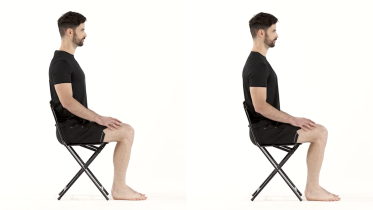 Chin tuck
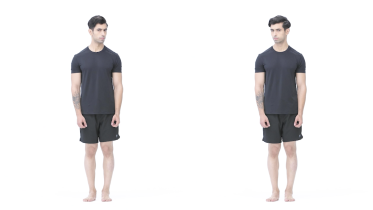 Neck rotation
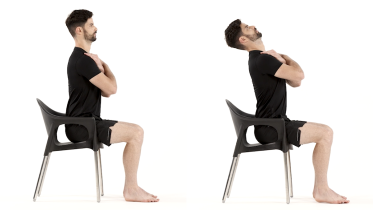 Seated thoracic extension
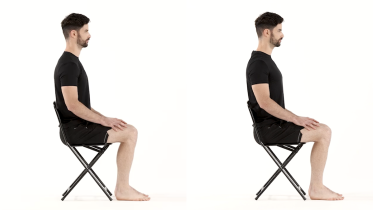 Scapular squeeze
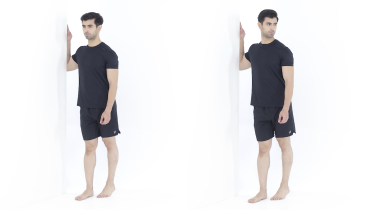 Pec stretch at a wall
Stage 2: Build endurance in the neck and shoulder blades
When stage 1 feels easy, often after a week or two. The deep neck flexor exercise trains the small muscles at the front of your neck to hold a gentle tuck for longer. Wall angels, the band row and the band pull-apart work the muscles between your shoulder blades, which do much of the work of holding you upright. Keep the chin tuck and the neck turns from stage 1 as short breaks during the day. The deep neck flexor exercise is done lying on your back, so if you are pregnant and past the first three months, check with your physio before exercising flat on your back.
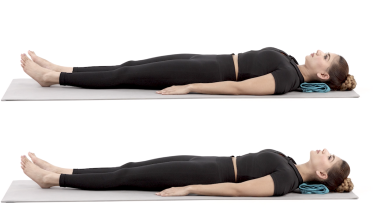 Deep neck flexor exercise
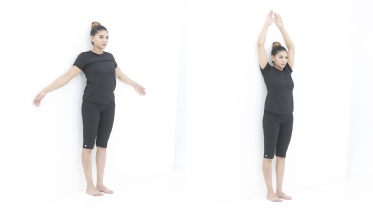 Wall angels
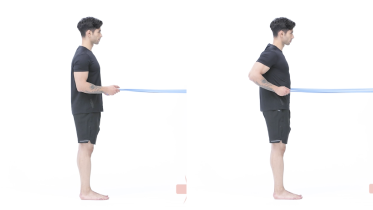 Resistance band row
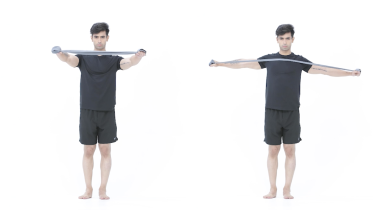 Band pull-apart
Stage 3: Build strength
Once stage 2 feels steady and your neck settles well afterward. The chin tuck head lift makes the front neck muscles hold your head against gravity, and the band exercise strengthens the back of the neck in a short, controlled range. The Y and T raises are done lying face down with your forehead on a small folded towel, and your head stays down while the arms lift. If you are pregnant and past the first three months, check with your physio before exercising flat on your back. Lying face down usually gets uncomfortable from the middle months of pregnancy, so ask your physio for a version of the Y and T raises done sitting or leaning forward. Ask your physio before the band exercise if you have rheumatoid arthritis or Down syndrome, or have been told the top of your neck is unstable or there is pressure on the spinal cord in your neck.
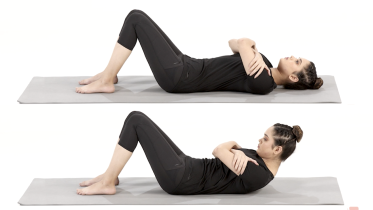 Chin tuck head lift
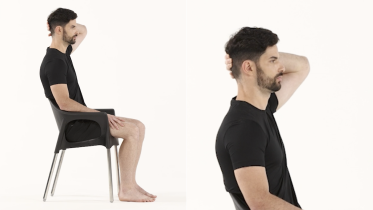 Seated neck extension strengthening
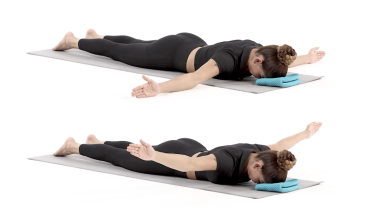 Prone T raise
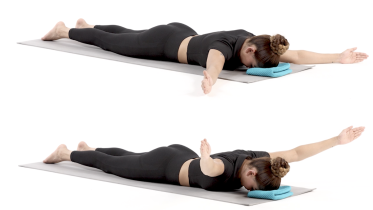 Prone Y raise
Screens, phones and desks
You do not need to sit bolt upright all day. The simplest change is to move more often: get up every so often, do a few chin tucks or neck turns, then carry on. Set up your screen so you can see it without craning forward, and hold your phone a little higher now and then rather than always looking down at your lap. Different positions through the day are fine, and no single one is right for everyone.
Children and teenagers
The program here is meant for adults. If a child or teenager has neck or back pain that lasts or keeps coming back, or a curve in the back that you are worried about, see a GP.
Other things to check first
After neck surgery or a broken bone in the neck, check with your surgeon or physio before you start. If you are pregnant, check with your physio or midwife before you start. If you have rheumatoid arthritis, or you have been told the spaces around the nerves or spinal cord in your neck are narrowed, check with your physio or doctor before you start. If you have high blood pressure, breathe steadily through every hold and never hold your breath.
When to see a physio or doctor
See a physio or doctor if your neck pain or stiffness has not gone away after a few weeks, if painkillers have not helped, or if you are worried about it (NHS). The same applies if you get headaches that keep coming back; the tension-type headache and cervicogenic headache programs cover those. Pain, numbness or tingling traveling down one arm can mean an irritated nerve in the neck, and the cervical radiculopathy page explains what to do. A head that keeps dropping further forward and is hard to lift is a different problem from forward head posture and needs a doctor within a few days. The warning signs below need faster help.
For physiotherapists
Mahmoud 2019 pooled 15 cross-sectional studies: adults with neck pain had a smaller craniovertebral angle than asymptomatic adults (mean difference 4.84 degrees), with significant correlations with pain intensity and disability, but no association with most neck pain measures in adolescents, and age acted as a confounder. Richards 2016 identified four sitting neck posture clusters in 1,108 adolescents and found no difference in the odds of neck pain or headache across them, although the slumped thorax and forward head cluster had higher odds of depression.
Sheikhhoseini 2018 (7 RCTs, 627 participants) reported a large pooled effect on craniovertebral angle and a moderate effect on neck pain, with no significant change in cranial angle. Heydari 2022 set a minimal clinically important difference of 1.40 degrees for craniovertebral angle after an 8-week program in male students. Posture change and pain change do not have to go together, so track symptoms and function as well as angles.
Screen for dropped head syndrome when the head posture is progressive or comes with neck extensor weakness. In the Drain 2019 review of 129 patients, the leading causes were isolated neck extensor myopathy, Parkinson's disease, myasthenia gravis and ALS. Ask about swallowing, speech, fatigable ptosis or diplopia, limb weakness and breathing, and refer for neurological assessment.
See a doctor promptly if
- Emergency: any sign of a stroke, even if it goes away. That means a face that droops on one side, an arm you cannot lift or keep up, slurred or muddled speech, weakness or numbness on one side of your body or face, sudden blurred vision, double vision or loss of sight, trouble swallowing, sudden dizziness with unsteadiness or falling over, a sudden severe headache, or a sudden fall where your legs give way but you do not black out (a drop attack). Call emergency services straight away. With neck pain, these can rarely come from a tear in an artery in the neck.
- Emergency: a new headache, or new pain on one side of your face, jaw or neck, with a drooping eyelid or a smaller pupil on the same side, or with a new pulsing or whooshing sound in one ear that keeps time with your heartbeat. Call emergency services or go to an emergency department straight away, and do not drive yourself. This can be a tear in an artery in the neck (cervical artery dissection), which can lead to a stroke.
- Emergency: a sudden, severe headache or neck pain that feels new and unlike anything you have had before. Call emergency services straight away.
- Dizziness, a spinning feeling or feeling sick that comes on when you turn or tip your head, without any of the emergency signs above. Stop the exercises and get medical advice the same day. If you faint, it does not settle within a few minutes of sitting still, or you cannot stand or walk steadily, call emergency services.
- Emergency: neck pain straight after a high-energy accident, such as a crash at high speed, a car that rolled over, being thrown from a vehicle, being hit by a vehicle while walking or cycling, a motorbike or quad bike accident, a horse riding accident, a diving injury, or a fall from a height or down several stairs. Keep still and call emergency services. If the neck pain only starts later and nobody has checked your neck since, go to an emergency department straight away, and do not drive yourself.
- Emergency: in the first days after the accident, numbness, tingling, pins and needles or weakness in your arms or legs, or a sudden electric shock feeling in your neck and back that runs into your arms or legs. If it starts straight after the accident, keep still and call emergency services. If it starts later, call emergency services or go to an emergency department straight away, and do not drive yourself.
- Emergency: a stiff neck with a fever, a severe headache that is getting worse, pain when you look at bright lights, confusion, or a rash that does not fade when you press a glass on it. Call emergency services. These can be signs of meningitis.
- Emergency: neck, jaw or arm pain that comes with chest pain, shortness of breath, sweating or feeling sick. Call emergency services.
- Emergency: new problems walking, for example your legs feel stiff, heavy or weak or you have become unsteady on your feet, new trouble controlling your bladder or bowels, or hands that suddenly become clumsy, for example you can no longer do up buttons. Call emergency services straight away. These can be signs of pressure on the spinal cord in the neck.
- Hands that have slowly become clumsy, for example trouble doing up buttons or dropping things, or numbness in both hands. Get medical advice the same day. These can be signs of pressure on the spinal cord in the neck (cervical myelopathy). If the clumsiness or numbness gets worse quickly, call emergency services straight away.
- Pain or tingling in both arms at the same time, rather than in one. Get medical advice the same day. This can also be a sign of pressure on the spinal cord in the neck.
- An arm or hand that is getting weaker. Get medical advice the same day.
- Severe neck or arm pain that comes on suddenly or is getting worse quickly, without any of the emergency signs above. Get medical advice the same day.
- Neck pain with a fever or chills, or you feel generally unwell. Get medical advice the same day, and go to an emergency department if you feel very unwell.
- New, frequent headaches with pain or tenderness at your temples or on your scalp, or jaw pain when you eat or talk. Get medical advice the same day. These can be signs of inflamed arteries in the head (temporal arteritis, also called giant cell arteritis). If your vision changes, call emergency services.
- New neck pain and you have had cancer, now or in the past, or you have lost weight without trying. Get medical advice the same day and mention it. If you are being treated for cancer now, contact your cancer team the same day.
- Emergency: you have had cancer, now or in the past, and your back or neck pain feels like a tight band around your body, or comes with pain spreading down an arm or leg, weakness, numbness or pins and needles in your arms or legs, trouble walking, or trouble controlling your bladder or bowels. Call your cancer team's emergency number straight away, or go to an emergency department if you do not have one or cannot get through. This can be cancer pressing on the spinal cord (metastatic spinal cord compression), which needs treatment straight away.
- Pain that is there all the time and does not ease with rest or changing position, or pain at night that keeps getting worse. See your doctor within a few days. If you have had cancer, now or in the past, or you have lost weight without trying, get medical advice the same day. If you are being treated for cancer now, contact your cancer team the same day.
- Emergency: new neck or back pain after a fall, a knock or a jolt, even a minor one such as a trip or a sudden stop in a car, if you have a condition that stiffens the spine, such as ankylosing spondylitis. Call emergency services or go to an emergency department straight away, do not drive yourself, and tell the staff about your spine condition, so they keep your neck and back in their usual position. A stiff spine can break after a small injury, and the break is easy to miss at first. If the pain started straight after the injury, or you also have numbness, tingling or weakness in your arms or legs, keep still and call emergency services.
- Neck pain after a car accident or a fall, even a minor one, if you are 65 or older, have low bone density (osteoporosis) or have taken steroid tablets for a long time. Get your neck checked by a doctor the same day, for example at an emergency department, before you start these exercises. At 65 or older, doctors usually want an X-ray or scan of the neck after an accident.
- You have rheumatoid arthritis and get new neck pain, or a new headache at the back of your head that keeps coming back. If it comes with tingling or numbness in your hands or arms, get medical advice the same day. If you also feel unsteady on your feet or your legs feel stiff, heavy or weak, call emergency services straight away. Without any of those, tell your doctor or rheumatology team within a few days, and leave out any neck exercises until you have been checked.
- Your head is dropping further forward over weeks or months, so your chin sinks toward your chest and it is hard to lift your head to look straight ahead, or the muscles at the back of your neck feel weak. See your doctor within a few days. This is not the usual forward head posture and can come from a muscle or nerve condition (dropped head syndrome). If it has come on over a few days rather than weeks, or you also have trouble swallowing or speaking, drooping eyelids, double vision that comes and goes, or weakness in your arms or legs, get medical advice the same day. If you have any trouble breathing, call emergency services.
- Routine: your upper back is rounded and it has not been checked, and the rounding stays when you try to sit or stand tall, looks sharp and angled rather than a smooth curve, or has come on in later life, or you have lost height. Book an appointment with your doctor before you start this program. If the rounding is getting worse over a few weeks or months, see your doctor within a few days. If it came on with sudden back pain, get medical advice the same day.
Common questions
Is text neck real?
The position is real: most of us bend our heads down to look at a phone. Whether it causes neck pain is less clear. In a study of 150 young adults aged 18 to 21, the way they held their neck while texting was not linked with neck pain (Damasceno 2018). One study cannot settle it, but it does not back up the more alarming warnings you may read online.
Can forward head posture be corrected?
Exercise can change it a little. A review of seven trials with 627 people with forward head posture found that therapeutic exercise improved the angle of the head on the neck and moderately reduced neck pain (Sheikhhoseini 2018). Your usual resting posture is also a habit, and it changes through the day. Aim for a neck and upper back that cope with lots of positions, not for one perfect pose.
How long does it take to fix forward head posture?
There is no reliable timeline. In one trial, 103 male students with forward head posture did a corrective exercise program for 8 weeks, and their head position improved compared with a control group (Heydari 2022). The change you can expect varies from person to person. Your physio will set a plan and adjust it as you go.
What is the correct posture for sitting at a computer?
There is no single correct posture. A survey of 544 physiotherapists found they mostly preferred an upright sitting posture, but the authors noted a lack of strong evidence that any specific posture is linked to better health (Korakakis 2019). The NHS does list sitting at a desk for a long time among common causes of neck pain. In practice, set up your screen so you can see it without craning forward, and change position often.
References
- Mahmoud NF, Hassan KA, Abdelmajeed SF, Moustafa IM, Silva AG. The relationship between forward head posture and neck pain: a systematic review and meta-analysis. Current Reviews in Musculoskeletal Medicine. 2019;12(4):562-577. https://doi.org/10.1007/s12178-019-09594-y
- Richards KV, Beales DJ, Smith AJ, O'Sullivan PB, Straker LM. Neck posture clusters and their association with biopsychosocial factors and neck pain in Australian adolescents. Physical Therapy. 2016;96(10):1576-1587. https://doi.org/10.2522/ptj.20150660
- Damasceno GM, Ferreira AS, Nogueira LAC, Reis FJJ, Andrade ICS, Meziat-Filho N. Text neck and neck pain in 18-21-year-old young adults. European Spine Journal. 2018;27(6):1249-1254. https://doi.org/10.1007/s00586-017-5444-5
- Sheikhhoseini R, Shahrbanian S, Sayyadi P, O'Sullivan K. Effectiveness of therapeutic exercise on forward head posture: a systematic review and meta-analysis. Journal of Manipulative and Physiological Therapeutics. 2018;41(6):530-539. https://doi.org/10.1016/j.jmpt.2018.02.002
- Sepehri S, Sheikhhoseini R, Piri H, Sayyadi P. The effect of various therapeutic exercises on forward head posture, rounded shoulder, and hyperkyphosis among people with upper crossed syndrome: a systematic review and meta-analysis. BMC Musculoskeletal Disorders. 2024;25(1):105. https://doi.org/10.1186/s12891-024-07224-4
- Heydari Z, Sheikhhoseini R, Shahrbanian S, Piri H. Establishing minimal clinically important difference for effectiveness of corrective exercises on craniovertebral and shoulder angles among students with forward head posture: a clinical trial study. BMC Pediatrics. 2022;22(1):230. https://doi.org/10.1186/s12887-022-03300-7
- Korakakis V, O'Sullivan K, O'Sullivan PB, et al. Physiotherapist perceptions of optimal sitting and standing posture. Musculoskeletal Science and Practice. 2019;39:24-31. https://doi.org/10.1016/j.msksp.2018.11.004
- Slater D, Korakakis V, O'Sullivan P, Nolan D, O'Sullivan K. "Sit up straight": time to re-evaluate. Journal of Orthopaedic and Sports Physical Therapy. 2019;49(8):562-564. https://doi.org/10.2519/jospt.2019.0610
- Blanpied PR, Gross AR, Elliott JM, et al. Neck pain: revision 2017. Clinical practice guidelines linked to the International Classification of Functioning, Disability and Health from the Orthopaedic Section of the American Physical Therapy Association. Journal of Orthopaedic and Sports Physical Therapy. 2017;47(7):A1-A83. https://doi.org/10.2519/jospt.2017.0302
- Drain JP, Virk SS, Jain N, Yu E. Dropped head syndrome: a systematic review. Clinical Spine Surgery. 2019;32(10):423-429. https://doi.org/10.1097/BSD.0000000000000811
- Davies BM, Mowforth OD, Smith EK, Kotter MR. Degenerative cervical myelopathy. BMJ. 2018;360:k186. https://doi.org/10.1136/bmj.k186
- Rushton A, Carlesso LC, Flynn T, et al. International framework for examination of the cervical region for potential of vascular pathologies of the neck prior to musculoskeletal intervention: International IFOMPT Cervical Framework. Journal of Orthopaedic and Sports Physical Therapy. 2023;53(1):7-22. https://doi.org/10.2519/jospt.2022.11147
- NHS. Neck pain. https://www.nhs.uk/symptoms/neck-pain-and-stiff-neck/
- NHS. Symptoms of a stroke. https://www.nhs.uk/conditions/stroke/symptoms/
- NHS. Meningitis. https://www.nhs.uk/conditions/meningitis/
- NHS. Temporal arteritis. https://www.nhs.uk/conditions/temporal-arteritis/
Written and checked by the PocketPhysio editorial team. Last updated 2026-09-28.
This page is general education, not a diagnosis or a personal treatment plan. See a physiotherapist or doctor for advice about your own situation.