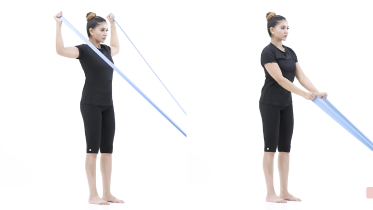
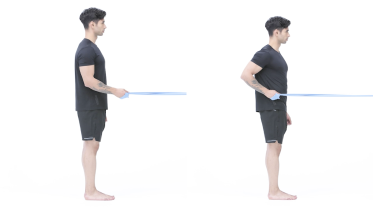
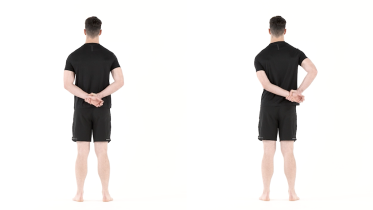
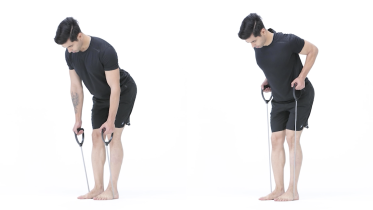
Pec stretch at a wall
The pec stretch works on the front of the chest and shoulder, mainly the large chest muscle (pectoralis major). Rest one forearm on a wall or door frame, elbow bent at or just below shoulder height, and turn your body away until you feel it across the chest.
How to do the pec stretch at a wall
- Stand side on to a wall or the edge of a door frame, with the side you want to stretch closest to it.
- Bend your elbow to about a right angle and rest your forearm flat on the wall. Your elbow sits at or a little below shoulder height, hand pointing up. The video shows it a little below.
- Take a small step forward with the leg nearest the wall.
- Slowly turn your chest away from the wall until you feel a stretch across the front of your chest and shoulder.
- Keep the shoulder down and relaxed, not hunched, and hold the stretch. Ease out of it slowly and lower the arm.
What you should feel
A steady stretch across the chest and the front of the shoulder on the arm against the wall. It often eases a little as you hold it.
Common mistakes
- Letting the shoulder hunch up or roll forward as you turn.
- Turning too far or too fast. A gentle stretch is enough.
- Placing the elbow above shoulder height. That changes which part of the muscle is stretched and puts more strain on the front of the shoulder.
- Arching the lower back or pushing the chest forward instead of turning.
How often
Often held for 20 to 30 seconds, 2 to 3 times on each side that needs it, once or twice a day. Your physio may suggest something different.
Stop and check with your physio if
- The front of the shoulder catches or hurts sharply.
- Pain, tingling or numbness spreads down your arm or into your hand.
- Pins and needles in your arm or hand that do not go away after you stop, or part of your arm or hand goes numb. Get medical advice the same day. If one side of your face or body suddenly goes numb or weak, or your speech becomes slurred or muddled, call emergency services, even if it goes away.
- The shoulder feels as if it might slip or give way.
- The shoulder feels as if it has slipped out of place, looks a different shape or suddenly locks so you cannot move the arm, or your hand turns cold, pale or blue. Go to an emergency department straight away, without driving yourself, and do not try to put the shoulder back in yourself.
From the clinic
The video uses the edge of a wall, and a door frame works exactly the same way. You may also see a version where both forearms rest on either side of a doorway and you lean through. Doing one arm at a time makes it easier to control how much stretch each side gets.
Has your shoulder dislocated before, or have you had surgery to stabilize it? Then talk to your physio before doing this stretch, because an arm held out to the side and turned back is exactly where an unstable shoulder can slip. After any other shoulder operation, your surgeon's protocol decides when stretching can start.
Tingling in the hand means ease off. Turn back a little or drop the elbow slightly. If it keeps happening, stop and ask your physio before you carry on.
Some programs pair this stretch with wall angels, which work the muscles between the shoulder blades.
Reviewed by the PocketPhysio by VirtueLife expert physiotherapy team. Last reviewed 2026-09-25.
This page is general education, not a diagnosis or a personal treatment plan. If you have pain, an injury or a health condition, see a physiotherapist or doctor before starting new exercises.