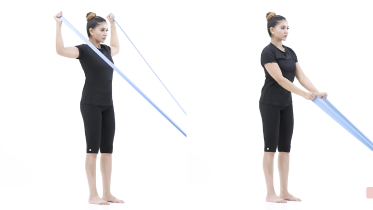
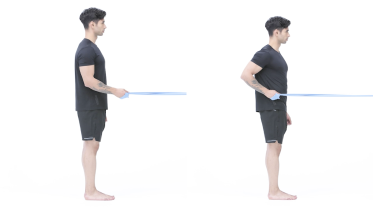
Bent-over band row
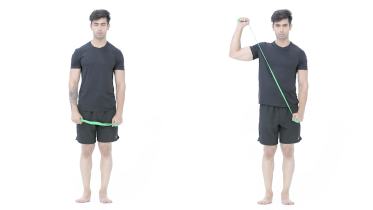
The bent-over band row is a rowing pull you do while leaning forward. You stand on the middle of a resistance band, hinge forward at the hips with a straight back, and draw both elbows up toward the ceiling until your shoulder blades squeeze together. It works the muscles between your shoulder blades and at the back of the shoulders (rhomboids, middle trapezius and posterior deltoid), while your back muscles hold the lean.
How to do the bent-over band row
- Stand on the middle of the band with your feet about hip width apart. Take one end, or one handle, in each hand.
- Soften your knees and lean your upper body forward from the hips, keeping your back straight. The video shows a moderate lean, well short of level with the floor. Let your arms hang down in front of your knees.
- Pull your elbows up and back toward the ceiling, keeping them close to your body, until your hands come in beside your waist. Breathe out as you pull rather than holding your breath.
- At the top, squeeze your shoulder blades together for a moment. Your back and head stay still.
- Lower your hands slowly until your arms hang straight again, then repeat. When the set is done, stand up tall by pushing your hips forward before you step off the band.
What you should feel
Effort between your shoulder blades and at the back of your shoulders. Your lower back works steadily to hold the lean, but it should not ache or feel sharp.
Common mistakes
- Rounding your back as you lean forward, or letting it round as you tire.
- Jerking your upper body up to help the pull, so the lean changes every rep.
- Shrugging your shoulders toward your ears instead of drawing the shoulder blades together.
- Letting the band drop your hands quickly on the way down.
How often
Programs commonly begin with 2 to 3 sets of 8 to 15, 2 to 3 times a week, using a band light enough that your back stays still. Rest in standing between sets if holding the lean tires your back. Your physio will adjust this.
Stop and check with your physio if
- Sharp pain in your lower back, or back pain that spreads into a leg.
- A sharp or catching pain in the shoulder during the pull.
- Pins and needles, numbness or pain traveling down an arm.
- Pins and needles in your arm or hand that do not go away after you stop, or part of your arm or hand goes numb. Get medical advice the same day. If one side of your face or body suddenly goes numb or weak, or your speech becomes slurred or muddled, call emergency services, even if it goes away.
- A sudden pop or snap at the front of your elbow, sudden sharp pain there, or the muscle at the front of your upper arm bunches up or changes shape. Stop and go to an urgent care center or emergency department the same day, even if you can still bend the elbow, as this can be a torn biceps tendon.
From the clinic
Lead with your shoulder blades. If the elbows bend first and the shoulder blades stay put, the arms do most of the work and you feel little in the middle of your back. The lean is what makes this row different from the resistance band row, which you do standing upright with the band fixed in front of you. If leaning forward bothers your back, start with that one instead.
Before you start, check the band for nicks or thin spots and make sure both feet pin it down firmly. A band that slips out from under a foot can flick up toward your face. If you have low bone density (osteoporosis), or your back is sore at the moment, ask your physio first, since leaning forward while you pull puts extra load through the spine. If you go ahead, keep your back straight throughout and never let it round under the pull. After shoulder surgery, check with your surgeon or physio before you add banded rows.
Written and checked by the PocketPhysio editorial team. Last updated 2026-09-28.
This page is general education, not a diagnosis or a personal treatment plan. If you have pain, an injury or a health condition, see a physiotherapist or doctor before starting new exercises.