Band lat pulldown
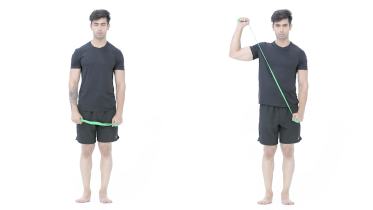
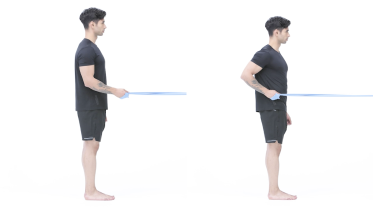
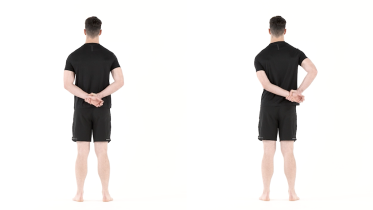
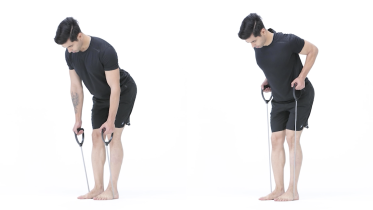
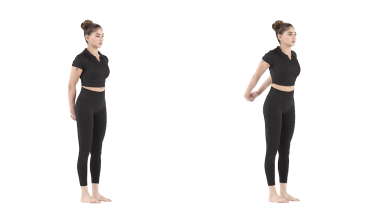
The band lat pulldown copies the gym pulldown machine at home. With a band fixed high over the top of a door, you stand facing the door, reach up to the band and pull it down, drawing your shoulder blades back and down as your elbows bend. It works the broad muscle down the side of your back (latissimus dorsi) and the muscles around the shoulder blades.
How to do the band lat pulldown
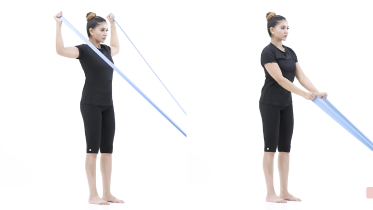
- Fix the middle of the band over the top of a closed door, with a door anchor if you have one, so it hangs above head height. Take one end in each hand.
- Stand facing the door, far enough back that your arms reach up and forward to the band at an angle, with a little tension in it.
- Draw your shoulder blades back and down first, then bend your elbows and pull the band down and out to the sides.
- Pull until your hands are about level with your ears, elbows pointing down and out. Pause there briefly.
- Let the band draw your arms back up slowly, keeping control until your arms are nearly straight again.
What you should feel
Work along the sides of your back below the armpits and between the shoulder blades, rather than in the neck or the front of the shoulder.
Common mistakes
- Leaning back to use your body weight instead of your arms and back.
- Allowing your shoulders to rise to your ears while the arms are up.
- Pulling only with the arms and forgetting to set the shoulder blades first.
- Letting the band yank your arms back up.
How often
A usual range is 2 to 3 sets of 10 to 12 pulls, 3 or 4 days a week. Your physio will adjust this.
Stop and check with your physio if
- A sharp pain or a catch in the shoulder while your arms are up or as you pull.
- Tingling or numbness spreading down an arm, or pain running into your hand.
- Pins and needles in your arm or hand that do not go away after you stop, or part of your arm or hand goes numb. Get medical advice the same day. If one side of your face or body suddenly goes numb or weak, or your speech becomes slurred or muddled, call emergency services, even if it goes away.
- With your arms up, the shoulder feels unstable, as though it could come out of joint.
- A shoulder ache that lingers for more than a few minutes once you finish, or a shoulder that is worse the following morning.
- A sudden pop or snap at the front of your elbow, sudden sharp pain there, or the muscle at the front of your upper arm bunches up or changes shape. Stop and go to an urgent care center or emergency department the same day, even if you can still bend the elbow, as this can be a torn biceps tendon.
- The shoulder feels as if it has slipped out of place, looks a different shape or suddenly locks so you cannot move the arm, or your hand turns cold, pale or blue. Go to an emergency department straight away, without driving yourself, and do not try to put the shoulder back in yourself.
From the clinic
Set the anchor up with care. Knot the band or use a door anchor on the far side of the door, close the door firmly and lock it if you can, so nobody opens it while you pull. Where possible choose a door that opens away from you, so your pull presses it shut. Check the band for nicks or tears before each session, because a band that breaks or slips off the door can snap back at your face.
Your arms start above shoulder height, so after a dislocation or shoulder surgery, check with your surgeon or physio before you try this exercise. If you have high blood pressure, breathe steadily through every repetition and never hold your breath. For a pull at waist height with the same band, see the resistance band row.
Written and checked by the PocketPhysio editorial team. Last updated 2026-09-28.
This page is general education, not a diagnosis or a personal treatment plan. If you have pain, an injury or a health condition, see a physiotherapist or doctor before starting new exercises.