Band row with external rotation
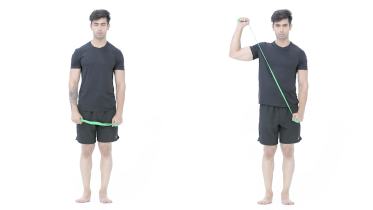
The band row with external rotation joins two shoulder exercises in one movement. Standing with a band fixed in front of you, you pull your elbows back into a row, then turn your forearms up so your hands rise beside your head, and reverse the path back to the start. It works the muscles between the shoulder blades and the ones at the back of the shoulder that turn the arm outward (part of the rotator cuff).
How to do the band row with external rotation
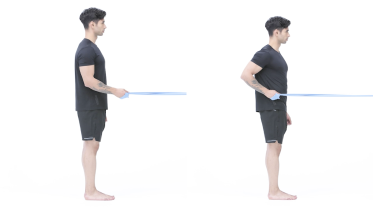
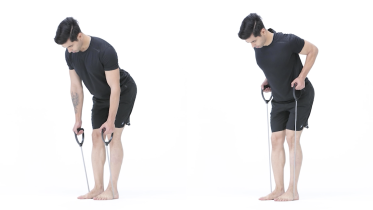
- Fix the middle of the band to a sturdy point in front of you, low down near the floor, as in the video. Stand tall facing it with your feet about hip width apart, holding one end in each hand, arms reaching forward and elbows slightly bent.
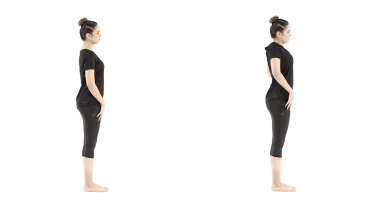
- Move back far enough that the band has a little tension. Tuck your chin gently and keep your shoulders back and your trunk still.
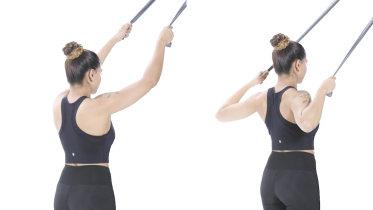
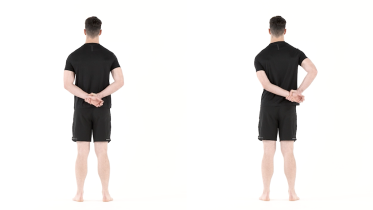
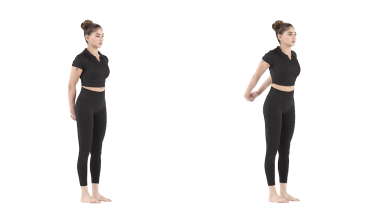
- Pull your elbows back and out to the sides, bending them to a right angle so your hands come up to about chest height. Squeeze your shoulder blades together.
- Keeping that right angle, lift your elbows out to the sides and turn your forearms up until your hands point to the ceiling beside your head. Your elbows finish at about shoulder height or a little below, never higher.
- Reverse the movement slowly: turn the forearms back down, bring the elbows in, and let your arms reach forward to the start.
What you should feel
Work between your shoulder blades and at the back of your shoulders, building as your forearms turn up. The top of your shoulders works too, but your neck should stay relaxed.
Common mistakes
- Arching your lower back or leaning back as the hands go up.
- Shrugging your shoulders toward your ears during the turn.
- Letting the elbows straighten or close up in the turn. Hold the right angle.
- Rushing the return so the band pulls you forward.
How often
A light band is the usual start, with 2 to 3 sets of 8 to 12 slow repetitions on 3 or 4 days a week. Your physio will adjust this.
Stop and check with your physio if
- A sharp pain, a catch, or a feeling that the shoulder might slip out as your hands turn up.
- Pain, numbness or tingling travels down an arm.
- Pins and needles in your arm or hand that do not go away after you stop, or part of your arm or hand goes numb. Get medical advice the same day. If one side of your face or body suddenly goes numb or weak, or your speech becomes slurred or muddled, call emergency services, even if it goes away.
- Your shoulder aches more than usual after the set and has not settled by the next day.
- A sudden pop or snap at the front of your elbow, sudden sharp pain there, or the muscle at the front of your upper arm bunches up or changes shape. Stop and go to an urgent care center or emergency department the same day, even if you can still bend the elbow, as this can be a torn biceps tendon.
- The shoulder feels as if it has slipped out of place, looks a different shape or suddenly locks so you cannot move the arm, or your hand turns cold, pale or blue. Go to an emergency department straight away, without driving yourself, and do not try to put the shoulder back in yourself.
From the clinic
The voice guide talks you through the row only. In the video the movement carries on into the turn, with the elbows held at a right angle as the forearms turn up, and the steps here follow the video. If the full movement is too much, split it in two: the resistance band row and shoulder external rotation with a band, done with the elbow at your side. 90/90 external rotation with a band trains the turned-up part on its own.
Hands up and turned out beside your head is the position in which an unstable shoulder is most likely to feel it could slip. If your shoulder has dislocated or you have had shoulder surgery, check with your surgeon or physio before you try this exercise. Before you start, inspect the band for small splits and tug on the anchor, because a band that snaps or pulls loose can whip back at you.
With low bone density (osteoporosis), the upright standing position suits this exercise. Keep your trunk facing forward without twisting. If you have ever fractured a bone in your spine, get your physio's go-ahead first. With a low anchor, bend your knees and keep your back straight to pick up the band ends, rather than stooping forward.
If you have high blood pressure, breathe steadily through every repetition and never hold your breath. In the first months after heart or chest surgery, check with your medical team before you add band work for the arms, because the breastbone needs time to heal.
Written and checked by the PocketPhysio editorial team. Last updated 2026-09-28.
This page is general education, not a diagnosis or a personal treatment plan. If you have pain, an injury or a health condition, see a physiotherapist or doctor before starting new exercises.