
Swimmer's shoulder exercises and physiotherapy
Warning signs, and when to get help
What is swimmer's shoulder?
Swimmer's shoulder is what people call a painful shoulder in someone who swims. It is a description of how the pain arrived, not a diagnosis, and that difference matters because the problems hiding behind the label are not treated the same way.
Pull the label apart and you usually find one of a handful of things. An irritated rotator cuff tendon is the commonest, and our rotator cuff tendinopathy page carries the fuller tendon program. Pain around the bony tip of the shoulder with a painful band partway up the lift fits subacromial pain, still widely called impingement. A sore spot at the very front of the shoulder that hurts to press can be the biceps tendon, and a shoulder blade that will not hold its position under load is covered on scapular dyskinesis.
The last group is the opposite problem. Some swimmers have shoulders that move a very long way and struggle to control the end of that range, and a few are generally loose-jointed. If your shoulder has ever slipped out or felt as though it might, start with shoulder dislocation rather than this page, and hypermobility covers the wider picture. A loading program built for a stiff, painful tendon can be the wrong answer for a shoulder that is too mobile.
The guidelines have moved the same way. The Dutch Orthopaedic Association guideline puts bursitis, calcium deposits, supraspinatus tendinopathy, partial cuff tears and biceps tendinitis inside one term, subacromial pain syndrome, and says the old anatomical idea of the cuff being pinched is not enough to cover what is going on (Diercks and colleagues, 2014). If your letter uses the word impingement, what causes shoulder impingement goes through how much of that older picture survived.
Where it hurts, and what it usually feels like
Ask a swimmer to point and the finger usually lands on the top and outer part of the shoulder, with some people adding a second spot at the front. Pain through the catch and the first half of the pull is the typical complaint, and it often arrives a few hundred meters in rather than on the first length. Sein and colleagues (2010) gave MRI scans to 52 of 80 elite swimmers and found supraspinatus tendinopathy, a problem with the tendon that runs over the top of the joint, in 69% of them, which is the structure sitting under the spot swimmers point to.
Out of the water, the same shoulder tends to complain about reaching to a high shelf, putting on a jacket and lying on that side at night. The first two are taken further on shoulder pain when lifting your arm, and the night on shoulder pain at night and sleeping with shoulder impingement.
Two patterns do not belong here. Pain that travels below the elbow, or comes with pins and needles, is more likely coming from the neck. A shoulder that has stopped short in every direction, including turning the arm out with the elbow tucked at your side, fits frozen shoulder better, and it needs a different plan.
What causes shoulder pain from swimming?
How much swimming, and above all how quickly that number changed, is where the evidence points, and it points there less firmly than most swimming advice admits. Sein and colleagues (2010) studied 80 elite swimmers aged 13 to 25; 73 of the 80, which is 91%, reported shoulder pain, and both weekly hours and weekly distance correlated with tendinopathy on MRI. Stroke preference did not, and shoulder looseness had only a weak link with impingement pain and none with the tendon changes. That was the study's whole point: it set out to test the idea that swimming makes the shoulder loose and the looseness causes the pain, and the numbers went the other way.
Be careful with that 91%, because it describes one particular group. These were elite swimmers in a single cross-sectional study, training a median of 16 hours and 40 km a week, and the figure counts anyone who reported shoulder pain at any frequency, from monthly to constant. Inside the same squad the scan findings tracked how hard the group trained: supraspinatus tendinopathy showed up in 40% of the state level swimmers, 89% of the national ones and all 4 of the internationals.
When the Feijen review of swim volume and shoulder pain reports adolescents highest at 91.3% and masters swimmers lowest at 19.4% (Feijen and colleagues, 2020), those two figures are not separate evidence. The 91.3% is Sein's own 73 of 80, carried over to one more decimal place, and the 19.4% is Tate and colleagues (2012), who studied 236 female competitive swimmers aged 8 to 77 and counted swimmers with substantial pain, dissatisfaction and disability rather than any pain at all. Of their 67 masters swimmers, 13 met that threshold on a group average of 4 hours of swimming a week, and roughly one in five of every other age band met it too, on group averages of 7 to 16 hours. If you swim with a masters club, that is the closest study to you, although it looked only at women.
The volume story is also graded more cautiously than the headline suggests. Feijen and colleagues (2020) rated the evidence linking training volume to shoulder pain as moderate in adolescents aged 15 to 17 and low in younger, adult and masters swimmers, and they note that cause and effect cannot be assumed from the studies available.
A larger review sharpens it further. McKenzie and colleagues (2023) went through 22 studies and rated the evidence as moderate that several things people blame are not associated with shoulder pain or injury in swimmers: internal and external shoulder range of motion, the back-scratch test, training frequency, specialty stroke, height, weight, sex and age. Their highest quality study, with 201 swimmers, pointed instead at a high acute-to-chronic workload ratio and at reduced strength endurance at the back of the shoulder. That review is also more careful about raw volume than the usual swimming advice is: across the same 22 studies it found limited evidence against training time being associated with injury at all, and conflicting evidence on training distance, and it rated none of the 22 as high quality. Put all of that together and you get something useful: how many hours you swim matters less than whether this month is far bigger than the last few, and whether the back of the shoulder can keep working when it gets tired.
Two things did carry moderate evidence of an association in that review, and neither is something you can stretch. One is the level a swimmer competes at, although the direction is unclear, so a move to a harder squad is worth noticing. The other is how the shoulder muscles switch on, measured with electrodes on dry land.
The factor with the largest numbers behind it, on limited evidence, is a shoulder you have already injured: across three studies a previous shoulder injury raised the risk of the next one by roughly 4 to 7 times, and in one of them a swimmer with that history was 11.3 times more likely to pick up an injury that cost more than 2 weeks of training. The same review downgraded joint looseness to conflicting evidence, which is the honest state of that question.
The same evidence is why this page spends less time on posture than the usual advice does. The measurement most people mean by tight shoulders, how far the joint turns in and out, came out unassociated in the McKenzie review. The length of the small chest muscle under the collarbone, which is the one chest measure these studies actually took, came out as conflicting evidence in the same place. The chest stretch in stage 2 is there because the prevention programs included one, not because a short muscle has been shown to cause the pain. A long taper followed by a sudden return to full distance, a training camp, a new squad or a masters swimmer adding a second session a week will do more than any amount of chest stretching.
Do swimmer's shoulder exercises work?
Most of what has been studied in swimmers sits on the prevention side. Yoma and colleagues (2022) screened 452 papers, included 14, and reported that 6 to 8 weeks of strengthening for the external rotators and the shoulder blade retractors, together with chest stretches, can lower how many swimmers develop shoulder pain. They also reported that adding hands-on treatment to exercise and stretching may help swimmers who are already sore. Programs that ran beyond 12 weeks raised external rotation force, endurance and the ratio between outward and inward turning strength, but those gains did not come with less pain, and the authors ask for caution because the studies they found were methodologically limited.
That last point is worth stating plainly rather than burying. The same authors ask for high-quality randomized trials of both prevention and management in swimmers, which tells you what weight to put on the studies they did find. The program below therefore borrows its shape from two places: the exercises the swimmer prevention studies used, and the guidelines for subacromial pain in the general population.
From the guideline side, the Dutch Orthopaedic Association recommends exercise at low intensity and high frequency, kept within the pain threshold, with slow lowering work and shoulder blade control included, and says subacromial pain should preferably be treated without surgery because there is no convincing evidence that operating does better (Diercks and colleagues, 2014). Yoma and colleagues also found dry-land and open chain exercise better than in-water and closed chain work for building rotator strength and endurance, which is the argument for doing this out of the pool rather than hoping swimming itself will fix it.
One piece of the published advice is not in the program below, and it is fairer to say so than to leave you thinking the list is complete. Wanivenhaus and colleagues (2012) put abdominal and core strengthening next to the shoulder blade and cuff work in their prevention list, and Tate and colleagues (2012) found less core endurance in the symptomatic swimmers aged 12 and over and ended on a recommendation that included core endurance training. What follows is the shoulder half. If your trunk gives way late in a set, or your legs sink as the session goes on, that is the half to ask your physio about.
How to use this program
Start at the stage that matches your shoulder this week, or at stage 1 if you cannot tell. Move up when the current stage feels easy and the shoulder is no worse the next morning, not on a date.
Each exercise page gives its own numbers and how often to do them, and your physio will adjust this. As a rough guide, the static holds run at 5 to 10 holds of 5 to 10 seconds once or twice a day, the band and shoulder blade exercises at 2 to 3 sets of 8 to 15 slow repetitions once a day or every other day, and the stretches at 2 to 5 holds of 15 to 30 seconds. Keep breathing through every hold, since straining with a held breath can raise your blood pressure, and if you have high blood pressure or a heart condition, ask your doctor or physio about long holds first.
Some discomfort while you work is normal. The working rule on this page is mild discomfort that settles soon after you finish and leaves the shoulder no worse the next morning. Sharp pain, a catch, or pain that builds with each repetition means that exercise comes out for now. A shoulder that is clearly worse the next day, or that starts waking you again, is telling you the total load went too high, in the water or out of it.
If chest pain, pressure or tightness does not ease quickly when you rest, spreads to your arm, neck, jaw, stomach or back, or comes with sweating, feeling sick, feeling light-headed or being short of breath, call emergency services straight away, as this can be a heart attack. If it eases quickly and none of these happen, get medical advice the same day, and do not exercise again until you have been checked.
After shoulder surgery, including a rotator cuff repair, or after a shoulder fracture or dislocation, follow your surgeon's or physio's plan, and do only the movements and range they have cleared. Many plans allow only passive movement at first, where the arm is moved for you and its muscles stay relaxed.
The exercise program
Stage 1: Settle the shoulder and keep swimming where you can
For a shoulder that hurts during the pull, aches after a session or wakes you when you lie on it. The two static holds load the muscles that turn the arm outward without the shoulder moving, which many swimmers manage even when reaching overhead still hurts. A usual starting dose is 5 to 10 presses held 5 to 10 seconds, once or twice a day, beginning lightly. In the wall version, keep the upper arms down near your sides rather than raised to the height its video shows. The arm out at shoulder height and turned back is a stage 3 position on this page, and the one an unstable shoulder likes least. The pendulum lets the joint move with the shoulder muscles relaxed, often 30 to 60 seconds in each direction, a few times a day. The lat stretch and the chair extension work the side of the ribs and the upper back, two places swimmers often feel tight, though the measurement evidence on tightness is thin. Hold the stretch 20 to 30 seconds, 2 to 3 times, and keep the chair version to 5 to 10 slow repetitions with a short pause at the end. If you have osteoporosis, or have had a fracture in your spine or ribs, check with your physio before you lean back over a chair edge, and keep your back upright in the lat stretch so that only the arm reaches. Your physio will adjust this.
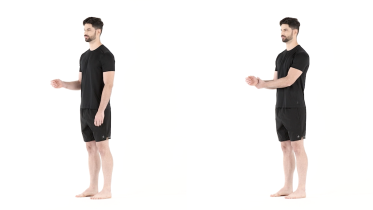 Isometric shoulder external rotation
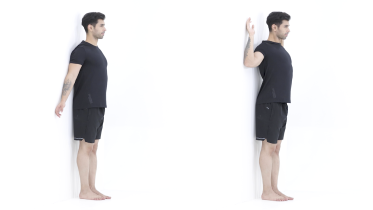 Isometric external rotation at a wall
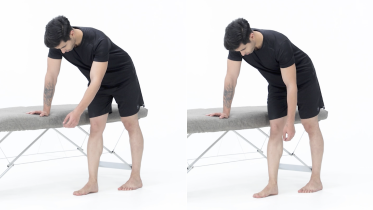 Pendulum exercise for the shoulder
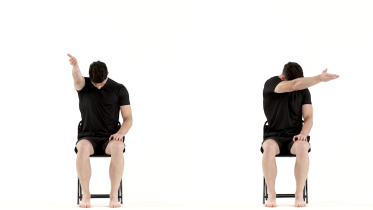 Seated lat stretch
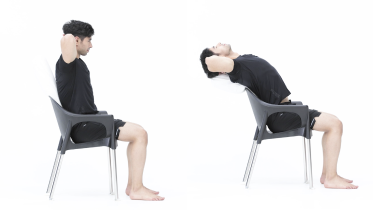 Thoracic extension over a chair
Stage 2: Shoulder blade control and the external rotators
When the holds feel easy and the first few hundred meters no longer hurt. The serratus punch and the wall push up plus train the muscle that slides the shoulder blade forward around the ribs, and the prone squeeze and wall angels train the muscles that pull it back and hold it down. Most of these start at 2 to 3 sets of 10 to 15, with wall angels commonly 1 to 3 sets of 8 to 12 and a 3 to 5 second squeeze on the prone version. Side-lying external rotation is the first moving work for the rotator cuff, 2 to 3 sets of 10 to 15 slow repetitions with nothing in the hand, and the elbow has to stay against your ribs or the exercise turns into a sideways lift. The foam roller extension is optional, held 20 to 30 seconds or 3 to 5 slow breaths, 2 to 3 times. The pec minor stretch is in this stage because the swimmer prevention programs paired the strengthening with a chest stretch. Hold it 15 to 30 seconds, 3 to 5 times. If you have osteoporosis, have had a fracture in your spine or have a recent rib injury, check with your physio before the foam roller. This is the stage the swimmer-specific research is built around: external rotator and shoulder blade work with a chest stretch. Those programs ran 6 to 8 weeks, so judge the program over that kind of span rather than over a fortnight, even if you have moved up to stage 3 inside it.
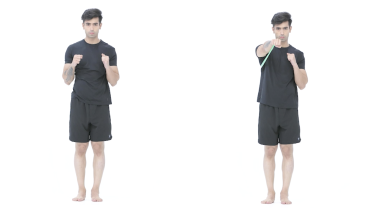 Band serratus punch
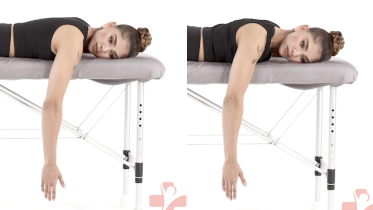 Prone scapular retraction
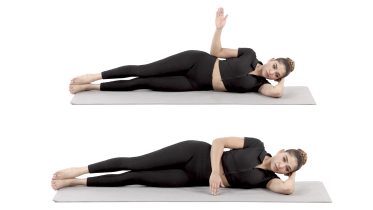 Side-lying external rotation
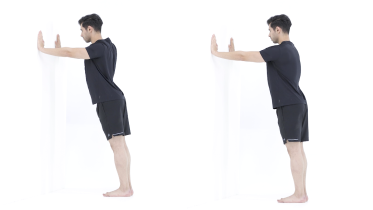 Wall push up plus
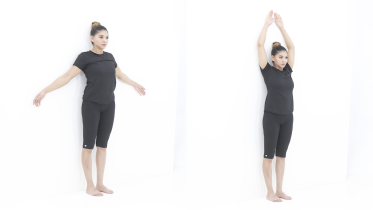 Wall angels
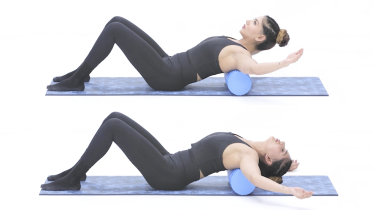 Foam roller thoracic extension
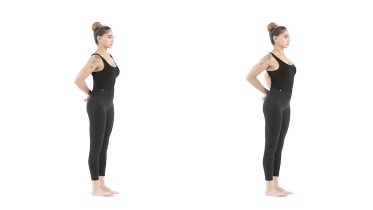 Pec minor stretch
Stage 3: Strength and back to full training
When 3 sets of stage 2 feel easy and the shoulder is no worse the next morning, keep the ones you need and add these. Four of them train the same outward turn in different ways, and that is deliberate. The band turn at your side is the plainest version, at 2 to 3 sets of 10 to 15. The row with a turn joins that turn to a pulling action, at 2 to 3 sets of 8 to 12 on 3 or 4 days a week. The other two hold the arm out at shoulder height the whole time: the 90/90 turn against a band at 2 to 3 sets of 8 to 15, and the slow lowering version, where a stick lifts the arm for you and you take 3 to 5 seconds to let it down again, at 2 to 3 sets of 8 to 12. The plain band row, 2 to 3 sets of 10 to 15, carries the load for the muscles between the shoulder blades. Leave the two shoulder height ones until last, and put the finish of the row with a turn in the same group, because all three end with the hands up beside the head. The arm out and turned back is the position in which a shoulder that has come out at the front feels least secure, and it is close to where a backstroker's hand enters the water. The quality the swimmer research keeps naming at the back of the shoulder is endurance rather than peak strength, so more repetitions at a band you can still turn against cleanly is as likely a next step as a stronger band. Your physio will set the band, the order and the numbers.
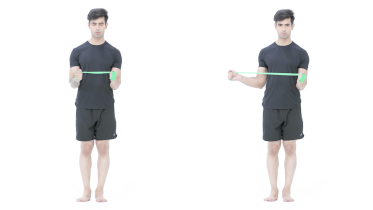 Shoulder external rotation with band
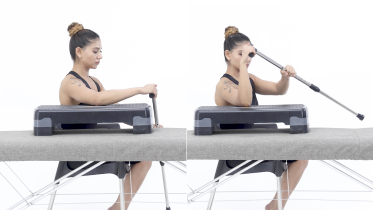 Eccentric external rotation
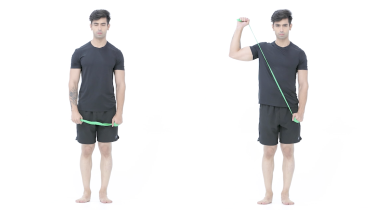 90/90 external rotation with band
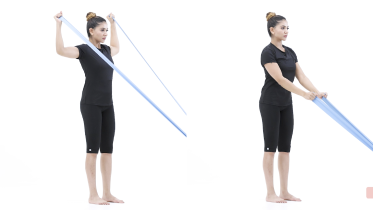 Band row with external rotation
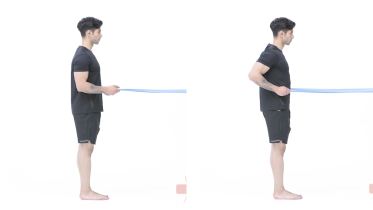 Resistance band row
How to keep swimming with a sore shoulder
Stopping altogether is rarely the first move. Wanivenhaus and colleagues (2012) make the case directly: absolute rest is seldom indicated because a trained swimmer loses condition quickly, so the aim is relative rest, which means less and different rather than none. They add, honestly, that the best length of that reduced period is not known.
The first things to change in a training week are the ones that add shoulder load without adding much else. Hand paddles and pulling sets are discouraged in that paper because they stress the shoulder and can make the injury worse. Whether paddles help cause shoulder problems in swimmers who are not yet sore is a separate question, and McKenzie and colleagues (2023) rated the evidence on it as conflicting, so take the advice for what it is: a way to take load off a shoulder that already hurts. Temporarily leaving out the strokes and positions that hurt is recommended too, and the paper names freestyle and butterfly as the usual culprits, while noting that many swimmers tolerate breaststroke without pain.
The usual substitutes come with their own small print, from the same paper. A kickboard holds volume while the arms do less, and the authors suggest keeping the elbows bent on it rather than stretching the arms straight out in front, which is the position that pinches, adding that even the bent elbow version may need adjusting if it pushes the shoulders up and forward. Fins are the other option they name, for holding body position with less work through the upper body. The catch with both, and with a pull buoy, is your lower back: all three appear in the same paper as devices that can arch the lumbar spine too far, so if your back starts complaining, that is where to look first.
Dry-land weight training for the arms and shoulders gets cut back or dropped while the shoulder is sore, which is also the NHS line on heavy gym equipment during shoulder pain. The targeted cuff and shoulder blade work in the program above is the exception to that, and it is not the same thing as a gym session.
Three practical details come from the same source and are worth knowing. The warm-up should be long and slow once a swimmer has started to hurt. Intensity, distance and frequency all get adjusted as soon as pain appears, rather than one of the three. And if pain persists through that, 3 days of complete rest followed by a reassessment before going back in the water is their suggestion, with a medical review if the pain returns as soon as training resumes.
Coaches have a part in this that a web page cannot replace. Wanivenhaus and colleagues describe a dropped elbow during the recovery phase of the freestyle stroke as a sign of injury, and a wider hand entry as one of the changes that shows up in a painful shoulder. Both are things someone on the pool deck can see and you cannot feel, which is a good reason to tell your coach the shoulder hurts rather than quietly swimming around it.
Which stroke causes shoulder pain?
This is the question swimmers ask first, and the answer is not the one most of them expect. McKenzie and colleagues (2023) rated the evidence as moderate that specialty stroke is not associated with shoulder pain or injury, and Sein and colleagues (2010) found no link between stroke preference and tendinopathy on MRI in their squad of 80.
So being a butterfly swimmer rather than a backstroker does not put you in a different risk group, as far as anyone has measured. What does change once the shoulder is already sore is which strokes are comfortable, and there freestyle and butterfly are the two most often taken out for a while (Wanivenhaus and colleagues, 2012). Those are two different statements, and conflating them is how swimmers end up giving up a stroke they never needed to lose.
The related piece of coaching advice, switching to breathing on both sides to even the shoulders up, has been measured as well. Breathing to one side came out unassociated with shoulder pain, and McKenzie and colleagues (2023) put breathing side among the risk factors that more recent research has contradicted. There may be other reasons to breathe bilaterally, but protecting the shoulder is not one the evidence supports.
How long swimmer's shoulder takes to settle
Nobody has tracked recovery time in swimmers with shoulder pain in a way that would let us give you a number, so this page will not invent one. The closest honest markers come from general shoulder pain and from the prevention studies: the NHS says recovery from shoulder pain can take 6 months or longer, and suggests keeping shoulder exercises going for 6 to 8 weeks to stop it returning, while the swimmer programs in the Yoma review ran 6 to 8 weeks.
What that means in the water is that progress shows up as distance tolerated rather than as a pain score. If 1,500 meters left you sore last fortnight and 2,000 does not now, the shoulder is getting better even if the hard sets still hurt. Build it in steps that size rather than in jumps, for the workload reason above. Keep a simple note of the distance and what the shoulder did the next morning, because a month of those notes answers the question better than how you feel on any one day. If 2 weeks of sensible changes have made no difference at all, that is the point the NHS suggests getting it looked at.
Junior and age group swimmers
This page is written for adults, and that is deliberate. A good deal of the swimmer's shoulder research was done in teenagers and young adults, and the link between training volume and shoulder pain was graded strongest in 15 to 17 year olds (Feijen and colleagues, 2020), which makes it tempting to hand a junior swimmer the same program. Do not. A young swimmer's shoulder should be examined in person, by a physio or doctor who can also talk to the coach about the training week, because load decisions for a growing athlete sit with the people who set the sessions. Take them to be seen rather than starting anything from a page.
When to see a physio or doctor
The NHS advises seeing a physio or doctor if shoulder pain is getting worse or has not improved after 2 weeks, or if it is very hard to move your arm or shoulder. Get it assessed sooner if you are not sure the pain is coming from the shoulder at all. Get medical advice the same day if symptoms travel into the arm, or the arm feels weak or numb, and nobody has looked at it yet.
An assessment is worth having early for a swimmer even when nothing looks alarming, because the two commonest mistakes are treating a loose shoulder as a stiff one and leaving the training week untouched. A physio can compare how far the arm goes when you lift it against how far it goes when they lift it, which is one of the findings that separates a stiff shoulder from a painful but mobile one. They can also plan the water volume alongside the dry-land work. No single test names the problem. The Dutch guideline says the diagnosis rests on a combination of clinical tests and names three worth doing: the Hawkins-Kennedy test, the painful arc, and a strength test of the muscle that turns the arm outward (infraspinatus) (Diercks and colleagues, 2014).
Surgery sits a long way down the list. The Dutch guideline says subacromial pain should preferably be managed without an operation and found no convincing evidence that surgical treatment works better, and keeps a bursectomy for people who have not responded to thorough non-surgical care (Diercks and colleagues, 2014). The trials behind that conclusion are set out on our shoulder impingement page, and if the question on your mind is which of several shoulder problems you actually have, impingement, bursitis or a rotator cuff tear compares them. The warning signs below all need medical attention, and some need it straight away.
For physiotherapists
This page treats swimmer's shoulder as rotator cuff related shoulder pain in a swimming athlete, and routes the differential rather than restating it: the subacromial and tendinopathy programs live on their own pages, and instability and generalized laxity are sent elsewhere before any loading begins. There is no post-surgical stage here by design.
The evidence base is worth knowing in its actual shape. Yoma and colleagues (2022) support 6 to 8 weeks of external rotator and scapular retractor strengthening with pectoral stretching as prevention, found no pain benefit from programs beyond 12 weeks despite strength and endurance gains, and favored dry-land open chain over in-water closed chain work for those qualities, with an explicit caution about study quality. Those authors call for high-quality randomized trials of both prevention and management in swimmers, so the staging on this page leans on Diercks and colleagues (2014) for low load, high frequency, within-pain-threshold exercise with eccentric and scapular components.
On risk factors, McKenzie and colleagues (2023) rated as moderate the absence of association for glenohumeral range of motion, the back-scratch test, training frequency, specialty stroke, anthropometrics, sex and age, with their highest quality study (n = 201) implicating acute-to-chronic workload ratio and posterior shoulder strength endurance. Only competitive level, where the direction of the association is unclear, and sEMG recruitment profiles reached moderate evidence of an association. Note what that review does to absolute load, because it is not what the swimmer literature is usually quoted for: limited evidence against training time, conflicting evidence on training distance, no included study rated high quality, and strength endurance named as the most clinically relevant modifiable intrinsic factor on limited evidence. Sein's volume correlations and Feijen's grading carry the absolute-volume claim; McKenzie carries the rate-of-change one, so dose the posterior cuff for endurance and read the training log for the delta rather than the total. Glenohumeral laxity and instability was downgraded to conflicting evidence in that review, and prior shoulder injury carried limited evidence with large effect sizes, 4.1 to 7 times for a subsequent injury and 11.3 times for one costing more than 2 weeks, which is the reason this page routes instability and generalized hypermobility out rather than loading them here.
Sein and colleagues (2010) remain the cleanest volume signal, with weekly hours and distance correlating with supraspinatus tendinopathy, and laxity relating weakly to impingement pain and not at all to tendinopathy. Prevalence figures in this literature are not interchangeable, and two of the ones in circulation are the same number twice over: the 91.3% adolescent figure in Feijen and colleagues (2020) is Sein's own 73 of 80 reporting pain at any frequency, and the 19.4% masters figure is Tate and colleagues (2012) meeting a pain, dissatisfaction and disability threshold. Progress patients on the 24-hour response and on tolerated distance rather than a fixed timeline, and treat the training log as part of the examination.
Warning signs
Get emergency help now
- Emergency: chest pain or tightness, which may spread to your arm, neck or jaw, or shoulder or arm pain that comes with shortness of breath, sweating or feeling sick. This can be a heart attack. Call emergency services straight away.
- Emergency: the shoulder feels as if it has slipped out of place, looks a different shape or suddenly locks so you cannot move the arm, or the pain is severe after a fall or an injury. Go to an emergency department straight away, without driving yourself, and do not try to put the shoulder back in yourself.
- Emergency: your arm, hand or fingers turn cold, pale, blue or gray compared with the other side. Call emergency services or go to an emergency department straight away, and do not drive yourself. The blood supply to the arm may be blocked.
Get help today
- Same day: the shoulder is hot, red and swollen, or you have a fever or feel unwell. This can be a joint infection, which needs treatment quickly. Go to an emergency department the same day, and call emergency services if you feel very unwell.
- Same day: sudden, very bad shoulder pain, or you suddenly cannot lift or move your arm at all. Get medical help the same day.
- Same day: a sudden pop or tearing feeling in the shoulder that brings sharp pain, new weakness or trouble lifting the arm. Stop and get medical advice the same day, or contact your surgical team the same day if you have had shoulder surgery.
- Same day: the pain started after a fall, a pull or another injury, especially if the arm has been weak since, for example you cannot lift it out to the side or hold it up. This can be a broken bone or a torn tendon. Get medical advice the same day, and say how it happened and that the arm has been weak since, because UK shoulder surgeons advise urgent referral for a rotator cuff tear caused by an injury.
- Same day: pins and needles or numbness in the arm that does not go away, no feeling in part of the arm, or weakness that is getting worse. Get medical advice the same day. For pain spreading down the arm from your neck, ask for an urgent appointment with your doctor. If one side of your face or body suddenly goes numb or weak, or your speech becomes slurred or muddled, call emergency services, even if it goes away.
- Same day: severe pain in both shoulders that has come on recently. Get medical advice the same day.
- Same day: you are over 50 and have aching and stiffness in both shoulders, often in the neck or hips too, that is worst in the morning and lasts more than 45 minutes after you get up. This can be an inflammatory condition (polymyalgia rheumatica) rather than a local shoulder problem. If you also get a new headache, pain or tenderness at your temples or on your scalp, or jaw pain when you eat or talk, get medical advice the same day, and if your vision changes, call emergency services. Even without those extra signs, see your doctor within a few days about the aching and stiffness.
- Same day: pain at night or at rest that is constant, that no rest or change of position eases at all, and that keeps getting worse. If you are being treated for cancer now, contact your cancer team the same day.
Book an appointment
- Within a day or two: new shoulder pain and you have had cancer, now or in the past, or you are losing weight without trying. See your doctor within a day or two and mention it.
- Within a day or two: pain at night or at rest that is constant, that no rest or change of position eases at all, and that keeps getting worse. If you have had cancer, now or in the past, or are losing weight without trying, see your doctor sooner, within a day or two, and mention it. This applies even if the pain is not getting worse.
- Within a few days: night pain is common with shoulder problems, but get checked within a few days if the pain is constant, no rest or change of position eases it at all, and it keeps getting worse.
Common questions
What does swimmer's shoulder feel like, and where is the pain?
Most swimmers point to the top and outer part of the shoulder, sometimes with a second sore spot at the front. The usual pattern is nothing for the first few lengths, then an ache that builds as the session goes on and is worst at the catch and through the pull. Sein and colleagues (2010) scanned 52 of 80 elite swimmers aged 13 to 25 and found tendinopathy of the tendon over the top of the shoulder (supraspinatus) in 69% of them, which fits where swimmers say it hurts. Pain that wakes you when you lie on that side is common with a sore cuff, and our page on shoulder pain at night goes through it. Pain spreading below the elbow, or pins and needles, points somewhere other than the cuff and needs checking.
How long does swimmer's shoulder take to heal?
Nobody has measured it properly in swimmers, so any single figure you read is someone's impression. What there is to go on: the NHS says it can take 6 months or longer to recover from shoulder pain and suggests keeping shoulder exercises going for 6 to 8 weeks to stop it coming back, and the swimmer prevention programs in the Yoma review ran 6 to 8 weeks. Wanivenhaus and colleagues (2012) say plainly that the best length of relative rest is not known. In practice, judge it by the water you can do without the shoulder being worse the next morning, and expect that number to climb over weeks rather than days. If nothing at all has changed after 2 weeks, that is the NHS threshold for getting it looked at.
Can I swim with swimmer's shoulder?
Usually yes, with less of it and with the painful parts taken out for a while. Wanivenhaus and colleagues (2012) advise temporarily avoiding the strokes and positions that hurt, which they say are typically freestyle and butterfly, and adjusting intensity, distance and frequency as soon as pain appears. They also say that complete rest is rarely the answer because an elite swimmer deconditions fast, and that if pain persists a 3-day period of absolute rest followed by a reassessment is reasonable. Hand paddles and pulling sets come out in that paper, since both load the shoulder harder, and heavy dry-land arm and shoulder work gets cut back at the same time. A longer, slower warm-up is the other thing they recommend once a swimmer has started to hurt.
Is swimmer's shoulder the same as a rotator cuff injury?
It overlaps with one but is not a synonym. Swimmer's shoulder is a description of where the pain came from, and a rotator cuff problem is the most common thing found underneath it: in the Sein study the dominant finding was supraspinatus tendinopathy. Other things sit under the same label, including subacromial pain, an irritated biceps tendon at the front and a shoulder that moves further than it controls. The Dutch Orthopaedic Association guideline groups bursitis, calcium deposits, supraspinatus tendinopathy, partial cuff tears and biceps tendinitis under one umbrella term, subacromial pain syndrome, and says the old picture of a tendon being pinched does not cover the problem (Diercks and colleagues, 2014). Our rotator cuff tendinopathy page carries the fuller tendon program.
How do you fix swimmer's shoulder?
With a load you can tolerate in the water and a strength program out of it, run long enough to count. The research in swimmers points at the muscles that turn the arm outward and the muscles that control the shoulder blade, trained for 6 to 8 weeks, with stretching for the chest (Yoma and colleagues, 2022), although that program was tested for preventing shoulder pain rather than for treating it. The Dutch guideline asks for exercise at low intensity and high frequency, within the pain threshold, with slow lowering work and shoulder blade control included, which is the shape of the program on this page. The part people skip is the training side, and that is the part the evidence on causes keeps pointing to. A physical therapist (physiotherapist) can set the water volume and the dry-land load together, which is more useful than either on its own.
How do you prevent swimmer's shoulder?
More has been studied on the prevention side than on the treatment side. Yoma and colleagues (2022) reported that 6 to 8 weeks of strengthening for the external rotators and the shoulder blade retractors, with chest stretches, can lower how many swimmers develop shoulder pain, while programs longer than 12 weeks built strength and endurance without that showing up as less pain. The same review found dry-land and open chain work better than in-water work for building rotator strength and endurance. The other half is the training record: the best quality study in the McKenzie review, with 201 swimmers, linked injury to a high acute-to-chronic workload ratio and to reduced strength endurance at the back of the shoulder. Big, sudden jumps in distance are the thing to watch, not the calendar.
Which stroke causes shoulder pain?
Your main stroke does not predict who gets pain, which surprises most swimmers. McKenzie and colleagues (2023) reviewed 22 studies and rated the evidence as moderate that specialty stroke is not associated with shoulder pain or injury, along with shoulder range of motion, training frequency, height, weight, sex and age. Sein and colleagues (2010) also found no link between stroke preference and tendinopathy on MRI, while weekly hours and weekly distance both correlated with it. So the honest answer is that what your training load does beats which stroke you swim. Once a shoulder does hurt, the strokes that hurt it come out of the week for a while, and in practice those are usually freestyle and butterfly (Wanivenhaus and colleagues, 2012).
References
- Sein ML, Walton J, Linklater J, Appleyard R, Kirkbride B, Kuah D, Murrell GAC. Shoulder pain in elite swimmers: primarily due to swim-volume-induced supraspinatus tendinopathy. British Journal of Sports Medicine. 2010;44(2):105-113. https://doi.org/10.1136/bjsm.2008.047282
- Tate A, Turner GN, Knab SE, Jorgensen C, Strittmatter A, Michener LA. Risk factors associated with shoulder pain and disability across the lifespan of competitive swimmers. Journal of Athletic Training. 2012;47(2):149-158. https://doi.org/10.4085/1062-6050-47.2.149
- Feijen S, Tate A, Kuppens K, Claes A, Struyf F. Swim-training volume and shoulder pain across the life span of the competitive swimmer: a systematic review. Journal of Athletic Training. 2020;55(1):32-41. https://doi.org/10.4085/1062-6050-439-18
- McKenzie A, Larequi SA, Hams A, Headrick J, Whiteley R, Duhig S. Shoulder pain and injury risk factors in competitive swimmers: a systematic review. Scandinavian Journal of Medicine and Science in Sports. 2023;33(12):2396-2412. https://doi.org/10.1111/sms.14454
- Yoma M, Herrington L, Mackenzie TA. The effect of exercise therapy interventions on shoulder pain and musculoskeletal risk factors for shoulder pain in competitive swimmers: a scoping review. Journal of Sport Rehabilitation. 2022;31(5):617-628. https://doi.org/10.1123/jsr.2021-0403
- Wanivenhaus F, Fox AJS, Chaudhury S, Rodeo SA. Epidemiology of injuries and prevention strategies in competitive swimmers. Sports Health. 2012;4(3):246-251. https://doi.org/10.1177/1941738112442132
- Diercks R, Bron C, Dorrestijn O, et al. Guideline for diagnosis and treatment of subacromial pain syndrome: a multidisciplinary review by the Dutch Orthopaedic Association. Acta Orthopaedica. 2014;85(3):314-322. https://doi.org/10.3109/17453674.2014.920991
- NHS. Shoulder pain. Page last reviewed 22 May 2023. https://www.nhs.uk/symptoms/shoulder-pain/
- NHS. Chest pain. https://www.nhs.uk/symptoms/chest-pain/
- NHS. Heart attack. https://www.nhs.uk/conditions/heart-attack/
- NHS. Dislocated shoulder. https://www.nhs.uk/conditions/dislocated-shoulder/
- NHS. Polymyalgia rheumatica. https://www.nhs.uk/conditions/polymyalgia-rheumatica/
- NHS. Temporal arteritis. https://www.nhs.uk/conditions/temporal-arteritis/
Written and checked by the PocketPhysio editorial team. Last updated 2026-10-29.
This page is general education, not a diagnosis or a personal treatment plan. See a physiotherapist or doctor for advice about your own situation.