
Hypermobility exercises and physiotherapy (HSD and hEDS)
What is joint hypermobility?
A hypermobile joint bends further than the usual range. The HMSA estimates that around 1 in 10 people are hypermobile, and it is more common in women and children and in people of African-Caribbean and Asian descent. Many have no symptoms at all, and for them there is nothing to treat. The NHS says it can run in families.
For others, flexible joints come with problems. The NHS lists joint and muscle pain and stiffness, frequent sprains and strains, joints that dislocate or "pop out", poor balance and tiredness that does not go away with rest. The HMSA describes symptoms often starting after something tips the body from coping to not coping, such as an injury, an illness, stress, pregnancy or a change in activity.
Hypermobility, HSD and hEDS: what the labels mean
Doctors use a few different names, and they can be confusing. When hypermobility causes symptoms and no other condition explains it, the usual diagnosis today is hypermobility spectrum disorder (HSD), a label set out by an international group of experts in 2017 (Castori 2017). Hypermobile Ehlers-Danlos syndrome (hEDS) is one of 13 types of Ehlers-Danlos syndrome, and it has a stricter set of criteria. Unlike the other types, there is no genetic test for it, so it is diagnosed from symptoms and an examination (Malfait 2017). Older names you may see include joint hypermobility syndrome and benign joint hypermobility syndrome.
The Ehlers-Danlos Society says there is not yet a test that can reliably tell HSD and hEDS apart, and that the principles of management are the same for both. So this program suits either diagnosis. Rarer types of Ehlers-Danlos syndrome are different. The NHS says vascular EDS, for example, affects the blood vessels, so if a doctor thinks you may have one of those types, follow the advice of your specialist team. Tell your doctor if you bruise very easily or your skin is thin, with small blood vessels easy to see on your upper chest or legs, as the NHS lists these among the signs of vascular EDS.
Part of the assessment is often the Beighton score, a 9 point test in which a doctor or physio checks how far your little fingers, thumbs, elbows and knees bend on each side, and whether you can put your palms flat on the floor with straight knees. It is a clinical test, not a self-test for diagnosis. A high score on its own does not mean you have a condition, and the Ehlers-Danlos Society encourages clinicians to look more broadly than the score.
How this page differs from other pages
This program is for hypermobility that affects several joints, where the aim is better strength and control all over. If one joint is the main problem, a program for that joint fits better. After a dislocated shoulder or kneecap, use the shoulder dislocation program or the patellar dislocation program, and for an ankle that keeps rolling, the chronic ankle instability program.
Widespread pain with poor sleep and tiredness, but without very flexible joints, may be fibromyalgia. The fibromyalgia program covers it. Pacing matters in both, so some of the advice on that page will sound familiar.
Does exercise help hypermobility?
Yes, for many people, although the evidence is thin. The NHS says there is no cure, and that the main treatment is improving muscle strength and fitness so your joints are better protected. An international physical therapy guideline for HSD and hEDS describes physical therapy as central to care, while noting that the research behind it is limited in size and quality (Engelbert 2017).
A systematic review of 11 studies found consistent improvements from before to after treatment, but only weak evidence from controlled trials that exercise and other conservative care beat the comparison treatments (Palmer 2021). Another review found 6 small randomized trials in hEDS, with 20 to 57 people each and programs of 4 to 8 weeks. Pain or joint position sense improved in the treated groups, whatever type of treatment was used, and quality of life improved as well (Reychler 2021).
Two small studies looked at balance and joint position work. After an 8-week home program of weight-bearing exercises, the sense of knee movement improved in 16 of 18 people with hypermobility, and balance, pain, strength and quality of life improved too, although that study had no comparison group (Ferrell 2004). In a study of 40 people, the 15 who did 8 weeks of joint position exercises had less pain than the 25 who did not (Sahin 2008).
Heavier strength work is not off limits. In a trial of 100 people with HSD and shoulder symptoms, 16 weeks of heavy shoulder strengthening, with a physio supervising two of the three sessions each week, improved shoulder function slightly more than light strengthening, although the difference was smaller than patients would usually notice (Liaghat 2022). After a year, heavy loading was no better than light loading (Liaghat 2024). The heavy group had more short-lived muscle soreness and headaches, and there were no serious side effects.
In practice, start light and build load gradually. Heavier loading is an option to work toward with your physio, not on your own, but it did not give better results after a year. The NHS notes that some people with Ehlers-Danlos syndromes are advised to avoid heavy lifting altogether, so ask your physio or specialist first.
Strength and control, not more stretching
Hypermobile joints already move further than most, and the NHS advises not overextending your joints just because you can. That is why this program has no deep stretches. A gentle stretch that stops short of the end of the range is fine if a muscle feels tight, but the aim is control, not more range.
Control means your muscles can hold a joint steady in the middle of its range and stop it drifting to the end. A common example is standing with your knees pushed back, which rests your weight at the end of the knee's range. Try a soft knee and weight through both feet instead, and notice how it feels. The balance exercises in stage 3 train your sense of where your joints are, which the HMSA lists among the benefits of exercise, along with muscle strength and more stable joints.
Pacing and flare-ups
Tiredness is common with hypermobility, and doing a lot on a good day often leads to several bad ones. The NHS advises against repetitive exercises or activities without regular breaks, which it calls pacing. Put simply, find the amount you can still do on a bad day and stay close to it on good days too. Add a little every week or two, and only once the last increase has settled.
Plan for flares before they happen. Decide now what a flare-day version looks like, for example the stage 1 holds and a short walk, and do that instead of stopping completely. Build back up in small steps as it settles.
How to use this program
Choose the stage that suits your joints right now. Unsure? Stage 1 is the place to begin, even if it looks too easy. Go up a stage when the one you are on is easy on most days and you are back to normal by the next day. Keep going with the earlier exercises that suit you as you add new ones.
You will find a starting dose on every exercise page. Roughly, the strength exercises begin at 1 to 3 sets of 5 to 15, depending on the exercise, done daily or on a few days each week. Quad sets and the shoulder hold use 5 to 10 second holds, while the planks and the cushion balance begin at 10 to 30 seconds.
With hypermobility, pick the lowest figure on each page and move slowly, in control the whole way through. Brisk walking often begins with 10 to 20 minutes, most days of the week, split into shorter walks if that is easier. Your physio will adjust this.
Working muscles should feel tired, and mild aching is common when you start. A little discomfort is fine as long as it fades soon after and you feel no worse the following morning. If a joint aches more the next day, feels unstable or slips during an exercise, go back a step and tell your physio.
The exercise program
Stage 1: Control in the middle of the range
For a first start, a flare or a return after time off. These exercises build steady control with small movements and holds, with your joints kept in the middle of their range instead of pushed to the end. In the quad sets, the towel under your knee stops it pressing back past straight, and in the bridge, lift only until your body makes a straight line. In the wall push-ups, stop just before your elbows lock straight. Press gently in the shoulder hold and push harder only while it stays comfortable. Begin with the smallest dose each exercise page gives.
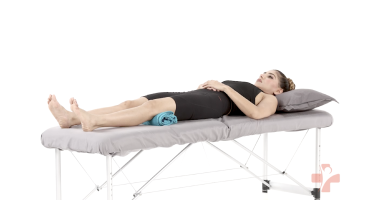 Quad sets (towel under knee)
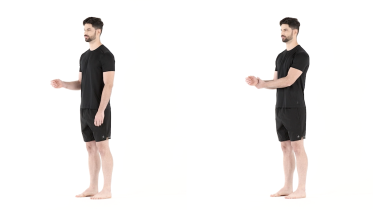 Isometric shoulder external rotation
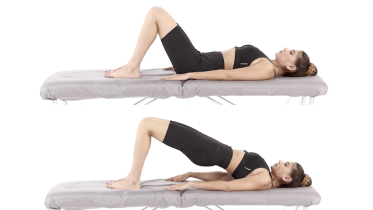 Glute bridge
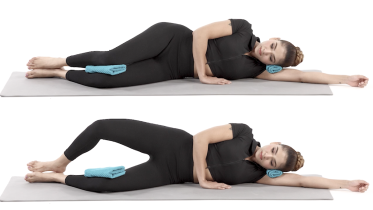 Clamshell
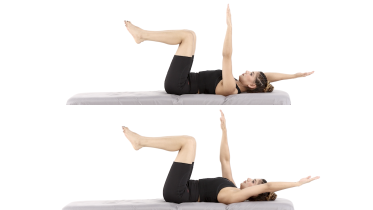 Dead bug
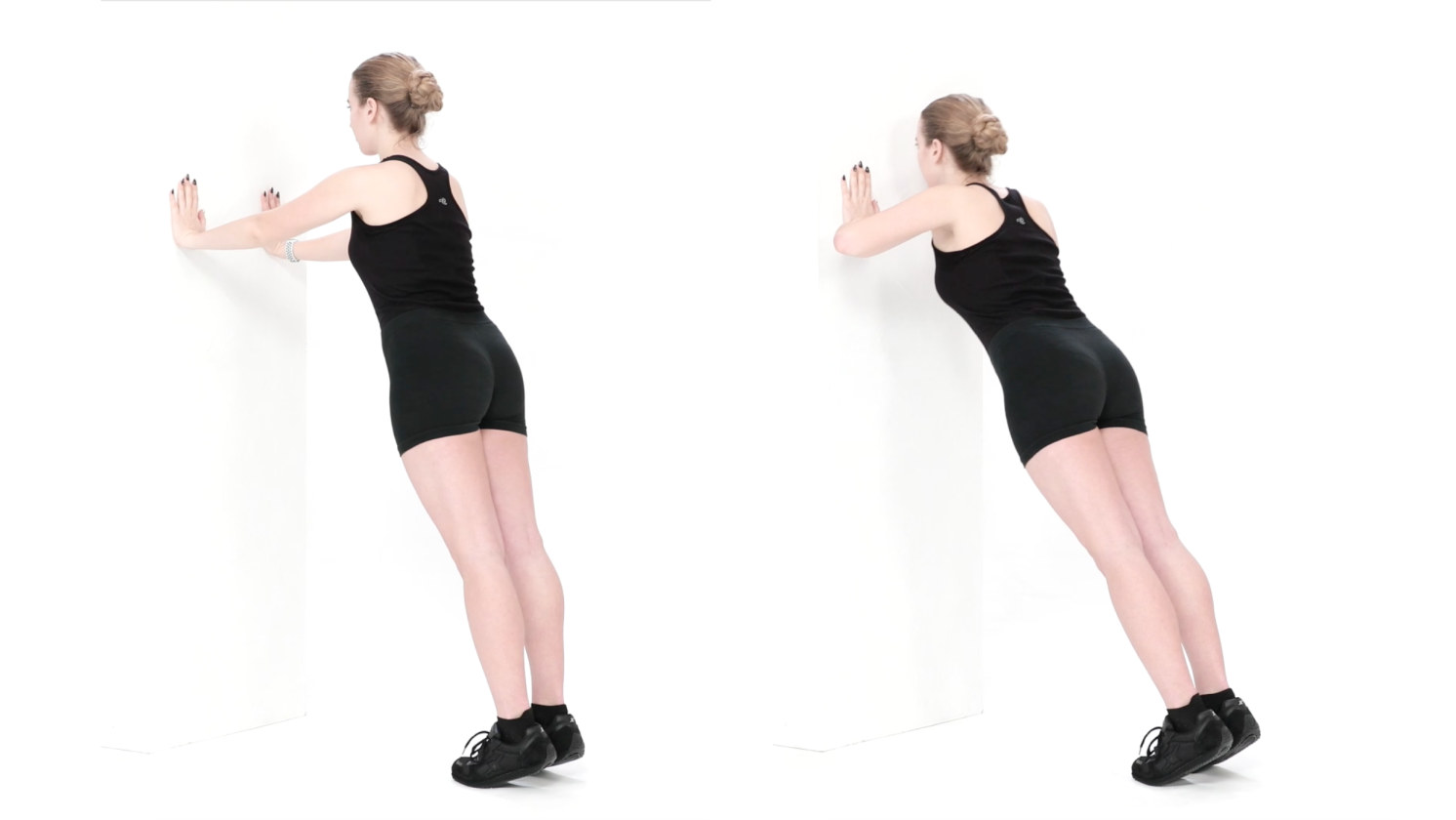 Wall push-ups
Stage 2: Build strength with light resistance
Once stage 1 is easy on most days and you are back to normal by the next day. Sit to stand, mini squats and calf raises train your legs with your weight on them, and the bands add load for the hips, shoulders and upper back. Stop each movement just short of locking your knees or elbows straight, and move slowly enough that you could stop at any point. Brisk walking builds fitness without jarring the joints. Add a set or a slightly stronger band before you add speed.
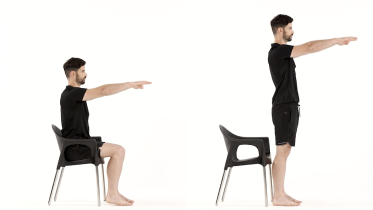 Sit to stand
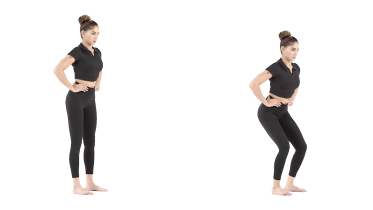 Mini squat
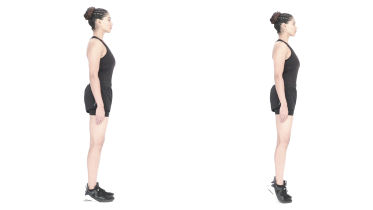 Calf raises
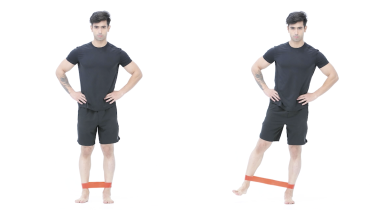 Standing hip abduction with band
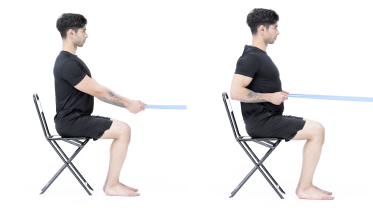 Seated row with band
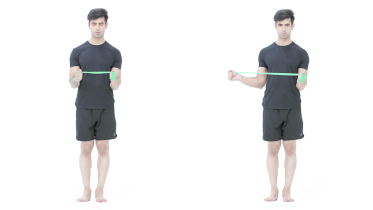 Shoulder external rotation with band
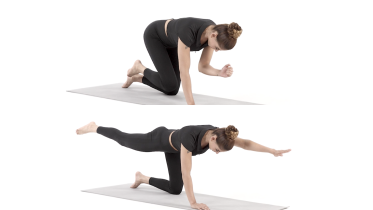 Bird dog
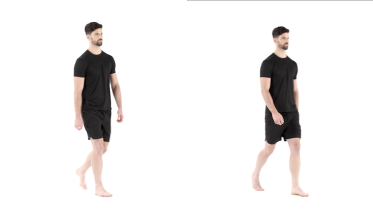 Brisk walking
Stage 3: Balance, joint position sense and single leg strength
Once stage 2 is easy and a busier week no longer sets off a flare. Balance work trains your sense of where your joints are (proprioception), which small studies found is often poorer with hypermobility. Stand next to a kitchen counter for every single leg exercise, and keep the standing knee soft rather than pushed back. The planks put your weight through your shoulders and arms, so start with short holds, and do the side plank on your forearm, elbow under your shoulder, if a straight elbow tends to lock. Make one change at a time.
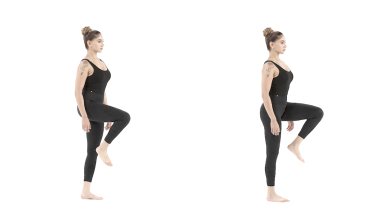 Single leg stance
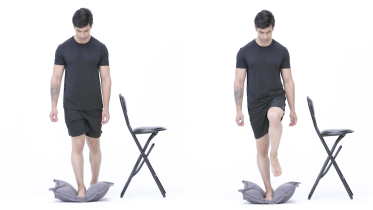 Single leg balance on a cushion
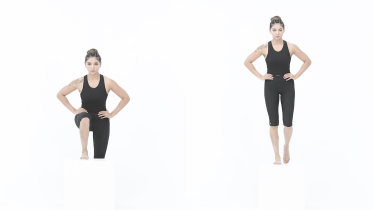 Step up
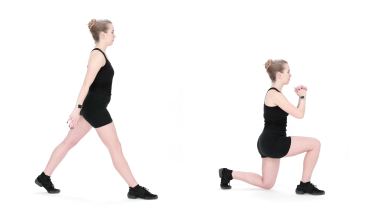 Split squat
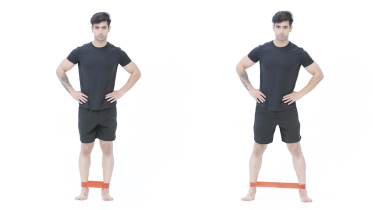 Lateral band walk
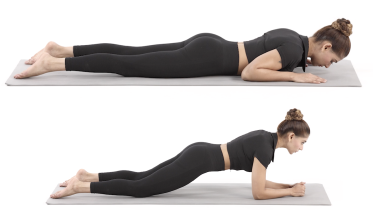 Kneeling plank
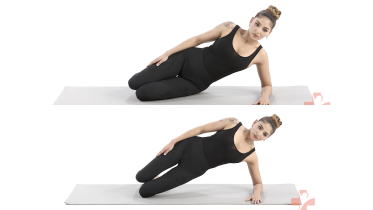 Kneeling side plank
What to avoid or change
The HMSA advises caution with contact sports, high-impact exercise such as running and jumping, and sudden twisting, and this program leaves them out. The NHS suggests starting with low-impact exercise such as swimming or cycling. Your physio can tell you when and how to build up to harder sport if it matters to you.
In every exercise, stop just short of locking your knees or elbows straight, and keep your movements slow enough to stop at any point. If a joint slips during an exercise, stop that exercise and tell your physio. The HMSA notes that splints or taping can help some people prevent injury, and your physio can advise whether they suit you. The NHS also suggests supportive shoes, insoles if a podiatrist recommends them, and keeping to a healthy weight.
For the balance work, keep a kitchen counter or sturdy chair within reach. Wear flat shoes that fit well and grip the floor, not socks, tights or bare feet.
With a heart condition or high blood pressure, check with your doctor before you start. If you have high blood pressure, breathe steadily through every repetition and never hold your breath. Stop straight away if you have any of these: chest pain or pressure, dizziness or feeling faint, a racing or irregular heartbeat, or being far more out of breath than the effort should cause. If you faint while exercising, call emergency services, even if you feel fine again quickly. What to do for chest pain is in the warning signs below.
If you have had a hip or knee replacement, get the go-ahead from your surgeon or physio before you try the clamshell, sit to stand, standing hip abduction with a band, lateral band walks, single leg stance, the kneeling plank and kneeling side plank, step ups and split squats. Some operations limit this kind of work for the first months, so the timing depends on your surgery. After any other joint surgery, follow your surgeon's program.
If you are pregnant, check with your physio or midwife before you start this program.
This page is for adults. If a child or teenager has painful joints or joints that keep slipping out of place, their doctor can refer them to a physio or a specialist team.
Dizziness, a racing heart and PoTS
Some people with hypermobility feel dizzy, lightheaded or faint when they stand up, sometimes with a racing heart. The NHS describes this as postural tachycardia syndrome (PoTS), in which your heart rate rises after you get up from sitting or lying down, and says people with joint hypermobility syndrome may be more likely to have it. If this sounds like you, see your doctor, and tell your physio before you start, as it changes how the program is set up. The warning signs below say when to get help faster.
When to see a physio or doctor
See your doctor if you think you have joint hypermobility syndrome, as the NHS advises. They can check for other causes of your symptoms and may refer you to a physical therapist (physiotherapist), an occupational therapist or a podiatrist. The NHS lists physical therapies as a way to reduce pain and improve muscle strength, posture and balance.
A physio is worth seeing if you cannot work out where to begin, if each try at exercise ends in a flare, or if joints slip out of place during everyday tasks. The warning signs below show which problems need faster help, from calling emergency services to booking a doctor's appointment within a few days.
For physiotherapists
The patient program above is a starting point, not a full plan. Engelbert and colleagues (2017) frame physical therapy for JHS (now largely HSD) and hEDS within the ICF and note that clinical decisions currently rest on theory and limited trial evidence. Palmer 2021 calls for well-designed randomized trials of long-term whole-body conservative management. Juul-Kristensen 2017 recommends the Beighton score with a cut-off of at least 5 of 9 in adults and at least 6 of 9 in children, while noting that the evidence on its measurement properties is limited.
In the HEAVY trial (HSD with shoulder pain or instability), a 16-week progressive, full-range, high-load shoulder program (supervised twice a week) improved the WOSI more than a low-load program kept in neutral and mid-range (between-group difference 174.5 points), but below the minimal important difference of 252 points (Liaghat 2022). At 1 year, high load was not superior (Liaghat 2024). Transient muscle soreness (56% vs 37%) and headaches (40% vs 20%) were more common with high load, with no serious adverse events, so high load is an option to grade toward. The mid-range emphasis on this page is a cautious starting point for unsupervised home work, not a finding that end-range loading is harmful. Screen for orthostatic symptoms, which the NHS links with joint hypermobility syndrome through PoTS.
See a doctor promptly if
- Emergency: a joint has come out of place and has not gone back, looks a different shape or sits at an odd angle, or is stuck so you cannot move it. Go to an emergency department straight away, and do not try to put it back in yourself. Do not drive yourself: ask someone to drive you, or call emergency services if you cannot get there.
- Emergency: after a dislocation, a fall or an injury, the arm, hand, leg or foot turns cold, pale, blue or gray compared with the other side, or goes numb or tingles. Call emergency services or go to an emergency department straight away, and do not drive yourself. The blood supply or a nerve may have been damaged.
- Emergency: after a fall or injury, an arm or leg has changed shape, is twisted or sits at an odd angle, a bone is showing through the skin, or there is a bad cut that is bleeding heavily. Call emergency services or go to an emergency department straight away, and do not drive yourself.
- Same day: after a fall or injury, a bone or joint is very painful, swollen or bruised, or you cannot move it or put weight on it. It may be broken, so get it checked the same day at an urgent care center or emergency department, even if you are used to sprains and strains.
- Same day: a joint came fully out of place and went back in by itself. Get medical advice the same day, even if it feels better, so it can be checked for a broken bone or torn tissue. If your doctor has already assessed this joint for repeated dislocations and given you a plan, follow it, and still get medical advice the same day if this time was different from usual, happened in a fall or other injury, was more painful, or the joint stays swollen or weak. If the joint swelled up very quickly afterward, go to an emergency department straight away.
- Within a few days: joints that partly slip out of place (subluxations) more often than before, or a joint that has started to feel unstable during everyday tasks. Book an appointment with your doctor or physio within a few days.
- Emergency: any sign of a stroke, even if it goes away. That means a face that droops on one side, an arm you cannot lift or keep up, slurred or muddled speech, weakness or numbness on one side of your body or face, sudden blurred vision, double vision or loss of sight, trouble swallowing, sudden dizziness with unsteadiness or falling over, a sudden severe headache, or a sudden fall where your legs give way but you do not black out (a drop attack). Call emergency services straight away. With neck pain, these can rarely come from a tear in an artery in the neck.
- Emergency: new problems walking, for example your legs feel stiff, heavy or weak or you have become unsteady on your feet, new trouble controlling your bladder or bowels, or hands that suddenly become clumsy, for example you can no longer do up buttons. Call emergency services straight away. These can be signs of pressure on the spinal cord in the neck.
- Emergency: pain, tingling, numbness or weakness in both legs, numbness or altered feeling around your genitals or bottom, or new trouble peeing or controlling your bladder or bowels. The same applies if you lose feeling in one leg. Call emergency services or go to an emergency department straight away. These can be signs of pressure on the nerves at the base of the spine (cauda equina syndrome).
- Emergency: you have had cancer, now or in the past, and your back or neck pain feels like a tight band around your body, or comes with pain spreading down an arm or leg, weakness, numbness or pins and needles in your arms or legs, trouble walking, or trouble controlling your bladder or bowels. Call your cancer team's emergency number straight away, or go to an emergency department if you do not have one or cannot get through. This can be cancer pressing on the spinal cord (metastatic spinal cord compression), which needs treatment straight away.
- Same day: new numbness, pins and needles or weakness in an arm, hand, leg or foot that does not go away when you stop the exercise. Get medical advice the same day. If the weakness is getting worse by the hour, go to an emergency department.
- Same day: hands that have slowly become clumsy, for example trouble doing up buttons or dropping things, or numbness in both hands. Get medical advice the same day. These can be signs of pressure on the spinal cord in the neck (cervical myelopathy). If the clumsiness or numbness gets worse quickly, call emergency services straight away.
- Same day: pain or tingling in both arms at the same time, rather than in one. Get medical advice the same day. This can also be a sign of pressure on the spinal cord in the neck.
- If chest pain, pressure or tightness does not ease quickly when you rest, spreads to your arm, neck, jaw, stomach or back, or comes with sweating, feeling sick, feeling light-headed or being short of breath, call emergency services straight away, as this can be a heart attack. If it eases quickly and none of these happen, get medical advice the same day, and do not exercise again until you have been checked.
- Dizziness or feeling faint during or after exercise, without any of the emergency signs above. Stop the exercises and get medical advice the same day. If you faint, it does not settle within a few minutes of sitting still, or you cannot stand or walk steadily, call emergency services.
- See your doctor: you often feel dizzy, lightheaded or faint, or your heart races or pounds, after you get up from sitting or lying down. This can be postural tachycardia syndrome (PoTS), which the NHS says may be more likely with joint hypermobility syndrome. Book an appointment with your doctor, and tell your physio before you start the program. If you have fainted, see your doctor to find out why. If you faint while exercising or lying down, or you faint and also have chest pain or a pounding, fluttering or irregular heartbeat, do not fully recover, have trouble speaking or moving, were badly hurt, or were shaking or jerking, call emergency services.
- Same day: a calf or thigh that is newly swollen, warm, tender, red or darker than usual, has swollen veins that are sore to touch, or has a throbbing or cramping pain that does not fit your injury or condition, or that feels different from normal muscle soreness after exercise. This can be a sign of a blood clot (deep vein thrombosis), especially after surgery, an injury, time in a cast or boot, a long trip or a spell of being much less mobile than usual. Get medical advice the same day. If you are also short of breath or have chest pain, call emergency services.
- Same day: a joint is hot, red and swollen, or you have joint pain with a high temperature or feel hot, cold or shivery. Get medical advice the same day, and go to an emergency department if you feel very unwell. This can be a sign of infection in the joint, which needs treatment quickly.
- Within a few days: pain at night or at rest that keeps getting worse. See your doctor within a few days. If you have had cancer, now or in the past, or you are losing weight without trying, get medical advice the same day and mention it, even if the pain is not getting worse. If you are being treated for cancer now, contact your cancer team the same day.
Common questions
Is exercise good for hypermobility?
For most people with symptoms, yes. The NHS says the main treatment is building muscle strength and fitness so your joints are better protected. Reviews of the trials found that pain, joint position sense and quality of life often improved, but the studies were small and short, so the evidence is weaker than for many other conditions (Palmer 2021; Reychler 2021). Begin with easy versions and add a little at a time.
Should you stretch if you are hypermobile?
Stretching is not the focus. The NHS advises not overextending your joints just because you can, and hypermobile joints already move further than most. A gentle stretch that stops short of the end of your range is fine if a muscle feels tight, but pushing deeper is not the aim. The NHS and the HMSA put the focus on muscle strength and joint control instead.
What exercises should you avoid with hypermobility?
No exercise is banned for everyone, but the HMSA advises caution with contact sports, high-impact exercise such as running and jumping, and sudden twisting. The NHS suggests starting with low-impact exercise such as swimming or cycling and taking regular breaks. Leave out anything that pushes a joint to the end of its range, such as locking your knees or elbows straight or deep stretching positions. Your physio can tell you when harder activities are safe for you.
What is the Beighton score?
It is a quick 9 point test that doctors and physios use to measure how far some joints bend: the little fingers, thumbs, elbows and knees on each side, plus bending forward to put your palms flat on the floor. The Ehlers-Danlos Society gives 5 or more as a positive score in adults, 6 or more in children before puberty and 4 or more over the age of 50. A score on its own does not diagnose anything, because many people with a high score have no symptoms. Have it done by a clinician, who will look at your symptoms and history as well.
Is hypermobility the same as Ehlers-Danlos syndrome?
No. Many people have flexible joints and no problems at all. When hypermobility causes symptoms, a doctor may diagnose hypermobility spectrum disorder (HSD) or, if a stricter set of criteria is met, hypermobile Ehlers-Danlos syndrome (hEDS), which is one of 13 types of Ehlers-Danlos syndrome (Castori 2017; Malfait 2017). The Ehlers-Danlos Society says the management principles are the same for HSD and hEDS.
Does hypermobility get better with age?
Often, yes. The NHS says joint hypermobility syndrome usually affects children and young people and often gets better as you get older. Symptoms can still come and go, and the HMSA notes they often start after a change such as an injury, an illness, stress, pregnancy or a change in activity. Keeping up your strength work between flares gives you a base to build back from.
References
- NHS. Joint hypermobility syndrome. Page last reviewed 30 August 2023. https://www.nhs.uk/conditions/joint-hypermobility/
- NHS. Ehlers-Danlos syndromes. Page last reviewed 4 October 2022. https://www.nhs.uk/conditions/ehlers-danlos-syndromes/
- NHS. Postural tachycardia syndrome (PoTS). Page last reviewed 22 July 2026. https://www.nhs.uk/conditions/postural-tachycardia-syndrome/
- Engelbert RH, Juul-Kristensen B, Pacey V, et al. The evidence-based rationale for physical therapy treatment of children, adolescents, and adults diagnosed with joint hypermobility syndrome/hypermobile Ehlers Danlos syndrome. American Journal of Medical Genetics Part C: Seminars in Medical Genetics. 2017;175(1):158-167. https://doi.org/10.1002/ajmg.c.31545
- Castori M, Tinkle B, Levy H, Grahame R, Malfait F, Hakim A. A framework for the classification of joint hypermobility and related conditions. American Journal of Medical Genetics Part C: Seminars in Medical Genetics. 2017;175(1):148-157. https://doi.org/10.1002/ajmg.c.31539
- Malfait F, Francomano C, Byers P, et al. The 2017 international classification of the Ehlers-Danlos syndromes. American Journal of Medical Genetics Part C: Seminars in Medical Genetics. 2017;175(1):8-26. https://doi.org/10.1002/ajmg.c.31552
- Juul-Kristensen B, Schmedling K, Rombaut L, Lund H, Engelbert RH. Measurement properties of clinical assessment methods for classifying generalized joint hypermobility: a systematic review. American Journal of Medical Genetics Part C: Seminars in Medical Genetics. 2017;175(1):116-147. https://doi.org/10.1002/ajmg.c.31540
- Palmer S, Davey I, Oliver L, Preece A, Sowerby L, House S. The effectiveness of conservative interventions for the management of syndromic hypermobility: a systematic literature review. Clinical Rheumatology. 2021;40(3):1113-1129. https://doi.org/10.1007/s10067-020-05284-0
- Reychler G, De Backer MM, Piraux E, Poncin W, Caty G. Physical therapy treatment of hypermobile Ehlers-Danlos syndrome: a systematic review. American Journal of Medical Genetics Part A. 2021;185(10):2986-2994. https://doi.org/10.1002/ajmg.a.62393
- Ferrell WR, Tennant N, Sturrock RD, et al. Amelioration of symptoms by enhancement of proprioception in patients with joint hypermobility syndrome. Arthritis and Rheumatism. 2004;50(10):3323-3328. https://doi.org/10.1002/art.20582
- Sahin N, Baskent A, Cakmak A, Salli A, Ugurlu H, Berker E. Evaluation of knee proprioception and effects of proprioception exercise in patients with benign joint hypermobility syndrome. Rheumatology International. 2008;28(10):995-1000. https://doi.org/10.1007/s00296-008-0566-z
- Liaghat B, Skou ST, Søndergaard J, Boyle E, Søgaard K, Juul-Kristensen B. Short-term effectiveness of high-load compared with low-load strengthening exercise on self-reported function in patients with hypermobile shoulders: a randomised controlled trial. British Journal of Sports Medicine. 2022;56(22):1269-1276. https://doi.org/10.1136/bjsports-2021-105223
- Liaghat B, Juul-Kristensen B, Faber DA, et al. One-year effectiveness of high-load compared with low-load strengthening exercise on self-reported function in patients with hypermobile shoulders: a secondary analysis from a randomised controlled trial. British Journal of Sports Medicine. 2024;58(7):373-381. https://doi.org/10.1136/bjsports-2023-107563
- The Ehlers-Danlos Society. What is HSD? https://www.ehlers-danlos.com/what-is-hsd/
- The Ehlers-Danlos Society. Assessing joint hypermobility. https://www.ehlers-danlos.com/assessing-joint-hypermobility/
- Hypermobility Syndromes Association (HMSA). What is hypermobility? https://www.hypermobility.org/what-is-hypermobility
- Hypermobility Syndromes Association (HMSA). Exercise. https://www.hypermobility.org/exercise
- NHS. Fainting. Page last reviewed 17 August 2026. https://www.nhs.uk/symptoms/fainting/
- NHS. Dislocated shoulder. Page last reviewed 16 September 2026. https://www.nhs.uk/conditions/dislocated-shoulder/
- NHS. Broken arm or wrist. Page last reviewed 26 May 2023. https://www.nhs.uk/conditions/broken-arm-or-wrist/
- NHS. Broken leg. Page last reviewed 11 June 2025. https://www.nhs.uk/conditions/broken-leg/
- NHS. Symptoms of a stroke. https://www.nhs.uk/conditions/stroke/symptoms/
- NHS. Chest pain. https://www.nhs.uk/symptoms/chest-pain/
- NHS. Septic arthritis. https://www.nhs.uk/conditions/septic-arthritis/
- NHS. Deep vein thrombosis (DVT). Page last reviewed 30 April 2026. https://www.nhs.uk/conditions/deep-vein-thrombosis-dvt/
- NHS. Cervical spondylosis. https://www.nhs.uk/conditions/cervical-spondylosis/
Written and checked by the PocketPhysio editorial team. Last updated 2026-09-28.
This page is general education, not a diagnosis or a personal treatment plan. See a physiotherapist or doctor for advice about your own situation.