
Chronic ankle instability exercises and physiotherapy
What is chronic ankle instability?
Chronic ankle instability is the name for an ankle that keeps giving way after a sprain. You may roll it again and again, or it may just feel as if it is about to go when you walk on uneven ground, step off a curb or turn quickly in sport. Hertel and Corbett (2019) describe it as repeat sprains, frequent episodes or feelings of the ankle giving way, and lasting symptoms such as pain, swelling, stiffness and weakness, more than a year after the first sprain. They estimate that up to 40% of people with a first sprain go on to develop it.
It matters for more than the next sprain. The International Ankle Consortium, an international group of ankle researchers and clinicians, links chronic ankle instability with people becoming less active and with arthritis of the ankle starting earlier than usual after the injury (Gribble and colleagues, 2016). For that reason, its position statement calls for better prevention and early care of the first sprain.
The program is written for adults and for teenagers from 16 up. If a younger child has hurt an ankle, a doctor or physio should see them before they start any exercises. If you have had surgery on your ankle, including an operation on the ligaments, follow the program from your surgeon and physio rather than this one.
How this differs from a fresh ankle sprain
If you have just rolled your ankle and it is swollen and sore, start with the ankle sprain program. It covers the first few days, when you need an X-ray, and the early stages of rehab. This page is for later on: an ankle you can walk on normally but that still gives way.
Pain mainly in the tendons behind the bony bump on the outside of the ankle is a different problem (peroneal tendinopathy) and needs its own assessment. The two can happen together, so if that is your sore spot, ask your physio to check it.
Why exercise is the main treatment for chronic ankle instability
After a sprain, a looser ankle is only part of the problem. Hertel and Corbett (2019) describe changes in the joint itself, in how well the ankle senses where it is, and in how your brain and muscles control the leg, with each feeding into the others. That is why this program trains balance and control as much as strength.
The US clinical practice guideline for physical therapists (physiotherapists) recommends balance and coordination exercise, also called proprioceptive and neuromuscular training, for chronic ankle instability (Martin and colleagues, 2021). It also supports hands-on treatment by a physio, including mobilization with movement, to improve ankle bend and balance in the short term. An overview of systematic reviews found moderate evidence that this kind of training lowers the chance of another sprain, and concluded that exercise therapy and bracing are supported for preventing chronic ankle instability (Doherty and colleagues, 2017).
The muscles on the outside of the lower leg (the fibularis, also called peroneal, muscles) turn the foot outward, against the direction of a roll, so many programs strengthen them. Physios often add hip work as well, because standing steady on one leg also needs the muscles at the side of the hip. Both are common practice. But the guideline advice above is about balance and coordination training, so that stays at the center of the program.
How to use this program
Pick the stage that matches your ankle today. If you are unsure, start at stage 1, and move up when the current stage feels easy and your ankle is no more sore or swollen the next morning. The signs given for each stage are a rough guide from common practice, not fixed rules.
Each exercise page gives a typical starting dose. As a rough guide, many programs use 2 to 3 sets of 10 to 15 for the band and hip exercises, once a day, and balance holds that start at 5 to 30 seconds, a few times on each leg. The jumps and hops often start with 1 to 3 short sets of 5 to 20 landings, and the fast footwork with 3 to 5 bursts of 10 to 30 seconds, a few times a week, with a rest day in between. Your physio will adjust the exercises and the numbers to suit your ankle and your sport.
Keep stage 1 pain free. From stage 2 on, mild discomfort is fine if it settles soon after and your ankle is no worse the next morning. Sharp pain on the outside of the ankle, the ankle giving way during an exercise, or more swelling the next day means the load was too much, so drop back a step.
Do the balance work next to a kitchen counter or a sturdy chair you can hold, on a clear floor. If you have had a fall in the past year or often feel unsteady, keep a hand on the support throughout, practice only when someone else is at home, and ask your physio before the eyes-closed, cushion and stage 3 work. Ask your doctor or physio about a falls check too.
The exercise program
Stage 1: Wake up the ankle muscles and start balance
For an ankle that feels weak or wobbly but is not freshly sprained. The isometric press and the band exercise train the muscles on the outside of your lower leg, which turn the foot outward, against the direction of a roll. Calf raises and single leg stance start the standing work, next to a kitchen counter you can hold. The band mobilization is for an ankle that still feels stiff when your knee moves forward over your toes, and the clamshell starts the hip work. Keep everything in this stage pain free.
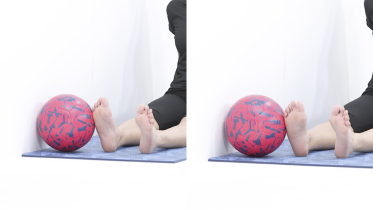 Isometric ankle eversion
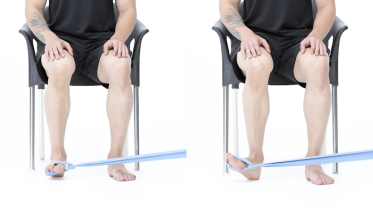 Ankle eversion with band
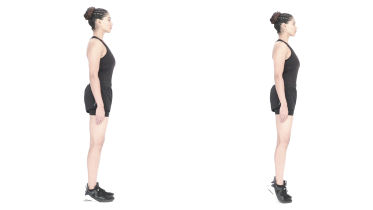 Calf raises
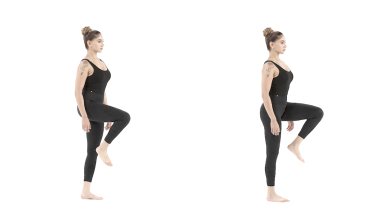 Single leg stance
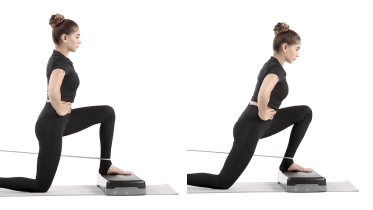 Ankle dorsiflexion mobilization with band
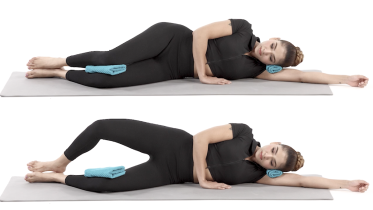 Clamshell
Stage 2: Harder balance and a stronger calf and hip
When single leg stance feels steady and the band work is easy. Closing your eyes, and then standing on a cushion, takes away help from your eyes and a firm floor, so the ankle has to correct itself. Keep the counter within reach for both. Single leg heel raises build the calf for running and jumping. The side leg lift and the band walk work the muscles at the side of your hip (gluteus medius), which hold the pelvis level when you stand on one leg.
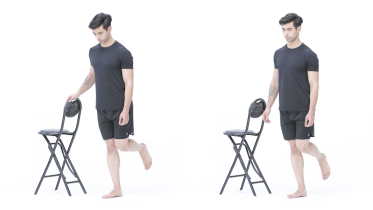 Single leg balance with eyes closed
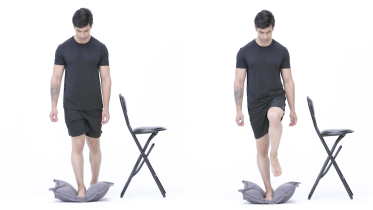 Single leg balance on a cushion
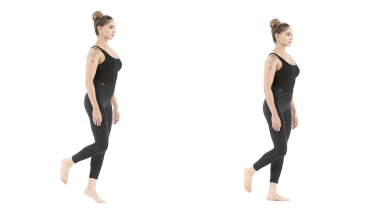 Single leg heel raise
 Side lying hip abduction
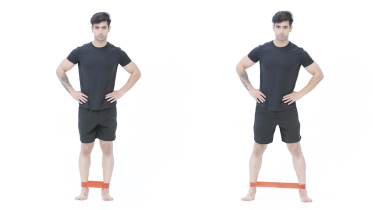 Lateral band walk
Stage 3: Balance while you move
When you can hold still on the cushion with only a fingertip on the counter. Sport and daily life ask the ankle to stay steady while the rest of you is moving, so the balance work now adds movement. The clock reach and the ball kicks make the standing ankle react while the other leg moves, and the single leg deadlift adds a hinge at the hip. Mild discomfort is fine if it settles soon after and your ankle is no worse the next morning.
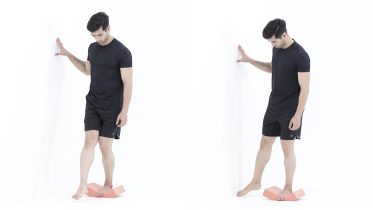 Single leg clock reach
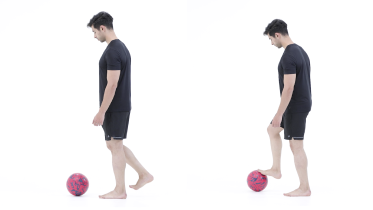 Single leg balance with ball kicks
.png) Single leg deadlift
Single leg deadliftStage 4: Hopping, landing and sport drills
When stage 3 feels solid, you can balance on the weak leg about as steadily as on the other one, and single leg heel raises no longer tire you quickly. Line jumps on both feet come first, then hops on one leg, then skater hops and fast footwork, which practice the quick landings and changes of direction that sport asks for. Land softly and quietly, with your knee bending and staying in line with your toes rather than dropping inward. Stop the set if your landings get wobbly or the ankle feels as if it will give way. If you have osteoporosis or have had a fall in the past year, ask your physio before you start this stage. If you have had a hip or knee replacement, get the go-ahead from your surgeon before you try hopping. Many surgeons advise against jumping and hopping after a joint replacement for good, not just for the first months, because each landing sends high impact through the new joint. If you are pregnant, have had a baby in the past year, or leak urine when you jump, cough or sneeze, check with your midwife or physio before you start this stage. With a heart condition or high blood pressure, check with your doctor before you start.
 Line jumps
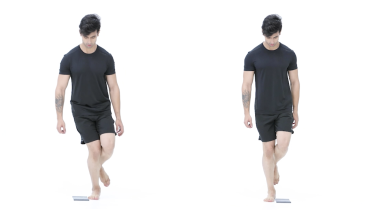 Single leg hops over a line
 Skater hops
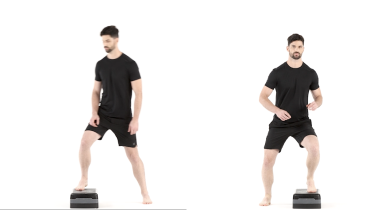 Fast feet side to side
Bracing and taping for sport
A brace is the support with the strongest evidence behind it. The overview by Doherty and colleagues (2017) found strong evidence that bracing lowers the chance of another sprain, and the Dutch guideline says a brace should be considered to prevent one (Vuurberg and colleagues, 2018). The US guideline recommends a brace together with balance training (Martin and colleagues, 2021).
Tape is another option. Either way, support protects the ankle but does not train it. The US guideline advises against relying on a brace or tape alone to improve balance, so keep the exercises going alongside.
Before you go back to a job on your feet or to your sport, the US guideline recommends training that copies what that job or sport will ask of your ankle. Many physios build people back up from jogging in straight lines to cutting and landing drills before full training. They often compare balance and hopping on the two legs before a return to sport. This part comes from everyday clinic practice, not from a tested plan.
When is surgery considered for chronic ankle instability?
Not usually first. The Dutch guideline says surgery should be kept for cases that do not respond to thorough, exercise-based treatment (Vuurberg and colleagues, 2018). If your ankle still gives way often after a full program of well-done rehab, ask your physio or doctor about seeing a foot and ankle surgeon, who can explain the options. After an operation, follow the rehab program from your surgeon and physio rather than this page.
When to see a physio or doctor
See a physio if your ankle keeps giving way, if you have sprained the same ankle more than once, or if you are going back to a sport with a lot of jumping and turning. A physio can test your balance and hopping against the other leg and look for other injuries a sprain can leave behind. They can then set the stages to suit your ankle. The warning signs below need prompt medical attention.
For physiotherapists
The 2021 JOSPT guideline covers first-time lateral ankle sprains and chronic ankle instability, noting that while most people recover, complaints of instability may continue and are defined as CAI (Martin and colleagues, 2021). For CAI it recommends proprioceptive and neuromuscular exercise, and manual therapy, including mobilization with movement, to improve weight-bearing dorsiflexion and dynamic balance in the short term. It advises against relying on external support alone to improve balance, recommends prophylactic bracing plus proprioceptive and balance training for secondary prevention, and recommends return to activity training matched to the patient's demands. It lists other injuries to consider alongside a lateral sprain, including syndesmotic injury, osteochondral lesions and fibularis tendon and retinacular injury.
Hertel and Corbett (2019) define CAI as more than 12 months from the index sprain with recurrent sprains, episodes or perceptions of giving way, and persistent symptoms. They model it as interrelated pathomechanical, sensory-perceptual and motor-behavioral impairments within a biopsychosocial frame, and offer the model as a framework for assessment and rehab. The International Ankle Consortium consensus statement frames lateral ankle sprain and CAI as drivers of reduced physical activity and early post-traumatic ankle osteoarthritis (Gribble and colleagues, 2016). Doherty and colleagues (2017) reported strong evidence for bracing and moderate evidence for neuromuscular training in preventing recurrence. The Dutch guideline reserves surgery for patients who do not respond to thorough exercise-based treatment (Vuurberg and colleagues, 2018).
See a doctor promptly if
- Emergency: the ankle or foot looks deformed or out of place, you heard a crack when you were injured, or the foot is numb, tingling, cold, pale or blue. Go to an emergency department straight away.
- You could not take 4 steps right after the injury and still cannot, or the back edge or tip of either ankle bone is tender to press. Get it checked for a fracture the same day. These are part of the Ottawa ankle rules, explained on the ankle sprain page.
- The pain is in the middle of your foot, and the bony bump halfway along the outer edge of the foot or the bony bump on the inner side of the midfoot is tender to press. Get it checked for a fracture the same day.
- You felt a sudden pop, snap or tearing feeling on the outside of your ankle, and since then the tendons feel as if they slip out of place behind the bony bump, the outside of the ankle is swollen and bruised, or turning your foot outward has become weak. Stop the exercises, take the weight off that foot as much as you can and get it checked the same day at an urgent care center or emergency department, even if you can still walk. The band that holds the tendons in their groove may have torn so they slip out (peroneal dislocation), or a tendon may have torn.
- You felt a pop or snap at the back of your heel or lower calf, or it felt as if someone kicked you there, even if you can still walk and push off. Go to an urgent care center or emergency department the same day, as this can be a torn Achilles tendon rather than a sprain.
- A calf or thigh that is newly swollen, warm, tender, red or darker than usual, has swollen veins that are sore to touch, or has a throbbing or cramping pain that does not fit your injury or condition, or that feels different from normal muscle soreness after exercise. This can be a sign of a blood clot (deep vein thrombosis), especially after surgery, an injury, time in a cast or boot, a long trip or a spell of being much less mobile than usual. Get medical advice the same day. If you are also short of breath or have chest pain, call emergency services.
- The pain is severe and getting worse, or the swelling or bruising is very large. Get medical advice the same day.
- The ankle or foot is hot, red and swollen, or you have a fever or feel unwell. Get medical help the same day, and go to an emergency department if you feel very unwell. If you have a very high or very low temperature, shivering you cannot control, you are breathing very fast or finding it hard to breathe, you are confused or your speech is slurred, your skin, lips or tongue look blue, gray, pale or blotchy (on brown or black skin this can be easier to see on the palms of the hands or soles of the feet), or you have a rash that does not fade when you press it, call emergency services, as this can be sepsis.
- You have diabetes or numb feet, and one foot becomes hot, swollen or red, or changes color or shape, with or without pain. Take your weight off that foot straight away and get advice the same day from your doctor or your diabetes foot team. This can be Charcot foot, where the bones and joints of the foot are damaged and the foot can collapse. Do not exercise that foot until it has been checked. If you also have a fever or feel very unwell, or redness is spreading up your foot or leg, go to an emergency department.
- You have diabetes or numb feet and find a new blister, cut or sore on your foot, especially one you did not feel, a wound that smells or is leaking, or new pain in your foot that you cannot explain. Get it seen by your doctor or foot team the same day. If you also have a fever or feel very unwell, redness is spreading up your foot or leg, or part of your foot or a toe turns black, go to an emergency department.
- A leg or foot that is getting weaker, for example your foot drags, catches on the ground or slaps down when you walk (foot drop). Get medical advice the same day. If the weakness is getting worse by the hour, go to an emergency department.
- The ankle has a deep ache inside the joint that keeps coming back, or it catches, locks or clicks with pain, even without a new sprain. The same applies if the pain sits mainly behind the bony bump on the outside of the ankle, the tendons there snap or slide over the bone, or the ankle gives way more often, or on flat ground, even though you are doing the exercises. This is not an emergency, but book an assessment with a physio or doctor in the next week or two, as a sprain can also injure the joint surface or the tendons behind that bone.
- You have numbness, tingling, burning or loss of feeling in the foot, often along the outer edge. Book an assessment with a doctor or physio in the next week or two.
- The pain is there at night or at rest as well as with activity and keeps getting worse. See your doctor within a few days. If you have had cancer, now or in the past, or are losing weight without trying, see your doctor sooner, within a day or two, and mention it. This applies even if the pain is not getting worse. If you are being treated for cancer now, contact your cancer team the same day.
Common questions
What are the symptoms of chronic ankle instability?
The main one is an ankle that gives way, or feels as if it might, often on uneven ground or when you turn quickly, along with repeat sprains. Hertel and Corbett (2019) also list lasting pain, swelling, stiffness, weakness and a sense that the ankle does not work as well as it should. In research, the term is used once the first sprain is more than a year old. A physio can check whether your symptoms fit and look for other problems.
How do you get chronic ankle instability?
It starts with a sprain on the outside of the ankle. Most people recover, but in some the ankle keeps giving way afterward. Hertel and Corbett (2019) describe a mix of changes after the first injury: in the joint itself, in how well the ankle senses its position, and in how you control the leg as you move. An overview of systematic reviews found that exercise therapy and bracing are supported for preventing it (Doherty and colleagues, 2017), which is why good rehab after the first sprain matters.
How do you treat chronic ankle instability?
Exercise comes first. The US physical therapy guideline recommends balance and coordination exercise for chronic ankle instability, and hands-on treatment to ease ankle stiffness and improve balance in the short term (Martin and colleagues, 2021). A brace for sport lowers the chance of another sprain. Surgery is kept for people who do not improve with a thorough exercise program. Your physio will set the program and how long to keep it going.
Should I wear a brace for chronic ankle instability?
For sport, it is worth considering. The evidence that a brace cuts the risk of spraining the ankle again is strong (Doherty and colleagues, 2017), and the Dutch guideline names braces as an option to consider for preventing a repeat sprain (Vuurberg and colleagues, 2018). The US guideline recommends a brace together with balance training, not instead of it, and advises against relying on a brace or tape alone to improve balance (Martin and colleagues, 2021). So wear it for sport and keep up the exercises.
When is surgery needed for chronic ankle instability?
Only for some people. According to the Dutch guideline, an operation is for ankles that have not settled with thorough, exercise-based treatment (Vuurberg and colleagues, 2018). If yours still gives way often once you have worked through a full rehab program, ask your physio or doctor whether you should see a foot and ankle surgeon to talk through the options. If you do have surgery, your surgeon and physio will give you a rehab program to follow, and that takes the place of this page.
References
- Martin RL, Davenport TE, Fraser JJ, et al. Ankle Stability and Movement Coordination Impairments: Lateral Ankle Ligament Sprains Revision 2021. Journal of Orthopaedic and Sports Physical Therapy. 2021;51(4):CPG1-CPG80. https://doi.org/10.2519/jospt.2021.0302
- Gribble PA, Bleakley CM, Caulfield BM, et al. 2016 consensus statement of the International Ankle Consortium: prevalence, impact and long-term consequences of lateral ankle sprains. British Journal of Sports Medicine. 2016;50(24):1493-1495. https://doi.org/10.1136/bjsports-2016-096188
- Hertel J, Corbett RO. An Updated Model of Chronic Ankle Instability. Journal of Athletic Training. 2019;54(6):572-588. https://doi.org/10.4085/1062-6050-344-18
- Vuurberg G, Hoorntje A, Wink LM, et al. Diagnosis, treatment and prevention of ankle sprains: update of an evidence-based clinical guideline. British Journal of Sports Medicine. 2018;52(15):956. https://doi.org/10.1136/bjsports-2017-098106
- Doherty C, Bleakley C, Delahunt E, Holden S. Treatment and prevention of acute and recurrent ankle sprain: an overview of systematic reviews with meta-analysis. British Journal of Sports Medicine. 2017;51(2):113-125. https://doi.org/10.1136/bjsports-2016-096178
- Stiell IG, Greenberg GH, McKnight RD, et al. Decision rules for the use of radiography in acute ankle injuries. Refinement and prospective validation. JAMA. 1993;269(9):1127-1132. https://doi.org/10.1001/jama.269.9.1127
- NHS. Sprains and strains. Page last reviewed 23 April 2024. https://www.nhs.uk/conditions/sprains-and-strains/
- Cambridge University Hospitals NHS Foundation Trust. Achilles tendon rupture. Patient information. https://www.cuh.nhs.uk/patient-information/achilles-tendon-rupture/
- NHS. Deep vein thrombosis (DVT). Page last reviewed 30 April 2026. https://www.nhs.uk/conditions/deep-vein-thrombosis-dvt/
- NHS. Septic arthritis. Page last reviewed 3 September 2026. https://www.nhs.uk/conditions/septic-arthritis/
- NHS. Sepsis. Page last reviewed 14 May 2026. https://www.nhs.uk/conditions/sepsis/
- National Institute for Health and Care Excellence. Diabetic foot problems: prevention and management. NICE guideline NG19. Published 26 August 2015, last updated 11 October 2019. https://www.nice.org.uk/guidance/ng19
- National Institute for Health and Care Excellence. Venous thromboembolism in over 16s: reducing the risk of hospital-acquired deep vein thrombosis or pulmonary embolism. NICE guideline NG89. Published 21 March 2018, last updated 13 August 2019. https://www.nice.org.uk/guidance/ng89
Written and checked by the PocketPhysio editorial team. Last updated 2026-09-28.
This page is general education, not a diagnosis or a personal treatment plan. See a physiotherapist or doctor for advice about your own situation.