Ankle dorsiflexion mobilization with band
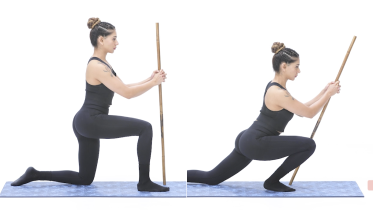
This is a mobility exercise for an ankle that does not bend forward far enough, for example when your knee cannot travel over your toes in a squat or on the stairs. You half kneel with the working foot on a low step and a thick band pulling the front of your ankle backward, then rock your knee forward over your toes while the heel stays down. It often comes into a program once a stiff ankle, after a sprain or a spell in a boot, is ready to be pushed a little further.
How to do the ankle dorsiflexion mobilization with band
- Tie a thick resistance band low down to something solid behind you, such as a heavy table leg. Place a low step or platform in front of you.
- Put your working foot flat on the step and go down onto the other knee behind it, into a half kneeling position. A folded towel under the kneeling knee makes it more comfortable.
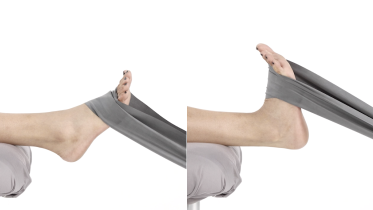
- Loop the band around the front of your working ankle, as low as it will go, just above the top of the foot. Move forward until the band pulls your ankle backward with firm tension. This is your starting position.
- Keep your heel down on the step and shift your weight forward, taking your knee over your toes as far as is comfortable. Your hands can rest on your hips, as in the video.
- Ease back only a little, without going all the way to the start, then rock forward again. Keep the knee lined up with your second toe each time.
What you should feel
A stretch low in the calf or around the Achilles, and the band pressing on the front of your ankle. Some tightness at the front of the ankle at the end of the movement is common. It should not turn into a sharp pinch.
Common mistakes
- The heel lifting off the step as the knee goes forward. Stop the rock just before it lifts.
- The knee falling inward toward the other foot instead of tracking over the toes.
- The band sitting too high up the shin, where it pulls on the leg instead of the ankle.
- Bouncing hard into the end of the movement.
How often
Many programs use 2 to 3 sets of 10 to 15 slow forward rocks, once or twice a day, sometimes with a short pause at the end of each one. Your physio will adjust this, including how firm the band should be.
Stop and check with your physio if
- A sharp or pinching pain at the front of the ankle that does not ease when you rock forward less far.
- Numbness or tingling in the foot. Loosen the band and check where it sits before you carry on.
- Pain in the kneeling knee, or the ankle giving way.
- Your calf or thigh becomes swollen, warm, tender, red or darker than usual, or has a throbbing or cramping pain that feels different from normal muscle ache. Stop and get medical advice the same day, as this can be a blood clot. If you are also short of breath or have chest pain, call emergency services.
From the clinic
The band should hold the ankle back while the shin moves forward over it, so it needs to sit low, right at the crease where the foot meets the leg. Band keeps sliding up? Move closer to the anchor to take some slack out and reset it. If kneeling bothers your knee, put a thicker cushion under it. The calf stretch works on the same stiffness from a standing position, and ankle dorsiflexion with a band strengthens the muscle that lifts the foot.
In the first days after a sprain, when the ankle is still swollen and sore, gentler movement such as ankle circles usually comes first. After an ankle fracture, ankle surgery or an Achilles tendon injury, wait until your surgeon or physio says the ankle is ready to be pushed into a stretch like this.
Written and checked by the PocketPhysio editorial team. Last updated 2026-09-26.
This page is general education, not a diagnosis or a personal treatment plan. If you have pain, an injury or a health condition, see a physiotherapist or doctor before starting new exercises.