Ankle alphabet
The ankle alphabet is a gentle range of motion exercise. You sit with your leg out straight and write the capital letters A to Z in the air with your foot, so the ankle moves up, down, in, out and around. It often comes in after an ankle sprain or fracture, once your physio or surgeon says the ankle is allowed to move.
How to do the ankle alphabet
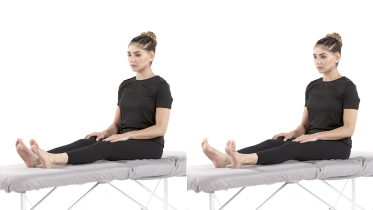
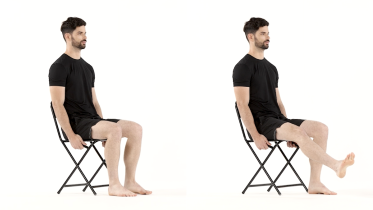
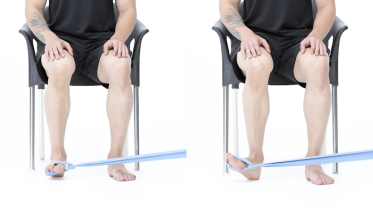
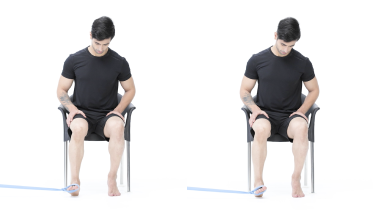
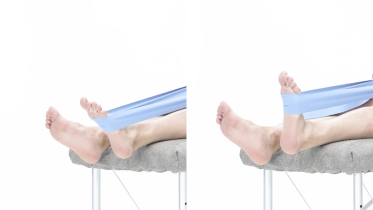
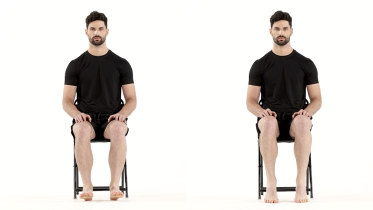
- Sit on a bed, couch or exercise table with your legs straight out in front of you, leaning back on your hands. The voice guide also allows sitting on the edge of a table with your lower legs hanging down.
- Hold your leg still so only the ankle moves. Knee and hip stay quiet.
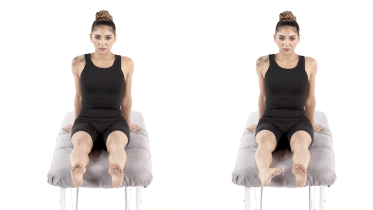
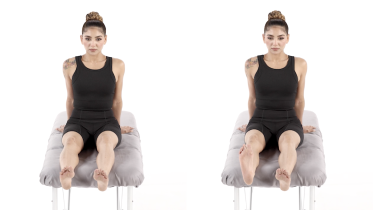
- Imagine your big toe is the tip of a pen. Trace the capital letters A to Z in the air, one after another.
- Make each letter as large as you comfortably can, so the foot moves up and down, side to side and around the curves.
- Go slowly. When you finish Z, rest, then repeat with the other foot if your program includes both.
What you should feel
The movement should feel easy and the effort should stay light. While the joint is stiff, some tightness or a mild ache at the ends of the range is expected.
Common mistakes
- Writing with your knee or hip. The toe is the pen, and the ankle drives it.
- Making tiny letters, so the ankle barely moves.
- Rushing through the alphabet.
- Pushing hard into a painful end of the range.
How often
While the ankle is stiff, many programs use 1 to 2 rounds of the full alphabet, 2 to 3 times a day. Your physio will adjust it for you.
Stop and check with your physio if
- Sharp ankle pain, or pain that is clearly worse afterward and does not settle.
- The ankle becomes more swollen, hot or red after the exercise.
- Your calf or thigh is getting more swollen, or becomes warm, tender, red or darker than usual, or has a new throbbing or cramping pain. This can be a blood clot, especially after an operation, an injury, time in a cast, boot or brace, or a spell of being much less mobile than usual, and after an operation it can also be an infection. Stop and contact your medical team or get medical advice the same day. If you are also short of breath or have chest pain, call emergency services.
- You suddenly become short of breath, get chest pain or pain in your upper back that may be worse when you breathe in, cough up blood, your heart beats very fast, or you faint. Call emergency services straight away, even if your leg looks normal, as this can be a blood clot in the lungs (pulmonary embolism).
- Emergency: while you are in a cast or boot, your toes turn blue, white or pale, or feel cold. Do not wait to see if raising your leg helps. Go to an emergency department straight away, and do not drive yourself. The cast or boot may be cutting off the blood supply, or pressure may be building up inside the leg (compartment syndrome), and both need checking quickly.
- In a cast or boot, the pain gets worse, your toes feel numb, tingle or burn or look more swollen, or the cast or boot feels too tight. Stop, raise your foot above your hip, keep moving your toes and contact your fracture clinic or get medical advice straight away. If you wear a boot, loosen the straps but keep it on. If you cannot move your toes, the pain is severe even after painkillers, or the numbness, tingling, burning or swelling has not settled within 30 minutes of raising your foot, go to your fracture clinic or an emergency department straight away, and do not drive yourself.
- Since the fracture or cast, the foot or ankle is getting more painful rather than less, the skin becomes very sensitive to light touch, or the foot changes color, temperature, swelling or sweating compared with the other one, or looks shiny. See your doctor or physio as soon as you can, within a few days at most, as this can be complex regional pain syndrome (CRPS) and early treatment may help.
From the clinic
If the ankle is swollen, you can do the same exercise lying on your back with the lower leg raised on pillows, so the ankle sits a little higher than your knee. Curvy letters such as S and O move the ankle in circles. Straight lines like I and L are simpler when you are just getting started.
After an ankle fracture or surgery, check two things before you start: whether the foot may come out of the cast or boot, and whether any direction is off limits for now. Once the alphabet feels easy, ankle pumps and the calf stretch are common next steps.
Written and checked by the PocketPhysio editorial team. Last updated 2026-09-26.
This page is general education, not a diagnosis or a personal treatment plan. If you have pain, an injury or a health condition, see a physiotherapist or doctor before starting new exercises.