
Plantar fasciitis exercises and physiotherapy
What is plantar fasciitis?
The plantar fascia is a thick band of tissue under your foot. It runs from the heel bone forward to the base of your toes and helps hold up the arch. Plantar fasciitis is pain where that band attaches under the heel, usually toward the inside. It is the most common cause of pain under the heel (plantar heel pain).
It is most common between the ages of 40 and 60. Risk factors listed in the US physical therapy guideline include a stiff ankle that does not bend up far and, in people who are not athletes, higher body weight. Running is on the list too, as are jobs with a lot of standing or walking, especially on hard surfaces.
The pattern is typical. Your first steps out of bed hurt, often sharply. The pain eases once you get moving, then creeps back after a long day on your feet or when you stand up after sitting. The NHS describes the same picture: pain under the heel and arch that is worse after rest and after a lot of activity.
Why does exercise help plantar fasciitis?
The heel needs to tolerate load again, and exercise lets you build that up in a controlled way. The US clinical practice guideline for physical therapists recommends stretching of the calf and the plantar fascia, and resistance training for the muscles of the foot and ankle (Koc and colleagues, 2023). A best practice guide in the British Journal of Sports Medicine puts education matched to the person at the core of first-line care, along with stretching and taping, and adds other options if progress is slow (Morrissey and colleagues, 2021).
Strength work has some support from a trial of 48 people with plantar fasciitis (Rathleff and colleagues, 2015). One group did heavy single leg heel raises with a towel under the toes every second day, the other stretched the plantar fascia daily, and both also had shoe inserts. The heel raise group had better foot function at 3 months, and by 12 months the two groups were similar. It is one small trial, so treat it as a reason to include heel raises, not proof that stretching is a waste of time.
How to use this program
Pick the stage that matches your heel today. If you are unsure, start at stage 1, and move up when the current stage feels easy and your heel is no worse the next morning.
Many programs use calf stretches held for about 30 seconds, 2 to 3 times on each leg, once or twice a day. Strength exercises often start at 2 to 3 sets of 8 to 15, a few days a week or every second day. Your physio will adjust this to your heel and to what you need to get back to.
A common guide is how your first steps feel the next morning. Mild discomfort during the exercises is common and usually acceptable if it settles within a day. If the morning pain is clearly worse the day after a session, the load was too much, so drop back a step rather than stopping altogether.
The exercise program
Stage 1: Settle the heel and loosen the calf
For a sore heel that hurts with most steps, and for the first weeks of any program. The stretch for the band under your foot (plantar fascia stretch) has no video here yet: sit with the sore foot resting across your other knee, hold the base of your toes and pull them back toward your shin until you feel a stretch along the arch. Many programs hold it for about 10 seconds and repeat it about 10 times, up to 3 times a day, and a lot of people do it with the ankle pumps and the alphabet while sitting on the edge of the bed, before the first steps of the morning. Do the calf stretch with the back knee straight and then with it slightly bent, so both calf muscles get stretched.
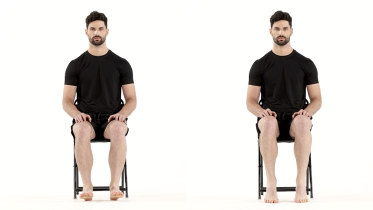 Ankle pumps
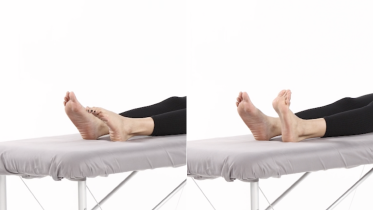 Ankle alphabet
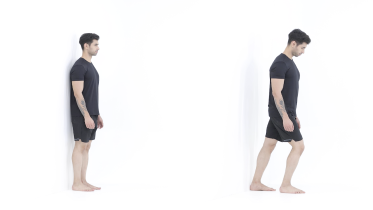 Calf stretch
Stage 2: Start loading the calf and foot
When the first steps of the morning are easier and everyday walking no longer builds the pain up. These strengthen the calf and a deep muscle that helps hold up your arch.
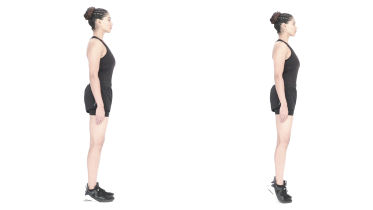 Calf raises
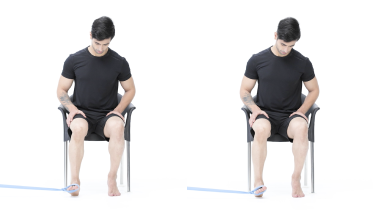 Ankle inversion with band
Stage 3: Heavier heel raises and back to full activity
When 2 to 3 sets of calf raises on both feet feel easy. The eccentric calf raise is the step in between: rise on both feet, then lower slowly on the sore foot. Heel raises on one leg come next and load the calf and the plantar fascia more, and some programs put a rolled towel under the toes so the toes are lifted at the top of the rise. For heel pain these heavier raises are usually done slowly and every second day, not daily, with your fingertips resting on a counter or wall for balance.
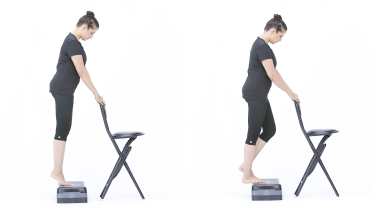 Eccentric calf raise
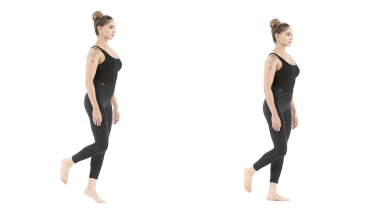 Single leg heel raise
Shoes, standing and daily load
What you do between sessions matters too. The NHS self-care advice includes supportive shoes, insoles, avoiding long periods of standing, and swapping some walking or running for low impact exercise such as swimming. It also suggests avoiding high heels, flip-flops and walking barefoot on hard floors while the heel is sore. If you are overweight, it suggests working toward a healthier weight.
A physio or podiatrist may add other treatments. Taping the foot can ease pain in the short term. Some people with bad first-step pain are given a night splint that holds the foot up while they sleep.
Insoles and orthoses are best used alongside exercise rather than as the only treatment. If things are still slow, options such as shockwave therapy or custom orthoses may be discussed. Less often, people are referred to a specialist to talk about surgery.
When to see a physio or doctor
See a physio or doctor if the pain is severe or stops you doing normal activities. The same goes if it keeps getting worse or coming back, or has not improved after 2 weeks of looking after it yourself. Tingling or loss of feeling in the foot needs checking, and so does any foot pain if you have diabetes.
Heel pain that does not fit the usual morning pattern is also worth a proper assessment, because a few other problems can cause pain in the same spot. The warning signs below need prompt medical attention.
For physiotherapists
This page gives patients a starting framework for plantar heel pain. The 2023 guideline supports diagnosis from the clinical pattern: pain under the inner heel, first-step pain, tenderness at the proximal plantar fascia and a positive windlass test, with tarsal tunnel tests negative. Consider spondyloarthritis, fat pad atrophy, calcaneal stress fracture and nerve entrapment when the picture does not fit or does not settle.
The guideline gives grade A recommendations to manual therapy and to plantar fascia and calf stretching. Taping and night splints also get grade A. Resistance training for the foot and ankle muscles is grade B, but the guideline found too little evidence to favor one type of strength training. It advises against adding therapeutic ultrasound to stretching.
Its suggested outcome measures are the FAAM and the FHSQ, plus the Foot Function Index. Base the loading on the pain response rather than a fixed sheet. Allow for footwear too, and for body weight and what the person's work asks of their feet.
See a doctor promptly if
- The heel pain started with a fall or a landing from height, or you cannot put weight on the foot. Get it checked the same day.
- The whole heel hurts when you squeeze it from both sides, especially after a sudden increase in running or walking, or if you have thin bones (osteoporosis). Stop running and jumping, cut down on walking and standing, and see a doctor within a few days, as this can be a stress fracture of the heel bone rather than plantar fasciitis. An X-ray can look normal for the first 2 to 3 weeks, so a normal early X-ray does not rule it out.
- You have numbness, tingling, burning or loss of feeling in the foot. Book an assessment with a doctor or physio in the next week or two.
- The heel or foot is hot, red and swollen, or you have a fever or feel unwell. Get medical help the same day, and go to an emergency department if you feel very unwell. If you have a very high or very low temperature, shivering you cannot control, you are breathing very fast or finding it hard to breathe, you are confused or your speech is slurred, your skin, lips or tongue look blue, gray, pale or blotchy (on brown or black skin this can be easier to see on the palms of the hands or soles of the feet), or you have a rash that does not fade when you press it, call emergency services, as this can be sepsis.
- The pain is there at night or at rest as well as when you stand and walk, and it is getting worse. See your doctor within a few days. If you have had cancer, now or in the past, or are losing weight without trying, see your doctor sooner, within a day or two, and mention it. This applies even if the pain is not getting worse. If you are being treated for cancer now, contact your cancer team the same day.
- Both heels hurt and you also have swelling or morning stiffness in other joints or your lower back. This is not an emergency, but see your doctor in the next week or two, as it can be a sign of an inflammatory arthritis.
- You have diabetes or numb feet, and one foot becomes hot, swollen or red, or changes color or shape, with or without pain. Take your weight off that foot straight away and get advice the same day from your doctor or your diabetes foot team. This can be Charcot foot, where the bones and joints of the foot are damaged and the foot can collapse. Do not exercise that foot until it has been checked. If you also have a fever or feel very unwell, or redness is spreading up your foot or leg, go to an emergency department.
- You have diabetes or numb feet and find a new blister, cut or sore on your foot, especially one you did not feel, a wound that smells or is leaking, or new pain in your foot that you cannot explain. Get it seen by your doctor or foot team the same day. If you also have a fever or feel very unwell, redness is spreading up your foot or leg, or part of your foot or a toe turns black, go to an emergency department.
- Part of your foot or a toe turns cold, pale, blue or black. Call emergency services or go to an emergency department straight away, and do not drive yourself, as the blood supply to the foot may be blocked.
- With diabetes, get any new foot pain checked by your doctor before you start this program.
- You felt a sudden pop or tearing under the foot, followed by bruising and difficulty walking. Get it checked the same day.
Common questions
How long does plantar fasciitis take to go away?
It varies a lot, and it is rarely quick, so progress is best judged over months rather than days. In one trial, people who did heavy heel raises improved faster over the first 3 months than people who only stretched, and by 12 months the two groups were at a similar level. If self-care has not helped after 2 weeks, the NHS advises getting it checked, and a physio can adjust the program to you.
Should I stretch or strengthen for plantar fasciitis?
Usually both. Stretching the calf and the plantar fascia is recommended in the US physical therapy guideline, and so is strengthening the foot and ankle muscles. Many programs start with stretching and add heel raises as the heel settles. Your physio will adjust the mix and the numbers.
Is walking good for plantar fasciitis?
Usually you can keep walking, in amounts your heel tolerates. Cut back on long spells of standing or walking on hard ground while the heel is sore, and swap some of it for swimming or other low impact exercise. Build walking back up in small steps as the first steps of the morning get easier.
Do I need insoles for plantar fasciitis?
Not always. Insoles and orthoses can help some people, but the US physical therapy guideline advises against using them as the only treatment and says they may help when combined with other treatment such as exercise. A physio or podiatrist can tell you whether they are worth trying for you.
References
- Koc TA Jr, Bise CG, Neville C, et al. Heel Pain - Plantar Fasciitis: Revision 2023. Journal of Orthopaedic and Sports Physical Therapy. 2023;53(12):CPG1-CPG39. https://doi.org/10.2519/jospt.2023.0303
- Morrissey D, Cotchett M, Said J'Bari A, et al. Management of plantar heel pain: a best practice guide informed by a systematic review, expert clinical reasoning and patient values. British Journal of Sports Medicine. 2021;55(19):1106-1118. https://doi.org/10.1136/bjsports-2019-101970
- Rathleff MS, Molgaard CM, Fredberg U, et al. High-load strength training improves outcome in patients with plantar fasciitis: a randomized controlled trial with 12-month follow-up. Scandinavian Journal of Medicine and Science in Sports. 2015;25(3):e292-e300. https://doi.org/10.1111/sms.12313
- NHS. Plantar fasciitis. Page last reviewed 14 February 2025. https://www.nhs.uk/conditions/plantar-fasciitis/
Written and checked by the PocketPhysio editorial team. Last updated 2026-09-28.
This page is general education, not a diagnosis or a personal treatment plan. See a physiotherapist or doctor for advice about your own situation.