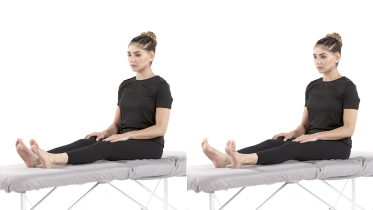
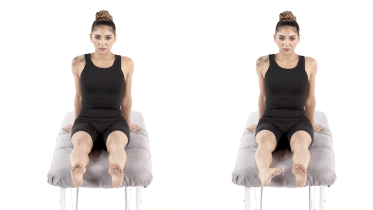
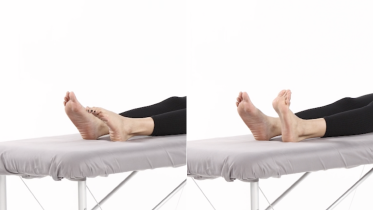
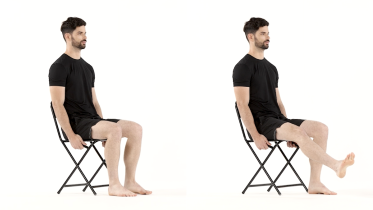
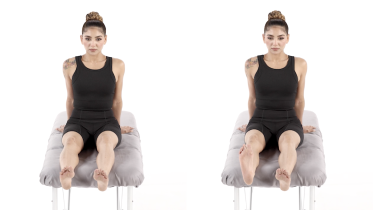
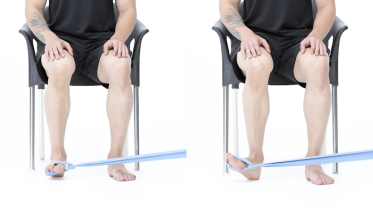
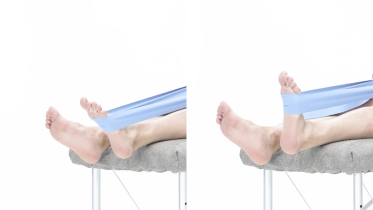
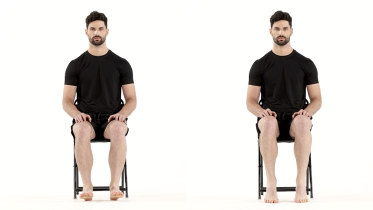
Ankle inversion with band
Ankle inversion with a band strengthens the muscles that turn your foot inward, mainly a deep muscle behind the shin that helps hold up the arch of your foot (tibialis posterior). With a band around the front of your foot pulling it outward, you sit on a chair and turn the foot in against it, keeping your heel where it is. Ankle sprain programs often include it alongside eversion, and so do programs for pain along the inner ankle and arch.
How to do the ankle inversion with band
- Sit tall on a firm chair with both feet flat on the floor.
- Loop the band around the front of the working foot, close to the base of the toes. Anchor the other end low down on the outside of that foot, to something heavy like a table leg or the leg of your chair, so the band pulls the foot outward.
- Place your foot so the band already has some tension, with your toes pointing straight ahead and your heel on the floor.
- Turn the front of your foot in toward your other foot, as far as is comfortable. The heel does not move, and your knee keeps pointing forward.
- Pause, then control the foot back out to the middle.
What you should feel
Effort on the inside of your lower leg and around the inner ankle. Some people feel it in the arch of the foot as well.
Common mistakes
- Swinging the knee inward to move the foot. Keep the knee still and turn at the ankle.
- Lifting the heel or letting it drift.
- Letting the band drag the foot back out instead of controlling the return.
How often
A typical start is a light band and 2 to 3 sets of 10 to 15 slow repetitions, once a day. The band strength and the numbers are for your physio to adjust.
Stop and check with your physio if
- Sharp pain on the inside of the ankle or along the arch, or pain that climbs as you work through the set.
- Swelling after the session, or the ankle giving way.
From the clinic
Don't expect a big movement. Most people get only a short arc before the heel wants to lift or the knee starts to help, and that is fine. A smooth, short turn does more for these muscles than a big one that uses the leg.
Ankle eversion with a band works the opposite direction, and the two are often done one after the other. Take care after a recent sprain, because turning the foot inward is the same direction the ankle rolls in a common sprain. Keep the turn small and pain free, and ask your physio when to add the band. The same goes after an ankle fracture or surgery.
Written and checked by the PocketPhysio editorial team. Last updated 2026-09-25.
This page is general education, not a diagnosis or a personal treatment plan. If you have pain, an injury or a health condition, see a physiotherapist or doctor before starting new exercises.