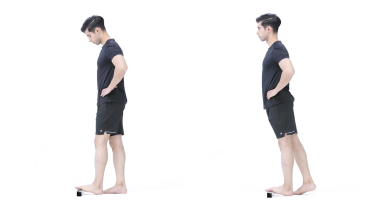
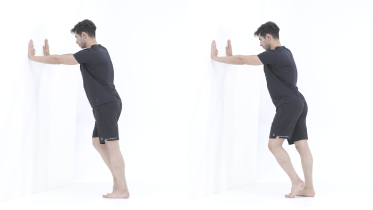
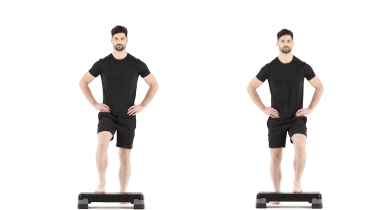
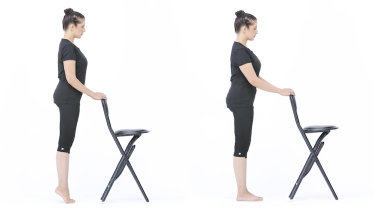
Single leg heel raise
A single leg heel raise is a calf raise done on one leg. You stand on the leg you are working, rise onto the ball of your foot with the knee straight, then lower the heel back down under control. It works the calf muscles (gastrocnemius and soleus). You will see it in a lot of rehab for the Achilles tendon and ankle, and for other lower leg problems.
How to do the single leg heel raise
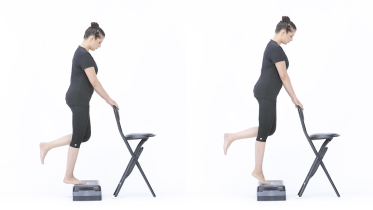
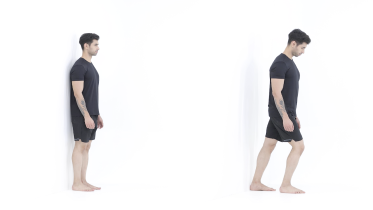
- Stand tall on a flat floor, barefoot or in flat shoes, next to a wall or kitchen counter you can touch with your fingertips.
- Bend your other knee to lift that foot off the floor, so you are standing on the leg you are working.
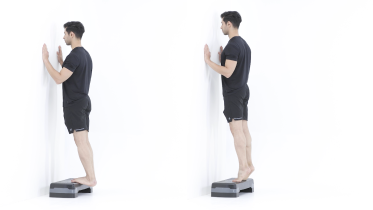
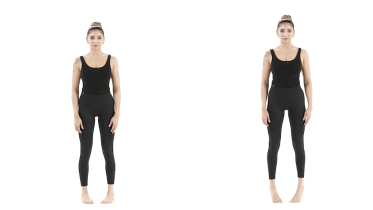
- Keep your standing knee straight and rise onto the ball of your foot, as high as you can control. Push through the big toe side of the foot. Do not roll onto the outer edge.
- Pause briefly at the top.
- Lower your heel slowly back to the floor, then repeat.
What you should feel
Work in the calf of your standing leg, often building to a burn near the end of a set. Your foot and ankle are busy too, just keeping you balanced.
Common mistakes
- Bending the standing knee on the way up. Keep it straight, as the voice guide says.
- Rolling onto the outside of the foot at the top so the ankle wobbles outward.
- Dropping the heel quickly instead of lowering it.
- Leaning so much weight on your support that the calf barely works.
How often
Many programs start with 2 to 3 sets of 8 to 15 on each leg, a few days a week. Your physio will adjust the numbers, and may start you on two feet first.
Stop and check with your physio if
- Sharp pain in the calf, Achilles tendon or ankle, or pain that keeps building through the set.
- A sudden pop or snap at the back of your ankle or heel, a feeling that someone kicked you there, or sudden pain there after which you cannot push off or rise onto your toes on that leg. Stop, take the weight off that leg carefully and go to an urgent care center or emergency department the same day, even if you can still walk, as this can be a torn Achilles tendon.
- You lose your balance or the ankle gives way.
- The Achilles tendon or calf is clearly more painful or stiff the next morning. Check with your physio before the next session.
From the clinic
Can't manage one smooth rise on one leg yet? Start with calf raises on both feet. There is a halfway step too: go up on both feet, shift your weight onto the working leg at the top, and come down on that leg alone.
Your physio may count how many single leg rises you can do on each side and compare the two. So do them the same way every time.
The video shows the rise done with nothing to hold. Most people do better with their fingertips on a wall or counter, and if your balance is poor or you have had falls, always hold on. After an Achilles tendon repair or ankle surgery, single leg rises usually come later in rehab. Wait until your surgeon's protocol and your physio both say you are ready.
Written and checked by the PocketPhysio editorial team. Last updated 2026-09-26.
This page is general education, not a diagnosis or a personal treatment plan. If you have pain, an injury or a health condition, see a physiotherapist or doctor before starting new exercises.