
ACL reconstruction rehab: exercises and recovery after surgery
What is an ACL reconstruction?
The anterior cruciate ligament (ACL) is a band of tissue inside your knee that helps it move and stay stable. It is often injured in sport, or by a twist, a blow to the knee or a quick change of direction or speed (NHS). An ACL reconstruction replaces the torn ligament with a graft, usually through keyhole surgery with small cuts. The graft is usually your own tissue, such as a hamstring tendon, the patellar tendon below your kneecap or the quadriceps tendon above it, and sometimes comes from a donor (OrthoInfo). Most people go home the same day and have regular physiotherapy for a few months afterward (NHS).
Your surgeon's and physio's plan comes first
Every surgical team has its own program, and it also depends on what was done in your operation. Follow their plan for weight bearing, crutches, any brace, how far you may bend the knee and when each new exercise starts. Use this page to understand the usual stages and to see the exercises on video, not to set your own timetable.
Two things change the plan more than most: the type of graft, and any other repair done in the same operation. After a patellar tendon graft, pain at the front of the knee and pain when kneeling are more common (OrthoInfo), and after a hamstring graft, resisted hamstring work is often held back for the first weeks, although advice on timing varies and the evidence is unclear (Högberg and colleagues, 2026). A meniscus repair or cartilage work done in the same operation also changes the early weeks. The Aspetar guideline says early rehab should then follow the surgeon's instructions, and OrthoInfo notes that how much weight you may take depends on the other injuries treated. Your surgeon may limit how far you bend the knee or how much weight you take for a while.
This page is for adults. A child or teenager who has had ACL surgery should follow the plan from their surgeon and physio, and ask them before trying any exercise on this page. If you are pregnant, check with your midwife, doctor or physio before you start.
If your operation is still ahead
Not every ACL tear needs surgery. The NHS says you may need it if you play a lot of sport and want to carry on, or if your knee keeps causing problems after physiotherapy. In a trial of 121 young, active adults with a new ACL tear, rehab plus early reconstruction gave results no better at 2 years than rehab with the option of surgery later, and 36 of the 59 people offered the second route had not had the operation by 2 years (Frobell and colleagues, 2010). If you are having surgery, the van Melick guideline recommends a rehab phase before the operation (prehabilitation). Ask your physio for a program to follow while you wait.
The first weeks after surgery
The NHS gives simple advice for the first weeks. Keep your leg raised when you rest, and hold an ice pack wrapped in a tea towel on the knee for 15 to 20 minutes every 2 to 3 hours to ease swelling and pain, but not if the skin there is numb. Do not put a pillow under your knee when you rest, and the NHS also advises against standing for long periods and against keeping the leg straight when you sit. That advice is about sitting for long spells. The seated heel prop in stage 1 is a short, timed stretch to help the knee straighten fully, so keep doing it if your physio gave it to you.
Take the painkillers you were prescribed and keep the wound dry as your hospital advised. Try not to twist the knee, and avoid bending down or reaching up as much as you can. Use crutches and a brace only as your surgeon or physio told you.
Blood clots in the leg (deep vein thrombosis) are one of the possible complications. The NHS advises getting up and walking around as your physio advises to help prevent them, and some people are given compression stockings or medicine to lower the risk. NICE guidance asks doctors to weigh your risk of a clot against your risk of bleeding when they decide about that medicine after knee surgery (NICE NG89). If you were given stockings, injections or tablets, use them exactly as your team told you. The warning signs of a clot are listed below.
Some numbness of the skin next to the scar is not unusual, and OrthoInfo notes that it may be temporary or permanent. The NHS says most people go back to work after about 4 to 6 weeks, depending on the job. It also advises not driving until your medical team says you are fit to drive.
How long does ACL reconstruction rehab take?
Guidelines describe rehab after an ACL reconstruction in stages. You move on when your knee reaches certain goals, not on fixed dates. The van Melick guideline, written for the Royal Dutch Society for Physical Therapy, describes a phase before surgery and three phases after it: getting back movement and strength, training for your sport, and returning to it. It advises that rehab after surgery carries on for 9 to 12 months, with strength, hop, movement quality and psychological tests used to decide when to move on (van Melick and colleagues, 2016).
The Aspetar guideline groups the evidence into rough time bands: very early (the first month), early (1 to 2 months), intermediate (2 to 4 months) and advanced (after 4 months) (Kotsifaki and colleagues, 2023). The four stages on this page follow those bands loosely. Your knee still decides when you move on.
The evidence behind the details is thin. The Aspetar guideline rated the certainty of the evidence as very low for most parts of rehab, and says there is little evidence on how much exercise, or how hard, works best. Most of its recommendations rest on agreement between expert clinicians, and it names exercise as the mainstay of rehab. The stages here follow that common practice, not a single tested program.
Not every session has to be supervised. In the studies the Aspetar guideline reviewed, knees were no looser after unsupervised programs than after supervised ones, and the guideline sees a home program as an option for people who cannot afford supervised rehab. Your physio still needs to see you regularly to test your knee and move you on.
How to use this program
Start each stage only when your surgeon or physio says you can, and keep to any limits they set on weight bearing, bending or a brace. Stage 1 covers roughly the first weeks. Move to stage 2 when your knee straightens fully, the swelling is settling and your team has cleared you to take your full weight. Move to stage 3 when you walk without a limp and stage 2 feels easy, and to stage 4 only when your physio has tested your knee and says you are ready. These signs are a rough guide from common practice, not fixed rules.
Each exercise page gives a typical starting dose. As a rough guide, many programs do the stage 1 exercises little and often: 10 to 15 slow heel slides 2 or 3 times a day, 10 quad sets with a 5 to 10 second hold several times a day, and heel prop holds that start at a few minutes and build toward about 10 minutes, 3 or 4 times a day. The strength exercises in the later stages often use 2 to 3 sets of 6 to 15, balance holds often start at 10 to 30 seconds, and hopping starts with small numbers, such as 1 to 3 sets of 5 to 10 single leg hops a few times a week. Your physio will adjust the exercises and the numbers to your knee and graft, and to what you need to get back to.
After surgery, some pain and stiffness during the exercises are expected, and so is a stretching feeling. That is usually fine if it settles soon after you finish and the knee is no more swollen or sore the next morning. Sharp pain, pain that builds with every rep, or a knee that is clearly more swollen the next day means the load was too much. Drop back a step rather than stopping altogether.
Tell your physio about pain at the front of the knee, especially after a patellar tendon graft, because the Aspetar guideline advises adjusting the load when it appears. If the knee gives way, locks or swells up quickly, stop. The warning signs below say what to do.
The exercise program
Stage 1: Settle the swelling, straighten the knee and switch on the thigh
For the first weeks after surgery, within the limits your team gave you for weight bearing, bending and any brace. The aims are a knee that straightens as fully as the other one, a thigh muscle (quadriceps) that switches on again and less swelling. In the heel prop, the weight of your leg eases the knee straight. Quad sets wake up the thigh. Heel slides bring back bending, but only as far as your plan allows. Ankle pumps keep the blood moving in your calf, and the straight leg raise comes in once you can lift the leg without the knee bending. A stretch, stiffness or a mild ache that settles soon after is expected. Sharp pain or more swelling is not.
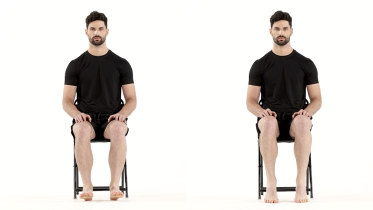 Ankle pumps
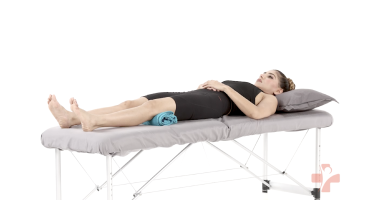 Quad sets (towel under knee)
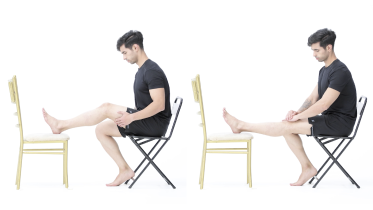 Seated heel prop
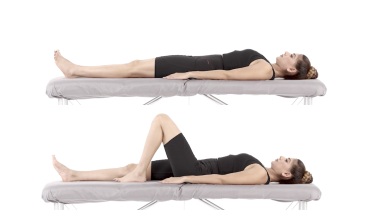 Heel slides
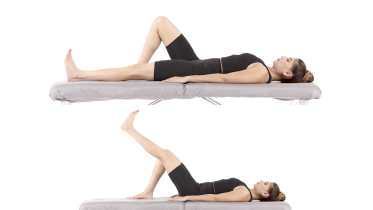 Straight leg raise
Stage 2: Walk normally and build strength on two legs
When your knee straightens fully, the swelling is settling and your team says you can take your full weight. Terminal knee extensions work the last part of straightening. The squats, bridges and calf raises build strength with both feet on the ground. Bend only as deep as you can control, with your kneecap over your second toe. In the eccentric squat, the work is in lowering slowly. Do the standing hamstring curl without any weight for now. After a hamstring graft, start the curl and the bridges only when your surgeon or physio says you can, and stop a bridge if you feel a pull or cramp at the back of the thigh. Use a low step for the step up, and hold a kitchen counter for single leg stance. By the end of this stage you should be walking without crutches and without a limp.
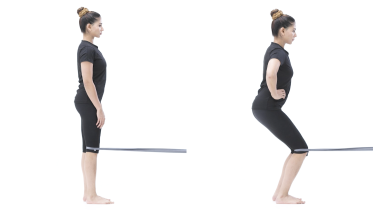 Terminal knee extension with band
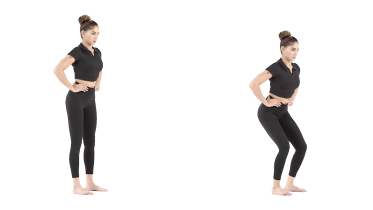 Mini squat
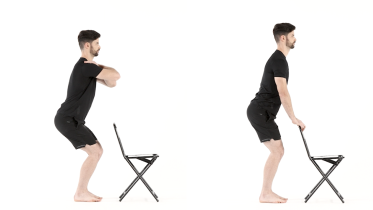 Eccentric squat
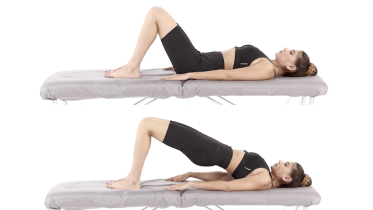 Glute bridge
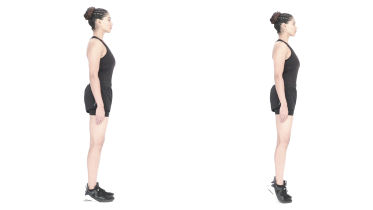 Calf raises
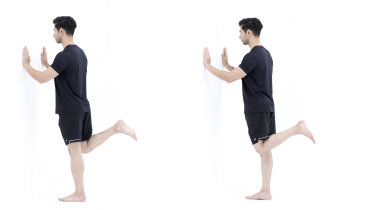 Standing hamstring curl
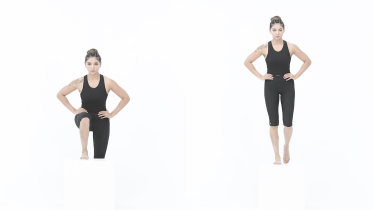 Step up
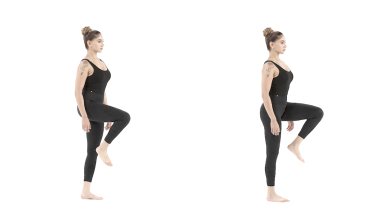 Single leg stance
Stage 3: Strength and control on one leg
When you walk without a limp, stage 2 feels easy and the knee is no worse the next morning. The supported single leg squat, the step down and the split squat build strength one leg at a time. Keep a counter within reach. In the two band exercises beside a chair, you hold the knee steady while the band pulls it outward or backward. The standing hamstring curl with a weight is resisted hamstring work. After a hamstring graft, start it only when your surgeon or physio says you can. The wobble cushion squat and the cushion balance put you on an unsteady surface to train balance and control.
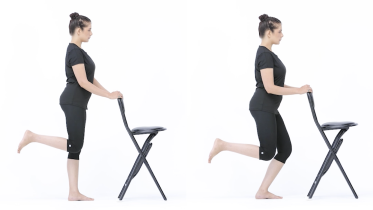 Supported single leg squat
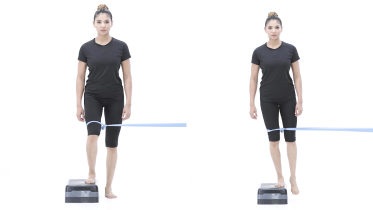 Lateral step-down with band
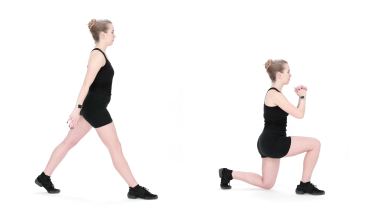 Split squat
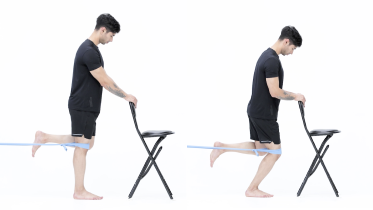 Knee hyperextension control with a band
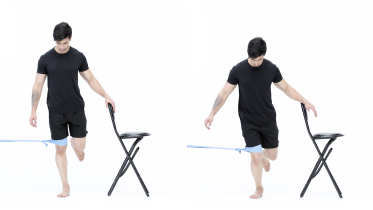 Knee stability with a band
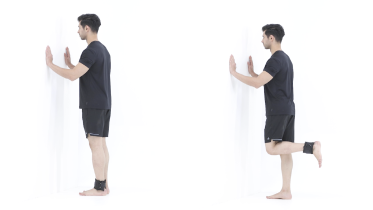 Standing hamstring curl with a weight
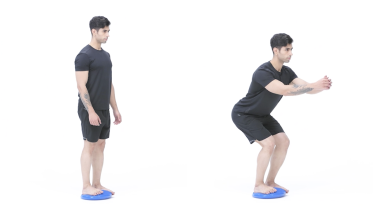 Squat on a wobble cushion
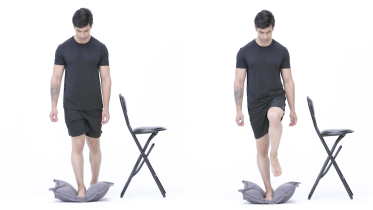 Single leg balance on a cushion
Stage 4: Get ready to run, jump and change direction
Only when your physio has tested your knee and says you are ready, which in most programs is at least about 3 months after surgery. The clock lunge and the side to side squat teach the knee to control your weight as you move in different directions. Pogo hops, line jumps and single leg hops bring in landing. Start with small hops and land softly. If the knee is more swollen the next day, cut back. Your physio plans running, cutting and drills for your sport with you. These exercises build toward sport, but they do not replace the tests your physio uses to decide when you are ready.
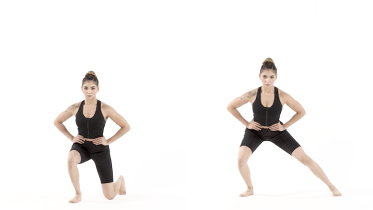 Clock lunge
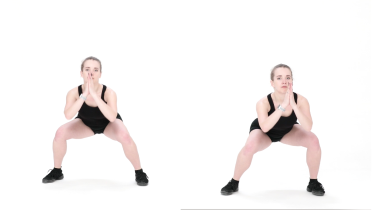 Side to side squat
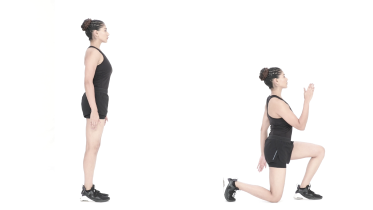 Forward lunge
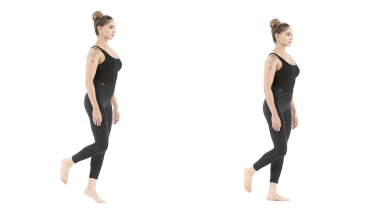 Single leg heel raise
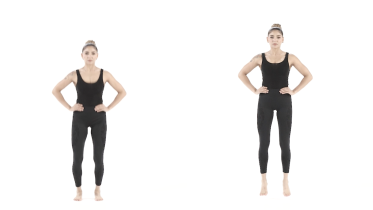 Pogo hops
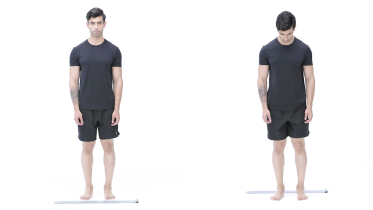 Line jumps
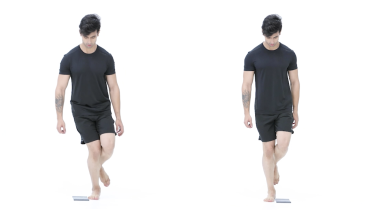 Single leg hops over a line
Exercises your physio may add
Your physio may add a seated knee extension with a band or a weight at the ankle, straightening the knee against resistance while you sit. The Aspetar guideline suggests starting this from about the fourth week, at first only through part of the range, from 90 to 45 degrees of knee bend. It also notes that hamstring grafts may be more vulnerable to this exercise when it starts early. Add it only once your physio has shown you the range to use.
Returning to running and sport
There is no set week for your first run. With no research to go on, the Aspetar guideline suggests signs to check first, based on expert agreement, including a knee that straightens fully and bends at least 95% as far as the other one, no more than a trace of swelling, thigh strength and a jump test each at least 80% of the other leg, and pain-free hopping on the spot on one leg. Most of the studies it reviewed also set a minimum of about 12 weeks after surgery, although some used 8 or 16 weeks. Your physio tests these and plans your first runs with you.
A return to sport, especially one with pivoting, cutting or jumping, needs more. As the minimum for an athlete going back to high demand pivoting sports, the Aspetar guideline lists no pain or swelling, full movement, a stable knee, thigh and hamstring strength equal to the other leg, jumping and running tests within 10% of the other leg, confidence measured with questionnaires, and a completed training program for your sport. It notes that fear of injuring the knee again is the biggest reason people do not return to sport, so tell your physio if you feel nervous about the knee. It also points out that the tests are not yet fully proven, and that studies disagree on how much passing them lowers the risk of a new tear.
Timing matters as well. In a study of 106 people who played pivoting sports and had an ACL reconstruction, the rate of injuring the knee again fell by about half for each month the return was delayed, up to 9 months after surgery, with no further drop after that (Grindem and colleagues, 2016). People whose thigh strength was closer to the other leg before they went back also had fewer reinjuries. It was one fairly small study. Still, it fits the van Melick advice that rehab carries on for 9 to 12 months.
When to see a physio or doctor
The NHS says you will have regular physiotherapy for a few months after the operation, and your surgeon or physio is the first call for questions about your plan. Contact them sooner if your knee is not straightening or bending as expected, you still limp after your team has taken you off crutches, the knee keeps swelling after exercise, or it feels unstable. Ask for a review before you start running or go back to sport, so your physio can test your knee against the other leg. Some problems need help sooner, from an emergency visit to a check within a few days. The warning signs below say how quickly for each one.
Check with your doctor before you start if you have a heart or lung condition, or blood pressure that is not under control. If you have fallen recently or feel unsteady, do the standing exercises next to a kitchen counter.
For physiotherapists
This page gives patients a general framework after ACL reconstruction and defers to the operating surgeon's protocol, particularly after concomitant meniscal repair or cartilage procedures, where the Aspetar guideline advises adapting the early phase to the surgeon's instructions. The Aspetar guideline (Kotsifaki and colleagues, 2023) followed AGREE II and GRADE and rated most components as very low certainty, with recommendations resting largely on expert agreement. It recommends active knee motion immediately after surgery, progressive controlled weight bearing from the first week, NMES in the very early phase, and open kinetic chain quadriceps work in 90 to 45 degrees of flexion from week 4, monitoring for anterior knee pain. It notes that hamstring grafts may be more vulnerable to early open kinetic chain loading, and that blood flow restriction training may be added in the early phase, particularly when knee pain limits loading.
Its return to running criteria, proposed by the guideline group despite an absence of research findings, are 95% knee flexion ROM, full extension, no or trace effusion, quadriceps LSI over 80%, countermovement jump eccentric impulse LSI over 80%, pain-free aqua jogging and anti-gravity treadmill running, and pain-free repeated single leg pogos. It adds that most studies in a scoping review of return to running set a minimum of 12 weeks, some 8 or 16, and that the safety of running at or before 12 weeks is unproven. Its proposed minimum criteria for a professional athlete to be cleared to train with the club add 100% isokinetic quadriceps and hamstring symmetry at 60 degrees per second, over 90% symmetry in countermovement and drop jumps and in running vertical ground reaction forces, normalized jump biomechanics, patient-reported function and psychological readiness (IKDC, ACL-RSI, Tampa Scale of Kinesiophobia), and a completed sport-specific program. The guideline states that there is no evidence on which progression or discharge criteria should be used.
van Melick and colleagues (2016) recommend prehabilitation and three criterion-based postoperative phases, with a battery of strength, hop, movement quality and psychological tests to guide progression and 9 to 12 months of postoperative rehab. In the Delaware-Oslo cohort of 106 pivoting-sport athletes, return to level I sport carried a 4.32 times higher reinjury rate, each month of delay up to 9 months reduced the reinjury rate by 51%, and more symmetrical quadriceps strength before return reduced reinjury. The difference between those who passed and failed the return to sport criteria (5.6% vs 38.2% reinjured) did not reach significance (p=0.075) (Grindem and colleagues, 2016). For patients still deciding on surgery, the KANON trial found rehab plus early reconstruction no better than rehab with optional delayed reconstruction on KOOS4 at 2 years in young active adults (Frobell and colleagues, 2010).
For hamstring grafts, a narrative review (Högberg and colleagues, 2026) reports that the timing of knee flexor strengthening is unclear. A scoping review it cites found the evidence inconclusive, recommended isometric work after 6 weeks, advised against dynamic flexor loading in the first 4 weeks and recommended it after 12 weeks. The narrative review also cites a clinical-experience suggestion of symptom-guided isometric loading at short to mid muscle lengths from about 4 weeks, and case reports of sudden sharp pain after aggressive loading in the first 3 to 4 weeks. The stage 3 weighted hamstring curl assumes the surgeon or physio has cleared resisted flexor loading.
For arthroscopic knee surgery, NICE NG89 says VTE prophylaxis is generally not needed when total anesthesia time is under 90 minutes and VTE risk is low, and to consider LMWH for 14 days when anesthesia time is over 90 minutes or VTE risk outweighs bleeding risk. Check that this has been assessed, and screen at each visit for DVT and pulmonary embolism, wound or joint infection, graft failure, extensor mechanism failure after patellar tendon or quadriceps tendon grafts (OrthoInfo), new distal neurological signs, a mechanical block to extension and progressive loss of extension.
See a doctor promptly if
- Emergency: sudden, severe pain in your lower leg that is much worse than you would expect, especially with a tight bandage or brace on the leg. It may come with a tight, swollen leg, pain that gets worse when the muscle is stretched, numbness, pins and needles or weakness. Call emergency services or go to an emergency department straight away, and do not drive yourself. This can be acute compartment syndrome, which needs urgent surgery.
- Emergency: since your operation, you suddenly become short of breath, you get chest pain or pain in your upper back that may be worse when you breathe in, you cough up blood, your heart is beating very fast, or you faint. Call emergency services straight away, even if your leg looks normal. These can be signs of a blood clot in the lungs (pulmonary embolism).
- Same day: a calf or thigh that is newly swollen, warm, tender, red or darker than usual, has swollen veins that are sore to touch, or has a throbbing or cramping pain that does not fit your injury or condition, or that feels different from normal muscle soreness after exercise. This can be a sign of a blood clot (deep vein thrombosis), especially after surgery, an injury, time in a cast or boot, a long trip or a spell of being much less mobile than usual. Get medical advice the same day. If you are also short of breath or have chest pain, call emergency services.
- Same day: since your operation, your wound is oozing, leaking or has pus coming out of it, or its edges start to come apart, or your knee is tender, swollen, painful or red and it is not getting better or is getting worse, or you have a high temperature or feel hot and cold or shivery. Redness can be harder to see on brown or black skin. Contact your surgical team the same day, or get urgent medical advice if you cannot reach them. These can be signs of an infection in the wound or the knee joint. If you feel very unwell, go to an emergency department. If you have a very high or very low temperature, shivering you cannot control, you are breathing very fast or finding it hard to breathe, you are confused or your speech is slurred, your skin, lips or tongue look blue, gray, pale or blotchy (on brown or black skin this can be easier to see on the palms of the hands or soles of the feet), or you have a rash that does not fade when you press it, call emergency services, as this can be sepsis.
- Same day: your knee gives way, or you feel a pop, a shift or a twist inside it, and it swells up within a few hours or is very painful. Keep your weight off it and contact your surgical team, or get assessed the same day at urgent care or an emergency department. A fall or a twist can damage the new ligament (graft) or a meniscus repair. If the knee looks out of shape, or your foot turns numb, cold or pale, go to an emergency department straight away, and do not drive yourself. If the knee only feels a little unsteady now and then, with no swelling or pain, it is not an emergency, but tell your physio or surgeon in the next few days.
- Same day: the knee is locked, which means it is stuck bent and you cannot straighten it, even after gently trying to move it, or it suddenly will not bend or straighten as far as it did before. Contact your surgical team, or get assessed the same day at urgent care or an emergency department. A torn piece of meniscus can get caught in the joint and block it. This is different from the slow, gradual stiffness of the early weeks.
- Same day: you suddenly cannot straighten your knee by yourself or lift your leg straight when you could before, often after a pop, a fall or a stumble, or you notice a dip or a gap just above or below your kneecap. Keep your weight off it and contact your surgical team, or get assessed the same day at urgent care or an emergency department. After a patellar tendon or quadriceps tendon graft, the tendon or the kneecap near where the graft was taken can rarely tear or break.
- Same day: a leg or foot that is getting weaker, for example your foot drags, catches on the ground or slaps down when you walk (foot drop). Get medical advice the same day. If the weakness is getting worse by the hour, go to an emergency department.
- Same day: new numbness, tingling or burning in your lower leg or foot, beyond the numb patch of skin near your scars. Contact your surgical team or get medical advice the same day. If your foot or toes turn cold, pale, blue or gray, call emergency services or go to an emergency department straight away, and do not drive yourself.
- Within a few days: your knee still will not straighten as far as the other one, or bend as far as your physio expects, and it is not improving from week to week, or it is slowly losing movement it had. This is not an emergency, but contact your physio or surgeon within the next few days. Getting the knee fully straight is one of the first aims of rehab.
Common questions
How long does it take to recover from ACL surgery?
Several months at least, and often about a year before sport. The NHS says most people can do most activities again within a few months, but it can take up to a year to play sport again. The van Melick guideline advises that rehab carries on for 9 to 12 months after surgery, and OrthoInfo says most people are allowed back to full sport within 6 to 12 months, depending on their progress, strength and movement. How fast you move through the stages depends on your graft, any other repair done at the same time and how your knee responds.
When can I stop using crutches after ACL surgery?
When your physio says you can. The NHS advises using crutches at first if you were given them, and stopping when your physiotherapist says so. The Aspetar guideline supports starting to put weight through the leg in the first week, built up in a controlled way. OrthoInfo notes that how much weight you are allowed depends on your surgeon and on any other injuries treated in the same operation. After a meniscus repair, your surgeon may limit weight or bending for a while, so follow your own plan.
When can I run after ACL surgery?
There is no set date, although most of the studies the Aspetar guideline reviewed set a minimum of about 12 weeks after surgery. The guideline suggests signs to check first, based on expert agreement, including a knee that straightens fully and bends at least 95% as far as the other one, no more than a trace of swelling, thigh strength at least 80% of the other leg, and hopping on the spot on one leg without pain. Your physio tests these and plans your first runs with you. That is also why pogo hops come in stage 4 of this program.
When can I return to sport after an ACL reconstruction?
When you pass return to sport testing, and often not before about 9 months. In a study of 106 people who played pivoting sports, the rate of injuring the knee again fell by about half for each month the return was delayed, up to 9 months, and people whose thigh strength was closer to the other leg had fewer reinjuries (Grindem and colleagues, 2016). The Aspetar guideline lists tests of strength, jumping, running, knee stability and confidence before a return to high demand sport. Your surgeon and physio make this decision with you.
Why can't I straighten my knee after ACL surgery?
Pain and swelling often limit how far the knee straightens in the early weeks, and resting with a pillow under the knee makes it harder. The NHS advises not putting a pillow under your knee when you rest, and OrthoInfo says early rehab puts the emphasis on getting the knee fully straight and the thigh muscle working. The seated heel prop and quad sets in stage 1 are there for this. If your knee still does not straighten as far as the other one and it is not improving from week to week, tell your physio or surgeon.
Does the type of graft change ACL rehab?
It can. OrthoInfo says pain at the front of the knee is common after a patellar tendon graft, and pain when kneeling is often more common too. After a hamstring graft, resisted hamstring exercises are often held back for the first weeks while the site where the tendon was taken heals, but advice on timing varies and the evidence is unclear (Högberg and colleagues, 2026). The Aspetar guideline notes that hamstring grafts may be more vulnerable when straightening exercises against a weight at the ankle start early. Your surgeon and physio set the plan for your graft.
When can I drive after ACL surgery?
The NHS says not to drive until your medical team says you are fit to drive, and to tell your insurer. Ask your surgeon or physio at your follow-up appointment.
References
- Kotsifaki R, Korakakis V, King E, et al. Aspetar clinical practice guideline on rehabilitation after anterior cruciate ligament reconstruction. British Journal of Sports Medicine. 2023;57(9):500-514. https://doi.org/10.1136/bjsports-2022-106158
- van Melick N, van Cingel REH, Brooijmans F, et al. Evidence-based clinical practice update: practice guidelines for anterior cruciate ligament rehabilitation based on a systematic review and multidisciplinary consensus. British Journal of Sports Medicine. 2016;50(24):1506-1515. https://doi.org/10.1136/bjsports-2015-095898
- Grindem H, Snyder-Mackler L, Moksnes H, Engebretsen L, Risberg MA. Simple decision rules can reduce reinjury risk by 84% after ACL reconstruction: the Delaware-Oslo ACL cohort study. British Journal of Sports Medicine. 2016;50(13):804-808. https://doi.org/10.1136/bjsports-2016-096031
- Frobell RB, Roos EM, Roos HP, Ranstam J, Lohmander LS. A randomized trial of treatment for acute anterior cruciate ligament tears. New England Journal of Medicine. 2010;363(4):331-342. https://doi.org/10.1056/NEJMoa0907797
- Högberg J, Wernbom M, Hamrin Senorski E. Can we rebuild what has been taken? A narrative review of biological and functional consequences of hamstring tendon harvest in ACL surgery. Science Progress. 2026;109(3):00368504261461371. https://doi.org/10.1177/00368504261461371
- NHS. ACL (anterior cruciate ligament) surgery. Page last reviewed 17 July 2025. https://www.nhs.uk/tests-and-treatments/acl-anterior-cruciate-ligament-surgery/what-it-is/
- NHS. How ACL (anterior cruciate ligament) surgery is done. https://www.nhs.uk/tests-and-treatments/acl-anterior-cruciate-ligament-surgery/how-its-done/
- NHS. Recovering from ACL (anterior cruciate ligament) surgery. Page last reviewed 17 July 2025. https://www.nhs.uk/tests-and-treatments/acl-anterior-cruciate-ligament-surgery/recovering/
- NHS. Complications of ACL (anterior cruciate ligament) surgery. Page last reviewed 17 July 2025. https://www.nhs.uk/tests-and-treatments/acl-anterior-cruciate-ligament-surgery/complications/
- American Academy of Orthopaedic Surgeons. ACL injury: does it require surgery? OrthoInfo. https://www.orthoinfo.org/en/treatment/acl-injury-does-it-require-surgery/
- NHS. Deep vein thrombosis (DVT). Page last reviewed 30 April 2026. https://www.nhs.uk/conditions/deep-vein-thrombosis-dvt/
- National Institute for Health and Care Excellence. Venous thromboembolism in over 16s: reducing the risk of hospital-acquired deep vein thrombosis or pulmonary embolism. NICE guideline NG89. Published 21 March 2018, last updated 13 August 2019. https://www.nice.org.uk/guidance/ng89
- NHS. Compartment syndrome. Page last reviewed 4 September 2026. https://www.nhs.uk/conditions/compartment-syndrome/
- NHS. Pulmonary embolism. Page last reviewed 25 May 2023. https://www.nhs.uk/conditions/pulmonary-embolism/
- NHS. Sepsis. Page last reviewed 14 May 2026. https://www.nhs.uk/conditions/sepsis/
Written and checked by the PocketPhysio editorial team. Last updated 2026-09-29.
This page is general education, not a diagnosis or a personal treatment plan. See a physiotherapist or doctor for advice about your own situation.