
Knee hyperextension control with a band
This exercise trains you to stop your knee pushing back past straight (hyperextension) when you stand on it. A band tied behind you pulls the front of the knee backward. You stand on that leg, bend the knee slightly, then straighten it only as far as straight, not beyond. The muscles at the back of the thigh and calf work with the front of the thigh to hold that position. Physios use it for knees that tend to lock back when you stand.
How to do the knee hyperextension control with a band
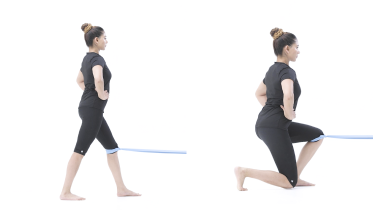
- Fix one end of a resistance band behind you at knee height, to a heavy table leg or similar. Face a sturdy chair and place your hands on its backrest.
- Put the loop around the front of the working knee, just below the kneecap, and step forward until the band pulls the knee gently backward.
- Shift your weight onto the banded leg and lift the other foot behind you, as in the video. Let the standing knee bend slightly.
- Slowly straighten the knee until it is straight, and stop there. Do not let the band push it back past straight.
- Bend the knee slightly again, with control, and repeat. Switch legs if your program includes both.
What you should feel
A steady effort in the back of the thigh and calf, and in the front of the thigh, as you hold the knee at straight. The back of the knee should not feel strained.
Common mistakes
- Letting the knee snap back into a locked position at the end of each rep.
- Pushing the hips forward or leaning back to find the straight position.
- Turning it into a deep squat. A small bend is enough.
- Using a band so strong that you cannot stop the knee going past straight.
How often
Many programs use 2 to 3 sets of 8 to 12 slow reps on each leg, with a light band. Your physio will adjust this.
Stop and check with your physio if
- Pain at the back or front of the knee, or the knee gives way or catches.
- You feel close to falling, even with your hands on the chair. Put the other foot down and stop.
- You feel dizzy, lightheaded, faint or sick, or the room seems to spin. Hold your support, sit down and get medical advice the same day before you practice again. If you faint, it does not settle within a few minutes of sitting still, your vision suddenly blurs or goes double, or you cannot stand or walk steadily, call emergency services.
From the clinic
Straight can be hard to judge by feel alone. A mirror beside you, or a phone video filmed from the side, shows you when the knee reaches straight and when it goes beyond. Start with a light band so you can control the end of each rep.
Anchor the band to something that cannot shift, such as a heavy table leg, and check it for splits before each session, because a band that comes loose can make your knee jolt forward. Use a chair that cannot tip, or a kitchen counter, and keep the floor around you clear. Wear flat shoes that fit well and grip the floor, not socks, tights or bare feet. If you have had a fall in the last 12 months or feel unsteady on one leg, keep both hands on the support, have someone nearby and ask your physio before you start. If your knee locks back because of a stroke or another condition that affects the nerves or muscles, do this exercise only in the way your physio has shown you.
After a knee fracture or knee surgery, including a knee replacement, follow your surgeon's or physio's plan, and start this exercise only when they have cleared you. This matters most after ligament or meniscus surgery, because the band pulls the knee toward over-straightening. If you have had a hip replacement, get the go-ahead from your surgeon or physio before you try this exercise. Some operations limit this kind of work for the first months, so the timing depends on your surgery. For a knee that struggles to reach straight rather than one that goes past it, the terminal knee extension uses a band from the other direction.
Written and checked by the PocketPhysio editorial team. Last updated 2026-09-26.
This page is general education, not a diagnosis or a personal treatment plan. If you have pain, an injury or a health condition, see a physiotherapist or doctor before starting new exercises.
.png)