Ball wall squat
A ball wall squat is a squat with a large exercise ball (gym ball) held between the small of your back and a wall. The ball rolls down the wall with you as your knees bend, so your back stays supported and you stay upright. It works the thighs and buttocks. Physios often use it as a stepping stone between a wall squat and a free standing squat.
How to do the ball wall squat
- Put a large exercise ball against a wall and lean back into it so it sits in the small of your back. Place your feet hip width apart, toes forward, a short step out from the wall.
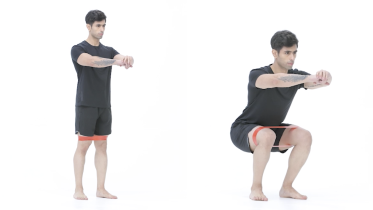
- Raise your arms in front of you with your hands together at about chest height, as in the video. Resting them at your sides is fine too.
- Bend your hips and knees slowly, as though lowering onto a seat, and let the ball roll down the wall behind you. Keep a gentle hollow in your lower back.
- Start with a shallow squat, and lower only as far as you can control without knee pain. In the video she stops once her thighs are close to level with the floor. Each kneecap should point over your second toe.
- Push through your heels to stand back up, squeezing your buttocks as you rise, and let the ball roll back up with you. Keep your knees steady, with no wobble from side to side.
What you should feel
Work in the front of the thighs and the buttocks. The ball steadies your trunk, so the effort should sit in your legs rather than your back or knees.
Common mistakes
- Standing with your feet tucked in close to the wall, which drives the knees far past your toes.
- Knees drifting in toward each other as you go down or come up.
- Leaning to one side, so the ball rolls off center.
- Dropping into the squat quickly instead of lowering slowly.
How often
A common starting point is 2 sets of 10 slow squats, building toward 3 sets of 12 to 15, on 3 or 4 days a week. Your physio will adjust this.
Stop and check with your physio if
- Sharp pain in or around the kneecap, or knee pain that keeps building with each squat.
- Your knee gives way, or you lose control of the ball.
- Your lower back hurts more the lower you go.
From the clinic
Pump the ball up firmly. Pick a clear patch of wall, away from light switches and picture frames. Your feet are out in front of you, so stand on a floor that grips, barefoot or in shoes that do not slip. If your balance is unsure, set a sturdy chair beside you to hold while you get into position and step away from the ball.
This sits alongside the wall squat, where your back slides directly on the wall, and the wall sit, which is a single long hold. Once the ball squat is easy and steady, many programs move on to the squat with no support at all. If you have had a hip or knee replacement, get the go-ahead from your surgeon or physio before you try the ball wall squat. Some operations limit this kind of work for the first months, so the timing depends on your surgery. Your surgical team will also tell you how far you are allowed to bend.
Written and checked by the PocketPhysio editorial team. Last updated 2026-09-26.
This page is general education, not a diagnosis or a personal treatment plan. If you have pain, an injury or a health condition, see a physiotherapist or doctor before starting new exercises.
.png)