Clock lunge
A clock lunge is a set of lunges in different directions from one spot. Imagine a clock face on the floor with you at its center: one leg lunges out to each hour in turn, from straight ahead round to straight behind, and you push back to the middle after every lunge. Then the other leg covers the other half. Because the direction changes with every lunge, the leg has to control load coming from every side. That is why it usually comes in the later stages of leg and sports rehab.
How to do the clock lunge
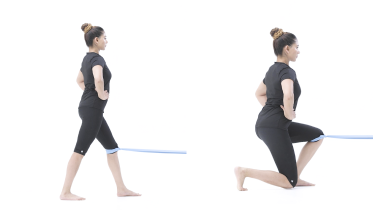
- Clear a circle of floor about two long strides across. Stand in the middle, tall, with your feet together and your hands on your hips, as in the video. Picture 12 o'clock straight ahead and 6 o'clock straight behind you.
- Lunge forward with your right leg to 12 o'clock. Lower until the front hip and knee are bent to about a right angle, with the back knee hovering above the floor, then push through the front foot to return to the center.
- Lunge with the same leg to 1 o'clock, then to each hour after it up to 6, coming back to the center each time. At 3 o'clock it becomes a side lunge, with the stepping knee bent and the other leg straight. At 6 o'clock the right leg steps straight back and the left knee bends in front, as in a reverse lunge.
- At 6 o'clock, switch to the left leg and work round the left half of the clock, through 9 o'clock and on to 12.
- In every direction, keep the bent knee pointing over your second toe and your chest facing forward, as she does in the video.
What you should feel
Work in the thigh and buttock of whichever leg is bent, which changes as you go round. The side lunges add a stretch along the inner thigh of the straight leg.
Common mistakes
- Stepping too short, which pushes the front knee far ahead of the toes.
- Letting the bent knee cave inward, most often in the diagonal and side lunges.
- Twisting round to face each lunge instead of keeping your chest facing forward.
- Rushing round the clock and wobbling on the way back to the center.
How often
Many programs use 1 to 3 rounds, each covering both halves of the clock, with a short rest in between. Your physio will adjust this.
Stop and check with your physio if
- The knee buckles, or you feel sharp pain in the knee or hip.
- A sharp pull in the groin or inner thigh during the side lunges.
- You stumble, or wobble so much that you cannot get back to the center with control.
From the clinic
Get each direction right on its own first. The forward lunge, lateral lunge and reverse lunge cover 12, 3 and 6 o'clock, and clock stepping teaches the same round-the-clock pattern with a plain step instead of a deep lunge. Start with shallow lunges and go deeper once the bent knee stays lined up over the foot in every direction.
The woman in the video lunges in open space. At home, move rugs and furniture out of the circle and keep a kitchen counter or sturdy chair close enough to grab. If you have fallen in the past year or feel unsteady on your feet, ask your physio whether this is the right stage for you, and practice clock stepping with a hand on the counter first.
If you have had a hip replacement, get the go-ahead from your surgeon or physio before you try clock lunges. Some operations limit this kind of work for the first months, so the timing depends on your surgery. Ask them too which directions are fine for you and how deep to go. After a knee fracture or knee surgery, including a knee replacement, follow your surgeon's or physio's plan, and start this exercise only when they have cleared you.
Written and checked by the PocketPhysio editorial team. Last updated 2026-09-26.
This page is general education, not a diagnosis or a personal treatment plan. If you have pain, an injury or a health condition, see a physiotherapist or doctor before starting new exercises.
.png)