Chair squat
A chair squat is a squat with a target. You sit your hips back and down until your bottom just touches a raised seat behind you, then stand straight back up without settling onto it. The seat tells you how deep to go, and stacking cushions on it makes the squat shallower. Physios use it a lot with older adults and in knee and hip programs, often before a full squat.
How to do the chair squat
- Put a sturdy chair behind you and raise the seat with firm cushions or folded pillows, as in the video. Stand just in front of it with your feet roughly hip width apart.
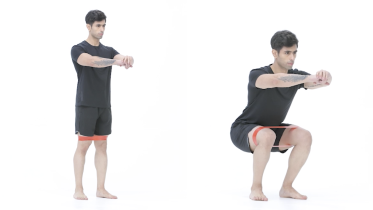
- Bend at the hips and knees and send your hips back toward the seat. Sitting back like this keeps your knees roughly above your feet. The man in the video lifts both arms forward to about shoulder height as he goes down, which helps with balance.
- Lower until your bottom lightly touches the cushion. Keep your weight on your feet rather than sitting down.
- Keep each kneecap pointing over your second toe and your heels on the floor, both on the way down and on the way up.
- Drive down through both feet, heels included, and return to standing tall, letting your arms come back to your sides.
What you should feel
Work in the front of your thighs and in your buttocks, mainly as you rise. It should feel like effort, not pain in the knee.
Common mistakes
- Dropping onto the cushions and resting there, instead of a light touch and straight back up.
- Knees drifting in toward each other as you rise.
- Pushing the knees far forward over the toes instead of sending the hips back.
- Heels lifting, so the weight tips onto the toes.
How often
Many programs start with 2 to 3 sets of 8 to 12, once a day or on most days, at a seat height you can manage with control. Your physio will adjust this.
Stop and check with your physio if
- A sharp pain in your knees, hips or low back, or knee pain that builds rep by rep.
- A knee buckles, or you start to lose your balance.
- You feel dizzy, lightheaded or faint as you get up. Sit back down and wait for it to pass. If it does not pass within a minute or two, or it keeps happening, get medical advice the same day before you practice again. If you faint, or it does not settle within a few minutes of keeping still, call emergency services.
- Chest pain or pressure, dizziness or feeling faint, a racing or irregular heartbeat, or being far more out of breath than the effort should cause.
From the clinic
Seat height is how you set the difficulty. More cushions make it easier, and each one you take away lets you go a little deeper, so the usual next stages are a plain chair and then the bodyweight squat. If even the raised seat is hard for now, the mini squat uses a smaller bend. The video uses a light folding chair, but at home a heavy chair with its back against a wall is less likely to shift. Wear flat shoes that fit well and grip the floor, not socks, tights or bare feet.
Osteoporosis, a recent fall or shaky balance are all reasons to keep a kitchen counter within reach for every rep, and to ask your physio before you take a cushion away. Knee pain on the way down is a sign to put a cushion back rather than push through it, and after knee surgery your physio will tell you how deep to go. If you have had a hip replacement, get the go-ahead from your surgeon or physio before you try chair squats. A low seat makes the hip bend past a right angle, and many surgeons ask you to avoid that for the first months after some operations. Ask them what seat height suits you.
If chest pain, pressure or tightness does not ease quickly when you rest, spreads to your arm, neck, jaw, stomach or back, or comes with sweating, feeling sick, feeling light-headed or being short of breath, call emergency services straight away, as this can be a heart attack. If it eases quickly and none of these happen, get medical advice the same day, and do not exercise again until you have been checked.
Written and checked by the PocketPhysio editorial team. Last updated 2026-09-28.
This page is general education, not a diagnosis or a personal treatment plan. If you have pain, an injury or a health condition, see a physiotherapist or doctor before starting new exercises.
.png)