
Knee arthroscopy recovery: a staged rehab program
Warning signs, and when to get help
Which operation did you actually have?
Most people come to a page like this the evening of the operation or the day after, with a bandage, a pair of crutches and a leaflet that has gone missing. The first thing to know is that the word arthroscopy describes the way the surgeon got in, not what was done once they were there. Four of the commonest jobs through those small cuts have four different sets of rules, and a page that gives one recovery for all of them is giving three of its readers somebody else's plan.
OrthoInfo lists the work done through a knee arthroscope, and it includes trimming the meniscus, stitching a torn meniscus, trimming or rebuilding the damaged joint surface, taking out loose fragments of bone or cartilage, clearing inflamed joint lining, and reconstructing a torn anterior cruciate ligament. So the names on your paperwork matter more than the word arthroscopy does.
Here is how to work out which one you had, in the order that usually gets there fastest.
Look for the operation note, the discharge summary or the letter to your family doctor. The procedure is written on all three, usually in one line near the top.
Partial medial meniscectomy or partial lateral meniscectomy means a piece of the meniscus was trimmed away. Meniscus repair, or meniscal suture, means it was stitched back together, which is a different operation with a different timetable. Debridement, washout or lavage means loose and inflamed material was cleared out. Chondroplasty is the word for trimming and smoothing a damaged patch of the joint surface, and the surgical literature uses it interchangeably with arthroscopic cartilage debridement (Anderson and colleagues, 2017). Microfracture, drilling, a graft or a cartilage transplant means the joint surface was deliberately repaired rather than tidied, and that is the slowest group of all.
If you cannot find the paperwork, three questions usually settle it. Were you given crutches and told how much weight you may put through the leg, and for how many weeks? Were you given a brace, or told how far the knee is allowed to bend? Did anybody mention stitches inside the knee?
A yes to any of those points away from a simple trim, and the answer changes what you may do this week. Ring the team who operated and ask. That is a short phone call, and it is the most useful thing you can do today.
If nobody answers, ring the hospital switchboard and ask for the ward or the day surgery unit you went home from, and say you have had an operation this week. That is a call they take all the time and it does not have to be office hours, so it beats waiting for a clinic appointment. Until somebody answers, keep to whatever you were last told, and keep to the first 48 hours advice below, which needs nobody's permission: leg up, ankle moving, wound dry.
One more piece of sorting. An arthroscopy is not a knee replacement, and rehabilitation after a new joint is a different program: that is total knee replacement rehab, and the knee that will not bend after a replacement has its own page. If your operation was an ACL reconstruction, follow ACL reconstruction rehab instead, because a graft sets limits this page does not cover. And if you are still deciding whether to have a scope at all, the trial evidence is on meniscus tear surgery or physio.
How long does knee arthroscopy recovery take?
The published ranges are wide on purpose. The NHS puts recovery from an arthroscopy at anywhere from about a week to several months. OrthoInfo puts 6 to 8 weeks on getting back to most everyday physical activity, sometimes a good deal sooner than that, and it attaches a condition to the figure which matters more than the figure does: it applies unless you had a ligament reconstruction, a meniscus repair or cartilage restoration. Cleveland Clinic gives the same 6 to 8 weeks without naming those exceptions.
Both of them put the same tail on the figure, and the tail is the part people skip: higher impact activity, sport and heavy physical work can need longer than 6 to 8 weeks even when ordinary activity does not. So if your operation was one of those three, 6 to 8 weeks was never your number, and a page that quotes it at you without the exception has quoted you somebody else's recovery.
Healthdirect in Australia is blunter about the long tail, and where it puts that bluntness matters. Severe pain, stiffness and loss of use of the knee appear on its list of possible complications of this operation, not in its account of ordinary recovery. It says such a knee can take months or years to improve and that the pain and stiffness are sometimes permanent. So a knee that is severely painful, that you cannot use, or that is stiffening rather than loosening is not the slow end of normal and is not something to wait out. It goes to the team who operated.
Stiffness has a page of its own, because the questions it raises are different from the ones on this page. If the knee is tight rather than painful, or you are wondering whether a range that has stopped moving is slow or stalled, knee stiffness after surgery covers the straightening as well as the bend, the timetable surgeons think in when a range stops improving, and what a manipulation or a release actually involves. That is deliberately not repeated here. Most people reading this page had a short keyhole operation and will get their movement back with the exercises below, and the surgical end of the stiffness story would sit oddly in the middle of a program. The reason to know the other page exists is the window: when a knee that has stopped moving is considered for anything surgical, the decision is measured in weeks and months rather than years, so a range that has flattened is raised early rather than saved for a yearly review.
Those are not contradictions. They are one range that covers four operations, and the operation is what narrows it. OrthoInfo splits the two meniscus operations for exactly this reason: rehabilitation after a partial meniscectomy takes roughly 3 to 6 weeks, and after a meniscus repair about 3 to 6 months, because a repair has to heal before it can be trusted.
What nobody can give you is a date. Two people operated on in the same week, by the same surgeon, can be months apart if one had a trim and the other had the tear stitched. Work out which group you are in, then judge progress against the stage you are on rather than against the calendar.
After a partial meniscectomy, a debridement or a chondroplasty
These three are the quick group, and they behave similarly because nothing inside the knee has been stitched and left to heal. OrthoInfo says a partial meniscectomy usually allows weight through the leg immediately and full movement soon afterwards, and puts rehabilitation at roughly 3 to 6 weeks.
Read that as what is typical, not as permission. Some surgeons restrict this group anyway, because of what they found inside the joint, or because the trim was large, or because the kneecap surface was involved. If your own instruction is stricter than what you have just read, your instruction is the one that counts, and you keep to it until the team who gave it says otherwise. A page cannot see your knee and your surgeon has.
Two things sit behind that sentence, and both point the same way. The figure OrthoInfo gives is for a partial meniscectomy. It does not publish a weight bearing rule for a debridement or for a chondroplasty, and neither does anybody else we could find, which is why there is no line on this page saying those two carry no restriction. Chondroplasty is not even one operation: it covers a range of techniques from radiofrequency smoothing to abrasion to trimming the loose cartilage back to a stable rim, there is no standard of care for it, and the technique varies between surgeons (Anderson and colleagues, 2017).
There is something useful to say about why, though, and it beats a week number, because it tells you what to ask. A surgeon limits weight through the leg when something inside the knee has to heal while you are standing on it: stitches holding a torn meniscus together, a repaired patch of joint surface, or bone deliberately made to bleed so that a new surface grows. A trim, a washout and a smoothing take tissue away and leave nothing behind that has to knit, which is why this is the group most often allowed onto the leg early. Most often is still not an instruction, because only the surgeon knows what was found once the camera was inside, and a chondroplasty can be done alongside other work in the same operation.
OrthoInfo puts it in one line: your weight bearing status after the operation is dictated by what was performed during it. It adds that if you have any question about putting weight through the leg, you call your surgeon, and on this page that is the sentence to act on.
The other thing is that being allowed weight is not the same as being able to take it. The BMJ panel that reviewed this surgery notes that most people cannot bear full weight on the leg in the first week and may need crutches, and that driving and activity are limited while they recover (Siemieniuk and colleagues, 2017). So a knee that will not take your whole weight on day two is behaving normally, and it is not a reason to force it.
What the first fortnight actually looks like here is a knee that is swollen, stiff first thing in the morning, and surprisingly weak. The weakness is not damage. A joint full of fluid is one of the things that stops the thigh muscle switching on properly (Rice and McNair, 2010), so the leg feels less reliable than the soreness alone would explain, and the last few degrees of straightening go at the same time.
Read that for what it covers, which is a thigh that is slow and weak from the first day. It does not cover a leg you could lift straight and suddenly cannot, a knee that will not straighten at all, or a dip or gap you can feel just above or below the kneecap. Those are on the warning list at the foot of this page and they go to your surgical team the same day, not into another week of exercises. That is what stage 1 is built for, which is why it opens with quad sets and kneecap glides rather than squats.
After a meniscus repair, which is a different operation
A repair is the one place on this page where getting it wrong matters most, so it gets the plainest paragraph.
The torn edges have been stitched together and left to knit, which takes months rather than weeks. While that is happening, the stitches are what is holding the tear, and every step you take tests them. OrthoInfo puts rehabilitation after a repair at about 3 to 6 months for that reason.
A repair is protected in two ways, and both of the numbers belong to your own surgeon: how much weight goes through the leg, and how far the knee is allowed to bend. There is no standard version of either. Cong and colleagues (2024) put six real repairs to members of the American Orthopaedic Society for Sports Medicine and got 451 replies. Their starting point was that North America has no agreed plan for rehabilitation after a meniscus repair, and what the replies showed was that the limits track the tear: a tear that leaves the ring of the meniscus intact was let onto the leg sooner than one that breaks it, and 83 percent of the surgeons braced the knee whichever kind it was. So a week number from a page, this one included, tells you nothing about your own knee, and the limits you were given are the ones to work inside.
The size of that disagreement is worth seeing, because it explains why we will not print a figure. O'Donnell and colleagues (2017) pooled 15 studies covering 17 treatment groups and found four distinct patterns: two that restricted nothing much, two that limited movement, four that limited weight, and nine that limited both. Fried and colleagues (2021) looked at 88 studies and found the same thing from the other end: the week at which weight and movement were allowed back varied widely from one protocol to the next, and the criteria for releasing people to sport were reported too poorly to compare. Both sets of authors concluded there is no consensus, and we are not going to print the middle of a spread as though it were a rule.
That cuts one way only. If your surgeon has you off the floor entirely for a fortnight, or capped at a right angle for six weeks, nothing in the research above contradicts your plan. It sits at the careful end of a wide spread, and you keep to it. The restrictions that come off last are the ones on kneeling, deep or loaded bending, twisting on a planted foot, hopping and landing, and they are lifted well after the ones on walking. Being allowed to walk normally says nothing about being allowed to kneel.
For the non-surgical side of the same injury, including which tears tend to be repaired and which trimmed, see meniscus tear.
After cartilage repair or microfracture
If the joint surface was repaired rather than trimmed, this is the slowest group and the one where a borrowed timetable does the most harm. OrthoInfo's cartilage page says the repaired surface has to be protected while it heals, that you may not be able to put weight through the leg at all, that crutches are needed for the first few weeks or possibly longer depending on the procedure and where the damaged patch sat, and that it can be several months before strenuous activity is safe.
This is the group where the gap between the names matters most. A chondroplasty tidies a rough surface. A microfracture deliberately makes the bone underneath bleed so that a new surface can grow into it. Those two words can sit a line apart on an operation note and they are not the same operation. If the words microfracture, drilling, graft, transplant or cartilage repair appear on yours, work from your surgeon's plan and treat the staging below as background reading rather than as your program.
The first 48 hours
Nothing complicated happens here, and almost nobody is told it in a dose.
Keep the leg up when you are sitting. The NHS advises raising the leg while sitting to help the swelling, using an ice pack wrapped in a tea towel for 20 minutes every 2 to 3 hours, and wearing a compression stocking if you were given one. OrthoInfo adds keeping the leg elevated as much as you can for the first few days.
Three ice precautions travel with that advice. Never put ice on skin that cannot feel properly, keep something between the pack and your skin, and do not fall asleep on it. If you have had an operation on the knee, ask your surgical team before you put ice over the wound or the dressing, because teams differ on that.
Leave the wound alone and keep it dry. OrthoInfo says to keep the cuts clean and dry, and that your surgeon tells you when you may shower or bathe, so a bath, a swim and a hot tub all wait for that answer rather than for the skin to look closed. Small cuts into a joint are still a way into a joint. If you were given stockings or a medicine to lower the risk of a clot, which OrthoInfo says a doctor may prescribe after this operation, keep going with them for as long as you were told rather than stopping when the knee starts feeling better. And a dressing that soaks through with blood, or bleeding that does not stop with gentle pressure on the dressing, is a phone call to the team the same day rather than another dressing: Cleveland Clinic puts bleeding from the cuts at the top of its own list of reasons to ring after this operation.
Move the ankle and work the thigh. OrthoInfo's exercise guide after a knee arthroscopy runs at roughly 20 to 30 minutes, 2 or 3 times a day, with most of its early exercises held about 5 seconds and repeated around 10 times. That is the dose stage 1 below uses. It also says to check with your therapist or surgeon before doing any of them, which is not a formality on this page: whether you may load the leg at all is the one thing that differs between its readers.
Expect the knee to be painful and stiff at first, which is what the NHS says about arthroscopy generally. Expect to be more tired than you planned for. And read the warning signs at the foot of this page tonight rather than at three in the morning.
How long will you be on crutches?
This is one of the first questions people ask and one of the last to get a straight answer, because there is no single number. Which is probably why so few pages will commit to one.
OrthoInfo says most people need crutches or some other support after arthroscopic surgery, that your weight bearing status is decided by what was done during the operation, and that your surgeon tells you when it is safe to put weight through the foot and leg. After cartilage work it runs to the first few weeks or longer. Cleveland Clinic says you may need crutches, and may be given a brace to hold the knee in position while it heals.
So the honest version is this. For a straightforward trim, crutches are often support rather than a restriction, and they go when your team has told you your weight bearing is not limited and you can walk without limping. Even in that group, most people are leaning on something for the first week or so, which is the point made in the meniscectomy section above: allowed is not the same as able. For a repair or cartilage work the crutches are doing a job, and they come off on a date somebody has chosen for a reason. If you do not know which of those you are, that is the phone call again.
Two practical points while you are on them. Get the height set by a physio instead of guessing, because crutches set too long drive the shoulders up and make the whole business harder. And carrying things in your hands while on crutches is how people fall, so a small rucksack earns its place for a fortnight. Going up stairs, lead with the stronger leg; coming down, put the operated leg down first so the stronger one lowers you, and take one step at a time with a hand on the rail.
When can you drive again?
Ask your surgical team, and check your insurer, because an insurer can take a different view from a surgeon and it is your policy that pays.
The published advice sits in a range. The NHS says you should be able to drive once you have recovered and can perform an emergency stop, usually at least 2 weeks after the operation, and that you must not drive after a general anaesthetic. OrthoInfo puts it at 1 to 3 weeks for a minor procedure, with longer needed after a bigger repair or a reconstruction.
Then there is a figure that gets quoted at the strict end, and it deserves its context. A systematic review and meta-analysis of braking reaction time recommended returning to driving 6 weeks after knee arthroscopic procedures (Palma and colleagues, 2021). Four of its five knee studies were ACL reconstructions, only one looked at partial meniscectomy, chondroplasty and diagnostic arthroscopy, the knee studies were pooled together rather than separated, and the authors graded most of their own pooled analyses as low or very low certainty.
Their own limitations section says it in plainer words than we could: the effect of an ACL reconstruction on braking may not be comparable to the effect of a meniscus repair or a diagnostic arthroscopy, and separating the procedures might produce different recommendations from the one they printed. They also say reaction time is only part of driving, and name coming off strong painkillers, the strength of the operated leg and its movement as the rest of it. So 6 weeks is a reasonable figure for a reconstructed knee and it is not the number for a simple scope.
One study inside that review did look at a simple scope, and it needs reading carefully rather than being seized on. Hau and colleagues (2000) measured braking reaction times in 30 people before and after a right knee arthroscopy, against 25 people who had not been operated on, and the review records the procedures as partial meniscectomy, chondroplasty and diagnostic arthroscopy. Their braking was slower a week after the operation than it had been before it, 920 milliseconds against 736, and at four weeks it was still slower than the braking of the people in the same study who had not been operated on, 685 against 582. The authors concluded that it is appropriate to delay driving for at least a week, and that the actual date should be set by how the person performs on two clinical tests rather than by the week number.
Notice what that does and does not say. One week is a floor from 30 people in a single 20 year old study, graded low certainty by the review that pooled it, and at that one week mark the braking was still worse than it had been before the operation. It is not a clearance, it is more permissive than the NHS, and we are not adopting it as this page's number. What it does support is the NHS's own gate: the date comes from the test, not the calendar.
Which leaves the test that all of them come back to. Could you stamp on the brake, hard, right now, without a moment's hesitation because of the knee? If the answer is no, you are not ready, whatever week it is. Strong painkillers are a separate reason to wait, whatever the knee can do, and getting off them is one of the things Palma and colleagues name as part of being ready rather than an afterthought. And if your own team has told you longer than anything written here, theirs is the instruction.
Why is the knee still swollen weeks later?
Because the skin heals faster than the joint does, and the two are not connected. Healthdirect says it is common for the knee to be a little swollen for a few weeks after an arthroscopy, and that the knee itself can take months to improve. Cleveland Clinic frames the first few days as the sore and swollen part, which is true, and is why week four comes as a surprise to people.
Swelling matters here for a reason that has nothing to do with worry. It is one of the things that keeps the thigh muscle switched off (Rice and McNair, 2010), so a knee that stays full stays weak, and a weak thigh is what makes stairs and kerbs feel unreliable. Breaking that cycle is most of what the program below does, and it is why the swelling gets managed and not waited out: leg up, ice as above, and the amount of walking that leaves the knee no worse the next morning.
Three patterns here, and only the first of them is ordinary. Ordinary swelling creeps up through a busy day and settles overnight or with the leg up, and it shrinks a little week by week. The kind that needs a call arrives over a few hours, makes the knee feel tight and full, and hurts more than it did yesterday.
There is a third pattern between those two, and it is the one people sit on longest: swelling that never arrives fast but is not shrinking either, week after week, or is slowly getting bigger. That is not an emergency and it is not ordinary, so tell your surgical team or your physio in the next few days rather than giving it another month.
Back to the fast kind. That one is on the warning list on this page, and it goes to your surgical team the same day, because bleeding into the joint and an early infection look much the same from outside and Healthdirect names both among the things that can follow this operation. If the knee is also hot, or you have a temperature, do not wait for a call back.
For swelling in a knee that has not been operated on, or that has come back long afterwards, see swollen knee.
If the scope was for a worn knee and it still hurts
A large share of knee arthroscopies are done on an older, arthritic knee for a meniscal tear that built up slowly rather than tore in one moment. If that was you, and you are three months out and quietly disappointed, you are owed a straight paragraph rather than silence.
A BMJ guideline panel reviewed this question and made a strong recommendation against arthroscopic surgery in nearly all people with degenerative knee disease, whether or not the knee clicks or catches, and named a knee that cannot objectively be straightened as the only possible exception. The panel found that most people get an important improvement in pain and function without the operation, and that in fewer than 15 percent of the people in the trials the surgery produced a small or very small improvement in pain or function at three months, which was not sustained at one year (Siemieniuk and colleagues, 2017).
Two things follow from that, and neither of them is deflating.
The first is that a knee which still aches after a scope for wear is a common outcome, not a sign that something went wrong or that you did your exercises badly. There is one pattern that paragraph is not about, so read it before you file the whole thing under normal: pain that is getting worse month by month rather than staying the same, or pain at night or at rest that keeps building, is on the warning list at the foot of this page and goes to a doctor rather than into the pile of things that are simply taking a long time. That is true whether or not the knee was arthritic to start with.
The second is that the treatment with the better evidence behind it is still available to you, and it is strength. The program on this page will get you moving again, and then the longer-term work belongs on knee osteoarthritis, which is built for a worn knee rather than for a healing one. If the pain sits at the front, around or behind the kneecap, rather than along the joint line, patellofemoral pain is the better fit.
One qualification, so this is not read too widely. The panel said plainly that it did not look at younger people with sports injuries or at anyone whose knee was badly injured in one event, and its definition excludes a knee whose symptoms began after a major injury with the joint swelling up (Siemieniuk and colleagues, 2017). If your knee was wrecked in a tackle or a fall, none of the paragraph above is about you.
How to use this program
Start where your surgical team says, not where this page starts, and if their list differs from ours, use theirs.
Before stage 1, settle two things. Whether you may put weight through the leg, and how much. And whether there is a limit on how far the knee may bend.
If there is one, ask one more question about it: does it apply to bending the knee at all, or only to bending it while you are standing on that leg, or to both? Those are three different instructions and they rule out different exercises, which is why you want the answer in those words and not just as a number of degrees. Those two answers decide which parts of this program are yours this week, they come from your surgeon, and they are the reason the stages below are written around them rather than around dates.
Four answers do most of the gating below, so settle which of them are true of you before you start. Were you given a brace. Were you given a cap on how far the knee may bend. Was the meniscus stitched. Was the joint surface repaired.
If any one of those is a yes, the exercises that bend the knee under your own body weight, and the one stretch that takes the bend to its limit, all wait until your surgeon or physical therapist has cleared that exercise by name. On this page that means the sit to stand, the chair squat and the standing quad stretch in stage 2, and the step up, the supported single leg squat and single leg stance in stage 3. Nothing else in the program is held by those four answers, so a yes does not put the whole thing out of reach.
If you have had knee surgery of any kind, a repair, a reconstruction, a cartilage trim or a replacement, your surgeon's or hospital team's own instructions come first, including where they differ from anything on this page. Anything new in an operated knee goes to that team, not to a web page. New pain, swelling, heat or giving way in a knee that has been operated on is a same-day call to them, for the same reason the warning list sends a hot, red and swollen knee for advice the same day: an infection, or a problem with the repair or the implant, has to be ruled out before anyone treats it as a strain.
Move up a stage when the current one feels easy and the knee is no worse the next morning, not when the calendar says so. Moving up is not adding a whole stage on top of the last one. Keep the straightening work from stage 1, which stays worth doing for months, and let the rest of stage 1 go as the new exercises take its place, so the total the leg does in a day does not keep climbing every time you progress.
Mild discomfort during the exercises is usually fine if it eases soon after you stop. More pain or more swelling the next day means the amount was too much, so drop back a step rather than stopping altogether, and OrthoInfo's own guide says the same thing in fewer words: if an activity brings on swelling or pain, limit or stop that activity until you feel better. It adds one line that is easy to read past, so it is repeated here: contact your surgeon if the symptoms carry on.
Check with your doctor before you start if you have a heart or lung condition, or blood pressure that is not under control. Breathe steadily through every hold and never hold your breath.
If you have fallen in the past year, feel unsteady on your feet, or take medicines that make you dizzy, keep a hand on a kitchen counter through every standing exercise, practice only when someone else is at home, and ask your doctor or physio about a falls check before the single leg work in stage 3.
If you live alone, that rule still stands, so plan around it rather than ignoring it. Do the exercises that ask for someone to be at home at your physio appointments instead, keep to the seated and supported work when you are on your own, and ask your physio which of the one-leg exercises you may do alone. Keep your phone in a pocket rather than in another room, so you can reach it from the floor, and ask about an alarm you wear. If you do fall and cannot get up, or you think you may have hurt your head, neck, back or hip, stay where you are, keep warm and call emergency services, or get someone to call for you. Do not let anyone haul you up first.
If you are pregnant, or you have given birth in the last few months, check with your midwife or physio before you start, and plan the program with your physio and your maternity team.
Two exercises are deliberately missing, so here is why. There is no wall sit and no squat hold anywhere below. Both are loaded knee bending held still, which is the movement a meniscus repair protocol restricts, and neither is a starting point for an operated knee until your surgeon or physical therapist has cleared that exercise by name. Your physio may well add one later.
Read the warning signs at the end of this page before you begin. The ones to know while you are working through the stages: a knee that swells fast and feels tight, a wound that leaks or a temperature, a calf that becomes swollen or tender, a knee that locks, catches or gives way after an operation on the meniscus, and a leg you had been standing on that will not take your weight any more. Sudden severe pain in the lower leg with a tight bandage on it is the one that means emergency services rather than a phone call.
The exercise program
The exercises below carry their own stop signs and precautions. Open the line under an exercise and read them before you try it.
Stage 1: Switch the thigh back on, from day one
Start these only once your surgical team has said you may, and use their list instead of this one if the two differ. OrthoInfo's own exercise guide after a knee arthroscopy says to check with your therapist or surgeon before you do any of the exercises in it, and that applies here too. One of the six does not wait for that answer, and it is worth saying which so a reader who cannot reach anybody tonight is not left doing nothing: the ankle movement puts no load through the knee at all and it is the exercise on this list working against a clot, so keep that going, along with the leg up and the wound care in the first 48 hours section above. The other five wait. Everything in this stage is done lying or sitting, so nothing is standing on the operated leg and nothing bends the knee under load. The ankle movement keeps the calf pumping while you are sitting about more than usual. Quad sets and hamstring sets ask the muscle to work while the knee barely moves, which is why they come before anything else: a knee full of fluid makes the thigh hard to switch on at all. Kneecap glides keep the kneecap sliding while the knee is sore and stiff. Heel slides bring the bend back, so coax it rather than forcing the last part, and if you were given a cap on how far the knee may bend, that cap sets the end of the slide and not how it feels on the day. The straight leg raise is the one to leave out if lifting the straight leg hurts at the front or you cannot hold the knee locked: do more quad sets instead and come back to it. One exception to that, and it matters more than the exercise does: if you could lift the leg straight after the operation and now you cannot, or you can feel a dip or a gap just above or below the kneecap, that is on the warning list at the foot of this page and it goes to your surgical team the same day rather than into more quad sets. OrthoInfo's guide works at holds of about 5 seconds, around 10 times, in sessions of roughly 20 to 30 minutes, 2 or 3 times a day. Your physio will adjust this.
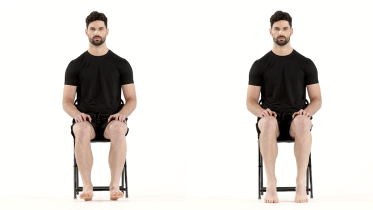 Ankle pumps
Stop signs and precautions for the ankle pumps
Before you start
- Had surgery on your foot or ankle, or wearing a cast or boot? Check which movements are allowed before you start.
When to stop and get help
- Your calf or thigh is getting more swollen, or becomes warm, tender, red or darker than usual, or has a new throbbing or cramping pain. This can be a blood clot, especially after an operation, an injury, time in a cast, boot or brace, or a spell of being much less mobile than usual, and after an operation it can also be an infection. Stop and contact your medical team or get medical advice the same day. If you are also short of breath or have chest pain, call emergency services.
- You suddenly become short of breath, get chest pain or pain in your upper back that may be worse when you breathe in, cough up blood, your heart beats very fast, or you faint. Call emergency services straight away, even if your leg looks normal, as this can be a blood clot in the lungs (pulmonary embolism).
- Any sharp pain in the foot or ankle.
- Emergency: while you are in a cast or boot, your toes turn blue, white or pale, or feel cold. Do not wait to see if raising your leg helps. Go to an emergency department straight away, and do not drive yourself. The cast or boot may be cutting off the blood supply, or pressure may be building up inside the leg (compartment syndrome), and both need checking quickly.
- In a cast or boot, the pain gets worse, your toes feel numb, tingle or burn or look more swollen, or the cast or boot feels too tight. Stop, raise your foot to about hip level and no higher, keep moving your toes and contact your fracture clinic or get medical advice straight away. If you wear a boot, loosen the straps but keep it on. Do not prop the foot higher than that and do not put ice on it, because if pressure is building up inside the lower leg both of those cut down the blood reaching your foot. If you cannot move your toes, the pain is severe even after painkillers, or the numbness, tingling, burning or swelling has not settled within 30 minutes of raising your foot, go to your fracture clinic or an emergency department straight away, and do not drive yourself.
- Since the fracture or cast, the foot or ankle is getting more painful rather than less, the skin becomes very sensitive to light touch, or the foot changes color, temperature, swelling or sweating compared with the other one, or looks shiny. See your doctor or physio as soon as you can, within a few days at most, as this can be complex regional pain syndrome (CRPS) and early treatment may help.
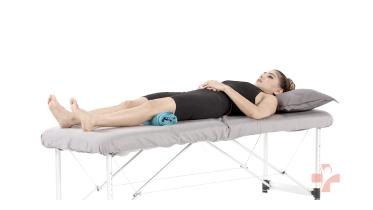 Quad sets (towel under knee)
Stop signs and precautions for the quad sets (towel under knee)
Before you start
- After a knee fracture or knee surgery, including a knee replacement, follow your surgeon's or physio's plan, and start this exercise only when they have cleared you.
When to stop and get help
- Your knee pain goes up sharply.
- Your calf or thigh is getting more swollen, or becomes warm, tender, red or darker than usual, or has a new throbbing or cramping pain. This can be a blood clot, especially after an operation, an injury, time in a cast, boot or brace, or a spell of being much less mobile than usual, and after an operation it can also be an infection. Stop and contact your medical team or get medical advice the same day. If you are also short of breath or have chest pain, call emergency services.
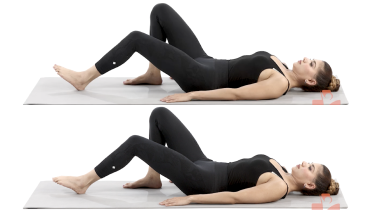 Hamstring sets (heel dig)
Stop signs and precautions for the hamstring sets (heel dig)
Before you start
- After a knee fracture or knee surgery, including a knee replacement, follow your surgeon's or physio's plan, and start this exercise only when they have cleared you.
- With a recent hamstring strain, even a still hold loads the injured muscle, so let your physio set when you start and how hard you press. The same applies after an ACL reconstruction that used a hamstring graft, where hamstring work is held back while the place the tendon was taken from heals, and the date comes from your surgeon's protocol. If you are pregnant and beyond the first trimester, ask your physio before you do this lying on your back.
- After a reconstruction of the posterolateral corner, the structures at the back of the outer side of the knee, leave this one out until your surgeon or physio tells you it is time. Digging the heel down to squeeze the back of the thigh is hamstring strengthening on its own, even though nothing moves and nothing resists you, and the protocol most widely followed holds hamstring strengthening on its own back for a minimum of four months, because the hamstring tendon on the outer side pulls on the fibular head, the small bone the graft is anchored into. So expect months rather than weeks there. If you have not had knee surgery, that wait does not apply to you.
- After an injury to the ligament at the back of the knee (the posterior cruciate ligament), the hamstrings pull the shin backward, which is the direction this ligament holds, so hamstring work is usually kept out of the early weeks. The knee stays close to straight in this hold, which is not where that pull is strongest, but your physio decides whether and when it fits, so do not start it on your own.
When to stop and get help
- Cramp in the back of the thigh, or a sudden sharp pull there. Stretch the leg out along the floor and rest.
- Knee pain that climbs sharply during or after the holds.
- Your calf or thigh is getting more swollen, or becomes warm, tender, red or darker than usual, or has a new throbbing or cramping pain. This can be a blood clot, especially after an operation, an injury, time in a cast, boot or brace, or a spell of being much less mobile than usual, and after an operation it can also be an infection. Stop and contact your medical team or get medical advice the same day. If you are also short of breath or have chest pain, call emergency services.
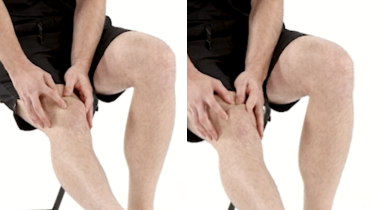 Kneecap glides
Stop signs and precautions for the kneecap glides
Before you start
- If you have had knee surgery, or your kneecap has ever dislocated or partly slipped out of place, check with your surgeon or physio before you try this. Kneecaps usually dislocate toward the outside of the knee, so your physio may ask you to leave out the outward glide.
When to stop and get help
- The kneecap feels as if it might slip out of place, or you feel a sudden sharp pain.
- The knee becomes more swollen, warm or painful after the glides.
- Your calf or thigh is getting more swollen, or becomes warm, tender, red or darker than usual, or has a new throbbing or cramping pain. This can be a blood clot, especially after an operation, an injury, time in a cast, boot or brace, or a spell of being much less mobile than usual, and after an operation it can also be an infection. Stop and contact your medical team or get medical advice the same day. If you are also short of breath or have chest pain, call emergency services.
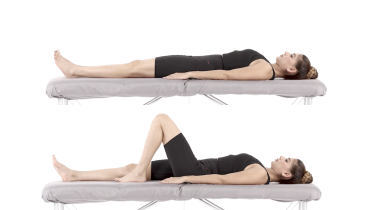 Heel slides
Stop signs and precautions for the heel slides
Before you start
- After a knee fracture or knee surgery, including a knee replacement, follow your surgeon's or physio's plan, and start this exercise only when they have cleared you.
- If you have had a hip replacement or other hip surgery, get the go-ahead from your surgeon or physio before you try heel slides. Sliding the heel toward you bends the hip, and many surgeons set a limit on how far it can bend for the first months after some operations, so find out what yours is.
- If you are pregnant and past the first three months, check with your physio before exercising flat on your back.
When to stop and get help
- Pain in the knee or hip becomes sharp or keeps increasing with each rep.
- Your calf or thigh is getting more swollen, or becomes warm, tender, red or darker than usual, or has a new throbbing or cramping pain. This can be a blood clot, especially after an operation, an injury, time in a cast, boot or brace, or a spell of being much less mobile than usual, and after an operation it can also be an infection. Stop and contact your medical team or get medical advice the same day. If you are also short of breath or have chest pain, call emergency services.
- Your wound becomes more red, hot, swollen or painful, or starts to leak. Contact your medical team the same day.
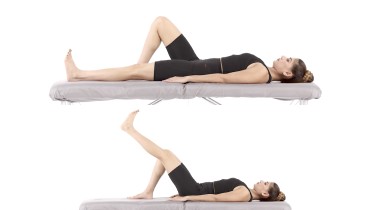 Straight leg raise
Stop signs and precautions for the straight leg raise
Before you start
- After a knee fracture or knee surgery, including a knee replacement, follow your surgeon's or physio's plan, and start this exercise only when they have cleared you.
- If you have had a hip replacement or other hip surgery, get the go-ahead from your surgeon or physio before you try this exercise. Some operations limit this kind of work for the first months, so the timing depends on your surgery. Lifting a straight leg is the heaviest way to use the muscles at the front of the hip, and after a periacetabular osteotomy a North American physiotherapy consensus panel asks for this exact movement, a straight leg lift while you are on your back, to be left out for 8 to 12 weeks.
- If you are pregnant and past the first three months, check with your physio before exercising flat on your back.
When to stop and get help
- Your lower back hurts.
- Knee pain increases during the set.
- You feel sharp pain in the front of the hip or groin.
- Your calf or thigh is getting more swollen, or becomes warm, tender, red or darker than usual, or has a new throbbing or cramping pain. This can be a blood clot, especially after an operation, an injury, time in a cast, boot or brace, or a spell of being much less mobile than usual, and after an operation it can also be an infection. Stop and contact your medical team or get medical advice the same day. If you are also short of breath or have chest pain, call emergency services.
- Your wound becomes more red, hot, swollen or painful, or starts to leak. Contact your medical team the same day.
Stage 2: Standing work, once you may load the leg
This stage waits for two things: your weight bearing instruction allows your full weight through the leg, and stage 1 feels easy. If either is missing, stay in stage 1, because none of this is worth bringing forward by a week. There is no in-between stage on this page for someone allowed part of her weight but not all of it, and that is deliberate rather than an omission: nobody can judge from a page how much of your weight is going through the leg while you stand on it, and partial weight bearing work is set and watched by the person who gave you the limit. So if you are partly weight bearing you are still in stage 1, which is not the same as doing nothing. Ask your physio for the in-between work, keep stage 1 going, and come back here when your full weight is allowed. One more permission is worth separating out, because it is not the same one, and it applies even when your full weight is allowed. Standing on the leg and bending the knee while standing on it are two different instructions. The sit to stand and the chair squat are the second kind, so if you were given a brace, or any cap on how far the knee may bend, or you had a meniscus repair or cartilage work, leave those two until your surgeon or physical therapist has cleared them by name, whatever your weight bearing instruction says. Nothing else in this stage puts your body weight through a bending knee, which is why the rest of it can start. Short arc quads and terminal knee extension train the last part of straightening, which is the part a swollen knee gives up first and the part that makes a knee feel like it might buckle on a kerb. The sit to stand and the chair squat are the same movement from two directions, and the seat height is the dose: start on the tallest firm seat in the house and lower it over the weeks rather than going deeper on day one. Because they are one movement under two names, do one of them in a session rather than both. Doing both doubles the number of loaded knee bends the leg takes in a day and buys nothing, which is easy to miss when they sit on the list as two separate exercises. OrthoInfo's guide puts a hard ceiling on the partial squat, which is not to go below a right angle at the knee, so treat that as the limit here as well. That ceiling is also where the lowering of the seat stops, which is worth saying because lower reads as better. A seat about the height of an ordinary dining chair leaves most people at roughly a right angle, so a seat lower than that is past the limit rather than the next step, and it waits for your surgeon or physio. Calf raises go back in with a hand on a counter. The standing quad stretch is the one exercise in this stage that takes the knee to the end of its bend, so if you were given a brace, or any cap on how far the knee may bend, or you had a meniscus repair or cartilage work, leave it out until your surgeon or physical therapist clears it by name. Breathe steadily through every hold rather than holding your breath, particularly if you have high blood pressure. Most of the counted work starts at 1 to 3 sets of 8 to 12, once a day rather than the two or three sessions a day of stage 1, and the sit to stand starts lower again at 5 to 10. The standing quad stretch is not counted in repetitions at all: it is held for 20 to 30 seconds, 2 or 3 times on each leg. Your physio will adjust it.
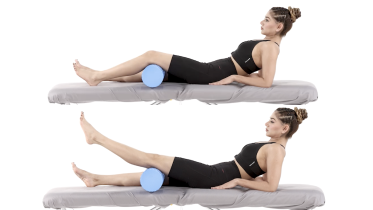 Short arc quads
Stop signs and precautions for the short arc quads
Before you start
- After a knee fracture or knee surgery, including a knee replacement, follow your surgeon's or physio's plan, and start this exercise only when they have cleared you.
When to stop and get help
- Knee pain increases sharply during the set.
- Your calf or thigh is getting more swollen, or becomes warm, tender, red or darker than usual, or has a new throbbing or cramping pain. This can be a blood clot, especially after an operation, an injury, time in a cast, boot or brace, or a spell of being much less mobile than usual, and after an operation it can also be an infection. Stop and contact your medical team or get medical advice the same day. If you are also short of breath or have chest pain, call emergency services.
- Your wound becomes more red, hot, swollen or painful, or starts to leak. Contact your medical team the same day.
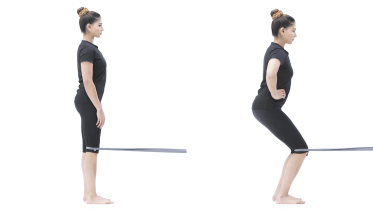 Terminal knee extension with band
Stop signs and precautions for the terminal knee extension with band
Before you start
- After a knee fracture or knee surgery, including a knee replacement, follow your surgeon's or physio's plan, and start this exercise only when they have cleared you.
When to stop and get help
- Pain at the front of the knee or behind the kneecap that builds during the set.
- The knee gives way, locks or catches.
- The knee is more swollen after the session than before it.
- You feel dizzy, lightheaded, faint or sick, or the room seems to spin. Stop, sit down and get medical advice the same day before you exercise again. If you faint, it does not settle within a few minutes of sitting still, your vision suddenly blurs or goes double, or you cannot stand or walk steadily, call emergency services.
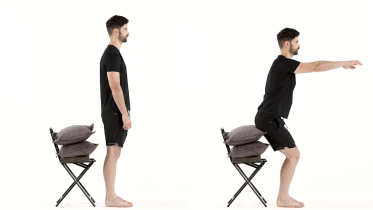 Chair squat
Stop signs and precautions for the chair squat
Before you start
- After a knee fracture or knee surgery, including a knee replacement, follow your surgeon's or physio's plan, and start this exercise only when they have cleared you.
- Knee pain on the way down is a sign to put a cushion back rather than push through it, and after knee surgery your physio will tell you how deep to go. If you have had a hip replacement, get the go-ahead from your surgeon or physio before you try chair squats. A low seat makes the hip bend past a right angle, and many surgeons ask you to avoid that for the first months after some operations. Ask them what seat height suits you.
- Osteoporosis, a recent fall or shaky balance are all reasons to keep a kitchen counter within reach for every rep, and to ask your physio before you take a cushion away.
When to stop and get help
- A sharp pain in your knees, hips or low back, or knee pain that builds rep by rep.
- A knee buckles, or you start to lose your balance.
- You feel dizzy, lightheaded or faint as you get up. Sit back down and wait for it to pass. If it does not pass within a minute or two, or it keeps happening, get medical advice the same day before you practice again. If you faint, or it does not settle within a few minutes of keeping still, call emergency services.
- Chest pain or pressure, dizziness or feeling faint, a racing or irregular heartbeat, or being far more out of breath than the effort should cause.
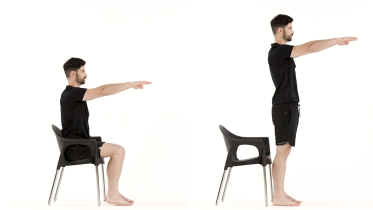 Sit to stand
Stop signs and precautions for the sit to stand
Before you start
- After a knee fracture or knee surgery, including a knee replacement, follow your surgeon's or physio's plan, and start this exercise only when they have cleared you.
- If you have had a hip replacement or other hip surgery, get the go-ahead from your surgeon or physio before you try sit to stand. Standing up from a low seat bends the hip past a right angle, and many surgeons ask you to avoid that for the first months after some operations. Ask them how high your seat should be. If you are pregnant, check with your midwife or physio before you start.
- Set up before the first stand: use a chair that will not slide, ideally with its back against a wall, and have someone nearby, or set the chair beside a kitchen counter you can reach, if you are not sure of your balance or you have fallen in the past year. Wear flat shoes that fit well and grip the floor, not socks, tights or bare feet.
When to stop and get help
- You feel dizzy, lightheaded or faint as you get up. Sit back down and wait for it to pass. If it does not pass within a minute or two, or it keeps happening, get medical advice the same day before you practice again. If you faint, or it does not settle within a few minutes of keeping still, call emergency services.
- Sharp pain in the knee, hip or lower back.
- Your knee gives way or you feel you might fall.
- Chest pain or pressure, dizziness or feeling faint, a racing or irregular heartbeat, or being far more out of breath than the effort should cause.
- You are pregnant and notice bleeding or fluid leaking from your vagina, regular painful tightenings, tummy pain that does not settle when you rest or comes with lower back pain, or a change in your baby's usual movements, such as moving less than usual. Stop and contact your midwife or maternity unit straight away. Do the same for a severe headache, problems with your vision such as blurring or flashing lights, pain just below your ribs, or sudden swelling of your face, hands or feet, which can be signs of pre-eclampsia. Call emergency services if the bleeding is heavy, the tummy pain is severe, bleeding or tummy pain comes with pain in your shoulder or feeling sick, faint or dizzy, or a headache comes on suddenly and is very severe.
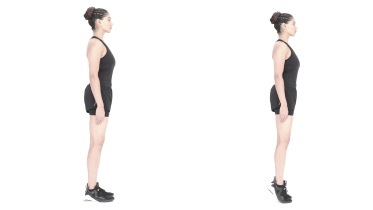 Calf raises
Stop signs and precautions for the calf raises
Before you start
- After an Achilles tendon repair or ankle surgery, calf raises usually come in at a set stage of your surgeon's protocol, often on both feet before one. Check with your physio before you start.
- After a knee or hip replacement, or other leg surgery, follow your surgeon's or physio's plan, and hold a counter or a sturdy chair back for the whole set. Rising onto your toes puts your weight forward onto a smaller base, which is where the balance goes.
When to stop and get help
- Sharp pain in the Achilles tendon, heel or arch.
- A sudden pop or snap at the back of your ankle or heel, a feeling that someone kicked you there, or sudden pain there after which you cannot push off or rise onto your toes on that leg. Stop, take the weight off that leg carefully and go to an urgent care center or emergency department the same day, even if you can still walk, as this can be a torn Achilles tendon.
- Achilles or heel pain that is clearly worse the next morning. Ease off and check with your physio.
- Your calf or thigh becomes swollen, warm, tender, red or darker than usual, or has a throbbing or cramping pain that feels different from normal muscle ache. Stop and get medical advice the same day, as this can be a blood clot. If you are also short of breath or have chest pain, call emergency services.
- Your ankle gives way, or you lose your balance.
- Since the fracture or cast, the foot or ankle is getting more painful rather than less, the skin becomes very sensitive to light touch, or the foot changes color, temperature, swelling or sweating compared with the other one, or looks shiny. See your doctor or physio as soon as you can, within a few days at most, as this can be complex regional pain syndrome (CRPS) and early treatment may help.
- You feel dizzy, lightheaded, faint or sick, or the room seems to spin. Stop, sit down and get medical advice the same day before you exercise again. If you faint, it does not settle within a few minutes of sitting still, your vision suddenly blurs or goes double, or you cannot stand or walk steadily, call emergency services.
- Chest pain or pressure, dizziness or feeling faint, a racing or irregular heartbeat, or being far more out of breath than the effort should cause.
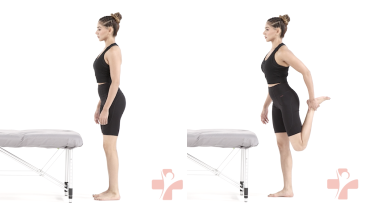 Standing quad stretch
Stop signs and precautions for the standing quad stretch
Before you start
- After a knee fracture or knee surgery, including a knee replacement, follow your surgeon's or physio's plan, and start this exercise only when they have cleared you.
When to stop and get help
- Sharp pain in the knee, especially at the front or behind the kneecap.
- You feel dizzy or unsteady. Hold on to support, or ask your physio about a lying version. If you faint while exercising, call emergency services, even if you feel fine again quickly.
- Tingling or numbness spreads down the front of the thigh.
Stage 3: One leg, stairs and distance
When stage 2 feels easy and the knee is no worse the next morning. OrthoInfo's guide keeps step ups, single leg work and a walking program for the later part of recovery, and calls walking an excellent activity for the middle stages of recovery from surgery, after 2 weeks. It says that about knee arthroscopy as a whole rather than about any one operation, so read the 2 weeks as the earliest that figure could mean anything and not as your date. Use a low step for the step up, roughly one stair high, and go up with the operated leg so that leg does the work rather than being hauled up. That is the opposite of the rule earlier on this page for stairs on crutches, and deliberately so: while the knee was sore the stronger leg led going up to spare it, and stage 3 is where it swaps over, because the point now is to make the operated leg lift you. The supported single leg squat and single leg stance both need a counter or a rail within reach, and if you have fallen in the past year, feel unsteady on your feet, or take medicines that make you dizzy, keep a hand on the counter for the whole of both and practice only when someone else is at home. If you live alone, the way to keep that rule rather than break it is set out above, in how to use this program. Stairs come back one step at a time with a hand on the rail, leading up with the operated leg and down with it first so the stronger leg lowers you. Build the walking in minutes rather than distance, and judge it by the next morning: a knee that is more swollen the day after a long walk has told you the amount, not that you need to try harder. Brisk is where the walking ends up rather than where it starts, so add the minutes first and the pace last. Twisting, pivoting, hopping, landing and kneeling are not in this stage at all, and after a meniscus repair or any cartilage work they need your surgeon's go-ahead by name. The step up and the two single leg exercises need that same go-ahead by name after a repair or cartilage work, and also if you were given a brace or any cap on how far the knee may bend, for a reason worth understanding rather than just following: they put your whole body weight through one knee while it is bending, which is the load those two operations are protected from, and it is a later permission than walking. Being told you may walk normally says nothing about this one. Usually 2 to 3 sets of 6 to 10 for the step up and the supported single leg squat, 2 or 3 days a week. The single leg stance is counted differently, at 5 to 10 lifts on each leg with a few seconds held on each, which is where that exercise starts rather than three sets of it. Your physio will adjust this.
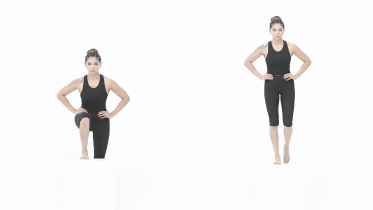 Step up
Stop signs and precautions for the step up
Before you start
- If you have had a hip or knee replacement, or other hip or knee surgery, get the go-ahead from your surgeon or physio before you try step ups. Some operations limit this kind of work for the first months, so the timing depends on your surgery. Your surgeon or physio will also tell you what step height is right for you.
- With a heart condition or high blood pressure, check with your doctor before you start.
- If you have fallen in the past year, have osteoporosis or feel unsteady on your feet, set the step beside a handrail, a kitchen counter or a sturdy chair back, keep one hand on it for every repetition, and ask your physio whether to start with step ups at all or to build up on a single stair first.
When to stop and get help
- You feel sharp pain in the knee or the knee gives way.
- Pain at the front of the knee builds with each rep.
- You feel dizzy, lightheaded, faint or sick, or the room seems to spin. Hold your support, sit down and get medical advice the same day before you practice again. If you faint, it does not settle within a few minutes of sitting still, your vision suddenly blurs or goes double, or you cannot stand or walk steadily, call emergency services.
- You feel unsteady enough that you might fall. Stop and sit down.
- Chest pain or pressure, dizziness or feeling faint, a racing or irregular heartbeat, or being far more out of breath than the effort should cause.
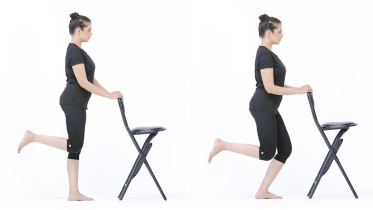 Supported single leg squat
Stop signs and precautions for the supported single leg squat
Before you start
- After a knee fracture or knee surgery, including a knee replacement, follow your surgeon's or physio's plan, and start this exercise only when they have cleared you. After a knee ligament reconstruction or meniscus surgery, ask as well how far you may bend at your stage. If you have had a hip replacement, get the go-ahead from your surgeon or physio before you try the supported single leg squat. Some operations limit this kind of work for the first months, so the timing depends on your surgery.
- If you have high blood pressure, breathe steadily through every repetition and never hold your breath.
When to stop and get help
- Sharp pain in the knee, pain at the front of the knee that grows with each bend, or the knee gives way.
- You feel dizzy, lightheaded, faint or sick, or the room seems to spin. Hold your support, sit down and get medical advice the same day before you practice again. If you faint, it does not settle within a few minutes of sitting still, your vision suddenly blurs or goes double, or you cannot stand or walk steadily, call emergency services.
- You nearly fall even with both hands on the chair. Put the lifted foot down and rest.
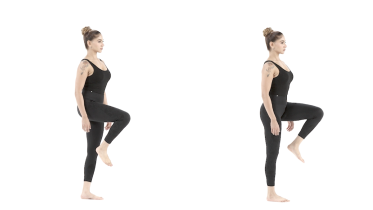 Single leg stance
Stop signs and precautions for the single leg stance
Before you start
- If you have had a hip or knee replacement, or other hip or knee surgery, get the go-ahead from your surgeon or physio before you try single leg stance. Standing on the operated leg alone comes at a set stage of rehab, and some hip operations limit how high the knee can lift in the first months after surgery.
When to stop and get help
- You feel dizzy, lightheaded, faint or sick, or the room seems to spin. Hold your support, sit down and get medical advice the same day before you practice again. If you faint, it does not settle within a few minutes of sitting still, your vision suddenly blurs or goes double, or you cannot stand or walk steadily, call emergency services.
- You lose your balance and cannot steady yourself with your support.
- Sharp pain in the hip, knee or ankle of the standing leg.
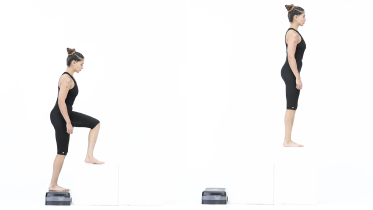 Stair climbing
Stop signs and precautions for the stair climbing
Before you start
- If you have had a hip or knee replacement, or other hip or knee surgery, get the go-ahead from your surgeon or physio before you try stair climbing. Some operations limit this kind of work for the first months, so the timing depends on your surgery.
- With a heart condition or high blood pressure, check with your doctor before you start.
- If you have fallen in the past year, have osteoporosis or feel unsteady on your feet, have someone with you for the first sessions and ask your physio whether to start on a single step.
When to stop and get help
- A sharp pain in your knee or hip, or a knee that gives way.
- The knee or hip is more swollen, or clearly more painful, the next morning. Stairs load the thigh harder than anything else in a home program, so cut the number of trips rather than pushing on, and after knee or hip surgery check with your physio before you build it up again.
- You feel unsteady or catch your foot on a step. Hold the rail, stop, and sit down on a step until you feel settled.
- Chest pain or pressure, dizziness or feeling faint, a racing or irregular heartbeat, or being far more out of breath than the effort should cause.
- You feel dizzy, lightheaded, faint or sick, or the room seems to spin. Hold your support, sit down and get medical advice the same day before you practice again. If you faint, it does not settle within a few minutes of sitting still, your vision suddenly blurs or goes double, or you cannot stand or walk steadily, call emergency services.
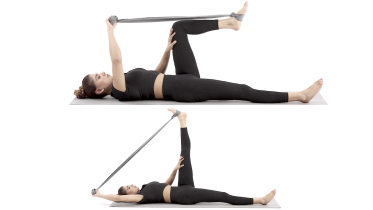 Supine hamstring stretch
Stop signs and precautions for the supine hamstring stretch
Before you start
- If you have had a hip replacement, get the go-ahead from your surgeon or physio before you try this exercise. Lifting the straight leg bends the hip a long way, and many surgeons ask you to avoid that for the first months after some operations. After a recent hamstring tear, ask your physio before you start. If you are pregnant and past the first three months, check with your physio before exercising flat on your back.
When to stop and get help
- You feel tingling, burning or pain running down the leg. That may be coming from a nerve rather than a stretching muscle.
- You get pain in your lower back.
- A sudden sharp pain, pop or snap at the back of your thigh. Stop straight away. If you then get large bruising spreading down the back of the thigh, a gap or dip you can feel, a stiff-legged walk, or clear weakness when you bend the knee, get assessed the same day at urgent care or an emergency department, as the tendon may have pulled away from the bone near the buttock.
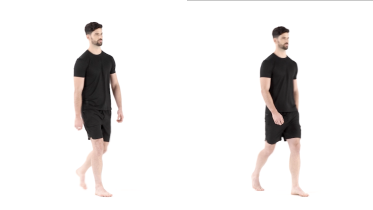 Brisk walking
Stop signs and precautions for the brisk walking
Before you start
- With a heart or lung condition, high blood pressure, or after a recent operation, ask your doctor or physio how much to walk and how fast before you start. If you are pregnant, check with your midwife or physio before you start.
When to stop and get help
- Chest pain or pressure, dizziness or feeling faint, a racing or irregular heartbeat, or being far more out of breath than the effort should cause.
- You feel dizzy, lightheaded, faint or sick, or the room seems to spin. Stop, sit down and get medical advice the same day before you exercise again. If you faint, it does not settle within a few minutes of sitting still, your vision suddenly blurs or goes double, or you cannot stand or walk steadily, call emergency services.
- A sharp pain in a foot, ankle, knee or hip that changes the way you walk.
- Aching, cramping or tightness in a calf, thigh or buttock that comes on at about the same walking distance every time and clears within a few minutes of standing still, and a doctor has not checked it yet. Keep the walk gentle and book an appointment with your doctor before you build up any further, as narrowed arteries in the legs (peripheral arterial disease) can cause this and are managed differently. If leg pain carries on while you are resting or in bed, or wakes you at night, get medical advice the same day. If a foot or leg suddenly turns cold, pale or blue, or suddenly becomes very painful, numb or weak, call emergency services and do not drive yourself, because the blood supply to the leg may be blocked and a leg that has gone numb or weak with it can be impossible to save if it is not treated within about six hours.
- Your calf or thigh becomes swollen, warm, tender, red or darker than usual, or has a throbbing or cramping pain that feels different from normal muscle ache. Stop and get medical advice the same day, as this can be a blood clot. If you are also short of breath or have chest pain, call emergency services.
- You feel unsteady on your feet or close to falling.
- You are pregnant and notice bleeding or fluid leaking from your vagina, regular painful tightenings, tummy pain that does not settle when you rest or comes with lower back pain, or a change in your baby's usual movements, such as moving less than usual. Stop and contact your midwife or maternity unit straight away. Do the same for a severe headache, problems with your vision such as blurring or flashing lights, pain just below your ribs, or sudden swelling of your face, hands or feet, which can be signs of pre-eclampsia. Call emergency services if the bleeding is heavy, the tummy pain is severe, bleeding or tummy pain comes with pain in your shoulder or feeling sick, faint or dizzy, or a headache comes on suddenly and is very severe.
What to change for a few weeks
Turning is easier to plan around than to avoid. Move your feet to turn instead of pivoting on the operated leg, get out of a car by swinging your whole body round on the seat and putting both feet down together, and bring low jobs up onto a table instead of dropping into a deep squat.
Sitting still is the other thing to manage, for two reasons. Long spells with the knee bent and down make it stiffer and more swollen, and long spells of not moving at all are one of the things that raises the risk of a clot in the leg, which is why the warning list on this page carries that line. Get up and walk about regularly, and keep the ankle moving while you are sitting.
Kneeling is the one to ask about rather than to test. So is any twisting sport. After a meniscus repair or cartilage work those are months away and they come back on your surgeon's timetable, not on how the knee feels on a good day.
When to contact your surgical team
The same day, for a wound that is leaking or opening, a temperature, a knee that becomes hot and red, a knee that swells fast and tightens, a calf that becomes swollen or tender, or a knee that locks, catches or gives way after a meniscus operation. Those are written out in full in the warning signs below, and none of them is a wait-and-see.
In the next few days, for pain that has not begun to improve, movement that is going backwards rather than forwards, a numb patch near the scars, or anything in your own plan that you cannot yet do. OrthoInfo says to talk to your doctor if the pain has not started improving within a few days of the operation, and that is a sentence to act on, not to read past. It sits in OrthoInfo's paragraph about painkillers, where the instruction is to come off them as the pain settles, so the practical test is the direction of travel in what you are taking: a knee still needing the same amount a week later, or more, has not started improving.
Movement that is going backwards has a page of its own, knee stiffness after surgery, and that page is best read while the range is still recent, not after a few months of waiting. Pain at night or at rest that keeps building, instead of easing off week by week, belongs in the same few days. But pain that is actively getting worse, or pain with swelling, heat, redness or a temperature, is in the same-day list above and not in this one.
And ask your physio for a reassessment if progress has flattened for more than two or three weeks, or if you have reached a stage and cannot meet what it asks. A recovery that stalls usually stalls for a findable reason, most often a knee that is not fully straightening or a thigh that is not switching on, and both are easier to fix early.
For physiotherapists
The page's organising decision is to branch on procedure before anything else. Patients arrive knowing the name of their operation, usually from a discharge summary, and the four commonest ones through a knee arthroscope (partial meniscectomy, debridement, chondroplasty and meniscus repair) do not share a weight-bearing rule, yet most patient information written on this subject gives a single recovery for all of them. The staging itself follows the AAOS OrthoInfo knee arthroscopy exercise guide's three-phase structure, with its own dose (20 to 30 minutes, 2 or 3 times daily, roughly 5 second holds, around 10 repetitions) and its explicit ceiling of no partial squat below 90 degrees carried into stage 2. Its ankle weight progression, 1 pound up to a maximum of 5 pounds over 4 weeks, or about 0.5 kg up to about 2.3 kg, is not on the patient page and is noted here so its absence is a choice: our library's straight leg raise and terminal knee extension pages are not written with a weighted progression, and adding one would mean prescribing load without any procedure-specific permission to do so.
No weight bearing percentage, crutch duration or flexion cap appears anywhere on the page, for any procedure. The sourcing for that omission is deliberate and is stated to the reader rather than hidden: O'Donnell and colleagues (2017) found 17 treatment groups across 15 studies falling into accelerated, motion-restricted, weight-restricted and dual-restricted categories with comparable clinical success and no consensus on parameters; Fried and colleagues (2021) reported central tendencies across 88 studies with wide spread and poorly reported return criteria, and its week figures are withheld here under the same ruling that removed them from our meniscus return-to-sport page; Cong and colleagues (2024) found no consensus among AOSSM respondents, restriction stratified by hoop integrity, and most respondents bracing the knee. That survey's median weight bearing, range of motion and bracing figures are deliberately absent from this page in both the patient text and this section, because a median read as a permission is the hazard on a page whose reader may be under a tighter protocol. The page states the direction of the error explicitly, that a reader whose instruction is stricter keeps her own.
The one timeline figure given per procedure comes from OrthoInfo's Meniscus Tears page, which separates partial meniscectomy (approximately 3 to 6 weeks, typically immediate weight bearing and early full range) from meniscus repair (about 3 to 6 months). The meniscectomy figure is a permission, so it is paired in the same section with the instruction to follow a stricter personal protocol.
OrthoInfo's other figure, return to most physical activities after 6 to 8 weeks or sometimes much sooner, is conditional in its own text on the reader not having had a ligament reconstruction, a meniscus repair or cartilage restoration, and the page now carries that condition in both places it quotes the figure. On a page whose organising decision is to branch on procedure, quoting that range without its exception would have handed the repair reader the meniscectomy timeline in the section written to stop exactly that. Cleveland Clinic gives the same range without the exception, and is cited as doing so rather than as corroborating it. Cartilage procedures take the restriction direction from OrthoInfo's Articular Cartilage Restoration page (protection of the repaired surface, possible non-weight-bearing, crutches for the first few weeks or longer by procedure and lesion site, months before strenuous activity), and the page does not attempt a staged cartilage program at all.
Driving is handled as a spread rather than a figure. NHS (emergency stop achievable, usually at least 2 weeks, no driving after general anaesthesia) and OrthoInfo (1 to 3 weeks for a minor procedure) sit at the permissive end; Palma and colleagues (2021) recommend 6 weeks after knee arthroscopy from pooled brake reaction time. The page states the Palma figure with its population, traced through the review's own extraction tables: 8 studies and 436 patients, of which 5 are knee studies and 4 of those are ACL reconstruction, pooled without separating procedure, most pooled analyses graded low or very low certainty, and the review's limitations section stating that the effect of ACL reconstruction on braking may not be comparable to that of a meniscus repair or a diagnostic arthroscopy. It is therefore reported as not transferable to a simple scope rather than adopted as our number.
The on-population study does exist and is now on the page. Hau and colleagues (2000) is the single knee study in that meta-analysis covering partial meniscectomy, chondroplasty and diagnostic arthroscopy: 30 operated right knees against 25 controls, braking 736 ms before, 920 ms at 1 week and 685 ms at 4 weeks, concluding at least 1 week with the date set by two clinical tests rather than by the week. It is reported for its direction and not adopted as a figure, because 1 week is the permissive end of the whole spread, it is a 30 patient study from 2000 graded low certainty by the review that pooled it, and the braking at that 1 week mark was still slower than the person's own baseline. That matters for the reader whose own instruction is tighter, which is the direction the page is built to protect: the NHS at least 2 weeks and the functional emergency stop test plus the reader's own team and insurer carry the recommendation.
Hau's full text is not readable here, and the battery was run before saying so: Crossref on the DOI, Unpaywall (closed, no open copy), Europe PMC (not held), NCBI efetch, the publisher with a browser user agent, and two Internet Archive snapshots, all of which return the abstract and a subscription notice. So nothing is taken from it beyond the abstract and the review's own extraction tables, and an earlier line here claiming that the type of procedure made no difference to the change in reaction time has been removed as unreadable rather than left standing. The correlation the abstract does report, between the two clinical tests the authors used and braking time, which the review records as sit-to-stand testing, is the reason this page keeps a functional test rather than a date.
Its 4 week figure, 685 ms against a pre-operative 736 ms, is deliberately absent from the patient text and recorded only here. Three reasons.
The comparison is to a baseline already slowed by the knee that needed operating on, so faster than before is not the same as safe. The spread swallows the difference: 736 plus or minus 191 before against 685 plus or minus 174 at 4 weeks, from table 5 of the review. And the control group in the same study braked at 582 ms at that point, so the operated knees were still slower than people who had not had an operation, which is the comparison the patient text now carries instead. On a patient page the faster-than-before sentence works as permission to drive sooner, against the NHS floor and against the clinical test that Hau's own conclusion rests on.
The degenerative section cites Siemieniuk and colleagues (2017) for the strong recommendation against arthroscopy in degenerative knee disease, the three-month onset and non-persistence of benefit at one year, and the single possible exception of objectively absent extension. Its exclusions are stated on the page as well as its conclusion, so a younger post-traumatic reader does not read a recommendation written about worn knees as a statement about her own. Rice and McNair (2010) supports the effusion to quadriceps inhibition link, which is the mechanism behind the stage 1 sequencing and behind the swelling section's argument for managing rather than waiting out an effusion.
Wall sits and squat holds are excluded from the program by design and the exclusion is stated to the reader, because loaded sustained knee flexion is the movement a repair protocol restricts and our library's wall sit page is written for an unoperated knee. The standing quad stretch stays, gated on any flexion cap and on a meniscus repair, since it is the only stage 2 exercise taken to end-range flexion: it is where the OrthoInfo guide itself puts the standing quadriceps stretch, in its intermediate program, and the exercise page carries its own post-operative gate, so the reader of this page meets that gate as well as the stage text. The stationary bike in the guide's advanced program has no counterpart here because the library has no cycling page, which is noted so its absence reads as a gap in the library rather than a clinical choice.
Three further points settled in review rather than left open. No statement is made that a chondroplasty or a debridement carries no weight-bearing restriction: OrthoInfo's immediate weight bearing figure is specific to partial meniscectomy, no readable source gives a rule for the other two, and Anderson and colleagues (2017) describes chondroplasty as a spectrum from radiofrequency to abrasion to mechanical debridement with no standard of care, so the group is not homogeneous enough to carry a blanket permission. O'Donnell's conclusion that early motion and immediate weight bearing showed no detrimental effect is deliberately not on the patient page, because on a patient page it reads as permission to work outside a protocol, and the page's rule is that the reader's own instruction wins. And there is no intermediate stage for partial weight bearing: a reader on a partial limit stays in stage 1 and is sent to her own physio for the work in between, because the load through a standing exercise cannot be metered from a page, which is stated to the reader rather than left as a silent gap.
Stage 3 contains no pivoting, hopping, landing or kneeling at all, and names those five movement classes as surgeon-cleared rather than stage-gated. The step up, the supported single leg squat and single leg stance are now named alongside them for the repair and cartilage reader, because single limb loaded flexion is the load those two procedures are protected from and it is a later permission than gait. Stage 2 separates the two permissions it had been treating as one: the sit to stand and the chair squat are loaded knee flexion, so a brace, any flexion cap, a meniscus repair or cartilage work holds those two by name even when full weight bearing has been allowed, since a repair reader braced in extension can satisfy a full weight bearing gate while loaded flexion is still restricted. The flexion cap question put to the reader before stage 1 is now asked in its three forms, because a cap on weight-bearing flexion, a cap on flexion of any kind and both together rule out different exercises and a figure in degrees does not say which was meant.
On the chondroplasty and debridement weight bearing question, no permission is stated and none can be, but the mechanism is, because it is what tells the reader what to ask. Load is restricted when tissue inside the joint has to heal under it, and resection leaves nothing to knit, which is why this group is most often allowed onto the leg early; the page says that and then hands the decision back, with OrthoInfo's own two sentences, that weight bearing status is dictated by what was performed and that a question about bearing weight is a call to the surgeon.
The stiffness ladder, manipulation and arthroscopic or open release, is deliberately not on this page and is signposted to our knee stiffness after surgery page in two places, in the recovery section and in the contact section, with the reason for the split stated: the modal reader here had a resection and will regain range with the program, while the surgical end of stiffness needs the timetable, the risk profile and the loss of gained range that the other page carries. The signpost is the load-bearing part of that split, since a split without it is an omission.
Wound care, early thromboprophylaxis adherence and portal bleeding are stated in the first 48 hours section, sourced to OrthoInfo (clean and dry, surgeon decides showering and bathing, aspirin may be prescribed) and Cleveland Clinic (bleeding from the incisions heads its call-the-provider list). Hamstring sets keep the generic knee clearance gate: the hamstrings load the posteromedial corner and the posterior horn attachments, the exercise is prescribed in stage 1 before the first post-operative review, and the reader may be in the repair or cartilage group, so the gate is doing work rather than being tidy. The ankle pumps, calf raises and supine hamstring stretch exclusions stand, and calf raises in fact renders its own post-operative leg surgery gate as well.
Read as the patient uses it, the page then needed its self-classification load cut and three dose figures capped. Four facts drive almost every gate here (a brace, a flexion cap, a stitched meniscus, a repaired joint surface), and they were stated one at a time inside three long stage paragraphs, which is a lot of sorting for a reader a week after an operation, so they are now also asked together once before the program with the exercises they hold named in one list.
The dose arithmetic found three things a single figure does not show. The sit to stand and the chair squat are one movement under two names, which the page says in its own words and then prescribed twice, so at the stage ceilings the reader was doing 36 plus 30 loaded knee bends in a day where either exercise page intends 36 or 30 as the whole dose of that movement; the page now asks for one of the two in a session. The stage 2 repetition figure read onto the standing quad stretch, which is a 20 to 30 second hold taken 2 or 3 times on each leg and not 8 to 12 repetitions of end-range flexion. Stage 3's one-leg figure gave single leg stance up to 30 lifts a leg against its own page's 5 to 10, so that exercise is now dosed separately. The seat-height progression had no floor under it while the same paragraph carried OrthoInfo's no-lower-than-a-right-angle ceiling, which is rule 10 in a progression rather than in a figure, so the page now says where the lowering stops and names an ordinary dining chair as the landmark.
Nothing said whether a stage replaces the one below it or stacks on top of it, so the total was unbounded at every progression, and the page now says the straightening work carries forward and the rest gives way. Two gates were narrower than their siblings for no stated reason and are widened to match: the standing quad stretch was held for a flexion cap or a meniscus repair but not for a brace or cartilage work, and stage 3's step up and single leg pair were held for a repair or cartilage work but not for a brace or a cap, so a reader capped in flexion without a repair could reach single limb loaded flexion ungated. Stage 1 told every reader to wait for clearance while the first 48 hours section told her to move the ankle and the ankle pump page carries no knee gate by design, which is three permissions for one movement, so stage 1 now names the ankle movement as the part that does not wait and holds the other five.
The reader who cannot reach her team, whom the page's whole opening depends on, is given the switchboard and the discharging ward rather than a clinic appointment, and told what needs no permission while she waits. LIVE-ALONE-ROUTE and the FALL-CANNOT-GET-UP body sentence are added byte for byte from the house record, because the page tells a faller to practice only when someone else is at home and offered her nothing if she lives by herself, and the pregnancy line now also reaches a reader who gave birth in the last few months.
Five further points settled on the second reading, recorded so the reasoning stays with the words. Healthdirect's months or years figure for a stiff knee sits in its complications list and not in its recovery section, next to severe pain, loss of use and sometimes permanent pain and stiffness, so the page now gives it as a complication and routes that knee to the surgical team instead of offering it as the slow end of normal. The stage doses are capped at the lowest figure any prescribed exercise page carries, which puts stage 2 at 1 to 3 sets of 8 to 12 once a day with the sit to stand lower at 5 to 10, and stage 3 at 2 to 3 sets of 6 to 10, because a stage figure multiplies across six exercises and stage 2 had no frequency of its own to stop it inheriting stage 1's 2 or 3 sessions a day.
The per-exercise gates were completed: straight leg raise, sit to stand, chair squat and hamstring sets reach this reader through the program, and each named hip surgery or nothing where the knee line was the one she needed, so KNEE-CHECK was added to all four. Two true reassurances were closed as routes away from the extensor mechanism warning, the quadriceps inhibition paragraph and the stage 1 instruction to swap a difficult straight leg raise for quad sets, both of which now name a leg that could be lifted straight and suddenly cannot. And a third swelling pattern was added, swelling that never arrives fast but stops shrinking or slowly grows, which fell between the fast same-day line and the reassurance that ordinary swelling shrinks week by week.
Warning signs
Get emergency help now
- Emergency: sudden, severe pain in your lower leg that is much worse than you would expect, especially after an operation on the leg or with a tight bandage or brace on the leg. It may come with a tight, swollen leg, pain that gets worse when the muscle is stretched, numbness, pins and needles or weakness, or pain that keeps building and is not settled by painkillers that were working before. Call emergency services or go to an emergency department straight away, and do not drive yourself. This can be acute compartment syndrome, which needs urgent surgery.
- Emergency: since your operation, you suddenly become short of breath, you get chest pain or pain in your upper back that may be worse when you breathe in, you cough up blood, your heart is beating very fast, or you faint. Call emergency services straight away, even if your leg looks normal. These can be signs of a blood clot in the lungs (pulmonary embolism).
Get help today
- Same day: your knee swells up quickly over a few hours and feels tight and full, with more pain than the day before, and there was no fall, twist or pop to explain it. This can happen while your temperature is normal and the wound looks fine. Contact your surgical team the same day, or get assessed the same day at urgent care or an emergency department if you cannot reach them. Bleeding into the joint and an early infection inside the joint can both look like this from the outside, and a knee that is hot to touch, or a temperature alongside it, makes an infection more likely. Do not wait for a call back if either is there. If you feel very unwell, go to an emergency department.
- Same day: since your operation, your wound is oozing, leaking or has pus coming out of it, or its edges start to come apart, or your knee is tender, swollen, painful or red and it is not getting better or is getting worse, or you have a high temperature or feel hot and cold or shivery. Redness can be harder to see on brown or black skin. Contact your surgical team the same day, or get urgent medical advice if you cannot reach them. These can be signs of an infection in the wound or the knee joint. If you feel very unwell, go to an emergency department. If you have a very high or very low temperature, shivering you cannot control, you are breathing very fast or finding it hard to breathe, you are confused or your speech is slurred, your skin, lips or tongue look blue, gray, pale or blotchy (on brown or black skin this can be easier to see on the palms of the hands or soles of the feet), or you have a rash that does not fade when you press it, call emergency services, as this can be sepsis.
- Same day: the knee is hot, red and swollen, or you have knee pain with a high temperature or feel hot, cold or shivery. Get medical advice the same day, and go to an emergency department if you feel very unwell. This can be a sign of infection in the joint, which needs treatment quickly.
- Same day: a calf or thigh that is newly swollen or getting more swollen, warm, tender, red or darker than usual, has swollen veins that are sore to touch, or has a throbbing or cramping pain that does not fit your injury or condition, or that feels different from normal muscle soreness after exercise. This can be a sign of a blood clot (deep vein thrombosis), especially after surgery, an injury, time in a cast or boot, a long trip or a spell of being much less mobile than usual. Get medical advice the same day. If you are also short of breath or have chest pain, call emergency services.
- Same day: since an operation on your meniscus, the knee locks, catches or gives way again, or you feel a pop or a shift inside it, or it swells up or becomes much more painful after a twist, a kneel or a deep bend. Keep your weight off it and contact your surgical team, or get assessed the same day at urgent care or an emergency department. A repair can come apart before the tear has healed, and a trimmed meniscus can tear again. If the knee is only a little achy after a busy day, with no swelling and no catching, it is not an emergency, but tell your physio or surgeon in the next few days.
- Same day: the knee is locked, which means it is stuck bent and you cannot straighten it, even after gently trying to move it, or it suddenly will not bend or straighten as far as it did before. Contact your surgical team, or get assessed the same day at urgent care or an emergency department. A torn piece of meniscus can get caught in the joint and block it. This is different from the slow, gradual stiffness of the early weeks.
- Same day: you suddenly cannot straighten your knee by yourself or lift your leg straight when you could before, often after a pop, a fall or a stumble, or you notice a dip or a gap just above or below your kneecap. Keep your weight off it and contact your surgical team, or get assessed the same day at urgent care or an emergency department. The tendon that straightens the knee can tear, which is not a meniscus or a ligament problem and is not treated with exercises. It is usually repaired, and a tendon repaired late does less well than one repaired early.
- Same day: you could put your weight through the leg and now you cannot, or walking has suddenly become much harder than it was a few days ago. Contact your surgical team the same day, or get assessed the same day at urgent care or an emergency department if you cannot reach them. If you cannot put any weight on the leg at all, or this followed a fall, a twist or a knock, go to an emergency department instead of waiting for your team, and do not drive yourself. This is not the same thing as a weight bearing limit you were given at the operation, which stands as it is until the team who set it changes it.
- Same day: a leg or foot that is getting weaker, for example your foot drags, catches on the ground or slaps down when you walk (foot drop). Get medical advice the same day. If the weakness is getting worse by the hour, go to an emergency department.
- Same day: new numbness, tingling or burning in your lower leg or foot, beyond the numb patch of skin near your scars. Contact your surgical team or get medical advice the same day. If it started after a fall or an injury, or your foot or toes turn cold, pale, blue or gray, call emergency services or go to an emergency department straight away, and do not drive yourself.
Book an appointment
- Within a few days: your pain has not begun to improve within a few days of the operation, or the knee is slowly losing movement it had rather than gaining it. Still needing as much pain relief as you did in the first days, or more, rather than steadily less, counts as pain that has not begun to improve, so read it that way rather than as a reason to take more. This is not an emergency, but contact your surgical team or your physio within the next few days rather than waiting for a routine appointment. If the pain is severe, or is getting worse rather than simply not improving, or the knee is swelling, tightening, going red or feeling hot with it, or you have a temperature, use the same-day lines above instead, because an infection inside the joint can start as pain that will not settle while the wound still looks fine.
- Within a few days: pain at night or at rest that keeps getting worse rather than easing as the weeks go by. Night pain is expected for the first weeks after this operation, so this line is about pain that is going the wrong way rather than pain that is simply there. See your doctor within a few days. If you have had cancer, now or in the past, see your doctor sooner, within a day or two, and mention it, even if the pain is not getting worse. Do the same if you have knee pain and are losing weight without trying, even if it does not hurt at night. If you are being treated for cancer now, contact your cancer team the same day.
Common questions
How long does it take to recover after a knee arthroscopy?
There is no single answer, because knee arthroscopy is not a single operation. The NHS gives the honest range for arthroscopy as a whole, which is about a week to several months. OrthoInfo's figure is 6 to 8 weeks to get back to most everyday physical activity, sometimes a good deal sooner than that, and it applies unless you had a ligament reconstruction, a meniscus repair or cartilage restoration. Cleveland Clinic gives the same range without naming those exceptions. Both add that higher impact activity, sport and heavy work can need longer than that. Inside that, the operation decides: OrthoInfo puts rehabilitation after a partial meniscectomy at roughly 3 to 6 weeks and after a meniscus repair at about 3 to 6 months, because stitched tissue has to heal before it can be loaded. Find out which one you had, and then read the stage of this page that fits it.
How long will I need crutches after a knee arthroscopy?
Most people need crutches or something to lean on for a while after an arthroscopy, and how long depends on what was done rather than on how the knee feels. OrthoInfo says your weight bearing status is decided by what was performed during the operation, and that your surgeon tells you when it is safe to put weight through the leg. After cartilage work it is longer: OrthoInfo's cartilage page says crutches are needed for the first few weeks or possibly longer, depending on the procedure and where the damaged patch was. Nobody can give you a number from a web page. If you have lost your instructions, ring the team who operated and ask, and until you reach them keep to whatever you were last told.
When can I drive after a knee arthroscopy?
The test everybody uses is whether you could stamp on the brake hard, right now, without hesitating because of the knee. The NHS says you should be able to drive again once you have recovered and can do an emergency stop, which is usually at least 2 weeks after the operation, and that you must not drive if you have had a general anaesthetic, with somebody else taking you home. OrthoInfo puts it at 1 to 3 weeks for a minor procedure and longer for a bigger repair or a reconstruction. One pooled analysis of braking reaction time suggested 6 weeks after knee arthroscopy, but four of its five knee studies were ACL reconstructions, so it is not a number for a simple scope (Palma and colleagues, 2021). The one study in it that did cover a simple scope found braking still slower than before the operation at one week, and concluded that the date should come from a clinical test rather than a week number (Hau and colleagues, 2000). Ask your surgical team, check your insurer, and if your own advice is longer than anything here, keep to it.
Why is my knee still swollen weeks after a knee arthroscopy?
Because a joint that has been operated on makes fluid for longer than the skin takes to heal. Healthdirect says it is common for the knee to be a little swollen for a few weeks, and it lists severe pain, stiffness and loss of use of the knee as a possible complication of the operation rather than as part of ordinary recovery, which is why a knee that is stiffening rather than loosening belongs with the team who operated. The swelling matters for a practical reason rather than an alarming one: swelling is one of the things that stops the thigh muscle switching on properly (Rice and McNair, 2010), so a knee that stays full stays weak, and the exercises are what break that cycle. What is not ordinary is swelling that arrives fast. A knee that tightens up over a few hours and hurts more than it did the day before is on the warning list on this page and needs contacting your team the same day, because bleeding into the joint and an early infection both look like that from outside. Swelling that never arrives fast but is not shrinking week by week, or is slowly getting bigger, is worth a call too, in the next few days rather than the same day.
What is the difference between a meniscectomy and a meniscus repair?
A partial meniscectomy takes the torn piece out. Nothing has to heal afterwards, so OrthoInfo says it usually allows weight through the leg immediately and movement back soon after, with rehabilitation of roughly 3 to 6 weeks. A repair stitches the torn edges together and leaves them to knit, so for a while the stitches are holding the tear while you use the leg. That is why surgeons restrict how much weight goes through it and how far it bends, and why OrthoInfo puts rehabilitation at about 3 to 6 months. The restrictions are not standard: two systematic reviews and a survey of American sports medicine surgeons all found wide variation and no agreement on them (O'Donnell and colleagues, 2017; Fried and colleagues, 2021; Cong and colleagues, 2024). Yours came with your operation.
My knee still hurts months after the scope. Does that mean it failed?
Not necessarily, and for a worn knee it is a common outcome rather than a surprising one. The BMJ guideline panel that reviewed this found that any benefit from arthroscopy in degenerative knee disease showed up at around three months and was not sustained at a year, and that most people improve in pain and function without the operation at all (Siemieniuk and colleagues, 2017). None of that means your knee cannot get better now. It means the work that helps is the strengthening, the weight through the leg and the walking, which is what the program on this page and the knee osteoarthritis program are built around. Pain that is getting worse, rather than failing to get better, is a different matter and belongs with your surgical team. So does pain at night or at rest that keeps building as the weeks go by, which is on the warning list at the foot of this page, and if you have had cancer, now or in the past, say so when you ring.
What should I not do after arthroscopic knee surgery?
The answers that apply to everybody are short. Do not go deeper than a right angle at the knee in a squat while you are working through the early exercises, which is OrthoInfo's own ceiling in its knee arthroscopy exercise guide. Do not put ice straight on the skin. Do not soak the knee in a bath, a pool or a hot tub until your surgeon has said the wound may get wet, since OrthoInfo's instruction is to keep the cuts clean and dry and leaves the date to your surgeon. Do not drive until you could brake hard without hesitating. Beyond that, the list depends on the operation, and the movements surgeons hold back after a meniscus repair or cartilage work are kneeling, deep or loaded bending, twisting on a planted foot, hopping and landing. Those limits often run for months and are lifted later than the ones on walking, so being allowed to put your weight through the leg tells you nothing about being allowed to kneel. Ask about those five by name rather than guessing from how the knee feels.
Do I need physical therapy after a knee arthroscopy?
It depends on the operation and on how the knee is behaving, and it is worth asking rather than assuming. The NHS says you may be referred to a physiotherapist for a few weeks after an arthroscopy, and OrthoInfo says regular exercise over several weeks is part of recovery whichever procedure you had. Two situations make supervision more useful than a leaflet. One is any operation with limits attached, because somebody has to decide when each limit comes off. The other is a knee that is not straightening fully or where the thigh is not switching on, because that is the pattern that quietly stalls a recovery and it is hard to spot in your own leg.
References
- American Academy of Orthopaedic Surgeons. Knee Arthroscopy. OrthoInfo. https://www.orthoinfo.org/en/treatment/knee-arthroscopy/
- American Academy of Orthopaedic Surgeons. Knee Arthroscopy Exercise Guide. OrthoInfo. https://www.orthoinfo.org/en/recovery/knee-arthroscopy-exercise-guide/
- American Academy of Orthopaedic Surgeons. Meniscus Tears. OrthoInfo. https://www.orthoinfo.org/en/diseases--conditions/meniscus-tears/
- American Academy of Orthopaedic Surgeons. Articular Cartilage Restoration. OrthoInfo. https://www.orthoinfo.org/en/treatment/articular-cartilage-restoration/
- NHS. Arthroscopy. https://www.nhs.uk/tests-and-treatments/arthroscopy/
- NHS. DVT (deep vein thrombosis). Page last reviewed 30 April 2026. https://www.nhs.uk/conditions/deep-vein-thrombosis-dvt/
- Healthdirect Australia. Arthroscopy of the knee. https://www.healthdirect.gov.au/surgery/arthroscopy-of-the-knee
- Cleveland Clinic. Knee Arthroscopy. https://my.clevelandclinic.org/health/treatments/17153-knee-arthroscopy
- O'Donnell K, Freedman KB, Tjoumakaris FP. Rehabilitation protocols after isolated meniscal repair: a systematic review. American Journal of Sports Medicine. 2017;45(7):1687-1697. https://doi.org/10.1177/0363546516667578
- Fried JW, Manjunath AK, Hurley ET, Jazrawi LM, Strauss EJ, Campbell KA. Return-to-play and rehabilitation protocols following isolated meniscal repair: a systematic review. Arthroscopy, Sports Medicine, and Rehabilitation. 2021;3(1):e241-e247. https://doi.org/10.1016/j.asmr.2020.07.023
- Cong T, Reddy RP, Hall AJ, Ernazarov A, Gladstone J. Current practices for rehabilitation after meniscus repair: a survey of members of the American Orthopaedic Society for Sports Medicine. Orthopaedic Journal of Sports Medicine. 2024;12(2):23259671231226134. https://doi.org/10.1177/23259671231226134
- Siemieniuk RAC, Harris IA, Agoritsas T, et al. Arthroscopic surgery for degenerative knee arthritis and meniscal tears: a clinical practice guideline. BMJ. 2017;357:j1982. https://doi.org/10.1136/bmj.j1982
- Palma S, Giannoudis V, Patel P, Palan J, Guy S, Pandit H, Van Duren B. Patients generally may return to driving 4 weeks after hip arthroscopy and 6 weeks after knee arthroscopy: a systematic review and meta-analysis. Arthroscopy, Sports Medicine, and Rehabilitation. 2021;3(6):e2067-e2092. https://doi.org/10.1016/j.asmr.2021.08.015
- Hau R, Csongvay S, Bartlett J. Driving reaction time after right knee arthroscopy. Knee Surgery, Sports Traumatology, Arthroscopy. 2000;8(2):89-92. https://doi.org/10.1007/s001670050192
- Rice DA, McNair PJ. Quadriceps arthrogenic muscle inhibition: neural mechanisms and treatment perspectives. Seminars in Arthritis and Rheumatism. 2010;40(3):250-266. https://doi.org/10.1016/j.semarthrit.2009.10.001
- Anderson DE, Rose MB, Wille AJ, Wiedrick J, Crawford DC. Arthroscopic mechanical chondroplasty of the knee is beneficial for treatment of focal cartilage lesions in the absence of concurrent pathology. Orthopaedic Journal of Sports Medicine. 2017;5(5):2325967117707213. https://doi.org/10.1177/2325967117707213
Written and checked by the PocketPhysio editorial team. Last updated 2026-11-02.
This page is general education, not a diagnosis or a personal treatment plan. See a physiotherapist or doctor for advice about your own situation.