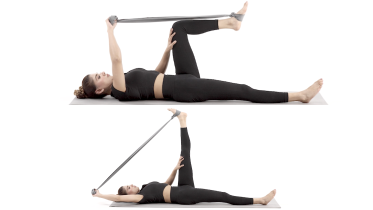
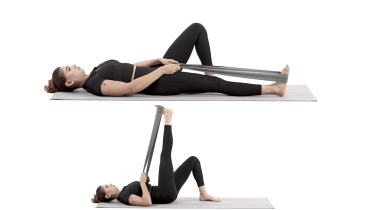
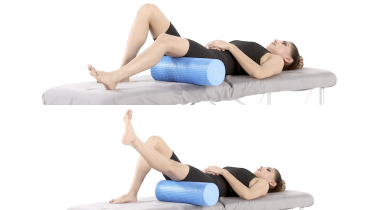
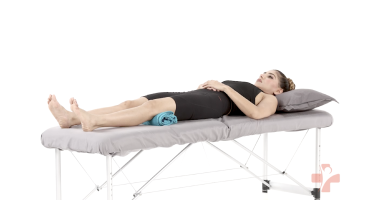
Hamstring sets (heel dig)
A hamstring set is a firm tightening of the muscles at the back of the thigh (hamstrings) while the knee stays still. You lie with your knees bent, dig one heel into the floor and hold. Physios often give it early in knee rehab, before bending the knee against resistance is comfortable or allowed.
How to do the hamstring sets (heel dig)
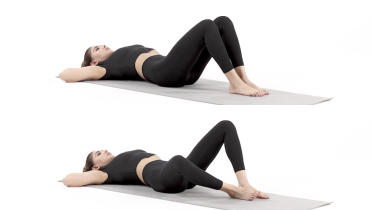
- Lie on your back on a mat or firm bed with both knees bent and your feet flat, about hip width apart. Keep your arms relaxed by your sides and your back in a comfortable, neutral position.
- Slide the foot of the leg you are working a little further away, so that knee is less bent and the heel rests on the surface. Dig that heel down, and slightly back toward your bottom, without letting the foot slide.
- Feel the back of the thigh go firm. The hip, knee and foot stay exactly where they are.
- Hold for a few seconds and keep breathing normally.
- Relax the leg fully, then repeat on the same leg or switch sides, as your physio has advised.
What you should feel
The muscle at the back of the thigh tightening, with no movement at the knee. Some people also notice a little work in the buttock.
Common mistakes
- Lifting the hips or arching the back as you push.
- Letting the foot slide, which turns the hold into a heel slide.
- Holding your breath while the heel digs in.
- Pushing so hard that it hurts. A moderate effort is plenty to begin with.
How often
Many programs start with about 10 holds of 5 to 10 seconds, a few times a day. Your physio will adjust this, and after surgery your surgeon's and physio's plan comes first.
Stop and check with your physio if
- Cramp in the back of the thigh, or a sudden sharp pull there. Stretch the leg out along the floor and rest.
- Knee pain that climbs sharply during or after the holds.
- Your calf or thigh is getting more swollen, or becomes warm, tender, red or darker than usual, or has a new throbbing or cramping pain. This can be a blood clot, especially after an operation, an injury, time in a cast, boot or brace, or a spell of being much less mobile than usual, and after an operation it can also be an infection. Stop and contact your medical team or get medical advice the same day. If you are also short of breath or have chest pain, call emergency services.
From the clinic
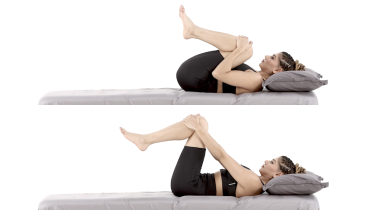
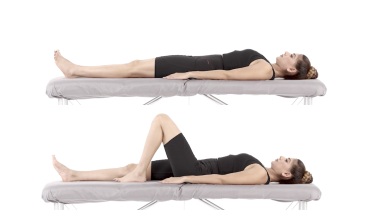
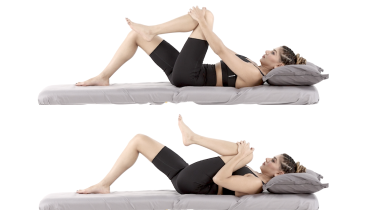
To anyone watching, nothing seems to happen. The work is all inside the muscle. It pairs well with quad sets, the same kind of still hold for the front of the thigh. Once your physio is happy for the knee to move, heel slides and later the hamstring bridge can follow.
With a recent hamstring strain, even a still hold loads the injured muscle, so let your physio set when you start and how hard you press. The same applies after an ACL reconstruction that used a hamstring graft, where hard hamstring work is usually held back for the first weeks. If you are pregnant and beyond the first trimester, ask your physio before you do this lying on your back.
Written and checked by the PocketPhysio editorial team. Last updated 2026-09-26.
This page is general education, not a diagnosis or a personal treatment plan. If you have pain, an injury or a health condition, see a physiotherapist or doctor before starting new exercises.