Lying hamstring press with a band
This lying band exercise works the back of the thigh (hamstrings) and the buttock. You lie on your back with a band looped around one foot, lift that leg up straight, then press it slowly back toward the floor while the band pulls against you. The knee stays straight the whole time. Your back is supported by the floor, so this is an easy place to start hamstring strengthening before you move on to standing or weighted work.
How to do the lying hamstring press with a band
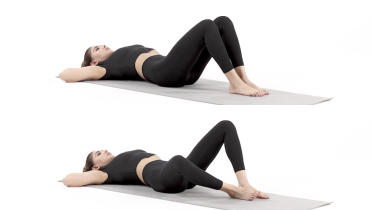
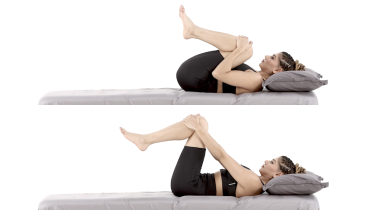
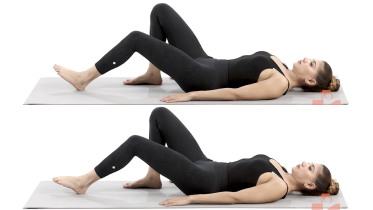
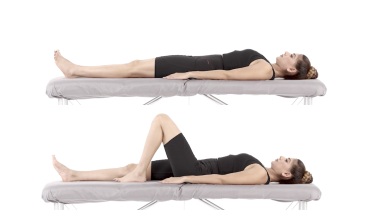
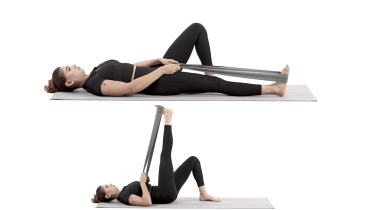
- Lie on your back on a mat with one knee bent and that foot flat. The working leg stays straight on the floor.
- Loop a resistance band around the sole of the straight leg's foot. Hold one end in each hand, elbows resting on the floor by your sides, so the band already feels a little tight.
- Keeping the knee straight, lift the leg up toward upright, only as high as the back of your thigh allows without the knee bending.
- Press the straight leg slowly back down against the band until it is just above the floor. Keep your elbows on the floor and let your forearms tip with the band, so the band does the resisting and your arms do not pull the leg.
- Take about 6 seconds for each lift and press, as in the video. Do every rep of the set on this leg before you swap. If the full range is uncomfortable, work in a smaller range.
What you should feel
Work at the back of the thigh and in the buttock as you press the leg down. A mild stretch behind the thigh near the top is normal, but it should not be the main thing you feel.
Common mistakes
- Bending the knee as the leg goes up or down.
- Pulling on the band with your arms instead of keeping your hands still.
- Letting the leg drop quickly instead of pressing it down slowly.
- Arching the lower back or lifting the hips off the mat.
How often
Many programs start with 2 to 3 sets of 8 to 15 slow presses on each leg, a few days a week, with a band light enough that the knee stays straight. Your physio will adjust this.
Stop and check with your physio if
- Sharp or sudden pain at the back of the thigh.
- A sudden sharp pain, pop or snap at the back of your thigh. Stop straight away. If you then get large bruising spreading down the back of the thigh, a gap or dip you can feel, a stiff-legged walk, or clear weakness when you bend the knee, get assessed the same day at urgent care or an emergency department, as the tendon may have pulled away from the bone near the buttock.
- Tingling, numbness or burning pain that runs down the leg.
- Pain in your lower back that builds as you go.
From the clinic
The voice guide with this video describes a hamstring stretch, with the band used to pull the leg up. That is not what the video shows. The arms only hold the band, and the leg works against it on the way down. This page follows the video, so it is a strengthening exercise.
If a stretch is what you are after, use the supine hamstring stretch. For a hamstring curl, where the knee bends against resistance, see the prone hamstring curl.
If you have had a hip replacement, get the go-ahead from your surgeon or physio before you try this exercise. Raising the straight leg high bends the hip a long way, and many surgeons ask you to avoid that for the first months after some operations. After an ACL reconstruction that used a hamstring graft, or a hamstring tear or repair, check with your surgeon or physio before you start, because loading the back of the thigh is usually brought in gradually after these. If you have back pain that travels down the leg, ask your physio first how high to lift it. If you are pregnant and past the first three months, check with your physio before exercising flat on your back.
Written and checked by the PocketPhysio editorial team. Last updated 2026-09-28.
This page is general education, not a diagnosis or a personal treatment plan. If you have pain, an injury or a health condition, see a physiotherapist or doctor before starting new exercises.