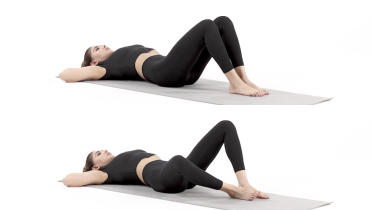
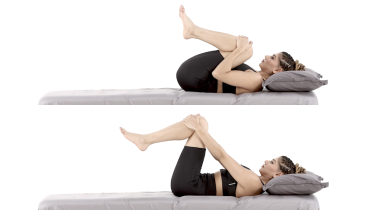
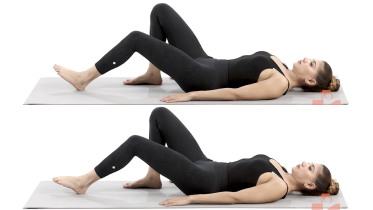
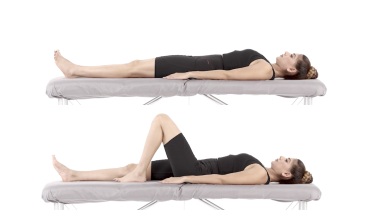
Lying hamstring stretch with strap
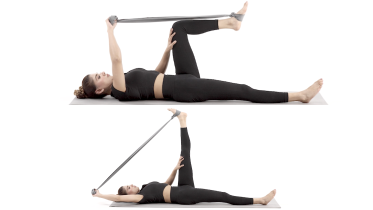
The lying hamstring stretch with a strap stretches the muscles at the back of your thigh (hamstrings) while your back rests on the floor. With one knee bent and that foot flat, you loop a strap around the other foot and use it to raise the straight leg until you feel a pull behind the thigh. The strap takes the weight of the leg, so your arms and neck can stay relaxed.
How to do the lying hamstring stretch with strap
- Lie face up on a mat with one knee bent and that foot flat on the floor. The other leg stays straight along the mat.
- Loop a strap, belt or towel around the arch of the straight leg's foot. Hold one end in each hand, with your elbows resting close to your sides, as in the video.
- Keeping that knee straight, raise the leg with help from the strap until you feel a gentle pull behind the thigh. How high it goes does not matter, and for many people it stops well short of upright.
- Hold there and breathe slowly. The back of the thigh often lets go a little as you wait. Keep your head, shoulders and hips down on the mat.
- Lower the leg slowly back to the mat with help from the strap. Repeat, then switch to the other leg.
What you should feel
A steady pull along the back of the raised thigh that eases a little as you hold. Some people notice it more behind the knee or high in the calf.
Common mistakes
- Bending the knee to get the leg higher. A lower leg with a straight knee gives a better stretch.
- Hauling on the strap until it hurts.
- Letting the hips or the bent leg's foot lift off the mat.
- Bouncing the leg up and down.
How often
Holds of 20 to 30 seconds, done 2 to 4 times on each leg, most days, are a common range. Your physio will adjust this.
Stop and check with your physio if
- Tingling, numbness, burning or pain that runs down your leg or into your foot. That may be coming from an irritated nerve rather than a tight muscle.
- A sudden sharp pain, pop or snap at the back of your thigh. Stop straight away. If you then get large bruising spreading down the back of the thigh, a gap or dip you can feel, a stiff-legged walk, or clear weakness when you bend the knee, get assessed the same day at urgent care or an emergency department, as the tendon may have pulled away from the bone near the buttock.
- Pain in your lower back, or a pinch at the front of the hip as the leg comes up.
From the clinic
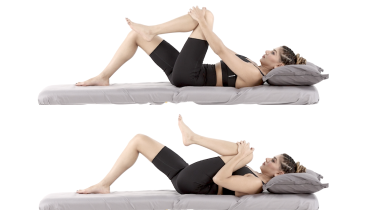
Feel it mostly in the calf or behind the knee? Let your foot relax rather than pulling the toes toward you, and allow the knee the smallest bend. The pull usually moves up into the thigh. The supine hamstring stretch is a close cousin: it starts with the knee bent and then straightens it, and the seated hamstring stretch is a chair option if getting down to the floor is hard.
If you have had a hip replacement, get the go-ahead from your surgeon or physio before you try this stretch. Raising the straight leg bends the hip toward a right angle or beyond, and many surgeons ask you to avoid that for the first months after some operations. After a recent hamstring strain, keep the stretch light and start only when your physio says so. With sciatica, pulling the toes toward you adds tension to the nerve that runs down the back of the leg, so keep the foot relaxed and ask your physio how far to take it. If you are pregnant and past the first three months, check with your physio before exercising flat on your back.
Written and checked by the PocketPhysio editorial team. Last updated 2026-09-28.
This page is general education, not a diagnosis or a personal treatment plan. If you have pain, an injury or a health condition, see a physiotherapist or doctor before starting new exercises.