Lying hamstring curl with band
This exercise bends the knee against a resistance band while you lie on your front. It strengthens the muscles at the back of the thigh (hamstrings) and is often used in knee and hamstring rehab once a curl without resistance feels easy.
How to do the lying hamstring curl with band
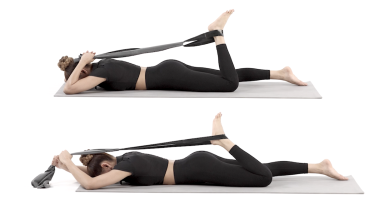
- Anchor one end of a resistance band low down, near the floor, beyond your feet. The frame of an exercise mat or a heavy piece of furniture works. Loop the other end around one ankle, just above the heel, as in the video.
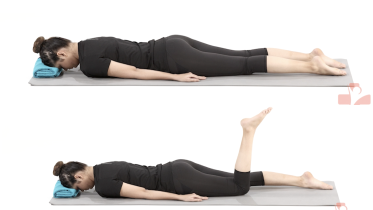
- Lie on your front on a mat with your legs straight. Rest your forehead on your folded hands, as in the video. Arms relaxed by your sides is fine too. Move up the mat until the band is just taut.
- Gently tighten your stomach muscles so your pelvis and lower back stay still.
- Keep your hips pressed into the mat and bend the knee, pulling the heel toward your buttock until the knee is at a right angle and the lower leg points straight up at the ceiling. Your thigh stays in line with your body and your back should not arch.
- Pause for a moment at the top.
- Lower slowly back to the mat, resisting the pull of the band. Finish your reps, then move the band to the other ankle.
What you should feel
Work in the back of the thigh, and a little in the calf. The front of the hips should stay on the mat.
Common mistakes
- Lifting the hips or bottom off the mat to pull the heel up.
- Letting the band snap the leg back down.
- Setting up too close to the anchor, so the band is slack, or so far away that you cannot bend to a right angle.
How often
Many programs use 2 to 3 sets of 10 to 15 on each leg with a light band, once a day. Your physio will adjust this and choose the band strength.
Stop and check with your physio if
- Sharp pain behind the knee or high at the back of the thigh near the buttock.
- A sudden sharp pain, pop or snap at the back of your thigh. Stop straight away. If you then get large bruising spreading down the back of the thigh, a gap or dip you can feel, a stiff-legged walk, or clear weakness when you bend the knee, get assessed the same day at urgent care or an emergency department, as the tendon may have pulled away from the bone near the buttock.
- Lower back pain while you lie or lift.
From the clinic
If lying flat on your front bothers your back, a pillow under the stomach often helps. Resting your forehead on your hands keeps the neck comfortable.
Pick a band light enough that you still reach the top on every rep. If the heel stops short of pointing at the ceiling, go down a band.
The band turns this into resisted hamstring work, and that is usually held back for the first weeks after knee surgery. This matters most after an ACL reconstruction using a hamstring graft. Your surgeon or physio should clear you before you use the band.
In pregnancy, lying on your front usually stops being suitable from about the halfway point. Ask your physio about the standing hamstring curl instead.
Reviewed by the PocketPhysio by VirtueLife expert physiotherapy team. Last reviewed 2026-09-25.
This page is general education, not a diagnosis or a personal treatment plan. If you have pain, an injury or a health condition, see a physiotherapist or doctor before starting new exercises.