Prone quad stretch with a strap
The prone quad stretch with a strap targets the big muscle group on the front of the thigh (quadriceps) while you lie on your front. A strap looped around your foot lets you draw the heel toward your buttock without twisting round to grab it. You are lying down, so balance does not come into it. That makes it a good choice if the standing version is hard to hold.
How to do the prone quad stretch with a strap
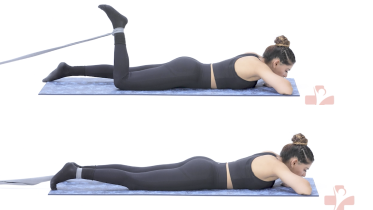
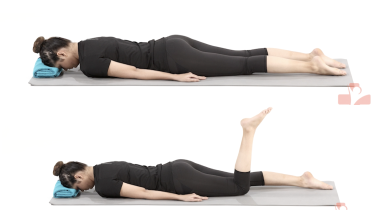
- Lie on your front on a firm bed or exercise mat, both legs straight.
- Bend one knee and loop a strap around the front of that ankle. The video uses a flat exercise band; a yoga strap, belt or long towel works the same way. Bring the ends up over your shoulder and hold them with both hands up by your head.
- Rest your head on the mat or your arms, and keep the front of your hips down on the mat.
- Pull the strap slowly so the heel moves toward your buttock. Stop once the front of the thigh feels a firm but comfortable stretch.
- Your knees stay side by side and resting on the mat, as the voice guide says. Hold and breathe easily, then let the foot down slowly and switch legs.
What you should feel
A gentle, even pull down the whole front of the thigh, which may spread toward the hip crease. You should not feel pain in the knee or lower back.
Common mistakes
- Letting the bent knee drift out to the side.
- Yanking on the strap so the heel is pulled in quickly.
- Letting the hips rise or the lower back sway to chase more stretch.
- Holding your breath.
How often
Many programs use 2 to 3 holds per leg, each lasting 20 to 30 seconds, once or twice a day. Your physio will adjust this.
From the clinic
The mat does two useful things. It takes balance out of the stretch, so nothing is being held up while you try to let a muscle go, and it stops the hips lifting, which is the escape route people take without noticing. That is why this version usually goes to anyone who cannot hold the standing one still long enough to feel anything.
Most people cannot reach their foot when lying face down, and trying to grab it twists the hip and back. That is why this version uses a strap. With the strap, your arms only need to hold a gentle, steady pull, so the thigh can relax into the stretch. If your heel comes close to your buttock easily, you may not need much pull at all.
Keep the two knees side by side. A knee that slides out to the side turns the stretch into a twist at the hip, and the front of the thigh gets very little of it. Nudge it back in, even if the heel then sits further from your buttock than it did.
Lying flat on your front is uncomfortable for some people with back pain. A pillow under the stomach can help, or you can ask your physio about the standing quad stretch instead. The standing version is also the usual swap in pregnancy, once lying on your front is no longer comfortable.
Before you start
- After knee surgery or a knee replacement, a deeply bent knee can be too much early on, so follow the limits your surgeon or physio has set.
- If you have had recent heart or chest surgery, do not lie face down on a healing chest wound. The weight of your chest presses on the wound for as long as you are down there, and pushing up through your arms to get off the bed pulls across the breastbone. Ask your surgeon or surgical team when lying on your front is allowed, and until then ask your physio for another way to do this while you lie on your side, sit or stand. If the breastbone clicks, grinds, shifts or feels as if it is moving while you do it, stop, and contact your surgical team the same day.
When to stop and get help
- The knee hurts sharply or pinches at the front.
- Your lower back hurts when you lie on your front or pull the strap.
- Numbness or tingling spreads down the thigh or leg.
Written and checked by the PocketPhysio editorial team. Last updated 2026-10-11.
This page is general education, not a diagnosis or a personal treatment plan. If you have pain, an injury or a health condition, see a physiotherapist or doctor before starting new exercises.