Band resisted lunge
The band resisted lunge is a split stance lunge with a resistance band looped just above the front knee and fixed to something in front of you at knee height. As you lower and rise, the band tries to pull the front knee forward, and the muscles of the thigh and buttock work to hold it steady over the foot. That is why the app calls it a stabilization lunge. It usually comes in knee and hip programs once a plain split stance lunge feels easy.
How to do the band resisted lunge
- Tie one end of a resistance band to something solid in front of you at about knee height, such as the leg of a heavy table. Loop the other end around the leg that will be in front, just above the knee.
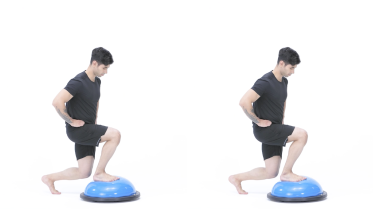
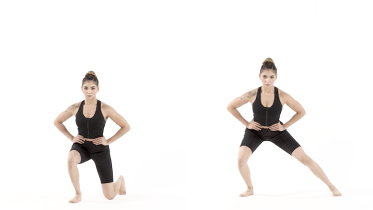
- Face the anchor and stand in a long stride, the banded leg in front and the other foot behind you on its toes. Move back until the band is taut, and rest your hands on your hips, as in the video.
- Bend both knees and lower your body straight down until the back knee is just above the floor, or as low as you can control.
- Hold the front knee over the ankle and in line with your second toe, so the band cannot drag it forward or inward.
- Push through the front heel to rise, keeping your feet where they are. Finish the set, then move the band to the other leg and change sides.
What you should feel
Work in the front of the thigh and the buttock of the front leg, with a steady effort around the knee as it resists the band. The back leg may feel a light stretch across the front of the hip.
Common mistakes
- Letting the band drag the front knee forward, so the front heel lifts or the knee drifts off line.
- The front knee sagging inward toward the other leg.
- Tipping the upper body forward as you lower.
- Standing so close to the anchor that the band goes slack and does no work.
How often
Many programs start with a light band and 2 to 3 sets of 6 to 10 lunges on each leg, a few days a week. Your physio will adjust this.
Stop and check with your physio if
- Sharp pain in the front knee, around the kneecap or in either hip, or knee pain that builds with each lunge.
- The knee buckles or you lose your balance. Hold your support and bring your feet together.
- The band starts to fray or slip down your leg, or the anchor moves.
From the clinic
What you see in the video matches the voice guide. She keeps one stride for the whole set, hands on hips, with the band pulling from in front at knee height. Fix the band to something that cannot shift, such as a heavy table leg or a door anchor in a door that is shut and locked, and check the band for small tears before each session.
Stand beside a kitchen counter or a sturdy chair so one hand can steady you if you wobble. If you have had a fall in the past year or feel unsteady in a long stride, keep that hand on the support for the whole set and ask your physio whether this level is right for you. Learn the supported lunge and then the split squat without a band before adding one, and keep the lunge shallow at first.
After a knee fracture or knee surgery, including a knee replacement, follow your surgeon's or physio's plan, and start this exercise only when they have cleared you. If you have had a hip replacement, get the go-ahead from your surgeon or physio before you try band resisted lunges. Lowering into a deep lunge bends the front hip toward a right angle and takes the back hip out behind your body, and many surgeons ask you to avoid that for the first months after some operations.
Written and checked by the PocketPhysio editorial team. Last updated 2026-09-28.
This page is general education, not a diagnosis or a personal treatment plan. If you have pain, an injury or a health condition, see a physiotherapist or doctor before starting new exercises.
.png)