BOSU squat
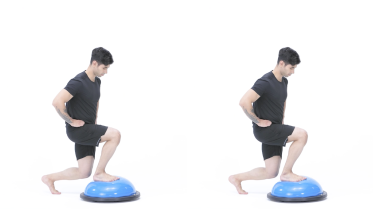
A BOSU squat is a squat done standing on the domed side of a BOSU ball, a half ball balance trainer with a flat base. The soft, shifting dome makes your ankles, knees and hips keep correcting to hold you steady while your thighs and buttocks do the squatting. It is hard. Most programs only add it once a squat on a firm floor feels easy and controlled.
How to do the bosu squat
- Put the BOSU dome side up on a non-slip floor, right next to a kitchen counter, wall rail or sturdy chair back you can grab.
- Hold your support and step one foot onto the middle of the dome, then bring the other foot up beside it, about hip width apart with your toes pointing forward.
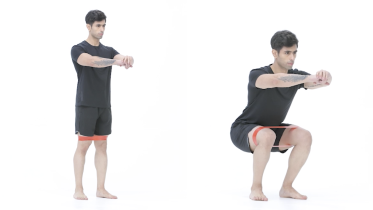
- Stand tall and find your balance. Then reach your arms straight out in front at shoulder height, as in the video, or keep one hand on the support.
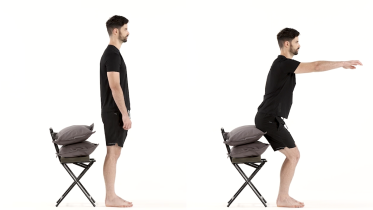
- Slowly bend your hips and knees to lower yourself, keeping your chest up, the natural curve in your lower back and your kneecaps over your second toes. In the video he pauses briefly with his thighs near level with the floor, but start with a small bend.
- Push back up to standing and settle your balance before the next squat.
- When you finish, hold your support and step down one foot at a time.
What you should feel
Hard work in the thighs and buttocks, plus constant small corrections in your ankles and feet as the dome moves under you.
Common mistakes
- Setting up out of reach of any support, or on a rug or slippery floor.
- Knees wobbling inward as you lower or rise.
- Squatting deeper than you can control and losing your balance at the bottom.
- Stepping on or off without holding on.
How often
Many programs start with 1 to 2 sets of 5 to 10 shallow squats, holding on at first, and add depth and reps as your balance improves. Your physio will adjust this.
Stop and check with your physio if
- You feel dizzy, lightheaded, faint or sick, or the room seems to spin. Hold your support, sit down and get medical advice the same day before you practice again. If you faint, it does not settle within a few minutes of sitting still, your vision suddenly blurs or goes double, or you cannot stand or walk steadily, call emergency services.
- Sharp pain in the knee, hip or ankle, or a joint that buckles.
- Pain at the front of the knee that builds with each squat.
- You lose your balance in a way your support cannot catch. Step down carefully and rest.
From the clinic
The person in the video steps up and squats with nothing to hold, but keep a counter, wall rail or sturdy chair within arm's reach every time. Hold it as you step on and off, and clear the floor around the BOSU so there is nothing to trip over if you step down in a hurry. Wear flat shoes that fit well and grip the floor, not socks, tights or bare feet. If you have had a fall in the last 12 months, feel shaky on your feet, take tablets that make you dizzy, have osteoporosis or are pregnant, talk to your doctor or physio before you use a BOSU, and have someone else in the house while you practice.
A sudden loss of balance is different. Call emergency services straight away for any sign of a stroke, even if it goes away: sudden dizziness with unsteadiness or falling over, a face that droops on one side, an arm you cannot lift or keep up, slurred or muddled speech, weakness or numbness on one side of your body or face, sudden blurred vision, double vision or loss of sight, or a sudden severe headache.
Work up to it. Get a steady squat on the floor first, then practice standing still on the dome while holding on, and only then add small squats. Balancing on one leg on a wobble cushion trains similar ankle control. Some programs turn the BOSU flat side up, which is far less stable and a much harder step, so leave that until your physio sets it. After knee or hip surgery, wait for your surgical team's go-ahead before any work on an unstable surface.
Written and checked by the PocketPhysio editorial team. Last updated 2026-09-28.
This page is general education, not a diagnosis or a personal treatment plan. If you have pain, an injury or a health condition, see a physiotherapist or doctor before starting new exercises.
.png)