Curtsy lunge
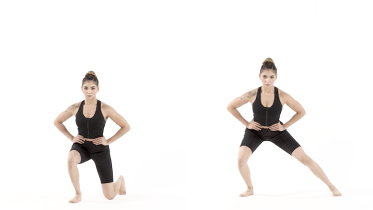
A curtsy lunge is a lunge where you step one leg back and across behind the other, as if curtsying, then bend both knees to lower down. The front leg does most of the work. The crossed position also asks the muscles at the side of the front hip (gluteus medius) to keep your pelvis level and your knee from caving in. It needs more balance than a lunge straight back.
How to do the curtsy lunge
- Stand upright, feet hip width apart, with your hands resting on your hips.
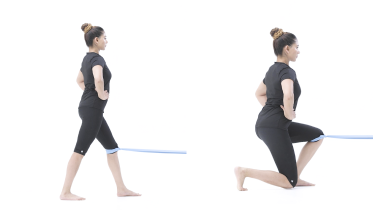
- Shift your weight onto your left leg. Step your right foot back and across so it lands behind your left leg, on the ball of the foot.
- Keep your hips and chest facing forward, then bend both knees and lower straight down. Go only as low as you can control, with the back knee hovering above the floor, never touching it.
- Keep your front knee pointing over your second toe and your front heel down.
- Push through the front foot to stand up and bring the right foot back to the start. In the video she repeats the same side each time, so finish the set with the right foot stepping back, then change legs. Some programs alternate sides on every rep instead.
What you should feel
Work in the buttock and the front of the thigh of your front leg, and at the side of that hip. You may also feel a light stretch on the outside of the back hip.
Common mistakes
- Twisting the hips and chest to face the side instead of keeping them square to the front.
- The front knee rolling in toward the back leg.
- Crossing so far behind that you wobble or strain the back knee.
- Dropping down fast and knocking the back knee on the floor.
How often
Many programs begin with 6 to 10 lunges per side, for 2 or 3 sets, with a hand on a counter if needed. Your physio will adjust this.
Stop and check with your physio if
- Sharp pain in the knee, hip or groin.
- The knee gives way, or you feel you might fall.
- Pain at the front of the knee that builds with each lunge.
From the clinic
The voice guide has you clasp your hands in front of your chest, while the video keeps them on the hips. Either is fine. If lunges are new to you, get the reverse lunge comfortable first, because stepping straight back is easier to balance. The voice guide asks you to go as deep as possible, but start with a small bend and only go lower while your front knee stays in line and you feel in control.
Do your first sessions next to a kitchen counter or a sturdy chair you can grab, and clear rugs and clutter from around your feet. If you have had a hip replacement, get the go-ahead from your surgeon or physio before you try curtsy lunges. Crossing the back leg behind you takes that leg across the middle of your body, and many surgeons ask you to avoid that for the first months after some operations. Ask your physio too if the bony point at the side of your hip is painful, since the crossed position can press on that spot.
Written and checked by the PocketPhysio editorial team. Last updated 2026-09-26.
This page is general education, not a diagnosis or a personal treatment plan. If you have pain, an injury or a health condition, see a physiotherapist or doctor before starting new exercises.