
Hamstring tendinopathy exercises and physiotherapy
What is hamstring tendinopathy?
Your three hamstring muscles run down the back of the thigh. At the top they share one tendon, which attaches to the bone you sit on (the ischial tuberosity). Proximal hamstring tendinopathy means that tendon has become painful. Proximal means the top end, so it is also called high hamstring tendinopathy. The usual complaint is a deep ache in the buttock at the sitting bone (Goom and colleagues, 2016).
It tends to come on over weeks, with no single moment of injury. Long spells of sitting or a hard seat bring it on. Squatting and running do too, as does walking uphill. Anything that bends the hip a long way is often worst, for example lunging, kicking or a hamstring stretch (Rich and colleagues, 2025, program guide). Long-distance runners and hurdlers get it often (Degen, 2019), but so do plenty of people who play no sport at all (Goom and colleagues, 2016).
The program here is for adults whose sitting-bone pain is being treated without an operation. A tendon torn off the bone is a different injury and is not covered. After hamstring surgery, follow the rehab plan from your surgeon. If a child or teenager has buttock pain, get them seen by a doctor or physio before they start any exercises.
Is it hamstring tendinopathy, a strain or sciatica?
Pain in the buttock and the back of the thigh has several possible causes, and each needs a different plan. A hamstring strain is a tear of some muscle fibers. It happens at one moment, usually while sprinting or kicking. Tendinopathy creeps up over weeks and stays at the sitting bone. The strain program also brings in gentle stretching early on, the opposite of the advice here.
Piriformis syndrome gives a deep buttock ache that sitting makes worse, too. The usual explanation is that the sciatic nerve gets squeezed in the buttock, so pain, tingling or numbness often spreads down the leg. Tendinopathy pain tends to stay in one spot at the bottom of the buttock (Rich and colleagues, 2025, trial).
Pain that starts in the lower back and travels down the leg points more toward sciatica. For pain on the outer side of the hip, the greater trochanteric pain syndrome program is the better match. These problems can overlap. If you cannot tell which one you have, get it assessed.
One injury must not be missed: the tendon tearing away from the bone. It comes with a pop or snap high in the back of the thigh and then heavy bruising (Degen, 2019). Get it checked the same day, as the warning signs below explain.
Why does exercise help hamstring tendinopathy?
The idea behind this program is that a sore tendon gets used to load again when the load goes up a little at a time. For this particular tendon, though, the proof is thin. A 2016 clinical review found no randomized trials of rehab for proximal hamstring tendinopathy, so it borrowed its principles from Achilles and patellar tendon pain (Goom and colleagues, 2016). Five years later, a systematic review pooled 12 studies with 424 people. All of the evidence was very low level, and it was not enough to recommend one treatment over another (Nasser and colleagues, 2021).
In a 2025 trial in Australia, 100 people had 6 sessions of either shockwave therapy or individualized physiotherapy built around a staged exercise program. Everyone got the same advice and education (Rich and colleagues, 2025, trial). Over a year, the two groups ended up about the same on overall improvement and function. Nobody went without treatment, so the trial cannot show how either compares with time alone.
The same team has written up their exercise program in detail (Rich and colleagues, 2025, program guide), and the stages on this page are similar. You start with held contractions and move on to strength work through movement. Then comes strength with more hip bend, and faster work last for those who need it. The authors grade their own write-up as level 5 evidence, which means expert opinion. It is a sensible framework, not a proven one.
Sitting, stretching and running: easing the load
With this tendon, being squeezed (compression) matters as much as being pulled. A deep hip bend presses the tendon against the sitting bone, and a sore tendon does not cope well with that (Rich and colleagues, 2025, program guide). So for a while:
- Sitting: sit for shorter spells, avoid hard seats and try a soft or pressure-spreading cushion. On a long drive or at a desk, stand up and move now and then.
- Stretching: no hamstring stretches, such as reaching for your toes, until your physio says they can come back.
- Deep hip bends: do fewer deep squats and long lunges, and less bending far forward. Stage 3 builds the hip bend back up gradually.
- Running: you can often keep going, as long as it stays within the pain limits below. Cut the parts that flare the tendon, such as hills and speed work, instead of stopping it all.
The Australian program only stopped running completely when it caused high pain or left the tendon worse for more than 24 hours (Rich and colleagues, 2025, program guide).
How to use this program
Choose the stage that fits how your tendon feels now. Not sure? Begin at stage 1. Move up once the current stage feels easy and the tendon has been no worse the following morning. Those two signs come from common practice. Treat them as a rough guide rather than a rule.
You will find a typical starting dose on every exercise page. The Australian program used 5 holds of 30 to 45 seconds with 90 seconds of rest in its first stage, and did the strength work 3 times a week or every second day (Rich and colleagues, 2025, program guide). At home, many programs do the strength exercises 2 to 3 times a week with a rest day between sessions. Your physio will tailor the exercises, sets and effort to your tendon and to the activities you want back.
A bit of tendon pain during the exercises is common. The Australian program accepted pain up to 4 out of 10 while exercising, and a small rise in pain over the next 24 hours. If pain went up by 3 points or more and stayed up beyond 24 hours, the exercise was changed (Rich and colleagues, 2025, program guide). At home nobody is checking the tendon for you, so err on the careful side. Mild discomfort that settles soon after the session and is no worse the next morning is usually fine.
The load was too much if the pain is sharp, builds with each repetition, or leaves the tendon clearly sorer the next day. Go back one step when that happens, and keep exercising.
If you have high blood pressure, breathe steadily through every hold and repetition and never hold your breath. With a heart condition or high blood pressure, check with your doctor before you start. If you have had a hip replacement, the stage 3 exercises and high knees bend the hip a long way, so get the go-ahead from your surgeon or physio first. If you are pregnant, check with your physio or midwife before you start.
The exercise program
Stage 1: Gentle loading with the hip straight
Start here if the tendon aches when you sit or walk, or is still too sore for strength work with movement. All four exercises work the hamstrings and buttock with the hip fairly straight, so the tendon is not pressed against the sitting bone. The program tested in an Australian trial began with long holds at the top of a hamstring bridge: get steady on the glute bridge first, then move onto your heels and hold the bridge rather than doing repetitions. That program used 5 holds of 30 to 45 seconds with 90 seconds of rest, each lasting only as long as the legs stayed steady without shaking, at a moderate effort that keeps the tendon calm. For the other exercises, start with the typical dose on each page (your physio will adjust all of it), and skip hamstring stretches for now, because they squeeze the tendon against the bone.
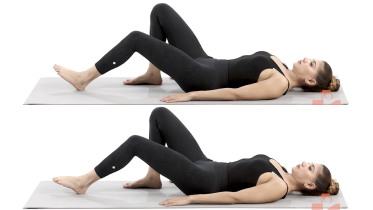 Hamstring sets (heel dig)
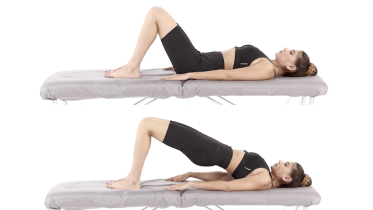 Glute bridge
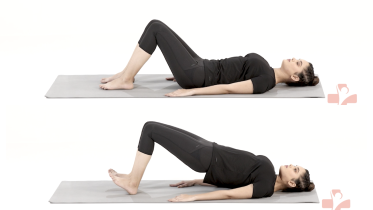 Hamstring bridge
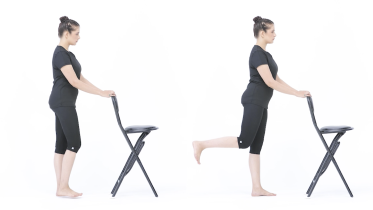 Standing hip extension
Stage 2: Build hamstring strength through movement
Move on once stage 1 feels easy and the tendon has been no worse the morning after. In the curls, the knee bends against gravity, a band or a ball while the hip stays straight or only slightly bent, so the hamstrings work hard and the tendon is not squeezed. The eccentric curl trains the slow lowering half of the movement, and the single leg bridge puts more of the load through one side. Your physio will adjust the numbers, but the Australian program went from 2 to 3 sets of 10 to 15 up to 4 to 5 heavier sets of 6 to 8, about 3 times a week. If the pain has been there a long time, getting the leg as strong as the other one can take 3 to 6 months or more.
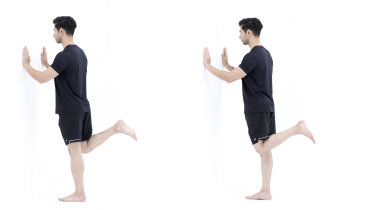 Standing hamstring curl
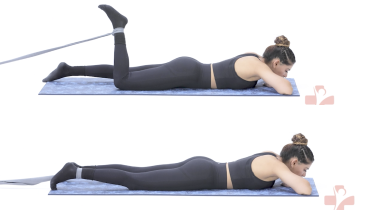 Lying hamstring curl with band
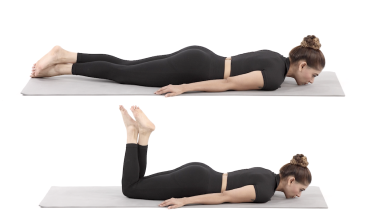 Eccentric hamstring curl
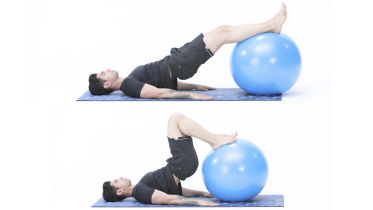 Stability ball hamstring curl
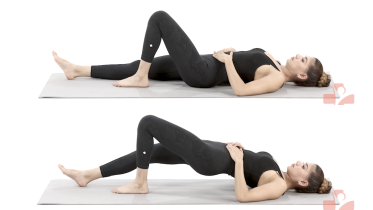 Single leg bridge
Stage 3: Bring back the hip bend
Add these when the curls feel strong and sitting has become easier. Each one bends the hip further while the hamstring is working, which is the load that usually hurts at first, so add one exercise at a time. Keep the single leg deadlift and the lunge small to begin with, hold a wall or chair if your balance wobbles, and go a little deeper over the weeks only while the tendon stays settled the next morning. The Australian program started this kind of work at 2 sets of 4 to 6, built up to 3 sets of 6 to 8, and stopped adding depth once it matched what daily life or sport needed. Your physio will set how deep you go.
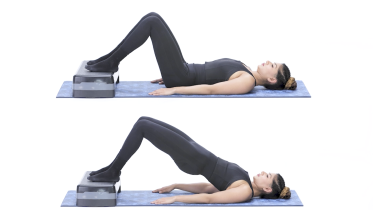 Bridge with feet on a step
.png) Single leg deadlift
Single leg deadlift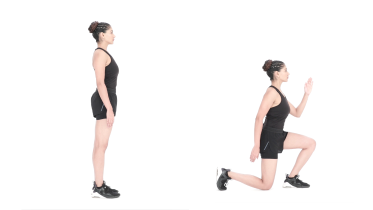 Reverse lunge
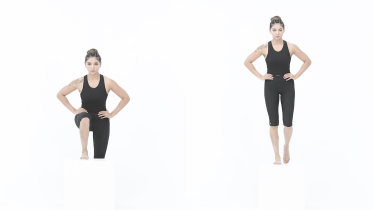 Step up
Stage 4: Faster work and a return to running
Only runners and people going back to sport need this stage; if you do not run, carry on with 2 or 3 of the earlier exercises twice a week. Begin once stage 3 feels strong and the tendon is steady each morning after. Jogging on the spot and butt kicks get the legs moving quickly again while you stay in one place. High knees lift the thigh toward the deep hip bend of sprinting, so add them last, with a low knee lift at first, and leave them out if you only jog. Running itself then restarts with short jog and walk intervals on flat ground, as set out below, and your physio can shape the plan around your sport.
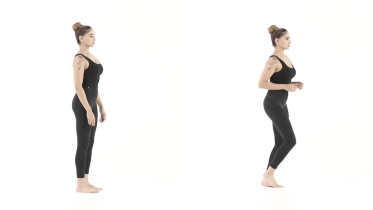 Jogging on the spot
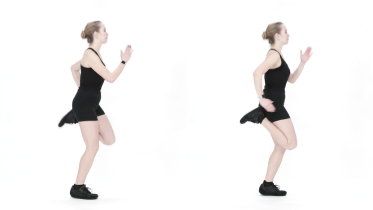 Butt kicks
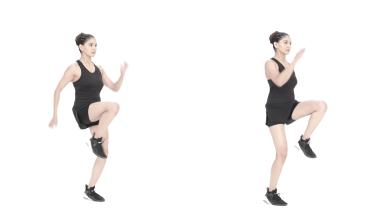 High knees running in place
Getting back to running
Runners come back in small steps. The first run in the Australian program was 2 minutes of running in total, done as one-minute jogs within a longer walk. Each run after that added 1 to 3 minutes, depending on how the tendon had behaved (Rich and colleagues, 2025, program guide). Distance and speed came only after runners had reached 20 minutes of running, and hills were added carefully after that. Faster or harder sessions were usually kept to twice a week.
Keep checking the tendon each morning, as you did through the exercise stages. When you are back to your normal running, the same team suggests keeping 2 or 3 strength exercises going twice a week. They also warn against sudden jumps in heavy training and against hard sessions on consecutive days.
Shockwave, injections and other treatments
Some clinics offer shockwave therapy. Over a year in the 2025 trial, it did about the same as individualized physiotherapy (Rich and colleagues, 2025, trial). An earlier review found very low-level evidence that it did better than a mix of other treatments (Nasser and colleagues, 2021).
Steroid injections improved pain scores straight away, but fewer than 38% of people still had relief 6 months later, according to a review by Degen (2019). The same review rates the research on platelet-rich plasma (PRP) injections as poor quality. Some people whose pain does not settle have surgery, and the evidence for that is also very low quality (Nasser and colleagues, 2021). Your doctor or physio can go through these options with you.
When to see a physio or doctor
See a physical therapist (physiotherapist) or doctor if the pain at your sitting bone has not started to ease after a few weeks of lighter load, keeps getting worse, or stops you sitting at work or running. Get it assessed as well if you are unsure where the pain comes from. The lower back, the sciatic nerve and a torn tendon can all hurt in this spot. A physio can check the diagnosis and pick your starting stage, and plan your way back to running if you need that.
Some of the warning signs below need help sooner. Each one says how soon, from calling emergency services to booking an appointment within 2 weeks.
For physiotherapists
The stages here are adapted from the individualized physiotherapy protocol of Rich and colleagues (2025, program guide), the physiotherapy arm of their RCT against shockwave. That protocol runs five stages: isometric (supine hamstring bridge, 5 x 30 to 45 s with 90 s rest, up to 4 times a day for pain relief or about 3 times a week within the program), isotonic (double or single leg hamstring bridge, prone or standing curl, 2 to 3 x 10 to 15 progressing to 4 to 5 x 6 to 8, every second day), kinetic chain (triceps surae, gluteus maximus and adductor magnus, lateral hip, and quadriceps where needed), graded compressive load, and energy storage for athletes who need it. Compressive loading used a modified deadlift, single leg deadlift with progressive hip flexion, lunge or single leg bridge on a step, from 2 x 4 to 6 to 3 x 6 to 8, and stopped progressing once the functionally required hip angle was tolerated.
Pain monitoring allowed up to 4/10 during exercise, with a latent increase of 3/10 or more lasting beyond 24 hours as the signal to modify; energy storage work used a stricter limit of 2/10. This page merges those stages into four, uses the library's exercises and sets a more cautious home pain rule. The protocol also includes compression education (sitting, hamstring stretching, deep hip flexion) and maintenance of 2 to 3 exercises twice a week after discharge.
The RCT (100 participants, 10 primary care practices in Victoria, Australia, 6 sessions each) found no between-group difference in global rating of change or VISA-H at 4, 12, 26 or 52 weeks, with greater satisfaction in the shockwave group at some time points (Rich and colleagues, 2025, trial). Nasser and colleagues (2021) found 12 studies with 424 participants, all of very low certainty, and suggested applying principles from other tendinopathies. Goom and colleagues (2016) noted that no RCTs of rehab existed at the time.
Degen (2019) describes the Puranen-Orava and bent-knee stretch tests, and MRI findings of increased tendon size, peritendinous T2 signal and ischial tuberosity edema. Anyone with a pop and extensive posterior thigh bruising needs screening for proximal avulsion and urgent referral; Degen favors acute repair within 4 weeks. Other differentials include hamstring strain, lumbar referral and radiculopathy, and deep gluteal syndrome. Ask about recent fluoroquinolone use (MHRA, 2024).
See a doctor promptly if
- Same day: you felt or heard a pop or snap high at the back of your thigh, near the buttock or the bone you sit on, and now have large bruising spreading down the back of the thigh, a gap or dip you can feel, a stiff-legged walk, or clear weakness when you bend the knee. Get assessed the same day at urgent care or an emergency department, and ask whether you need a scan and a surgeon's opinion. The tendon may have pulled away from the bone (proximal hamstring avulsion). When surgery is needed, repair within the first 4 weeks is favored over later repair, so do not wait to see if it settles. This page does not cover this injury.
- Emergency: pain, tingling, numbness or weakness in both legs, numbness or altered feeling around your genitals or bottom, or new trouble peeing or controlling your bladder or bowels. The same applies if you lose feeling in one leg. Call emergency services or go to an emergency department straight away. These can be signs of pressure on the nerves at the base of the spine (cauda equina syndrome).
- Emergency: you have had a fall or an injury and now have severe hip pain, or you cannot walk or put weight on the leg. Call emergency services or go to an emergency department. This can be a sign of a broken hip (hip fracture).
- Emergency: tingling or loss of feeling in the hip or leg after a fall or injury. Call emergency services or go to an emergency department.
- Same day: a leg or foot that is getting weaker, for example your foot drags, catches on the ground or slaps down when you walk (foot drop). Get medical advice the same day. If the weakness is getting worse by the hour, go to an emergency department.
- Same day: buttock, hip or back pain with a fever, or you feel hot, cold, shivery or generally unwell, or the hip or buttock is hot and swollen or the skin over it has changed color. Get medical advice the same day, and go to an emergency department if you feel very unwell. An infection needs treatment quickly.
- Same day: new back, buttock, hip or groin pain after a fall or strain, even a small one, if you are older, have low bone density (osteoporosis) or have taken steroid tablets for a long time, even if you can still walk. Get medical advice the same day. A broken bone is not always obvious at first.
- Same day: severe pain that comes on suddenly or is getting worse quickly. Get medical advice the same day.
- Same day: a calf or thigh that is newly swollen, warm, tender, red or darker than usual, has swollen veins that are sore to touch, or has a throbbing or cramping pain that does not fit your injury or condition, or that feels different from normal muscle soreness after exercise. This can be a sign of a blood clot (deep vein thrombosis), especially after surgery, an injury, time in a cast or boot, a long trip or a spell of being much less mobile than usual. Get medical advice the same day. If you are also short of breath or have chest pain, call emergency services.
- Same day: your tendon pain or swelling started while you were taking a fluoroquinolone antibiotic, such as ciprofloxacin or levofloxacin, or in the months after a course. Contact your doctor straight away. The UK medicines regulator (MHRA) advises stopping the antibiotic at the first sign of tendon pain or swelling and talking to your doctor. Hold off the hamstring exercises until you have been checked.
- Same day: a child or teenager has sudden pain in the hip, buttock, thigh or knee, is limping, or cannot put weight on one leg. Get an urgent appointment with a doctor the same day. If they have a high temperature or seem very unwell, go to an emergency department. This page is for adults, and hip and buttock pain in children has different causes.
- Within a few days: buttock or hip pain at night or at rest that does not ease when you change position, and keeps getting worse. See your doctor within a few days. If you have had cancer, now or in the past, or are losing weight without trying, see your doctor sooner, within a day or two, and mention it. This applies even if the pain is not getting worse. If you are being treated for cancer now, contact your cancer team the same day.
- Within a few days: new pain in the groin or buttock, and you take steroid tablets long term, or have in the past, or you regularly drink a lot of alcohol. This can be a sign of a problem with the blood supply to the top of the thighbone (avascular necrosis). Book an appointment with your doctor within a few days and mention the steroids or alcohol.
- Within 2 weeks: numbness, tingling, pins and needles or burning pain spreading down the leg, below the knee or into the foot, or buttock pain that comes with back pain. This can come from the sciatic nerve or your lower back rather than the tendon. It is not an emergency, but book an assessment with a physio or doctor in the next week or two. If your leg or foot is getting weaker, get medical advice the same day. If the tingling started with a pop or snap high up near the buttock, get assessed the same day, because a tendon pulled off the bone can also irritate the sciatic nerve.
- Within 2 weeks: a lump or swelling you can feel in the buttock or the back of the thigh. Book an appointment with your doctor and mention it. Rarely, a growth in this area can cause pain like this.
Common questions
How long does hamstring tendinopathy take to heal?
Months rather than weeks, and it varies a lot between people. Goom and colleagues (2016) describe the pain as often long-standing, getting in the way of both sport and daily life. In the Australian program, a leg with long-standing pain could need 3 to 6 months or more to match the strength of the other side. How quickly people progressed depended on how deconditioned the leg was, how bad the symptoms were and how regularly they did the exercises (Rich and colleagues, 2025, program guide). Look at how the tendon is doing across several weeks, not from one day to the next.
Should I stretch my hamstring if I have hamstring tendinopathy?
Not early on. A hamstring stretch bends the hip a long way, and that presses the sore tendon against the sitting bone (Rich and colleagues, 2025, program guide). This is one way it differs from a hamstring strain, where gentle stretching has a place in rehab. If a stretch leaves the sitting bone sorer that evening or the next morning, drop it. Your physio will tell you if and when stretching can come back.
Can I keep running with high hamstring tendinopathy?
Usually some of it, yes. In the Australian program, running stopped completely only if it caused high pain or the tendon was still worse more than 24 hours later (Rich and colleagues, 2025, program guide). Otherwise people cut back the running that loads the tendon most, such as hills and speed work, and kept their easy runs. Ask your physio how much running your tendon can take at the moment.
Why does sitting hurt with hamstring tendinopathy?
Because you are sitting on the spot where the tendon attaches. Your weight presses on it, and the bent hip squeezes it harder against the bone. The Australian program advises shorter spells of sitting, avoiding hard seats and using a soft or pressure-spreading cushion (Rich and colleagues, 2025, program guide). Getting up and moving every so often breaks up long spells at a desk or in the car.
Is shockwave therapy good for hamstring tendinopathy?
It is one reasonable option. In a trial of 100 people, 6 sessions of shockwave therapy did about the same over a year as 6 sessions of individualized physiotherapy, and the shockwave group was more satisfied at some time points (Rich and colleagues, 2025, trial). Both groups got the same advice about easing the load, and there was no untreated group. So the trial cannot show how much either treatment adds to time and advice. Talk it through with your physio or doctor.
References
- Goom TS, Malliaras P, Reiman MP, Purdam CR. Proximal Hamstring Tendinopathy: Clinical Aspects of Assessment and Management. Journal of Orthopaedic and Sports Physical Therapy. 2016;46(6):483-493. https://doi.org/10.2519/jospt.2016.5986
- Rich A, Cook J, Hahne A, Ford J. Treatment of Proximal Hamstring Tendinopathy with Individualized Physiotherapy: A Clinical Commentary. International Journal of Sports Physical Therapy. 2025;20(6):892-910. https://doi.org/10.26603/001c.138308
- Rich A, Ford J, Cook J, Hahne A. Physiotherapy Compared With Shockwave Therapy for the Treatment of Proximal Hamstring Tendinopathy: A Randomized Controlled Trial. American Journal of Sports Medicine. 2025;53(14):3396-3407. https://doi.org/10.1177/03635465251391134
- Nasser AM, Vicenzino B, Grimaldi A, Anderson J, Semciw AI. Proximal Hamstring Tendinopathy: A Systematic Review of Interventions. International Journal of Sports Physical Therapy. 2021;16(2):288-305. https://doi.org/10.26603/001c.21250
- Degen RM. Proximal hamstring injuries: management of tendinopathy and avulsion injuries. Current Reviews in Musculoskeletal Medicine. 2019;12(2):138-146. https://doi.org/10.1007/s12178-019-09541-x
- Medicines and Healthcare products Regulatory Agency. Fluoroquinolone antibiotics: must now only be prescribed when other commonly recommended antibiotics are inappropriate. Drug Safety Update. 22 January 2024. https://www.gov.uk/drug-safety-update/fluoroquinolone-antibiotics-must-now-only-be-prescribed-when-other-commonly-recommended-antibiotics-are-inappropriate
- NHS. Deep vein thrombosis (DVT). Page last reviewed 30 April 2026. https://www.nhs.uk/conditions/deep-vein-thrombosis-dvt/
Written and checked by the PocketPhysio editorial team. Last updated 2026-09-28.
This page is general education, not a diagnosis or a personal treatment plan. See a physiotherapist or doctor for advice about your own situation.