
Piriformis syndrome exercises and physiotherapy
What is piriformis syndrome?
The piriformis is a small muscle deep in the buttock. It runs from the base of the spine (the sacrum) to the top of the thighbone and helps turn your hip outward. The sciatic nerve passes close to it, usually just underneath, on its way down the back of the leg. Piriformis syndrome is the idea that the muscle squeezes or irritates the nerve at that point, giving buttock pain and sometimes sciatica-type pain down the leg.
The diagnosis has been argued about for a long time. A systematic review by Hopayian and colleagues (2010) noted that it had been described for over 70 years and yet remained controversial, and that most of what is written about it comes from case series and narrative reviews rather than strong studies. Surgeons have also found the nerve pressed on by other small hip muscles (the obturators and gemelli) and by bands of fibrous tissue (Hopayian and Heathcote, 2019). That is why specialists now prefer the broader name deep gluteal syndrome: buttock pain from the sciatic nerve being trapped in the buttock, outside the pelvis and not by a disc in the spine (Martin and colleagues, 2015).
An updated review found four features reported most often (Hopayian and Danielyan, 2018). They are buttock pain, pain made worse by sitting, tenderness when the area near the notch in the pelvis where the nerve leaves (the greater sciatic notch) is pressed, and pain with any movement that puts the piriformis under tension. People with this problem often report an earlier injury (Martin and colleagues, 2015).
Is it piriformis syndrome or sciatica from your back?
Most buttock and leg pain of this kind starts in the lower back. The NHS names a slipped disc as the most common cause of sciatica. In hospital clinics, an estimated 6 to 17% of people with sciatica meet the criteria for deep gluteal syndrome (Hopayian and Heathcote, 2019). The authors think these figures may be too low, but for most people the cause still lies elsewhere, most often the back.
No single test settles it. The straight leg raise, a test doctors use for sciatica, may or may not be positive in deep gluteal syndrome, so it does not tell the two apart (Hopayian and Heathcote, 2019). A routine MRI of the lower back does not show the deep buttock. Scans of the pelvis and special nerve scans can, but how accurate they are for this problem has not been well studied.
So a physio or doctor checks your back first. Physios often take it as a sign that the back is involved if your pain started in your lower back, or if bending or arching your back changes the leg pain. It is a clue from clinical experience, not a proven test. If that fits you, the sciatica program or the low back pain program is the better starting point.
If your pain is on the outside of your hip, over the bony point, and lying on that side hurts, read the greater trochanteric pain syndrome program instead. Pain mainly in the groin, with a stiff hip, fits better with the hip osteoarthritis program.
Does exercise help piriformis syndrome?
Nobody can say for sure, because the evidence is thin. When Hopayian and Heathcote reviewed it in 2019, they found no controlled trial of physiotherapy (stretching muscles or mobilizing exercises) for deep gluteal syndrome. Since then, a few small trials have compared one stretching or hands-on method with another (Shahzad and colleagues, 2020; Danazumi and colleagues, 2021). None of these tested exercise against no treatment. Hopayian and Heathcote still suggest physiotherapy as the least invasive treatment to try first, and Martin and colleagues (2015) also place physical therapy ahead of surgery.
So the program below rests on clinical reasoning and common practice, not trial results. The stretches and nerve glides come from specialist descriptions, mainly of rehab after surgery for this problem (Martin and colleagues, 2015), and from common practice. They have not been tested in trials for people who have not had surgery. The hip strengthening is borrowed from programs for other hip and buttock pain.
First you settle the area: sit for shorter spells and keep the hip and the nerve moving gently. Then you build strength in the muscles around the hip for daily life. The NHS advice for sciatica also applies here: carry on with your normal activities as much as you can, and avoid sitting or lying down for long periods.
How to use this program
Pick the stage that matches how your buttock and leg feel today. If you are not sure, start at stage 1. Move slowly and breathe normally.
Each exercise page gives a typical starting dose. As a rough guide, the stretches are often held for 20 to 30 seconds, 2 to 3 times on each side, once or twice a day. The nerve glides usually start with 5 to 10 slow, easy movements, 1 to 3 times a day. The strength exercises often start with 1 to 3 sets of 6 to 15 repetitions, depending on the exercise, on most days or a few days a week. Your physio will adjust this.
A stretch or a tired ache in the buttock muscles is fine. Pain, numbness or tingling that travels down your leg is not, so make that exercise smaller or leave it out for now. Mild buttock discomfort after a session is usually acceptable if it settles soon after and is no worse the next morning. If your buttock or leg is clearly worse the next morning, drop back to the last level that felt fine.
If numbness or weakness in your leg is getting worse, stop the exercises and get medical advice the same day, even if the pain is easing.
Move up a stage when the current one feels easy and your buttock settles well afterward. These are rough guides from common practice, not fixed rules.
The exercise program
Stage 1: Settle the buttock and keep moving
For the early weeks, when sitting is sore and the buttock aches deep down. Knee to chest circles move the hips and lower back gently. The three stretches work the same deep hip muscles in different positions, so pick the one or two that feel best rather than doing all of them. Stretch only to a mild pull in the buttock, and if a stretch brings on pain, numbness or tingling down your leg, make it smaller or leave it out. The glute bridge starts gentle strength work for the big buttock muscle.
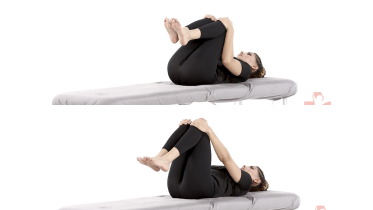 Knee to chest circles
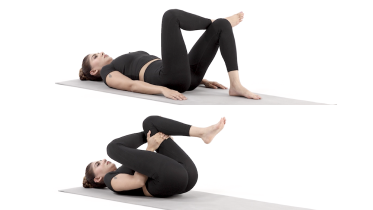 Lying figure 4 stretch
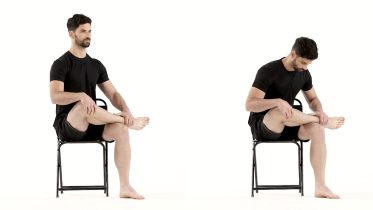 Seated figure 4 stretch
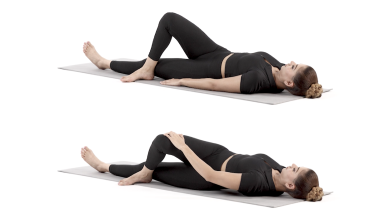 Piriformis stretch
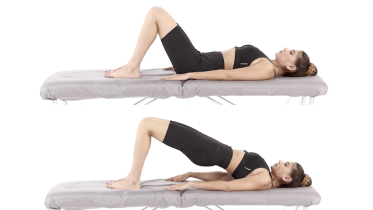 Glute bridge
Stage 2: Build hip strength and move the nerve gently
When sitting is easier and the buttock is calmer, which takes days for some people and weeks or longer for others. The clamshell works the muscles that turn the hip outward, and donkey kicks work the big buttock muscle. Side lying hip abduction and seated hip abduction on a gym ball work the muscles at the side of the hip; set the ball next to a wall or counter you can hold, and if your balance is poor, leave it out or ask your physio first. The two nerve glides are for pain or tingling that runs down the leg: they move the sciatic nerve gently without stretching it, and they stay short of any tingling. Ask a physio to check your leg before you start them.
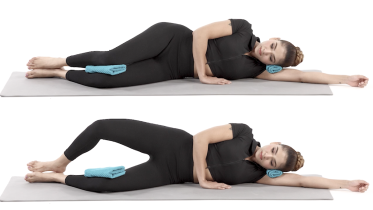 Clamshell
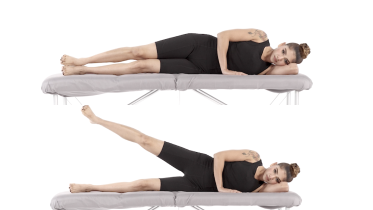 Side lying hip abduction
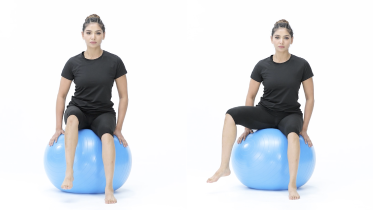 Seated hip abduction on a gym ball
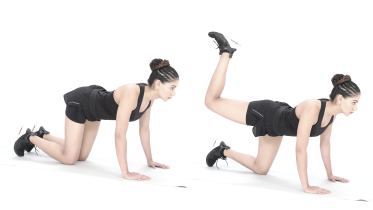 Donkey kicks
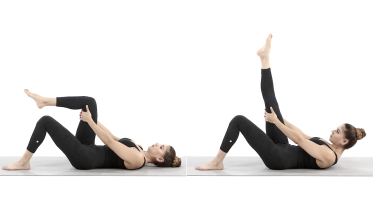 Lying sciatic nerve glide
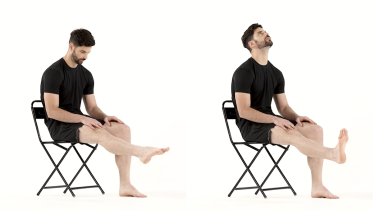 Seated sciatic nerve glide
Stage 3: Get strong for sitting, stairs and sport
For getting back to long drives, desk work, stairs and sport once the buttock pain comes and goes rather than being there all day. The three bridges ask more of one buttock at a time, so work through them in the order listed. Reverse hypers work the buttocks and lower back hard, so add them last, and ask your physio first if you have spinal stenosis or spondylolisthesis. Sit to stand and the step up train your hips for getting out of a chair and climbing stairs. Keep one or two of the stage 1 stretches if they still help.
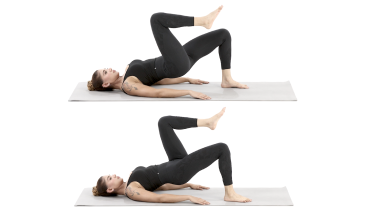 Marching bridge
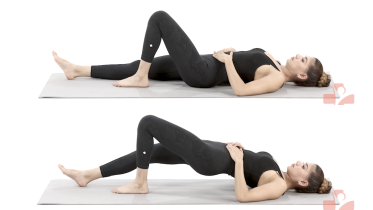 Single leg bridge
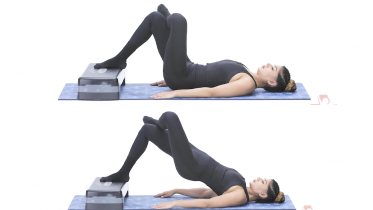 Figure 4 glute bridge
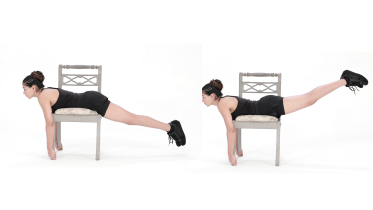 Reverse hypers
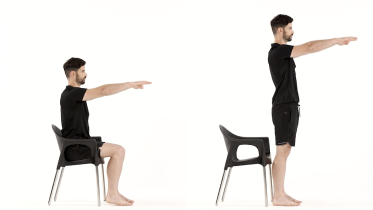 Sit to stand
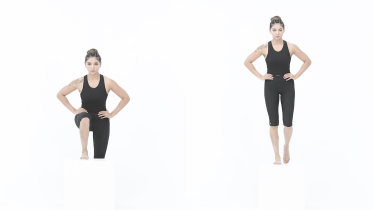 Step up
What to avoid or change
Break up long spells of sitting. Stand up, walk a few steps and then sit again, and on long drives plan regular breaks to get out and move. Try different seats and cushions, and use whatever eases the buttock.
If you use a massage ball or foam roller on the buttock or the back of the thigh, keep off any spot that brings on tingling or pain down the leg. The sciatic nerve runs deep in the buttock and down the back of the thigh, under the muscles.
The piriformis stretch pulls the knee across your body, a position that presses on the tendons at the side of the hip. If you also have pain over the bony point on the outside of your hip, leave that stretch out and use the figure 4 stretches, or read the greater trochanteric pain syndrome program.
If you have been told you have spinal stenosis or spondylolisthesis, check with your physio before reverse hypers and donkey kicks, which arch the lower back a little. If you have low bone density (osteoporosis), ask your physio before the knee to chest circles. If you have had a hip replacement, several of these exercises cross the legs or bend the hip past a right angle, so get the go-ahead from your surgeon or physio first.
This program is not for rehab after surgery on the hip, the buttock or the back. If you have had an operation, follow your surgeon's program. If you are pregnant, check with your physio or midwife before you start. The program is written for adults: if a child or teenager has buttock or leg pain, get them checked by a doctor or physio first.
Injections and other treatments
Injections into the piriformis muscle, including steroid and botulinum toxin injections, are sometimes offered. Most reports on them come from case series or poorly reported trials (Hopayian and Heathcote, 2019). One trial found botulinum toxin did better than a dummy injection, but it was not clear the difference was big enough to matter to patients.
Surgery to free the nerve is used for some people (Hopayian and Heathcote, 2019). Martin and colleagues (2015) describe it for the rare cases where other treatment, including physical therapy and injections, has not worked. Talk these options through with your doctor.
When to see a physio or doctor
See a physio or doctor if your buttock or leg pain has not improved after a few weeks of home care, is getting worse, or stops you doing your normal activities. These timings come from the NHS advice on sciatica. Because this diagnosis depends on ruling other causes out, it is worth being assessed before you settle on it yourself. The warning signs below need faster help, from an emergency visit to an appointment within a few days.
For physiotherapists
This page gives patients somewhere to start, not a full plan. Hopayian and Danielyan (2018) describe four core features: buttock pain, pain aggravated by sitting, external tenderness near the greater sciatic notch, and pain on any maneuver that increases piriformis tension. They note that better-designed cross-sectional studies of diagnostic accuracy are needed before its prevalence among people with back and leg pain can be known.
Martin and colleagues (2015) define deep gluteal syndrome as non-discogenic, extrapelvic entrapment of the sciatic nerve. Reported causes include the piriformis, fibrous bands, the gemelli-obturator internus complex, the hamstrings, vascular abnormalities and space-occupying lesions. The combination of the seated piriformis stretch test and the active piriformis test showed a sensitivity of 91% and a specificity of 80% for the endoscopic finding of sciatic nerve entrapment in one study cited by both Martin and colleagues (2015) and Hopayian and Heathcote (2019). Hopayian and Heathcote note it was set in a tertiary center, so accuracy may be overestimated. Martin also lists ischiofemoral impingement, ischial tunnel syndrome, pudendal nerve entrapment and intra-articular hip pathology among the differentials, after the lumbar spine.
Hopayian and Heathcote (2019) suggest suspecting deep gluteal syndrome when sciatica comes with buttock pain aggravated by sitting, or when routine MRI has not found a cause, which they report happens in as many as 49% of patients with sciatica. They list space-occupying mimics, including hematomas, abscesses, endometriotic deposits causing cyclical sciatica, aneurysms, sarcomas and metastases, so the usual red flag screen applies. The Finucane 2020 framework notes that high-quality evidence for the diagnostic accuracy of most red flags is lacking, so treat them as prompts for clinical reasoning.
The exercise choices are extrapolated. Martin and colleagues (2015) describe piriformis stretching and nerve glides applied within the limit of pain, as part of post-operative rehabilitation after endoscopic sciatic nerve decompression. They state these are the same techniques used in pre-operative conservative treatment, but neither setting has trial data. Randomized trials since 2019 are small and compare one technique with another, with stretching in both arms (Shahzad and colleagues, 2020; Danazumi and colleagues, 2021), so they do not isolate the effect of exercise. The hip strengthening is extrapolated from other hip and buttock pain programs.
The piriformis stretch on this page uses flexion with adduction, with the knee bent, close to the provocation position of the seated piriformis stretch test, so expect it to reproduce symptoms in some patients and swap it for a figure 4 variation if it does.
See a doctor promptly if
- Emergency: numbness, tingling or altered feeling around or under your genitals, between your inner thighs, or around your bottom (anus), for example it feels different when you wipe after using the toilet. Call emergency services or go to an emergency department straight away. This can be a sign of pressure on the bundle of nerves at the base of the spine (cauda equina syndrome), which needs emergency treatment.
- Emergency: you find it hard to start peeing, cannot pee, cannot feel yourself peeing or cannot control when you pee, or you do not notice when you need to poo or cannot control when you poo, and this is not normal for you. The same applies to a new change in how your genitals feel during sex, or new trouble getting an erection or ejaculating. Call emergency services or go to an emergency department straight away. These can also be signs of cauda equina syndrome.
- Emergency: sciatica in both legs, or pain, tingling, numbness or weakness in both legs. The same applies if you lose feeling in one leg. Call emergency services or go to an emergency department straight away.
- Emergency: back, buttock or leg pain that started after a serious accident, such as a car crash or a fall from a height, or back pain with chest pain. Call emergency services.
- Emergency: you have had a fall or an injury and now have severe hip pain, or you cannot walk or put weight on the leg. Call emergency services or go to an emergency department. This can be a sign of a broken hip (hip fracture).
- Emergency: tingling or loss of feeling in the hip or leg after a fall or injury. Call emergency services or go to an emergency department.
- Same day: a leg or foot that is getting weaker, for example your foot drags, catches on the ground or slaps down when you walk (foot drop). Get medical advice the same day. If the weakness is getting worse by the hour, go to an emergency department.
- Same day: buttock, hip or back pain with a fever, or you feel hot, cold, shivery or generally unwell, or the hip or buttock is hot and swollen or the skin over it has changed color. Get medical advice the same day, and go to an emergency department if you feel very unwell. An infection needs treatment quickly.
- Same day: new back, buttock, hip or groin pain after a fall or strain, even a small one, if you are older, have low bone density (osteoporosis) or have taken steroid tablets for a long time, even if you can still walk. Get medical advice the same day. A broken bone is not always obvious at first.
- Within a few days: new pain in the groin or buttock, and you take steroid tablets long term, or have in the past, or you regularly drink a lot of alcohol. This can be a sign of a problem with the blood supply to the top of the thighbone (avascular necrosis). Book an appointment with your doctor within a few days and mention the steroids or alcohol.
- Same day: new back, buttock or leg pain and you have had cancer, now or in the past, or you have lost weight without trying. Get medical advice the same day and mention it. If you are being treated for cancer now, contact your cancer team the same day.
- Emergency: you have had cancer, now or in the past, and your back or neck pain feels like a tight band around your body, or comes with pain spreading down an arm or leg, weakness, numbness or pins and needles in your arms or legs, trouble walking, or trouble controlling your bladder or bowels. Call your cancer team's emergency number straight away, or go to an emergency department if you do not have one or cannot get through. This can be cancer pressing on the spinal cord (metastatic spinal cord compression), which needs treatment straight away.
- Within a few days: pain that does not ease at all with rest or changing position, or is worse at night. See your doctor within a few days. Get medical advice the same day if you also feel unwell, have lost weight without trying, or have had cancer, now or in the past. If you are being treated for cancer now, contact your cancer team the same day.
- Same day: severe pain that comes on suddenly or is getting worse quickly. Get medical advice the same day.
- Same day: a calf or thigh that is newly swollen, warm, tender, red or darker than usual, has swollen veins that are sore to touch, or has a throbbing or cramping pain that does not fit your injury or condition, or that feels different from normal muscle soreness after exercise. This can be a sign of a blood clot (deep vein thrombosis), especially after surgery, an injury, time in a cast or boot, a long trip or a spell of being much less mobile than usual. Get medical advice the same day. If you are also short of breath or have chest pain, call emergency services.
- Within 2 weeks: a lump or swelling you can feel in the buttock or the back of the thigh, or buttock and leg pain that flares each month around your period. Book an appointment with your doctor and mention it. Rarely, a growth or patches of endometriosis near the sciatic nerve can cause pain like this.
- Same day: a child or teenager has sudden pain in the hip, buttock, thigh or knee, is limping, or cannot put weight on one leg. Get an urgent appointment with a doctor the same day. If they have a high temperature or seem very unwell, go to an emergency department. This page is for adults, and hip and buttock pain in children has different causes.
Common questions
What is the difference between piriformis syndrome and sciatica?
Sciatica describes where the pain is felt: along the sciatic nerve, in the buttock and down the back of the leg. Most of the time the nerve is irritated where it leaves the lower back, and the NHS names a slipped disc as the most common cause. In piriformis syndrome, or the broader deep gluteal syndrome, the nerve is thought to be trapped further down, in the buttock. Sciatica that comes with buttock pain made worse by sitting is one reason doctors think of the buttock as the source (Hopayian and Heathcote, 2019), but back-related sciatica can be worse when sitting too. The two can feel alike, so a physio or doctor needs to check your back first.
Can piriformis syndrome show on an MRI?
Not on a routine scan of the lower back, which does not show the deep part of the buttock (Hopayian and Heathcote, 2019). A scan of the pelvis or a special nerve scan (MR neurography) can show the area, but how accurate these scans are for this problem has not been well studied. Whether you need a scan is a decision for your doctor.
Does stretching help piriformis syndrome?
Buttock stretches are a common home treatment, but they have not been tested well. A 2019 review found no controlled trial of stretching or other physiotherapy exercises for this problem (Hopayian and Heathcote, 2019). A few small trials since then have compared one stretching or hands-on method with another (Shahzad and colleagues, 2020; Danazumi and colleagues, 2021), not with no treatment, so they do not show how much stretching itself helps. Stretch gently, to a mild pull in the buttock, and stop if a stretch sends pain, numbness or tingling down your leg. This program pairs the stretches with hip strengthening rather than relying on stretching alone.
How long does piriformis syndrome last?
There is no reliable figure. The reviews used for this page describe the symptoms and treatments of piriformis syndrome, and none of them gives a typical recovery time. For sciatica in general, the NHS says it usually gets better in a few weeks to a few months but can last longer. If your pain has not started to ease after a few weeks of home care, or it is getting worse, see a physio or doctor so the cause can be checked.
Is sitting bad for piriformis syndrome?
Sitting often brings the pain on. Pain made worse by sitting is one of the four features reported most often in people diagnosed with piriformis syndrome (Hopayian and Danielyan, 2018). Break up long spells of sitting with short walks, try different seats or cushions, and use whatever eases the buttock. Keep moving through the rest of your day as far as the pain allows.
Do injections help piriformis syndrome?
Some people are offered them, but the evidence is weak. Most reports on these injections come from case series or poorly reported trials (Hopayian and Heathcote, 2019). In one trial, botulinum toxin did better than a dummy injection, but it was not clear the difference was large enough to matter to patients. A specialist may also use an injection guided by a scan to help work out where the pain is coming from (Martin and colleagues, 2015). Whether one suits you is a decision to make with your doctor.
References
- Hopayian K, Song F, Riera R, Sambandan S. The clinical features of the piriformis syndrome: a systematic review. European Spine Journal. 2010;19(12):2095-2109. https://doi.org/10.1007/s00586-010-1504-9
- Hopayian K, Danielyan A. Four symptoms define the piriformis syndrome: an updated systematic review of its clinical features. European Journal of Orthopaedic Surgery and Traumatology. 2018;28(2):155-164. https://doi.org/10.1007/s00590-017-2031-8
- Hopayian K, Heathcote J. Deep gluteal syndrome: an overlooked cause of sciatica. British Journal of General Practice. 2019;69(687):485-486. https://doi.org/10.3399/bjgp19X705653
- Martin HD, Reddy M, Gómez-Hoyos J. Deep gluteal syndrome. Journal of Hip Preservation Surgery. 2015;2(2):99-107. https://doi.org/10.1093/jhps/hnv029
- Shahzad M, Rafique N, Shakil-Ur-Rehman S, Ali Hussain S. Effects of ELDOA and post-facilitation stretching technique on pain and functional performance in patients with piriformis syndrome: a randomized controlled trial. Journal of Back and Musculoskeletal Rehabilitation. 2020;33(6):983-988. https://doi.org/10.3233/BMR-181290
- Danazumi MS, Yakasai AM, Ibrahim AA, Shehu UT, Ibrahim SU. Effect of integrated neuromuscular inhibition technique compared with positional release technique in the management of piriformis syndrome. Journal of Osteopathic Medicine. 2021;121(8):693-703. https://doi.org/10.1515/jom-2020-0327
- NHS. Sciatica. Page last reviewed 3 December 2024. https://www.nhs.uk/conditions/sciatica/
- NHS. Back pain. Page last reviewed 5 March 2026. https://www.nhs.uk/conditions/back-pain/
- NHS. Hip pain in adults. Page last reviewed 20 November 2025. https://www.nhs.uk/symptoms/hip-pain/
- NHS. Deep vein thrombosis (DVT). Page last reviewed 30 April 2026. https://www.nhs.uk/conditions/deep-vein-thrombosis-dvt/
- Finucane LM, Downie A, Mercer C, et al. International framework for red flags for potential serious spinal pathologies. Journal of Orthopaedic and Sports Physical Therapy. 2020;50(7):350-372. https://doi.org/10.2519/jospt.2020.9971
Written and checked by the PocketPhysio editorial team. Last updated 2026-09-28.
This page is general education, not a diagnosis or a personal treatment plan. See a physiotherapist or doctor for advice about your own situation.