Knee to chest circles
Knee to chest circles are a gentle movement for the lower back and hips. Lying on your back, you bring both knees up toward your chest, rest your hands on them and draw slow circles, first one way and then the other. Instead of holding one stretch, the circling rocks the pelvis and lower back through a small, easy range.
How to do the knee to chest circles
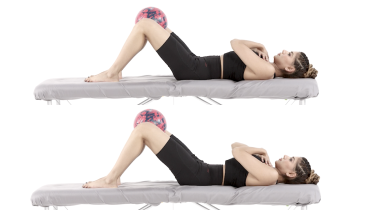
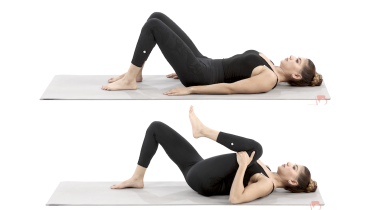
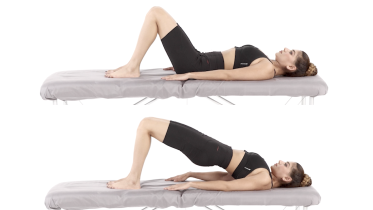
- Lie on your back on a mat or a firm bed with your knees bent and feet flat. The video shows it on a treatment table.
- Lift one knee toward your chest, then the other, so you are not raising both legs at once.
- Rest a hand on each knee, as in the video. The voice guide also allows holding behind your thighs or around your shins. If your knees are sore, hold behind your thighs, which lets the knees stay less bent.
- Keeping the knees together and close to your chest, move them in slow, small circles. Your pelvis and lower back roll gently with them.
- Do several circles one way, then the same number the other way.
- To finish, lower one foot at a time back to the bed.
What you should feel
A gentle easing, almost massaging feeling across the lower back and the backs of the hips. It should feel comfortable, never sharp.
Common mistakes
- Making the circles big or fast. Small, slow circles keep the movement easy on your back.
- Letting the knees drift a long way from your chest, so the weight of the legs pulls on your lower back.
- Lifting your head and shoulders to reach your knees. Keep them relaxed on the bed.
How often
Many programs use 5 to 10 slow circles in each direction, repeated 2 to 3 times, once or twice a day. Your physio will adjust this.
From the clinic
Most of the lower back stretches here put you in one position and ask you to stay there. This one keeps moving instead, and that is the only real difference: the same knees to chest position, drawn round in slow circles so the pelvis and lower back travel through a small range the whole time. People with a stiff back often prefer it to a held stretch, and it is in the piriformis syndrome program for the same reason.
Small circles, slowly, is the instruction people drift away from once it feels easy. The circle grows, the pace picks up, and your back ends up being swung around rather than eased through its range. If you cannot describe the circle you just made, it was too fast.
It builds on the knee to chest stretch and the double knee to chest stretch. If getting down to the floor is hard, a firm bed works just as well. Lower trunk rotation is another gentle lying down movement for the lower back.
Before you start
- If you have had a hip replacement, get the go-ahead from your surgeon or physio before you try knee circles. Holding both knees in toward your chest bends the hips well past a right angle while the circles turn them, and many surgeons ask you to avoid that for the first months after some operations. With low bone density (osteoporosis), or once you are past the first three months of pregnancy, check with your physio before doing this one.
When to stop and get help
- Pain, numbness or tingling spreads into a leg.
- Your back hurts more as you circle, rather than loosening.
- A pinching pain at the front of the hip or in the groin when the knees are drawn up.
Written and checked by the PocketPhysio editorial team. Last updated 2026-10-11.
This page is general education, not a diagnosis or a personal treatment plan. If you have pain, an injury or a health condition, see a physiotherapist or doctor before starting new exercises.