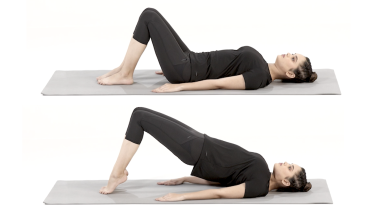
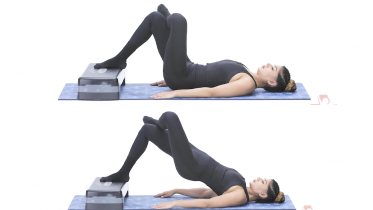
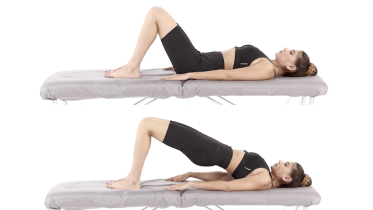
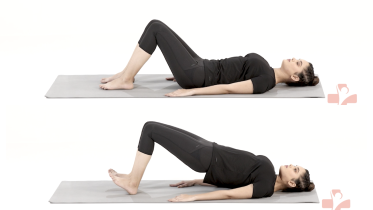
Bridge with calves on a ball
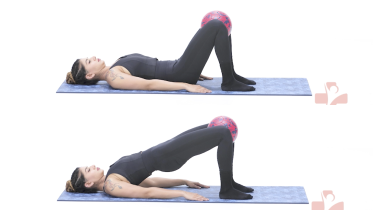
A bridge with calves on a ball is done with your lower legs resting on top of a large exercise ball instead of your feet on the floor. You tilt your pelvis to flatten your lower back, gently switch on your pelvic floor and buttocks, then lift your hips a little way off the mat while keeping the ball still. The ball can move under you, so your trunk and buttocks have to steady it as well as lift you. That is why the voice guide puts control ahead of height.
How to do the bridge with calves on a ball
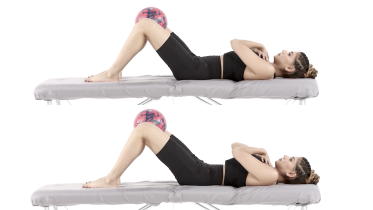
- Lie back on a mat with your calves resting on top of an exercise ball and your knees bent. Fold your arms across your chest, as in the video, or rest them at your sides for more support.
- Tilt your pelvis so your lower back flattens gently onto the mat, as if you were tucking your tailbone under.
- Gently tighten your pelvic floor, the muscles you would use to stop yourself passing wind, and keep breathing.
- Squeeze your buttocks and lift your hips off the mat. Go only as high as you can while the ball stays still and your back does not arch.
- Pause briefly, then lower your hips slowly back to the mat and repeat.
What you should feel
Your buttocks and hamstrings do the lifting, while your stomach and trunk keep the ball still. Your lower back should stay out of it.
Common mistakes
- Driving the hips up high and arching the lower back.
- Letting the ball roll away from you or drift sideways.
- Holding your breath as your hips come up.
- Dropping back down quickly instead of lowering under control.
How often
Often 2 to 3 sets of 8 to 12 slow lifts, with a short pause at the top. Your physio will adjust this.
Stop and check with your physio if
- Your hamstrings cramp. Come down, slide your legs off the ball and let them rest.
- Your lower back hurts rather than your buttocks, even when you lift less, or pain, pins and needles or numbness spreads into a leg.
From the clinic
In the video the hips rise only a short way. That is deliberate, because the work here is keeping the pelvis steady and the ball still. The ball adds a balance task, so get comfortable with the glute bridge on the floor first. Use a firm ball and clear some space around it so it cannot roll into furniture. The stability ball hamstring curl is a harder exercise for later.
If you have recently given birth, including by cesarean section, or you have a gap down the middle of your stomach muscles (diastasis recti), ask your physio, midwife or doctor first. If you are pregnant and past the first three months, check with your physio before exercising flat on your back.
If you have had a hip replacement, get the go-ahead from your surgeon or physio before you try this exercise. Some operations limit this kind of work for the first months, so the timing depends on your surgery. After back or knee surgery, ask your surgeon or physio when bridges can start.
Written and checked by the PocketPhysio editorial team. Last updated 2026-09-28.
This page is general education, not a diagnosis or a personal treatment plan. If you have pain, an injury or a health condition, see a physiotherapist or doctor before starting new exercises.