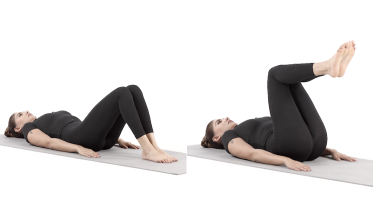
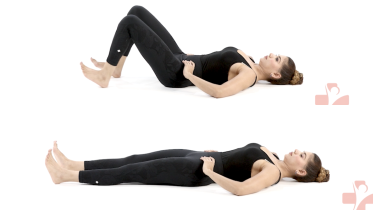
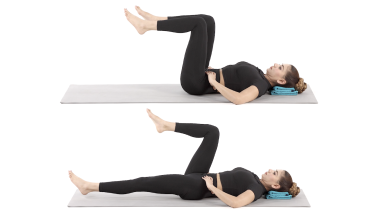
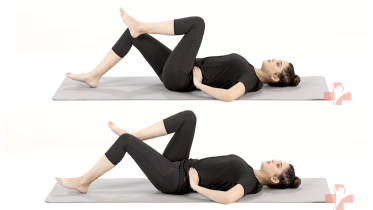
Stability ball hamstring curl
You lie on your back with your heels on a large exercise ball, lift your hips, then bend your knees to roll the ball toward you. The back of the thighs (hamstrings) bend the knees while the buttocks and trunk hold the hips up. It is harder than a floor bridge, and because the ball can roll, you have to balance as well.
How to do the stability ball hamstring curl
- Lie on your back on a mat with your legs straight and your heels and lower calves resting on top of an exercise ball. Put your arms by your sides, palms down, to help you balance.
- Tighten your stomach and lift your hips off the mat until your body is in a straight line from shoulders to heels.
- Keeping the hips up, bend your knees and draw the ball toward your bottom, pressing down into it with your heels. By the end, your feet are flat on top of the ball.
- Hold your hips level throughout, so neither side dips or twists.
- Straighten your legs slowly to roll the ball back out, with your hips still lifted.
- Repeat. When the set is done, lower your hips to the mat.
What you should feel
A strong effort in the back of the thighs as the ball rolls in, with the buttocks and stomach working to keep your hips up and steady.
Common mistakes
- Letting the hips sag as the ball rolls in or out.
- Letting one side of the pelvis drop, or the ball wander to one side.
- Rolling out fast, so the ball pulls your legs straight.
How often
Often 2 to 3 sets of 6 to 10 curls, with a rest between sets. Your physio will adjust this.
Stop and check with your physio if
- A cramp or a sudden sharp pull in the back of the thigh. Lower your hips, take your legs off the ball and rest.
- Pain in the lower back, or pain, tingling or numbness spreading down a leg.
- Pain behind the knee as the ball rolls in.
From the clinic
This is a big step up from the glute bridge and the hamstring bridge, so be steady with those first. If holding your hips up through the whole set is too much, a simpler start is to keep your legs straight on the ball and just lift and lower your hips. Clear some space around you in case the ball rolls away.
The curl works the hamstrings hard, so after a recent hamstring strain your physio should decide when you begin and how many you do. If you are pregnant and past the first trimester, get your physio's go-ahead before lying on your back for this.
Written and checked by the PocketPhysio editorial team. Last updated 2026-09-25.
This page is general education, not a diagnosis or a personal treatment plan. If you have pain, an injury or a health condition, see a physiotherapist or doctor before starting new exercises.