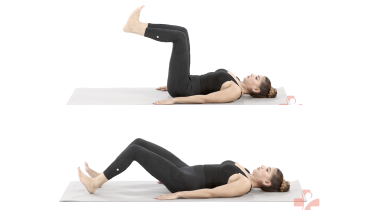
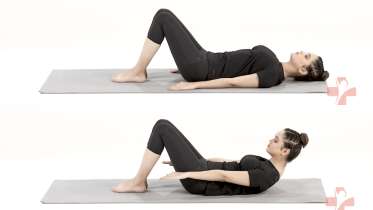
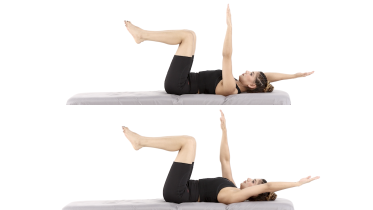
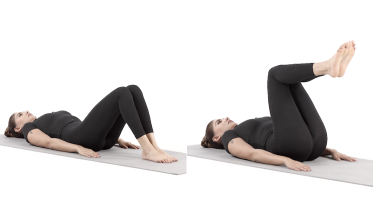
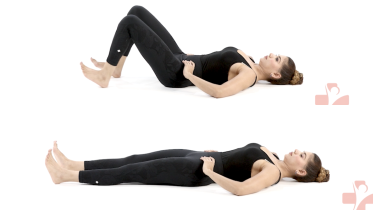
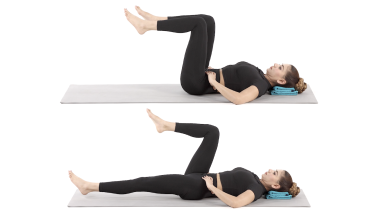
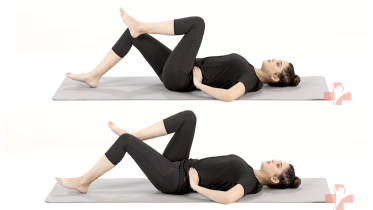
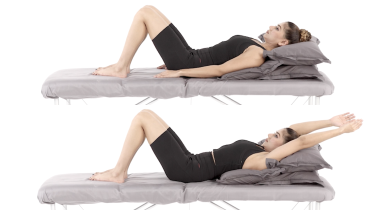
Dead bug with band
The dead bug with band is a harder version of the dead bug. A resistance band links one ankle to the opposite hand. From a tabletop position you straighten that leg down toward the floor as the arm reaches back over your head, and your lower back stays still on the mat while the band stretches between them.
How to do the dead bug with band
- Loop one end of a light resistance band around one ankle and hold the other end in the opposite hand. Lie face up on a mat, knees bent and feet down.
- Bring your legs up one at a time so your hips and knees are bent to about 90 degrees, with the lower legs horizontal. Point both arms at the ceiling. The band should be just taut.
- Draw your belly button in and gently lift your pelvic floor, as if stopping the flow of urine. Keep breathing slowly into your stomach and ribs.
- Slowly straighten the banded leg out and down toward the floor while the arm holding the band lowers back past your head. The other arm and leg stay where they are.
- Stop just before your heel touches the floor, or earlier if your lower back starts to lift. Bring the leg and arm back up to the start with control.
- After your last rep, set each foot back on the mat. The video stops after one side, so move the band to the other ankle and hand and do the same number there.
What you should feel
Deep work in your stomach holding your back still, with the band adding a steady pull as the arm and leg move apart. The front of the hip on the lowering leg works as well.
Common mistakes
- Letting the lower back arch as the leg nears the floor. Stop the leg higher, or keep a small bend in the knee.
- Letting the band snap the arm and leg back together. Come back as slowly as you went out.
- Holding your breath while the leg is low.
- Letting the pelvis twist toward the band side, or the tabletop leg drift.
How often
Many programs use 2 to 3 sets of 5 to 8 slow reps on each side, a few days a week. Your physio will adjust this.
Stop and check with your physio if
- Your lower back hurts during the set, even when you stop the leg higher.
- A leg tingles or turns numb, or pain runs from your back down it.
- A ridge or bulge appears along the middle of your stomach, you leak urine, or you feel pressure or heaviness in the pelvis. Mention it to your physio.
From the clinic
Get comfortable with the plain dead bug first, until your back stays still while an arm and a leg move. With the band on, a straight leg held just above the floor is a long lever, and it asks far more of your stomach than a bent knee does. If your back lifts, let the knee stay bent as the foot goes down, or swap to a lighter band. A slow, short movement with a still back does more for you than a long one where the back arches.
A hernia, recent stomach or back surgery, or diastasis recti (a widened gap between the two sides of the front stomach muscle, often after pregnancy) are reasons to ask your physio before starting. If you have had a hip replacement, get the go-ahead from your surgeon or physio before you try this exercise. Some operations limit this kind of work for the first months, so the timing depends on your surgery. If you are pregnant, check with your midwife or physio first. From about 16 weeks the NHS advises against lying flat on your back for long periods because it can make you feel faint.
Written and checked by the PocketPhysio editorial team. Last updated 2026-09-26.
This page is general education, not a diagnosis or a personal treatment plan. If you have pain, an injury or a health condition, see a physiotherapist or doctor before starting new exercises.