
Hip flexor strain exercises and physiotherapy
What is a hip flexor strain?
The hip flexors are the muscles at the front of the hip that lift your thigh. The deep one, iliopsoas, is really two muscles (iliacus and psoas major) running from the pelvis and lower spine to the top of the thighbone. The front thigh muscle (rectus femoris) is one of the four quadriceps, and the only one of them that crosses the hip as well as the knee. A hip flexor strain, or pulled hip flexor, means some fibers in one of these muscles have torn.
Kicking and sprinting are the usual culprits. Serner and colleagues (2018) scanned 33 male athletes with a hip flexor injury. Rectus femoris was hurt most often, mainly while kicking or sprinting, and only the deep hip flexor (iliacus and psoas major) was injured on a change of direction. The authors say hip flexor injuries make up about a third of sudden groin injuries, and most of the rectus femoris injuries in their study also involved the tendon, which they suggest may matter for recovery.
The program here is for adults with a mild to moderate strain that is being treated without surgery. A strain of the inner thigh muscles (the adductors) hurts on the inside of the groin, and that is a different injury with its own exercises. This page is also not meant for children or teenagers whose bones are still growing (see below), or for rehab after hip surgery. After any operation, follow the program your surgeon gives you.
Is it a hip flexor strain or something else?
Several problems cause pain at the front of the hip and in the groin, and they overlap. The Doha agreement, an international consensus on groin pain in athletes, ties iliopsoas pain to tenderness over the muscle. It says that pain is more likely to come from iliopsoas when lifting the leg against resistance or stretching the front of the hip brings it on (Weir and colleagues, 2015). The same group advises that the hip joint should always be considered as a cause of groin pain. A physical therapist (physiotherapist) can examine the hip and work out which one you have.
If the pain sits deep in the groin and comes on with deep bending, twisting or sitting in a low chair, rather than starting with one kick or sprint, it may be hip impingement. Clicking, catching or locking can point to a hip labral tear. Both are joint problems with their own programs. That is why a stretch that gives you a pinch deep in the front of the hip means stop and get the hip checked.
A bulge in the groin or upper thigh that swells when you cough or sneeze and goes down when you lie flat may be a hernia (NHS). Get it seen by your doctor rather than training through it. The Doha agreement also names avulsion fractures among the other causes of groin pain, and puts stress fractures, such as one in the neck of the thighbone, on its list of causes not to miss (Weir and colleagues, 2015). That stress fracture is often missed at first, so groin pain that builds up with running needs checking (Clough, 2002).
In a teenager, sudden pain at the front of the hip while kicking or sprinting needs a doctor, not this program. Until the bones stop growing, a sudden hard pull of the muscle can tear a small piece of bone away from its growth area on the pelvis. Rossi and Dragoni (2001) collected a large series of these avulsion fractures in young athletes. The rectus femoris attachment was one of the commonest sites, and soccer was the sport with the most cases. The warning signs below tell you how quickly to be seen.
The first few days after a hip flexor strain
For 2 to 3 days after the injury, the NHS advice goes by the letters PRICE: protect, rest, ice, compress and elevate. In practice that means stopping sport and exercise, icing the front of the hip for up to 20 minutes at a time, every 2 to 3 hours (wrap the ice pack in a towel), and resting with the leg propped on a pillow whenever possible. For those first days the NHS also says to avoid heat (hot baths, heat packs), massage and alcohol. Ask a pharmacist which painkillers suit you.
Stage 1 starts once pain no longer stops you moving the leg. If you cannot walk or put any weight on the leg after the injury, go to an emergency department.
How to use this program
Choose the stage that fits your hip today. Not sure? Start at stage 1, and step up when the stage you are on feels easy and the hip feels no worse the following morning. There is little research on rehab for hip flexor strains: the studies found for this page describe the injuries but do not test exercise programs for them. So this program borrows the staged approach used for other muscle strains, such as the hamstring strain program, and its signs for moving on are practical rather than tested.
Each exercise page lists a usual starting dose. Roughly, the gentle holds are often done once or twice a day, and once the strength exercises get harder, many programs use 2 to 3 sets of 5 to 12 on a few days a week. Your physio will tailor both the exercises and the doses to your hip and to the sport or activity you are aiming for.
Stage 1 should not hurt at all. From stage 2, some mild discomfort is usually fine, as long as it fades soon after you finish and the hip is not worse the following morning. Sharp or tearing pain tells you that session asked too much of the hip. So does pain that climbs with each rep, or a hip that is sorer the next day. Go back a step; you do not need to stop completely.
The exercise program
Stage 1: Protect the hip and start gentle holds
Use this stage while walking is still sore or lifting the leg hurts, starting after the 2 to 3 days of protection described above, as soon as pain no longer blocks you from moving the leg. In the two knee presses the hip flexors work while the hip stays still, at a gentle effort to begin with, and in the assisted hip bend your hands help lift the leg so the sore muscle can stay relaxed. The bridge and the side leg lift keep the buttock and outer hip working; take the bridge only as high as feels comfortable at the front of the hip, since the top position puts that area on a gentle stretch. Many programs start with 5 to 10 presses, each held 5 to 10 seconds and done once or twice a day, along with 2 to 3 sets of 10 to 12 bridges, and your physio will adjust this. Nothing in this stage should hurt, and you are ready to move on once your stride is back to normal and pain free and a firm knee press no longer hurts.
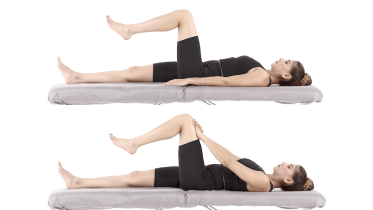 Isometric hip flexion
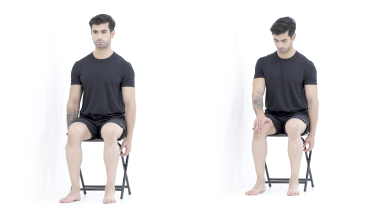 Seated isometric hip flexion
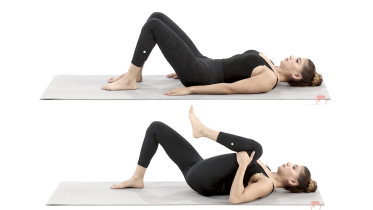 Assisted hip bend lying down
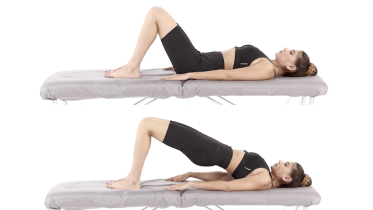 Glute bridge
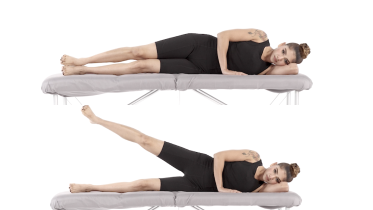 Side lying hip abduction
Stage 2: Lift the leg and build strength
Once walking is pain free, the leg lifts ask the hip flexors to move the leg: sitting and lying first, then standing, with marching on the spot to link the lift to a walking rhythm. The dead bug and the kneeling side plank teach your trunk to hold the pelvis steady while one leg moves, which running and kicking also need. Stretching starts here, and it should only ever feel like a gentle pull, not pain: the hip flexor stretch reaches the deep hip flexor, and the standing quad stretch, with the knee bent, reaches the front thigh muscle that crosses both the hip and the knee. Many programs use 2 to 3 sets of 8 to 12 lifts, with each stretch held 20 to 30 seconds and repeated 2 to 3 times a side, and your physio will adjust this. Move on when the lifts feel as strong as they do on your good side, and brisk walking and stairs no longer hurt.
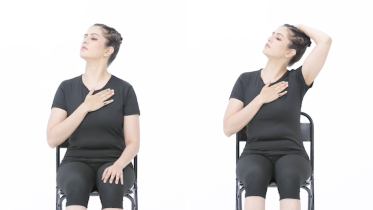 Seated hip flexion
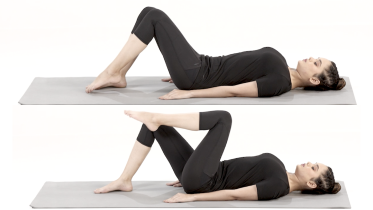 Supine marching
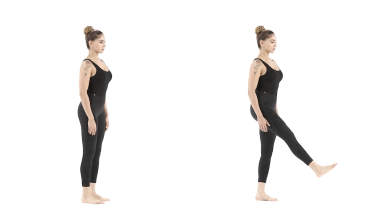 Standing hip flexion
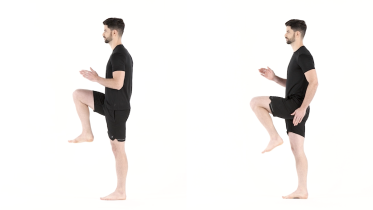 Marching on the spot
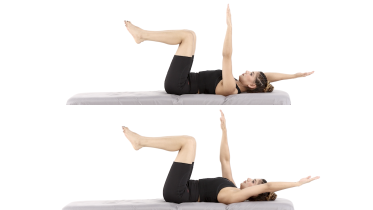 Dead bug
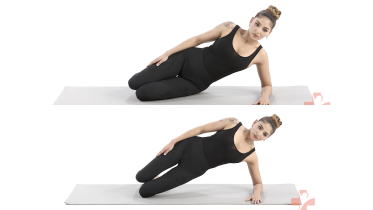 Kneeling side plank
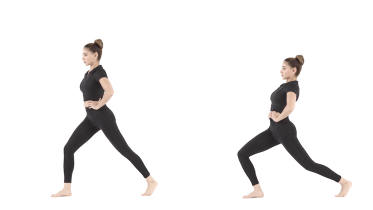 Hip flexor stretch
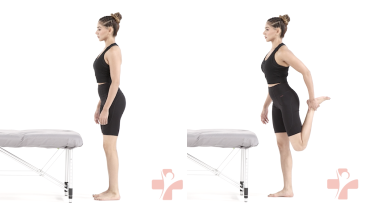 Standing quad stretch
Stage 3: Heavier strength and longer lengths
When stage 2 feels easy, the band lift and the dead bug with a band make the hip flexors work harder, and lowering the leg slowly counts as much as lifting it. The lunges and the step up rebuild leg strength for running, and in each lunge the back leg takes the front of that hip into a controlled stretch. The reverse lunge knee drive adds a quicker knee lift while you balance on one leg, and the Thomas stretch is a stronger stretch for the front of the hip, so keep it until the gentler stretches feel easy. Many programs use 2 to 3 sets of 5 to 12 reps on a few days each week, with the side plank held for 10 to 30 seconds and a counter or chair within reach for the standing work, and your physio will adjust this. Expect a mild pull at times, but stop and drop back a step if you feel a sharp or tearing pain.
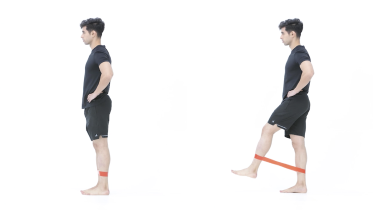 Standing hip flexion with a band
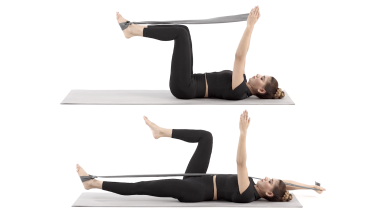 Dead bug with band
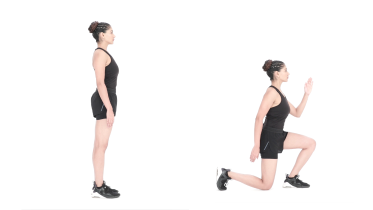 Reverse lunge
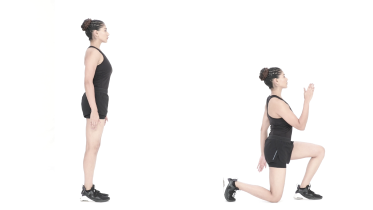 Forward lunge
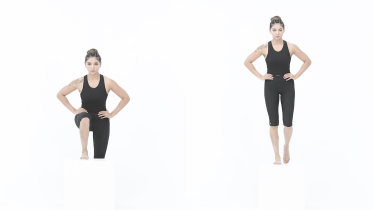 Step up
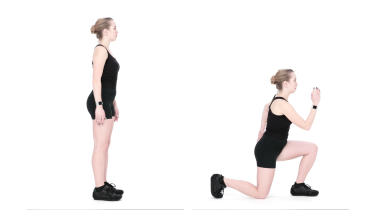 Reverse lunge knee drive
.png) Side plank
Side plank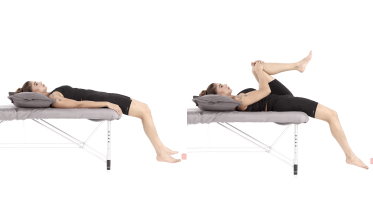 Thomas stretch
Stage 4: Getting back to sprints and kicks
You only need this stage if you are going back to running or a kicking sport; otherwise, carry on with stage 3 on 2 to 3 days a week. Wait until all of these are true: the stage 3 work feels strong, brisk walking, stairs, lunges and step ups cause no pain, a hard press of your knee up into your hands and the Thomas stretch no longer hurt, and pressing on the front of the hip is no longer tender. Jogging and high knees on the spot bring back running in place, and the leg kicks and lunge kicks rebuild the fast forward swing of the leg, low and gentle at first, then higher and quicker over the sessions. The ball kicks add a real ball: start with gentle short passes and build distance and power in small steps, leaving long kicks and full sprints until last. Many programs use 2 to 4 rounds of 15 seconds to 2 minutes for the running drills and 1 to 3 sets of 6 to 15 kicks, and your physio can shape the plan around your sport.
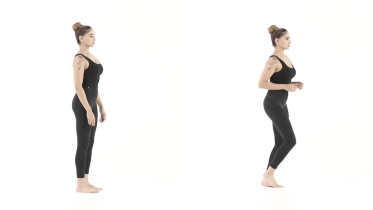 Jogging on the spot
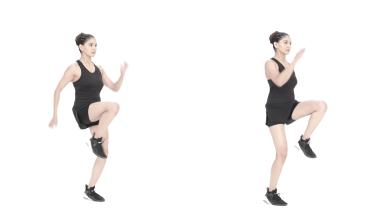 High knees running in place
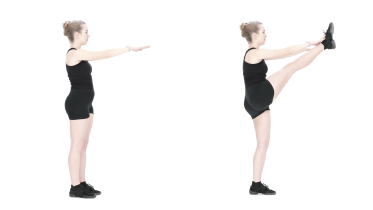 Straight leg kicks
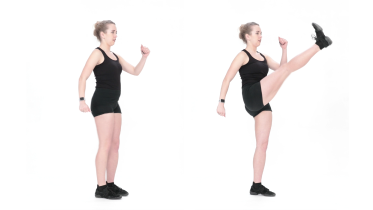 Reverse lunge to front kick
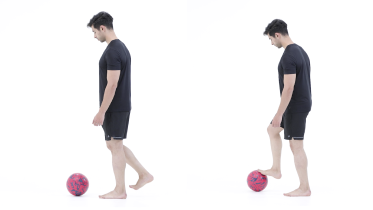 Single leg balance with ball kicks
When to see a physio or doctor
Get help the same day, the NHS says, if the pain is severe or getting worse, the bruising or swelling is large or growing, the hip is very stiff, or you have a high temperature or feel hot, cold or shivery. After a hip injury, if you cannot walk or put weight on the leg, go to an emergency department so a broken hip can be ruled out. The NHS also says to call emergency services or go to an emergency department if you heard a crack when you got hurt. And if the strain is not improving with home care, see a doctor or physio.
Book a physio early if your sport involves kicking or sprinting, if you have strained this hip flexor before, or if you are not sure the muscle is the source of the pain. They can examine the strain, look for a joint problem or a hernia, choose where you start in the program and map out your way back to running and kicking. The warning signs below set out how soon to get help, from an emergency visit down to seeing a doctor in the next 2 weeks.
For physiotherapists
The program is a starting framework for adults with grade 1 to 2 hip flexor strains, with no tendon or bony avulsion. The Doha agreement defines iliopsoas-related groin pain by iliopsoas tenderness, made more likely by pain on resisted hip flexion or on hip flexor stretch (Weir and colleagues, 2015). It recommends FABER and FADIR testing in every case, since the hip joint should always be considered. The group felt the classification could cover most acute groin injuries but noted that some, proximal rectus femoris injuries among them, would not readily fit.
In Serner and colleagues (2018), 33 of 156 male athletes with acute groin pain had an MRI-confirmed hip flexor injury. By muscle: rectus femoris 16, iliacus 12, psoas major 7, sartorius 4, tensor fasciae latae 1. Rectus femoris injuries occurred mainly with kicking (10) and sprinting (4), and 10 of the 16 (63%) showed tendinous injury. Iliacus and psoas major injuries were mostly at the musculotendinous junction, and these were the only muscles injured during change of direction. The authors cite hip flexor injuries as about a third of acute groin injuries; in their own cohort it was 33 of 156.
No trials of rehab protocols for hip flexor strains were identified for this page, so the staging and progression criteria are pragmatic. Stage 1 uses submaximal isometrics and assisted range, stage 2 active hip flexion through range with gentle stretching of iliopsoas and rectus femoris, stage 3 loaded and lengthened work including eccentric control, and stage 4 graded running and kicking. The criteria used are normal gait, pain-free resisted hip flexion, symmetrical strength on the leg lifts, then pain-free lunges and step ups, pain-free maximal resisted hip flexion and hip flexor stretch, and no tenderness on palpation before running and kicking.
Screen adolescents for apophyseal avulsion. In Rossi and Dragoni (2001), 203 pelvic avulsion fractures in 198 adolescent athletes involved the ischial tuberosity (109), the anterior inferior iliac spine (45) and the anterior superior iliac spine (39). Soccer and gymnastics were the commonest sports, and plain radiographs were central to diagnosis. Other differentials: femoroacetabular impingement, labral pathology, inguinal or femoral hernia, adductor-related groin pain, femoral neck stress fracture (Clough, 2002), osteonecrosis of the femoral head and lumbar referral.
See a doctor promptly if
- Emergency: you have had a fall or an injury and now have severe hip pain, or you cannot walk or put weight on the leg. Call emergency services or go to an emergency department. This can be a sign of a broken hip (hip fracture).
- Emergency: tingling or loss of feeling in the hip or leg after a fall or injury. Call emergency services or go to an emergency department.
- Emergency: pain, tingling, numbness or weakness in both legs, numbness or altered feeling around your genitals or bottom, or new trouble peeing or controlling your bladder or bowels. The same applies if you lose feeling in one leg. Call emergency services or go to an emergency department straight away. These can be signs of pressure on the nerves at the base of the spine (cauda equina syndrome).
- Same day: a teenager or young person whose bones are still growing gets sudden pain at the front of the hip or groin while kicking, sprinting or jumping, sometimes with a pop, and now limps or finds it hard to lift the leg. Get an urgent appointment with a doctor the same day and ask whether an X-ray is needed. If they cannot put weight on the leg, go to an emergency department. At this age the muscle can pull a small piece of bone away from the pelvis (an avulsion fracture), and this page does not cover it.
- Same day: a child or teenager has sudden pain in the hip, thigh or knee, is limping, or cannot put weight on one leg. Get an urgent appointment with a doctor the same day. If they have a high temperature or seem very unwell, go to an emergency department. This page is for adults, and hip pain in children has different causes.
- Same day: you felt a pop or a tearing feeling at the front of the hip or the top of the thigh and now have severe pain, large bruising, a dent or lump in the front of the thigh, or you cannot lift the leg or walk normally. Get assessed the same day at urgent care or an emergency department, and ask whether you need a scan. The tendon may be badly torn, and that can change the plan and how long recovery takes.
- Same day: a lump or bulge in your groin or upper thigh has become painful or tender, or you have a groin lump and a bloated tummy, you feel or are being sick, you are constipated, or you have a high temperature or feel hot, cold or shivery. This can be a hernia that has become trapped. Get medical help straight away, the same day, for example at urgent care or an emergency department. If the pain is severe or came on suddenly, you cannot poo or pass wind at all, you are vomiting blood or your vomit looks like coffee grounds, or you have suddenly become confused, call emergency services or go to an emergency department straight away.
- Same day: a calf or thigh that is newly swollen, warm, tender, red or darker than usual, has swollen veins that are sore to touch, or has a throbbing or cramping pain that does not fit your injury or condition, or that feels different from normal muscle soreness after exercise. This can be a sign of a blood clot (deep vein thrombosis), especially after surgery, an injury, time in a cast or boot, a long trip or a spell of being much less mobile than usual. Get medical advice the same day. If you are also short of breath or have chest pain, call emergency services.
- Same day: severe hip pain that came on suddenly without a fall, or pain that is getting worse quickly over a few days. Get medical advice the same day.
- Same day: the hip is hot and swollen, the skin around it has changed color, or you have hip pain with a high temperature or feel hot, cold or shivery. Get medical help the same day, and go to an emergency department if you feel very unwell. A joint infection needs treatment quickly.
- Same day: groin pain that built up with running, marching or jumping, often after you increased your training, and now hurts when you walk, makes you limp, or aches at rest or at night. Stop running and jumping and keep walking to a minimum until it has been checked. Get medical advice the same day and mention your training. If you cannot put weight on the leg, go to an emergency department. This can be a stress fracture in the neck of the thighbone (femoral neck stress fracture), which is easy to miss at first and can become a full break if you keep loading it.
- Same day: new hip or groin pain after a fall, even a small one, if you are older, have low bone density (osteoporosis) or have taken steroid tablets for a long time, even if you can still walk. Get medical advice the same day. A broken hip is not always obvious at first.
- Same day: a leg or foot that is getting weaker, for example your foot drags, catches on the ground or slaps down when you walk (foot drop). Get medical advice the same day. If the weakness is getting worse by the hour, go to an emergency department.
- Within a few days: hip or groin pain that is worse at night or does not ease with rest, and keeps getting worse. See your doctor within a few days. If you have had cancer, now or in the past, or are losing weight without trying, see your doctor sooner, within a day or two, and mention it. This applies even if the pain is not getting worse. If you are being treated for cancer now, contact your cancer team the same day.
- Within a few days: new groin or hip pain and you take steroid tablets long term, or have in the past, or you regularly drink a lot of alcohol. This can be a sign of a problem with the blood supply to the top of the thighbone (avascular necrosis). Book an appointment with your doctor within a few days and mention the steroids or alcohol.
- Within a few days: the strain is not getting any better after a week or so of looking after it yourself, or your hip flexor keeps getting strained again. This is not an emergency, but book an assessment with a physio or doctor in the next few days.
- Within 2 weeks: a lump in your groin or upper thigh that is not painful, especially one that gets bigger when you cough or sneeze and smaller when you lie down. This can be a hernia. Book an appointment with your doctor.
- Within 2 weeks: pain that spreads down the leg below the knee, especially with numbness or tingling in the leg or foot. The pain may be coming from your lower back rather than the hip. Book an appointment with a doctor or physio.
Common questions
How long does a hip flexor strain take to heal?
That depends on how badly the muscle is torn. The NHS says most sprains and strains feel better after 2 weeks, but advises avoiding strenuous exercise such as running for up to 8 weeks because of the risk of further damage, and says severe strains can take months. In an MRI study of athletes with a hip flexor injury, most injuries to the front thigh muscle (rectus femoris) also involved its tendon, which the authors suggest may matter for recovery time (Serner and colleagues, 2018). Few studies have looked at recovery times for hip flexor strains, so your physio will go by how well the hip works, not by the calendar.
Should I stretch a strained hip flexor?
Yes, but gently, and not in the first days. In this program stretching waits until stage 2, when you walk normally, and it should feel like a mild pull, never pain. That timing is a cautious choice, not something trials of hip flexor strains have tested, so your physio may bring stretches in earlier or later for your hip. If a stretch gives you a pinch deep in the front of the hip rather than a pull in the muscle, stop and tell your physio, because that can point to the hip joint instead.
Can I walk with a hip flexor strain?
Rest and protect the injury for 2 to 3 days and stop exercise and sport, the NHS advises. After that, stage 1 begins once pain no longer stops you moving the leg, and walking with a normal, pain-free stride is the sign to move up to stage 2. If, after the injury, you cannot walk or put weight on the leg, go to an emergency department.
Is it a hip flexor strain or a hernia?
Usually a strain begins at a single moment, such as a kick, a sprint or a sharp turn. After that it hurts to lift the knee against resistance or to stretch the front of the hip (Weir and colleagues, 2015). A hernia, in the NHS description, is a bulge or lump that may grow with a cough or sneeze and shrink when you lie down, and in the groin it can give a heavy, dragging feeling. See your doctor if you think you have one. A lump that has turned painful, or that comes with feeling or being sick or a bloated tummy, needs medical help the same day.
When can I kick or sprint again after a hip flexor strain?
They come back last, a little at a time. No return to sport criteria have been tested for hip flexor strains, so this program uses practical checks: stage 3 feels strong, lunges and step ups do not hurt, a hard knee press and the Thomas stretch are pain free, and the front of the hip is no longer tender when you press on it. Then build from soft, short passes to long kicks, and from jogging to full sprints, over several sessions. The NHS advises avoiding strenuous exercise such as running for up to 8 weeks after a strain, and your physio can match the steps to your sport.
References
- Serner A, Weir A, Tol JL, Thorborg K, Roemer F, Guermazi A, Yamashiro E, Hölmich P. Characteristics of acute groin injuries in the hip flexor muscles: a detailed MRI study in athletes. Scandinavian Journal of Medicine and Science in Sports. 2018;28(2):677-685. https://doi.org/10.1111/sms.12939
- Weir A, Brukner P, Delahunt E, et al. Doha agreement meeting on terminology and definitions in groin pain in athletes. British Journal of Sports Medicine. 2015;49(12):768-774. https://doi.org/10.1136/bjsports-2015-094869
- Rossi F, Dragoni S. Acute avulsion fractures of the pelvis in adolescent competitive athletes: prevalence, location and sports distribution of 203 cases collected. Skeletal Radiology. 2001;30(3):127-131. https://doi.org/10.1007/s002560000319
- Clough TM. Femoral neck stress fracture: the importance of clinical suspicion and early review. British Journal of Sports Medicine. 2002;36(4):308-309. doi:10.1136/bjsm.36.4.308
- NHS. Sprains and strains. Page last reviewed 23 April 2024. https://www.nhs.uk/conditions/sprains-and-strains/
- NHS. Hernia. Page last reviewed 19 May 2026. https://www.nhs.uk/conditions/hernia/
Written and checked by the PocketPhysio editorial team. Last updated 2026-09-28.
This page is general education, not a diagnosis or a personal treatment plan. See a physiotherapist or doctor for advice about your own situation.