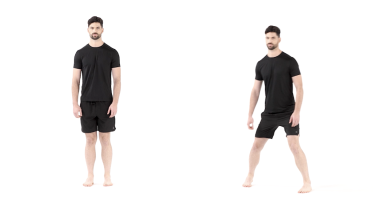
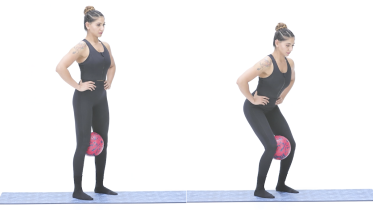
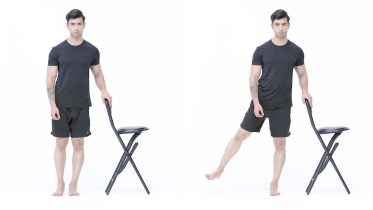
Standing hip flexion with a band
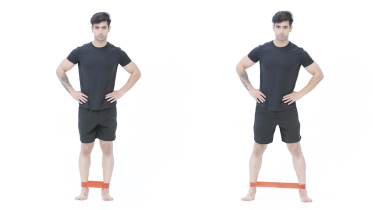
Standing hip flexion with a band works the muscles at the front of your hip (hip flexors). With a loop band around both ankles, you lift one straight leg forward against the band and lower it slowly while the other leg holds you steady. They are the muscles that swing your leg forward with every step you take, on the flat or on stairs.
How to do the standing hip flexion with a band
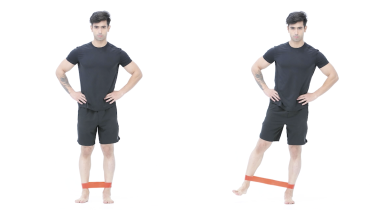
- Loop a light band around both ankles and stand tall with your feet a little apart, as in the video, so the band sits snug without slack.
- Stand side-on to a kitchen counter or the back of a sturdy chair and rest one hand on it. The video shows hands on hips, which only suits people who already balance well on one leg.
- Put your weight on the leg nearer the support, keep that knee soft rather than locked, and gently tighten your stomach.
- With the other knee straight and the toes pointing forward, lift that leg forward against the band. In the video the foot comes only a short way off the floor, and that is enough.
- Lower the leg slowly, resisting the band, until the foot rests beside the other one. Finish your reps, then turn around and work the other leg.
What you should feel
Work at the front of the hip and the top of the thigh on the leg that lifts. The buttock and outer hip of the standing leg work as well, holding you steady on one foot.
Common mistakes
- Leaning back to get the leg higher. Your trunk stays upright over the standing leg.
- Bending the knee of the lifting leg, which turns the exercise into a march.
- Swinging the leg up fast and letting the band drag it back down.
- Locking the standing knee back hard.
How often
A common starting point is 2 to 3 sets of 8 to 12 slow lifts on each leg with a light band, once a day. Your physio will adjust this.
Stop and check with your physio if
- Sharp or pinching pain at the front of the hip or in the groin.
- Pain in your lower back, or pain, tingling or numbness running down the leg.
- You feel unsteady even while holding on. Put both hands on your support and sit down.
From the clinic
Have the counter or chair close enough to grab without reaching. If you have fallen in the past year, or you wobble when you stand on one leg, keep a hand on the support for every lift and ask your physio before you let go. Check the band for small splits or thin patches before each session. Lay it flat around the ankles, so it cannot roll down over the foot halfway through a lift.
Moving the band up to just above the knees makes the lift lighter, because it then pulls closer to the hip. Seated hip flexion works the same muscles without the balance challenge. The same band set-up is used for standing hip extension with a band and standing hip abduction with a band, which work the back and side of the hip.
If you have had a hip replacement, get the go-ahead from your surgeon or physio before you try standing hip flexion with a band. Lifting a straight leg against a band loads the muscles at the front of the hip, and many surgeons ask you to avoid that for the first months after some operations. After an operation done from the front of the hip (anterior approach), these muscles are easily irritated, so pain at the front of the hip or in the groin as you lift is a reason to stop and tell your physio. The lift stays well below a right angle, but you also stand on one leg while the other lifts, so ask when that is safe on the operated side.
Written and checked by the PocketPhysio editorial team. Last updated 2026-09-26.
This page is general education, not a diagnosis or a personal treatment plan. If you have pain, an injury or a health condition, see a physiotherapist or doctor before starting new exercises.