
Total hip replacement rehab: exercises and recovery
What is a total hip replacement?
In a total hip replacement, the surgeon removes the worn ball at the top of the thighbone and replaces it with a metal stem and a metal or ceramic ball. The damaged surface of the socket in the pelvis is replaced as well. Arthritis is the most common cause of long-term hip pain and disability (OrthoInfo). If you are still deciding about surgery, the hip osteoarthritis program covers treatment without an operation.
This page is for adults after a planned total hip replacement. It is a general guide to what recovery usually looks like and to the exercises many hospital programs use. If your hip was replaced after a fall and a broken hip, or you have had a partial replacement or a repeat operation, your plan may be quite different, so follow it closely.
Your surgeon's and physio's plan comes first
Your surgical team knows how your hip was operated on and how stable it is, and what else is going on with your health. Their plan for exercises, walking aids and positions to avoid comes before anything on this page. If this page and your hospital leaflet disagree, follow the leaflet and ask your physio.
NICE advises that a physio or occupational therapist starts your rehab on the day of surgery if possible, and no later than 24 hours after it. Before you leave hospital, you should be given advice and a home exercise program to carry on with yourself. People who need more help, or who find that working on their own is not getting them where they want to be, should be offered supervised sessions (NICE NG157).
Hip precautions: why hospitals differ
Hip precautions are movements you are asked to avoid for a while after the operation, to lower the chance of the new hip dislocating. The NHS recovery page lists not bending your hip past a right angle, not crossing your legs, not bending down to touch your feet and not sitting in low chairs or on low toilet seats. Leeds Teaching Hospitals adds not twisting your leg or waist. Where precautions are used, they usually last about 6 weeks (OrthoInfo), and some consultants ask for 6 to 12 weeks (Newcastle Hospitals).
Not every hospital gives the same list, or any list. OrthoInfo explains that precautions vary with the surgical approach your surgeon used. At Leeds, the surgeon decides whether you need them at all, and the Cambridge University Hospitals leaflet gives no list of hip precautions and says you may lie in bed however you feel comfortable.
The evidence behind routine precautions is weak. A Cochrane review found only low or very low quality evidence and could not say whether precautions prevent dislocation (Smith 2016). A later review of more than 8,000 people who had the operation from the back (posterior approach) found there may be little or no difference in early dislocations with or without precautions, although the certainty of that evidence was low or very low (Korfitsen 2023). None of this means you should drop precautions your team gave you. Follow them for as long as they asked, and ask them before you change anything.
Typical recovery after a hip replacement
Treat these as typical times, not targets. They come from NHS and hospital information, and your own recovery may be faster or slower.
In hospital, most people are up and walking with a frame or crutches soon after the operation, and those who are generally fit usually go home around 1 to 3 days later (NHS). Pain and swelling in the leg and foot are common and usually get better over a few weeks. OrthoInfo adds that some discomfort with activity and at night is common for several weeks.
Most people are back to most light daily activities within 3 to 6 weeks (OrthoInfo). The NHS advises waiting at least 6 weeks before driving and says going back to work usually takes about 6 weeks, depending on your job. Follow-up appointments are often around 6 to 12 weeks after surgery (NHS).
From about 6 weeks, some hospital programs, such as the one in the Cambridge leaflet, add harder exercises once you feel able. The same leaflet says most people walk without aids by 12 weeks, and that at 6 months almost everyone is greatly improved, although stamina can take longer. Full recovery often takes 6 to 12 months (Hull University Teaching Hospitals).
Does exercise help after a hip replacement?
Exercise is used to get the hip moving, rebuild the muscles that months of hip pain and the operation have weakened, and get you walking normally again (OrthoInfo). The NHS says following the exercises early in your recovery helps the long-term strength and movement in your hip.
The evidence for particular programs is thin. A review of exercise trials after hip replacement found that supervised exercise programs after the operation were not clearly better than usual care for day-to-day function or hip strength, and there was very low certainty about whether one type of exercise works better than another (Saueressig 2021). The NICE guideline committee found much the same: after a hip or knee replacement, rehab you do yourself with advice from the physio team worked about as well as supervised rehab (NICE NG157). So the stages here follow common hospital programs, such as NHS hospital leaflets and the OrthoInfo exercise guide. Your own team's plan still comes first.
How to use this program
Start only with the exercises your team has cleared, and move up a stage when they say so and the current one feels easy. Hospital leaflets commonly give about 10 repetitions of each early exercise, 3 to 4 times a day (Leeds, Gateshead Health, OrthoInfo). For the later strength exercises, OrthoInfo gives 10 repetitions 4 times a day for its band exercises, and many physios use 2 to 3 sets of 10 to 15 once a day instead. Each exercise page gives a typical starting dose, and your physio will adjust this to your hip and your goals.
OrthoInfo describes walking programs that start with 5 to 10 minutes, 3 or 4 times a day, and build up toward 20 to 30 minutes, 2 or 3 times a day. The NHS advises walking every day as far as is comfortable, and not sitting still for long periods, which helps with swelling.
Mild discomfort, stiffness or a pulling feeling during the exercises is expected. It is fine if it settles within about an hour after you stop (Gateshead Health) and your hip is no worse the next morning. Sharp pain, pain that builds with every repetition, or a hip that is clearly more painful or swollen the next day means the load was too much, so do fewer or smaller movements next time and tell your physio. If you have high blood pressure, breathe steadily through every repetition and never hold your breath.
Two things mean you stop the exercises and get help:
- Your calf or thigh is getting more swollen, or becomes warm, tender, red or darker than usual, or has a new throbbing or cramping pain. This can be a blood clot, especially after an operation, an injury, time in a cast, boot or brace, or a spell of being much less mobile than usual, and after an operation it can also be an infection. Stop and contact your medical team or get medical advice the same day. If you are also short of breath or have chest pain, call emergency services.
- Your wound becomes more red, hot, swollen or painful, or starts to leak. Contact your medical team the same day.
The warning signs at the end of this page list the rest, with how quickly to act.
The exercise program
Stage 1: In bed and in the chair, from the first days
From the first days, starting in hospital. Ankle pumps and quad sets keep the blood moving and wake up the thigh muscle, and many leaflets suggest doing them often through the day. For heel slides, bend the hip only as far as your team allows, which is often no further than a right angle, and keep the knee pointing at the ceiling. Short arc quads and straight leg raises strengthen the front of the thigh, but not every hospital program includes straight leg raises, so leave them out if yours does not. Your team may add buttock squeezes or a lying leg slide out to the side, so do those the way they showed you.
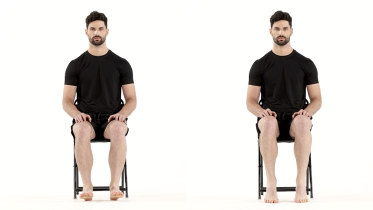 Ankle pumps
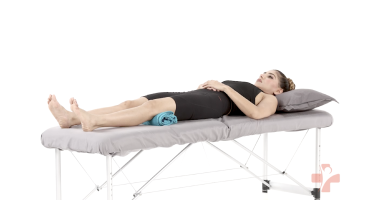 Quad sets (towel under knee)
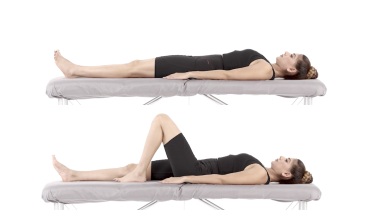 Heel slides
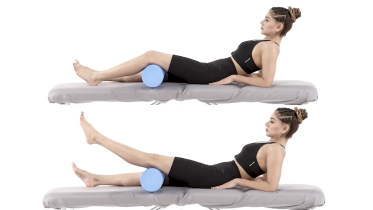 Short arc quads
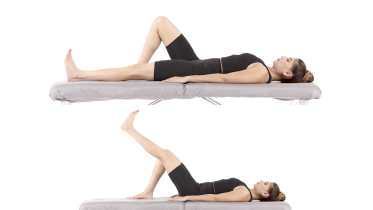 Straight leg raise
Stage 2: Standing exercises and walking further
When you are up and walking with your frame, crutches or stick and your team says standing exercises are fine. Many hospitals start these before you go home. If you were told to keep some weight off the operated leg, follow that in every standing exercise. Hold a kitchen counter or a sturdy chair, stand on your other leg and move the operated leg, keeping the knee lower than your hip when you lift it in front. Take the leg back only a short way in standing hip extension, and ask how far if your hip was replaced from the front. If your team asked you not to work the side of your hip yet, leave out the side leg lift until they say so. Use a firm, high chair with arms for sit to stand, start bridges only when your team says so, and do not swap crutches for a stick until your physio says you are ready. Calf raises and the side to side weight shift build steadiness on both legs.
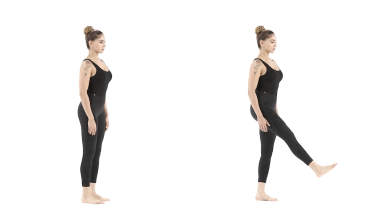 Standing hip flexion
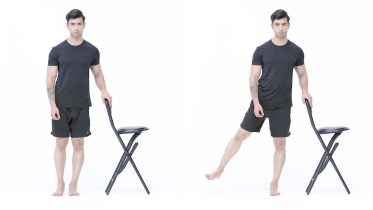 Standing hip abduction
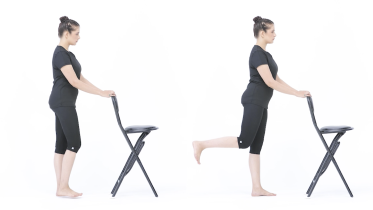 Standing hip extension
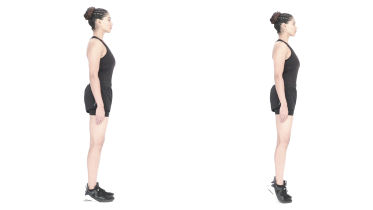 Calf raises
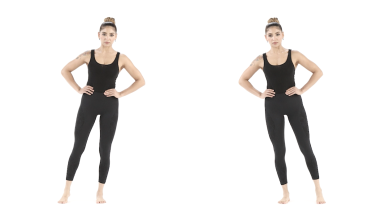 Side to side weight shift
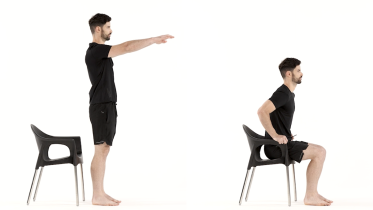 Sit to stand using armrests
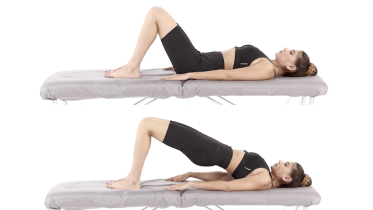 Glute bridge
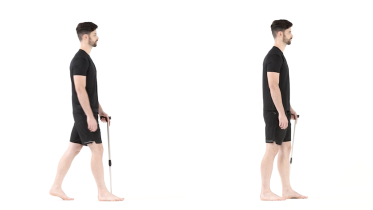 Walking with a cane
Stage 3: Strength, stairs and balance
Often from about 6 weeks, when your team is happy and stage 2 feels easy. The band adds load to lifting the leg in front, and mini squats and sit to stand without your hands build strength for chairs, cars and toilets, so keep the bend small and the seat high. Get the go-ahead from your surgeon or physio before you try step ups. Some operations limit this kind of work for the first months, so the timing depends on your surgery. Hold the rail on stairs, and until your physio says you are ready to go foot over foot as in the video, go up leading with your good leg and down leading with the operated one. Do the balance holds next to a counter, and build up your walks gradually.
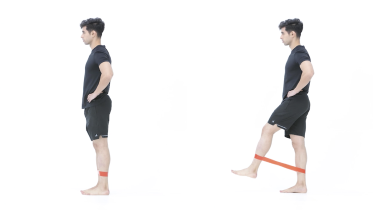 Standing hip flexion with a band
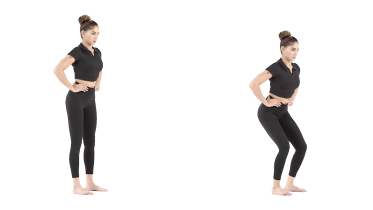 Mini squat
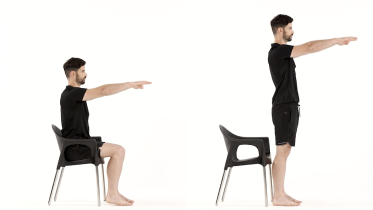 Sit to stand
 Step up
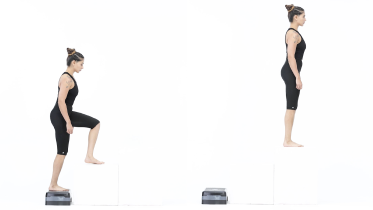 Stair climbing
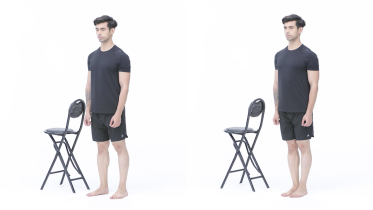 Standing with feet together
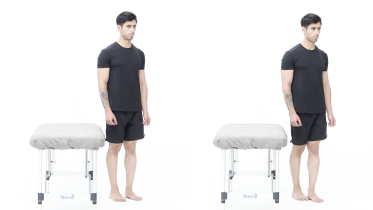 Semi-tandem stance
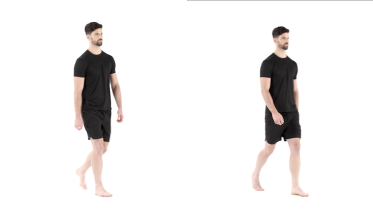 Brisk walking
What to avoid or change
Deep bending, crossing your legs and twisting on the operated leg take the new hip toward the positions where it can come out of its socket, and many surgeons ask you to avoid that for the first months after some operations. Several hip exercises elsewhere on this site bend the hip well past a right angle, bring the leg across your body or turn it inward, such as knee to chest stretches, figure 4 stretches and deep squats. Others take the leg far behind you or turn it outward, such as a kneeling hip flexor stretch, which some surgeons limit after an operation done from the front of the hip. That is why they are not in this program. Add them later only if your surgeon or physio says your hip is ready.
The NHS also advises against exercises with jumping, sudden turns or a high risk of falling while your hip is recovering, and against lifting or moving heavy objects until you are told it is safe. For the longer term, OrthoInfo says most surgeons advise against high-impact activities such as running and jogging, so ask your surgeon before you take up running. If you have had a hip or knee replacement, get the go-ahead from your surgeon before you try jumping or hopping. Many surgeons advise against jumping and hopping after a joint replacement for good, not just for the first months, because each landing sends high impact through the new joint. Sit on a firm, high chair with arms rather than a low sofa, and use a raised toilet seat if you were given one.
Walking, stairs and falls
Use your frame, crutches or stick exactly as your physio showed you, and do not swap to a lighter aid until they say you are ready. OrthoInfo suggests a single crutch or a stick once you can walk and stand for more than 10 minutes without leaning your weight on the walker or crutches. At first, go one step at a time on stairs, leading up with your good leg and down with your operated leg, and always use a handrail (OrthoInfo).
A fall in the first weeks after surgery can damage a new hip and may mean more surgery (OrthoInfo), and the NHS advises avoiding activities with a high risk of falling while your hip is recovering. Clear rugs, cables and clutter from the floor, and keep a light on at night on the way to the toilet. Wear flat shoes that fit well and grip the floor, not socks, tights or bare feet. If you are older, have fallen before or feel unsteady, the balance and falls prevention program builds on stage 3.
Blood clots after a hip replacement
A hip replacement raises the chance of a blood clot in a deep vein of the leg (deep vein thrombosis), and sometimes a clot can travel to the lung (pulmonary embolism), which needs treatment straight away (NHS). NICE advises offering medicine to lower the risk after a planned hip replacement when your risk of a clot outweighs your risk of bleeding, and the courses it lists carry on for several weeks after surgery (NICE NG89). If you were given injections, tablets or stockings, use them exactly as your team told you, for as long as they said.
Moving your ankles and walking regularly are part of the plan too. The warning signs of a clot are listed below. A calf or thigh that is newly swollen, warm or painful needs checking the same day, and sudden breathlessness or chest pain is an emergency.
When to see a physio or doctor
Your surgical team will usually see you around 6 to 12 weeks after the operation (NHS). Ask for a physio review sooner if your walking is not improving, you still limp badly, you cannot manage the stairs at home, or you are unsure how far to push the exercises. If working on your own is not getting you to your rehab goals, NICE says you should be offered supervised sessions (NICE NG157).
Some problems need help much faster. The warning signs below say which ones are an emergency and which need a call to your surgical team the same day. Keep your hospital's contact number somewhere easy to find for the first months.
For physiotherapists
This page gives patients a general framework after primary elective total hip replacement and defers to the operating team's protocol, including approach-specific precautions and weight-bearing status. NICE NG157 recommends physio or OT rehab on the day of surgery if possible and within 24 hours, and advice on self-directed rehabilitation before discharge, with supervised group or individual outpatient rehabilitation for people with additional needs or who are not meeting their goals.
Saueressig 2021 (JAMA Network Open) found very low to moderate certainty evidence that supervised land-based postoperative exercise was not associated with benefit over usual care for self-reported function and hip strength, and very low certainty for differences between exercise types. On precautions, Smith 2016 (Cochrane, 3 trials, 492 participants) rated the evidence low to very low quality, and Korfitsen 2023 reported there may be no or negligible difference in early dislocation after posterior-approach THA with and without precautions (RCTs RR 1.8, 95% CI 0.6 to 5.2; non-randomized studies RR 0.9, 95% CI 0.3 to 2.5), with low and very low certainty.
With the cues given (heel slide range, a high seat for sit to stand, knee below hip in standing flexion), the exercise selection avoids hip flexion past 90 degrees, adduction across the midline and internal rotation, so it stays within conventional posterior-approach precautions. Check extension and external rotation limits after an anterior approach, and active or resisted abduction after a lateral approach, against the surgeon's protocol, along with any restricted weight-bearing status. Screen at each visit for dislocation, deep vein thrombosis and pulmonary embolism, wound infection, nerve symptoms including foot drop, and new leg length or rotation changes, and check that VTE prophylaxis under NICE NG89 is being taken as prescribed.
See a doctor promptly if
- Emergency: sudden severe pain in your hip or groin, sometimes with a clunk or pop, and you cannot move the leg or put weight on it, or the leg suddenly looks shorter or turned in or out. Do not try to walk on it or push it back into place. Keep still and call emergency services or go to an emergency department, and do not drive yourself. Your new hip may have come out of its socket (dislocated), and a medical team needs to put it back.
- Emergency: your operated leg looks shorter than it did, or its foot turns in or out more than before, or the hip moves in an unusual way, even if the pain is not severe. Keep your weight off it and go to an emergency department straight away, and do not drive yourself. If you are in severe pain or cannot move the leg, call emergency services.
- Emergency: you have had a fall or an injury and now have severe hip pain, or you cannot walk or put weight on the leg. Call emergency services or go to an emergency department. This can be a sign of a broken hip (hip fracture).
- Same day: after a fall or a knock, even a small one, your hip, groin or thigh is newly painful, bruised or swollen, even if you can still walk and your leg looks normal. Stop the exercises and contact your surgical team or get medical advice the same day. A break in the bone around a new hip is not always obvious at first.
- Emergency: since your operation, you suddenly become short of breath, you get chest pain or pain in your upper back that may be worse when you breathe in, you cough up blood, your heart is beating very fast, or you faint. Call emergency services straight away, even if your leg looks normal. These can be signs of a blood clot in the lungs (pulmonary embolism).
- Same day: a calf or thigh that is newly swollen, warm, tender, red or darker than usual, has swollen veins that are sore to touch, or has a throbbing or cramping pain that does not fit your injury or condition, or that feels different from normal muscle soreness after exercise. This can be a sign of a blood clot (deep vein thrombosis), especially after surgery, an injury, time in a cast or boot, a long trip or a spell of being much less mobile than usual. Get medical advice the same day. If you are also short of breath or have chest pain, call emergency services.
- Same day: your wound becomes more red, hot, swollen or painful, starts to leak or ooze, has pus coming out of it or its edges start to come apart, or you have a high temperature or feel hot, cold or shivery. Contact your surgical team or get medical advice the same day. Redness can be harder to see on brown or black skin. If you feel very unwell, go to an emergency department. If you have a very high or very low temperature, shivering you cannot control, you are breathing very fast or finding it hard to breathe, you are confused or your speech is slurred, your skin, lips or tongue look blue, gray, pale or blotchy (on brown or black skin this can be easier to see on the palms of the hands or soles of the feet), or you have a rash that does not fade when you press it, call emergency services, as this can be sepsis.
- Same day: since your operation, the pain, redness, warmth, tenderness or swelling in your hip or leg is not getting better or is getting worse, for example the hip pain keeps building both when you move and when you rest, or you have a new throbbing or cramping pain in your hip or leg. Contact your surgical team or get medical advice the same day, as this can be a sign of infection around the new joint or a blood clot. If you feel very unwell, go to an emergency department.
- Same day: your hip clunks and feels as if it partly slipped out of place and went back, even if it settles straight away and your leg looks normal. Stop the exercises, avoid the movement that brought it on, and contact your surgical team or get medical advice the same day. If the leg then looks shorter or turned, or you cannot move it or put weight on it, call emergency services.
- Same day: a leg or foot that is getting weaker, for example your foot drags, catches on the ground or slaps down when you walk (foot drop). Get medical advice the same day. If the weakness is getting worse by the hour, go to an emergency department.
- Same day: new numbness, tingling or burning in your operated leg or foot, beyond the numb patch of skin around your scar. Contact your surgical team or get medical advice the same day. If your foot or toes turn cold, pale, blue or gray, call emergency services or go to an emergency department straight away, and do not drive yourself.
- Routine: since the operation your leg has felt a little longer or shorter than the other one, with no sudden change and no new pain. This is not unusual after a hip replacement. Mention it to your physio or at your follow-up appointment, as some people are more comfortable with a shoe raise.
- Routine: your walking or movement has stopped improving over a week or two, you still limp badly, or you cannot manage the exercises your team gave you, but your pain, redness and swelling are not getting worse. This is not an emergency, but ask your physio or surgical team for a review in the next week or two.
Common questions
How long does it take to recover from a hip replacement?
The NHS says it may take several months. OrthoInfo, from the American Academy of Orthopaedic Surgeons, says most people can get back to most light daily activities within 3 to 6 weeks. A leaflet from Cambridge University Hospitals says most people walk without aids by 12 weeks, and that at 6 months almost everyone is greatly improved but may not have full stamina yet. Hull University Teaching Hospitals puts full recovery at 6 to 12 months, with a big improvement for most people much sooner. These are typical times, and your own recovery depends on your health, your fitness before the operation and your surgery.
When can I stop using crutches after a hip replacement?
When your physio says you are ready, not by a fixed date. The NHS says you will need crutches or a walking frame at first. OrthoInfo suggests moving to a single crutch or a stick once you can walk and stand for more than 10 minutes and your leg is strong enough that you are not leaning your weight on the walker or crutches. Most people walk without aids by 12 weeks, according to the Cambridge leaflet. If you still limp without the stick, keep using it and ask your physio.
Do I have to follow hip precautions after a hip replacement?
Follow whatever your own surgical team told you. Precautions depend on how the hip was operated on (OrthoInfo), and at Leeds Teaching Hospitals, for example, the surgeon decides whether you need them. Where they are used, they usually last about 6 weeks, and some consultants ask for up to 12 weeks (Newcastle Hospitals). Reviews of the research have not shown that routine precautions prevent dislocation (Smith 2016, Korfitsen 2023), and some hospitals no longer give them to everyone. That is a decision for your surgeon, so do not stop precautions you were given without asking them.
When can I drive after a hip replacement?
The NHS says to wait at least 6 weeks and to check with your doctor that you are fit to drive. Gateshead Health adds that you should be able to do an emergency stop safely. Your surgeon may ask you to wait longer, depending on your surgery and which leg was operated on.
Can I sleep on my side after a hip replacement?
It depends on your hospital's advice. The Cambridge University Hospitals leaflet, for example, says you may lie in bed however you feel comfortable, and that a pillow between your legs may help if you lie on the side that was not operated on. If your team gave you precautions, ask them which sleeping positions those cover and for how long.
Why does one leg feel longer after a hip replacement?
The NHS says the operated leg sometimes ends up slightly longer than the other, and that the difference is often so small that most people do not notice it. OrthoInfo explains that the surgeon aims for even leg lengths but may lengthen or shorten the leg slightly to make the hip more stable. Some people are more comfortable with a shoe raise. A leg that suddenly looks shorter or turned is different, and is an emergency.
References
- National Institute for Health and Care Excellence. Joint replacement (primary): hip, knee and shoulder. NICE guideline NG157. Published 4 June 2020. https://www.nice.org.uk/guidance/ng157
- National Institute for Health and Care Excellence. Venous thromboembolism in over 16s: reducing the risk of hospital-acquired deep vein thrombosis or pulmonary embolism. NICE guideline NG89. Published 21 March 2018, last updated 13 August 2019. https://www.nice.org.uk/guidance/ng89
- NHS. Recovering from a hip replacement. Page last reviewed 6 March 2024. https://www.nhs.uk/tests-and-treatments/hip-replacement/recovering-from-a-hip-replacement/
- NHS. Complications of a hip replacement. Page last reviewed 6 March 2024. https://www.nhs.uk/tests-and-treatments/hip-replacement/complications-of-a-hip-replacement/
- NHS. Deep vein thrombosis (DVT). Page last reviewed 30 April 2026. https://www.nhs.uk/conditions/deep-vein-thrombosis-dvt/
- NHS. Pulmonary embolism. Page last reviewed 25 May 2023. https://www.nhs.uk/conditions/pulmonary-embolism/
- NHS. Sepsis. Page last reviewed 14 May 2026. https://www.nhs.uk/conditions/sepsis/
- American Academy of Orthopaedic Surgeons. Total hip replacement. OrthoInfo. https://www.orthoinfo.org/en/treatment/total-hip-replacement/
- American Academy of Orthopaedic Surgeons. Total hip replacement exercise guide. OrthoInfo. https://www.orthoinfo.org/en/recovery/total-hip-replacement-exercise-guide/
- Smith TO, Jepson P, Beswick A, et al. Assistive devices, hip precautions, environmental modifications and training to prevent dislocation and improve function after hip arthroplasty. Cochrane Database of Systematic Reviews. 2016;(7):CD010815. https://doi.org/10.1002/14651858.CD010815.pub2
- Korfitsen CB, Mikkelsen LR, Mikkelsen ML, et al. Hip precautions after posterior-approach total hip arthroplasty among patients with primary hip osteoarthritis do not influence early recovery: a systematic review and meta-analysis of randomized and non-randomized studies with 8,835 patients. Acta Orthopaedica. 2023;94:141-151. https://doi.org/10.2340/17453674.2023.11958
- Saueressig T, Owen PJ, Zebisch J, Herbst M, Belavy DL. Evaluation of exercise interventions and outcomes after hip arthroplasty: a systematic review and meta-analysis. JAMA Network Open. 2021;4(2):e210254. https://doi.org/10.1001/jamanetworkopen.2021.0254
- Leeds Teaching Hospitals NHS Trust. Total hip replacement: a guide to your rehabilitation. Patient information. https://www.leedsth.nhs.uk/patients/resources/total-hip-replacement-a-guide-to-your-rehabilitation/
- Cambridge University Hospitals NHS Foundation Trust. Hip replacement, total: advice and exercises following. Patient information. https://www.cuh.nhs.uk/patient-information/hip-replacement-total-advice-and-exercises-following/
- The Newcastle upon Tyne Hospitals NHS Foundation Trust. Total hip replacement. Patient information. https://www.newcastle-hospitals.nhs.uk/resources/total-hip-replacement/
- Gateshead Health NHS Foundation Trust. Physiotherapy following hip replacement surgery. Patient information. https://www.gatesheadhealth.nhs.uk/resources/physiotherapy-following-hip-replacement-surgery/
- Hull University Teaching Hospitals NHS Trust. Total hip replacement. Patient leaflet HEY380/2024. https://www.hey.nhs.uk/patient-leaflet/total-hip-replacement-benefits-risks-outcome/
- University Hospitals Plymouth NHS Trust. Hip dislocation. Patient information leaflet. https://www.plymouthhospitals.nhs.uk/display-pil/pil-hip-dislocations-4038/
Written and checked by the PocketPhysio editorial team. Last updated 2026-09-29.
This page is general education, not a diagnosis or a personal treatment plan. See a physiotherapist or doctor for advice about your own situation.