Standing hip extension
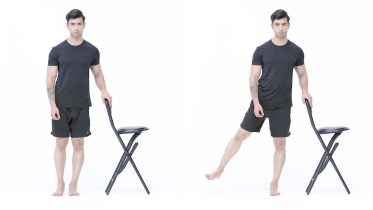
For standing hip extension, you hold a chair and take one leg back behind you. It works the big muscle of your buttock (gluteus maximus), with help from the hamstrings at the back of the thigh. It needs no floor space and no equipment, which is why it is often one of the first hip exercises people get to do at home.
How to do the standing hip extension
- Stand facing the back of a sturdy chair or a counter and hold it with both hands. Keep your feet hip width apart and your weight even.
- Shift your weight onto one leg. Stand tall and look straight ahead.
- Bend the knee of the other leg so the foot lifts behind you. Keeping the knee bent, move the whole thigh back behind your body from the hip. It only travels a short way, and that is normal.
- Go only as far as you can while your back stays straight and your body stays upright.
- Lower the leg slowly back to the start and repeat. Then change legs.
What you should feel
Work in the buttock of the leg that moves, and a little in the back of the thigh. Your lower back should stay quiet.
Common mistakes
- Arching the lower back to get the leg higher. The movement then comes from your spine, not your hip.
- Leaning the upper body forward over the chair as the leg goes back.
- Only bending the knee and lifting the heel, without taking the thigh back. That is a hamstring curl, a different exercise.
- Swinging the leg instead of moving it slowly.
How often
Many programs start with 2 to 3 sets of 10 to 15 on each leg, once a day. Your physio will adjust the numbers to suit you.
Stop and check with your physio if
- You feel a sharp or pinching pain in the lower back.
- Sharp pain in the hip or buttock, or pain that keeps building through the set.
- Numbness, tingling or pain that spreads down the leg.
- Your calf or thigh is getting more swollen, or becomes warm, tender, red or darker than usual, or has a new throbbing or cramping pain. This can be a blood clot, especially after an operation, an injury, time in a cast, boot or brace, or a spell of being much less mobile than usual, and after an operation it can also be an infection. Stop and contact your medical team or get medical advice the same day. If you are also short of breath or have chest pain, call emergency services.
From the clinic
The hip does not go far behind you. If your foot is swinging up high, your knee or your lower back is usually doing the extra work. One trick: squeeze the buttock of the moving leg first, then let the leg travel back. Stop the moment you feel your back start to arch.
Pick a chair heavy enough that it will not slide, and keep both hands on it if your balance is shaky. If you have had a hip replacement or other hip surgery, get the go-ahead from your surgeon or physio before you try standing hip extension. Taking the leg back behind you stretches the front of the hip, and many surgeons ask you to avoid that for the first months after some operations, especially when the hip was replaced from the front (anterior approach). Ask them how far to take the leg.
The glute bridge works the same buttock muscle lying down. If your program also has the standing hamstring curl, compare the two: in the curl only the knee bends, and in this exercise the thigh moves back. Some programs do this one with the knee straight instead. Both versions work the buttock, so follow the one your physio gives you.
Written and checked by the PocketPhysio editorial team. Last updated 2026-09-26.
This page is general education, not a diagnosis or a personal treatment plan. If you have pain, an injury or a health condition, see a physiotherapist or doctor before starting new exercises.