Hip hike
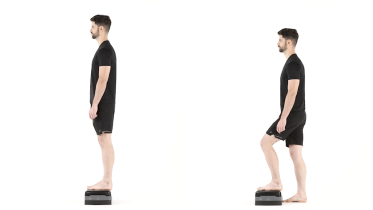
The hip hike is a small movement done standing on one leg on a step, with the other leg hanging off the side. You lift the pelvis on the hanging side, then lower it back down, without bending your knees to cheat. It works the muscles at the side of the standing hip (gluteus medius) and a deep muscle at the side of the lower back on the lifting side (quadratus lumborum). You will find it in many hip, knee and running programs.
How to do the hip hike
- Stand on a sturdy step, box or the bottom stair on one leg, with the other leg hanging off the side edge so its foot is free.
- Put your hands on your hips, as in the video, or rest a hand on a wall or stair rail if your balance is not steady. Stand tall.
- Keep the standing knee straight but not locked, with a slight bend that stays the same the whole time. Let the hanging leg stay straight and relaxed.
- Lift the hip on the hanging side up toward your ribs. The hanging foot rises because the pelvis tilts, not because the knee bends.
- Lower that hip slowly back down, letting it drop a little below level if you can control it, then lift again.
- Finish your set, then turn around and work the other side.
What you should feel
Work at the side of the standing hip and, on the side that lifts, at the side of your waist or lower back. It is a small movement, and the effort can surprise you.
Common mistakes
- Bending the hanging knee or the standing knee to make the foot rise.
- Leaning the upper body toward the standing leg instead of moving the pelvis.
- Twisting the pelvis forward or back.
- Letting the hip drop fast instead of lowering it with control.
How often
Many programs start with 2 to 3 sets of 10 to 15 on each side, once a day. Your physio will adjust this.
Stop and check with your physio if
- Sharp or pinching pain in the hip, groin or lower back.
- Pain spreads down the leg, or you get numbness or tingling.
- You feel unsteady on the step. Hold on to the rail or step down.
From the clinic
The bottom stair of a staircase with a rail is a good place to do this, because you can hold the rail and step down easily. Whatever you use has to be stable and must not slide on the floor. With your hands on your hips you should feel the pelvis tilt under them while your shoulders stay level. If your shoulders tip, the movement is coming from your trunk instead. When standing on one leg on a step is too hard for now, side lying hip abduction and standing hip abduction work the same hip muscles from a steadier position.
If you have had a hip replacement or other hip surgery, get the go-ahead from your surgeon or physio before you try hip hikes. Some operations limit this kind of work for the first months, so the timing depends on your surgery. Standing on the operated leg alone with your full weight on it comes at a set stage of rehab. If you have had recent lower back surgery, check with your surgical team or physio before you start as well.
Written and checked by the PocketPhysio editorial team. Last updated 2026-09-26.
This page is general education, not a diagnosis or a personal treatment plan. If you have pain, an injury or a health condition, see a physiotherapist or doctor before starting new exercises.