
Hip osteoarthritis exercises and physiotherapy
What is hip osteoarthritis?
Osteoarthritis is the most common kind of arthritis. In the hip, the smooth cartilage that lines the ball and socket gets thinner and the bone around the joint changes. The pain is most often felt in the groin, and it can spread to the thigh, the buttock or the knee (AAOS). Stiffness is often worse first thing in the morning or after sitting for a while, and bending down to put on socks and shoes can get harder.
What shows on an X-ray and how much a hip hurts often do not match. In a large study from the US, many hips that showed osteoarthritis on X-ray were not often painful, and many painful hips showed no osteoarthritis on X-ray (Kim 2015). NICE advises that in people aged 45 or over, osteoarthritis can usually be diagnosed without an X-ray when the joint aches with activity and any morning stiffness lasts no longer than 30 minutes.
This page is for hip osteoarthritis that is being managed without surgery. It does not cover rehab after a hip replacement. If you have had a hip replacement or other hip surgery, follow the program from your surgical team and physio instead.
Why does exercise help hip osteoarthritis?
Stronger hip and thigh muscles can help support the joint, and regular movement can ease stiffness. The international osteoarthritis society OARSI lists education and structured land-based exercise as core treatments for hip osteoarthritis. NICE in the UK recommends exercise tailored to the person, such as local muscle strengthening and general aerobic fitness, for everyone with osteoarthritis.
The latest Cochrane review of land-based exercise for hip osteoarthritis (Hall 2026) found that, compared with no exercise or usual care, exercise probably reduces pain and improves physical function slightly. The authors judged these average changes unlikely to be big enough to make a clear difference, and exercise probably made little difference to quality of life. Only 2 small trials compared exercise with a placebo treatment, so that question is still open.
NICE advises that sticking with an exercise plan over the long term increases its benefits. So pick exercises you can keep doing for months, not just a couple of weeks. The program below starts gently for that reason.
How to use this program
Pick the stage that matches you today. If you are not sure, start at stage 1. Move up a stage when the current one feels easy and your hip settles well afterwards.
Each exercise page gives a typical starting dose. As a rough guide, many programs use 2 to 3 sets of 8 to 15 repetitions, and stretches are often held for 20 to 30 seconds. The lying and sitting exercises can be done most days, while harder strength work such as step ups and backward step downs is often done 2 to 3 days a week so the muscles can recover between sessions. Your physio will adjust the exercises and the numbers to suit you.
Breathe normally through every repetition rather than holding your breath, especially if you have high blood pressure.
NICE also recommends general aerobic exercise alongside strength work. Walking, cycling and swimming are common choices. If you carry extra weight, NICE advises that losing weight improves pain and function, and that any amount of weight loss is likely to help.
The exercise program
Stage 1: Get the hip moving and the muscles working
For a painful or very stiff hip, and for anyone new to exercise. These are done lying down or sitting, so the hip is not carrying your body weight yet. Prone hip rotation is done lying on your stomach. If that position is uncomfortable, leave it out for now. Move only as far as feels comfortable and controlled.
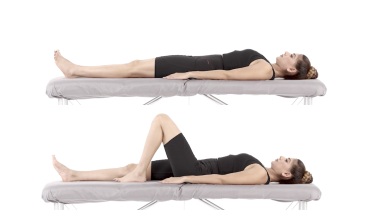 Heel slides
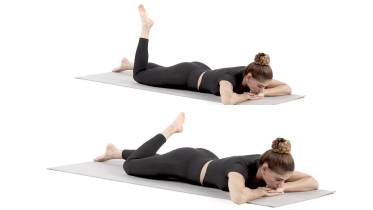 Prone hip rotation
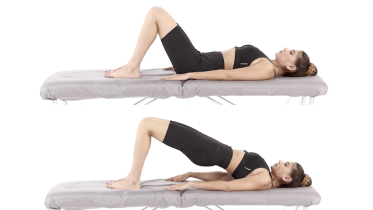 Glute bridge
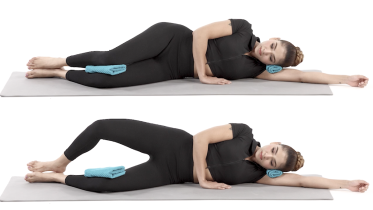 Clamshell
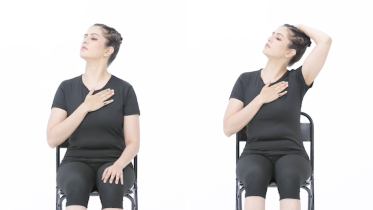 Seated hip flexion
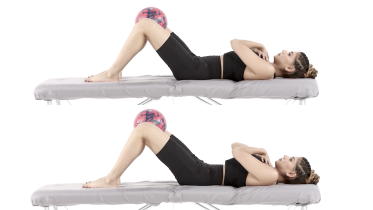 Adductor ball squeeze
Stage 2: Build strength standing up
When stage 1 feels easy, often after one to three weeks. These train the hip in standing and work the muscles at the side and back of the hip. Hold a kitchen counter or the back of a sturdy chair for the standing ones if your balance is not steady. Use a higher chair for sit to stand if a normal one is too hard, and for the mini squat, only bend as far as feels comfortable. The hip flexor stretch works the front of the hip and uses a long, narrow stance, so hold on to something if you feel wobbly.
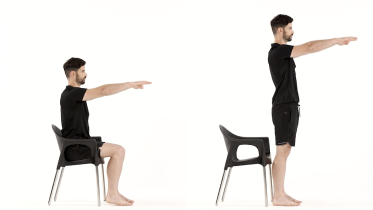 Sit to stand
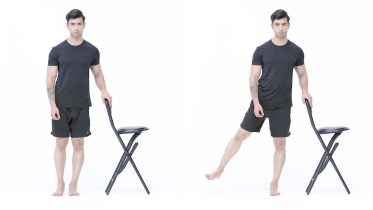 Standing hip abduction
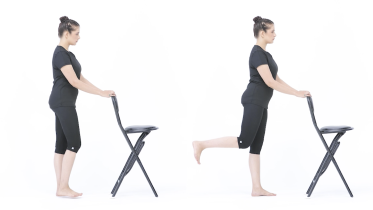 Standing hip extension
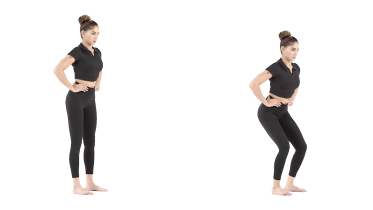 Mini squat
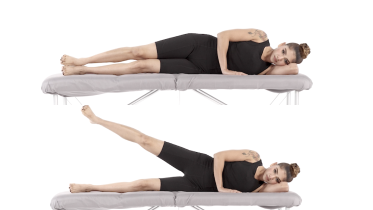 Side lying hip abduction
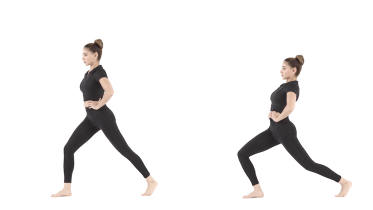 Hip flexor stretch
Stage 3: Stairs, balance and single-leg strength
When stage 2 feels easy and the hip settles well afterwards. Step ups and backward step downs practice stairs, and the rest load one leg at a time, the way walking does. Start with a low step. Balance and control work (neuromuscular exercise) is part of programs such as GLA:D. Keep a counter or rail within reach for single leg stance and the hip hike until you feel steady.
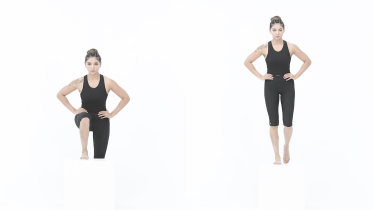 Step up
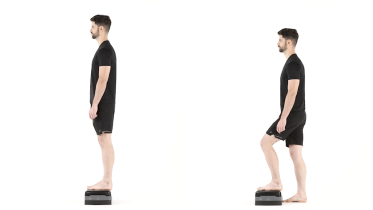 Backward step-down
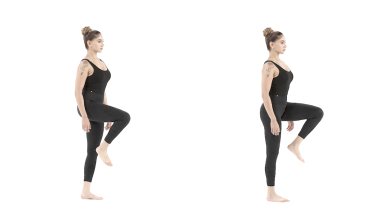 Single leg stance
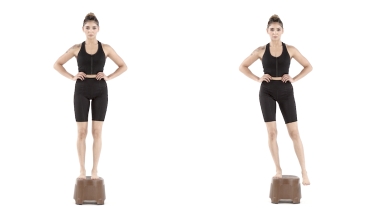 Hip hike
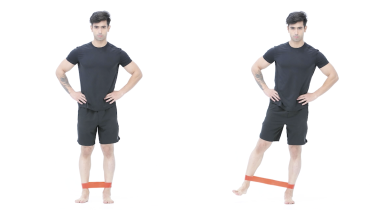 Standing hip abduction with band
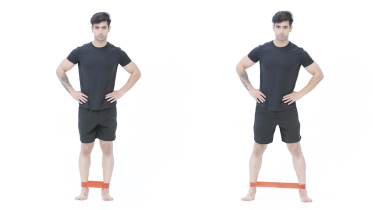 Lateral band walk
What to avoid or change
You do not need to stop moving, but you may need to change how much you do. Very deep bending, sudden jumps in how far you walk and long spells in low chairs can all flare a sore hip. The NHS advises not sitting in low chairs, as they put extra pressure on the hip. Build up in small steps instead, and on a bad day do a shorter or easier session rather than none.
After a hip replacement, some movements are limited for a while, and the limits depend on the operation. Your surgical team will tell you what is safe, so follow their program rather than this one.
When to see a physio or doctor
Book a routine appointment with a GP or physio if hip pain is stopping you sleeping or doing normal activities, if the pain is getting worse or keeps coming back, or if your hip is stiff for more than 30 minutes after waking. New hip pain that has not improved after 2 weeks of looking after it at home is also worth getting checked (NHS). If you already know you have hip osteoarthritis, see one if your hip is not improving after 6 to 8 weeks of regular exercise, or if you are not sure which stage suits you.
Some signs need help faster, from an emergency visit to an appointment within a few days. They are listed under the warning signs below.
Check with your doctor before you start if you have a heart or lung condition, or blood pressure that is not under control. If you have fallen recently or feel unsteady, do the standing exercises next to a kitchen counter.
For physiotherapists
This page gives patients a starting framework. NICE recommends exercise tailored to the person, so most people with hip osteoarthritis need the program adjusted to their pain, strength and range of movement, and to what they want to get back to doing. A patient-reported measure such as the HOOS (Nilsdotter 2003), alongside performance tests from the OARSI recommended set such as the 30-second chair stand test and the 40 m fast-paced walk test (Dobson 2013), helps show progress over the first 6 to 12 weeks.
See a doctor promptly if
- Emergency: you have had a fall or an injury and now have severe hip pain, or you cannot walk or put weight on the leg. Call emergency services or go to an emergency department. This can be a sign of a broken hip (hip fracture).
- Emergency: tingling or loss of feeling in the hip or leg after a fall or injury. Call emergency services or go to an emergency department.
- Same day: the hip is hot and swollen, or the skin over it has changed color, or you have hip pain with a high temperature or feel hot, cold or shivery. Get medical help the same day, and go to an emergency department if you feel very unwell. A joint infection needs treatment quickly.
- Same day: severe hip pain that came on suddenly without a fall, or pain that is getting worse quickly over a few days. Get medical advice the same day.
- Same day: a child or teenager has sudden pain in the hip, thigh or knee, is limping, or cannot put weight on one leg. Get an urgent appointment with a doctor the same day. If they have a high temperature or seem very unwell, go to an emergency department. This page is for adults, and hip pain in children has different causes.
- Same day: new hip or groin pain after a fall, even a small one, if you are older, have low bone density (osteoporosis) or have taken steroid tablets for a long time, even if you can still walk. Get medical advice the same day. A broken hip is not always obvious at first.
- Within a few days: hip or groin pain that is worse at night or does not ease with rest, and keeps getting worse. See your doctor within a few days. If you have had cancer, now or in the past, or are losing weight without trying, see your doctor sooner, within a day or two, and mention it. This applies even if the pain is not getting worse. If you are being treated for cancer now, contact your cancer team the same day.
- Within a few days: new groin or hip pain and you take steroid tablets long term, or have in the past, or you regularly drink a lot of alcohol. This can be a sign of a problem with the blood supply to the top of the thighbone (avascular necrosis). Book an appointment with your doctor within a few days and mention the steroids or alcohol.
Common questions
Is walking good for hip osteoarthritis?
For most people, yes. NICE recommends exercise for general fitness as well as strength, and walking is one of the easiest ways to get it. If a long walk flares your hip, split it into shorter walks through the day and build up the distance slowly. NICE also says a walking aid such as a stick can be considered for some people with hip or knee osteoarthritis. A physio can set the height and show you how to use it.
Should exercises hurt?
A little discomfort is common and is usually fine if it settles by the next morning and is not building up from week to week. Sharp pain, or a hip that is clearly worse the next day, means the load was too much for now. Do fewer repetitions or a smaller movement next time rather than stopping altogether. Your physio will help you set a limit.
What exercises should I avoid with hip arthritis?
No exercise is off limits for everyone. What matters is how your own hip responds over the next day. Deep bending, such as very low squats or pulling the knee hard toward your chest, and vigorous activity such as jumping can flare a sore hip, so ease into them or swap them for something gentler. After a hip replacement, your surgical team will tell you which positions to avoid while the hip heals.
How long before exercise helps?
Give it several weeks. The GLA:D program, for example, runs 12 supervised exercise sessions, twice a week for 6 weeks. People with hip osteoarthritis in it reported less pain on average at their 3-month check (Skou and Roos 2017). That report had no comparison group, so it cannot show how much of the change was due to the program itself. Strength builds slowly, so doing a little regularly matters more than doing a lot at once.
Will I need a hip replacement?
Not necessarily. NICE advises that joint replacement is worth discussing when your hip symptoms have a big effect on your quality of life and treatment without surgery, such as exercise, weight loss and pain relief, has not worked or is not suitable. Your doctor or surgeon will talk it through with you. If you have already had a hip replacement, follow the rehab program from your surgical team rather than this page.
References
- National Institute for Health and Care Excellence. Osteoarthritis in over 16s: diagnosis and management (NG226). 2022. https://www.nice.org.uk/guidance/ng226
- Bannuru RR, Osani MC, Vaysbrot EE, et al. OARSI guidelines for the non-surgical management of knee, hip, and polyarticular osteoarthritis. Osteoarthritis and Cartilage. 2019;27(11):1578-1589. doi:10.1016/j.joca.2019.06.011
- Hall M, Lawford BJ, Hinman RS, et al. Exercise for osteoarthritis of the hip. Cochrane Database of Systematic Reviews. 2026;(7):CD007912. doi:10.1002/14651858.CD007912.pub3
- Skou ST, Roos EM. Good Life with osteoArthritis in Denmark (GLA:D): evidence-based education and supervised neuromuscular exercise delivered by certified physiotherapists nationwide. BMC Musculoskeletal Disorders. 2017;18:72. doi:10.1186/s12891-017-1439-y
- Kim C, Nevitt MC, Niu J, et al. Association of hip pain with radiographic evidence of hip osteoarthritis: diagnostic test study. BMJ. 2015;351:h5983. doi:10.1136/bmj.h5983
- Dobson F, Hinman RS, Roos EM, et al. OARSI recommended performance-based tests to assess physical function in people diagnosed with hip or knee osteoarthritis. Osteoarthritis and Cartilage. 2013;21(8):1042-1052. doi:10.1016/j.joca.2013.05.002
- Nilsdotter AK, Lohmander LS, Klässbo M, Roos EM. Hip disability and osteoarthritis outcome score (HOOS): validity and responsiveness in total hip replacement. BMC Musculoskeletal Disorders. 2003;4:10. doi:10.1186/1471-2474-4-10
- American Academy of Orthopaedic Surgeons. Osteoarthritis of the hip. OrthoInfo. https://www.orthoinfo.org/en/diseases--conditions/osteoarthritis-of-the-hip/
- American Academy of Orthopaedic Surgeons. Osteonecrosis of the hip. OrthoInfo. https://www.orthoinfo.org/en/diseases--conditions/osteonecrosis-of-the-hip/
- NHS. Osteoarthritis. https://www.nhs.uk/conditions/osteoarthritis/
- NHS. Hip pain in adults. https://www.nhs.uk/symptoms/hip-pain/
- NHS. Hip pain in children (irritable hip). https://www.nhs.uk/symptoms/hip-pain-children-irritable-hip/
Written and checked by the PocketPhysio editorial team. Last updated 2026-09-28.
This page is general education, not a diagnosis or a personal treatment plan. See a physiotherapist or doctor for advice about your own situation.